Start by separating the report’s layers
You’re reading a synastry report when you notice a problem. It lists Venus in the seventh house and Mars in the eighth, but you only supplied planetary placements. Should you keep the reading, delete the whole report, or trust the neat table? Keep the usable layers. Quarantine the house claims.
A house claim can look official simply because it appears in a neat table. That table may show Venus in the seventh house, Mars in the eighth, or the Moon near an Ascendant. If the underlying report had only sign placements, though, the table has crossed a line. It has supplied chart structure that wasn’t in the source data.
The first question isn’t whether the interpretation sounds familiar. It’s whether the report had what that interpretation needs. A synastry report may contain several layers at once: planets in signs, exact or rounded degrees, planet-to-planet aspects, angles, houses, house rulers, and an interpretive summary. These layers don’t all have the same data requirement. Treating them as one block is how a useful comparison becomes a confident-looking blur.
For this article, placements means the sign positions you already know, such as Moon in Taurus, Venus in Leo, or Mars in Gemini. It can also include degrees if those were supplied. It does not mean a complete natal chart with a verified time, place, Ascendant, Midheaven, and house cusps. That distinction controls the reading.
Use a three-way audit. Mark each statement as supported, conditional, or unsupported. A supplied sign is supported. A conjunction between two supplied degrees may be supported after you check the geometry and orb. A claim that someone’s Venus falls in the other person’s seventh house is conditional on the house chart. A house ruler, angle contact, or planet near a cusp is unsupported when the necessary birth data and settings are absent.
This may feel like a smaller report. It’s actually a cleaner one. You can still ask what each person needs emotionally, how affection is offered, how desire moves, and where two styles cooperate or rub. Preserve what the data can carry, and label the rest as unavailable.
Preserve the source wording too. Write “Venus in Leo, sign only” rather than silently turning it into a degree. Write “birth time unknown” rather than “12:00” unless noon was genuinely recorded. That keeps a display convention from becoming a fake chart input and makes any later recalculation easy to compare.
Delete the unsupported claim, not the whole report. A missing house layer doesn’t cancel a known Moon sign or a checked Venus-Mars aspect. It narrows the sentence to what the chart can carry.
Sources: A Brief Introduction to Astrology: The House System; House System - Astrodienst Astrowiki
Why houses need more than sign placements
Signs describe the style of a planet. Houses describe the field of life where that planet is placed. In synastry, a house overlay asks where one person’s planet falls inside the other person’s chart. It is directional. Your Venus in their seventh house is not the same statement as their Venus in your seventh house, even if both overlays appear in the same report.
To establish that field, a chart needs an Ascendant and a set of house cusps. Those depend on the birth moment and location. Astrodienst describes house division as a calculation based on the exact time of birth and geographic position, and its house-system reference distinguishes the zodiac’s celestial frame from the houses’ terrestrial frame. The houses aren’t just another name for the signs. They are a different coordinate layer.
Birth time matters because the angles move. The Ascendant marks the eastern horizon at the birth moment, while the Midheaven marks the meridian point used by many house systems. A small change in time can shift the Ascendant degree and move a planet from one house to another, especially when that planet sits near a cusp. If the time is unknown, the report cannot know which room of the chart it is entering.
Birthplace matters too. House calculations use geographic position, not only the calendar date. Latitude changes the relationship between the horizon, meridian, and zodiac. The chosen house system matters after that. Placidus divides the chart through time-based arcs. Whole Sign houses place the complete rising sign in the first house. Equal houses begin each house from the Ascendant degree. These are meaningful choices, not decorative settings.
So a report that receives only Moon, Venus, and Mars signs can’t responsibly derive a seventh-house overlay from those signs. It may print one anyway because a tool needs a default input. A default is not evidence. If the report inserted a noon birth time, a midnight chart, a solar chart, or an unannounced house system, the house labels belong in the audit column marked unsupported.
Could another reader reproduce the house label from the information on the page? If not, leave it out. A birth date can anchor some sign placements, but it cannot stand in for the horizon, meridian, and cusps. If the report says “houses included” without naming the system, treat that output as a setting to verify, not a fact to absorb.
Keep the distinction plain. A sign tells you how a planet speaks. A house tells you where that voice enters the chart, and in synastry that room belongs to the house person’s chart. Without the frame, you can read the planet’s style but not name its room. Someone may feel deeply drawn to a partner without having an established eighth-house overlay. The feeling is material for reflection; the house label is a separate technical claim.
Sources: A Brief Introduction to Astrology: The House System; House System - Astrodienst Astrowiki; Swiss Ephemeris Programmer's Documentation: Astrological House Systems
What a missing house layer changes in synastry
Removing houses doesn’t erase the relationship reading. It changes the question you can answer. Without overlays, you can read how two planets interact and how each planet operates by sign. You can’t make a precise claim about whether the connection activates partnership, home, romance, intimacy, work, or public life in one person’s chart.
That difference is easy to miss because synastry language often joins the two layers in one sentence. “Her Venus in his seventh house trines his Mars” contains both a planet-to-house statement and a planet-to-planet statement. If the houses are missing, keep the trine if the degrees support it. Remove the seventh-house claim. The sentence becomes narrower, but it stays alive: her Venus and his Mars form a contact that can describe attraction, response, and the way affection meets desire.
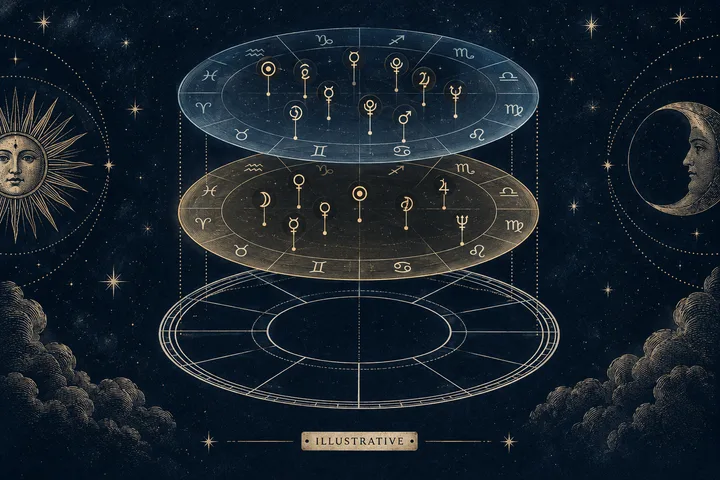
Think of aspects as the conversation between two planets. Think of overlays as the place where that conversation is experienced in the house person’s life. Current synastry reference material makes this distinction directly: an aspect describes how two planets interact, while an overlay describes where the interaction shows up. You need both layers for a full house-based reading, but one layer can still be read on its own.
The same discipline applies to angles. A planet conjunct the other person’s Ascendant is an angle contact, not merely a sign match. It needs a reliable Ascendant degree. A claim about the ruler of the seventh house needs the seventh-house cusp and the sign on it. A claim about a planet near the fourth-house cusp needs the cusp degree and the chart settings. When those are absent, the report must not turn a familiar relationship theme into a house placement by implication.
This protects the meaning of the houses themselves. A seventh-house overlay can describe one-to-one focus, but it doesn’t certify a relationship. An eighth-house overlay can bring intimacy or shared resources into the reading, but it doesn’t prove a bond is fated. Sign and aspect layers describe the qualities meeting; overlays describe the life area receiving them. If one layer is missing, don’t ask it to settle the question meant for the other.
Use the missing layer as a question about focus, not as a hole to fill. If the couple keeps discussing commitment, trust, or shared money, a later overlay might add context. The present report should start with the contacts that are actually known and the life they are already living.
Sources: Synastry House Overlays: Planets in Houses and Meanings; A Brief Introduction to Astrology: The House System
Consider an example: the report has planets, but no chart frame
Imagine Maria and Leo comparing a short report. The supplied material lists Maria’s Moon in Taurus, Venus in Leo, and Mars in Gemini. It lists Leo’s Moon in Scorpio, Venus in Cancer, and Mars in Libra. No birth times appear. No birthplaces appear. Degrees are absent. The report still includes a paragraph saying Maria’s Venus falls in Leo’s seventh house and Leo’s Mars falls in Maria’s eighth house.
The first move is not to decide whether those overlays sound convincing. It’s to remove them from the supported reading. The report has enough to compare the signs. It doesn’t have enough to establish the two Ascendants, the house cusps, or the direction of either overlay. Maria’s Venus in Leo remains usable as a sign placement. Leo’s Mars in Libra remains usable as a sign placement. The house labels become unknown.
Now read the supplied layers in order. Maria’s Taurus Moon and Leo’s Scorpio Moon belong to opposite signs, so the emotional styles may pull in different directions. Taurus seeks steadiness, tangible reassurance, and a pace that can settle into the body. Scorpio reads for depth, privacy, loyalty, and emotional truth beneath the surface. That contrast can create fascination. It can also create pressure if one person asks for calm while the other asks for complete disclosure.
Next, compare Venus and Mars by sign. Maria’s Leo Venus may express affection warmly and visibly. Leo’s Libra Mars may pursue through charm, conversation, and a wish to keep the exchange balanced. That pairing can describe a pleasant style of approach, but it still isn’t an aspect. Without degrees, you don’t know whether the planets form a close conjunction, square, trine, or no major contact at all.
The useful conclusion is clear: the sign layer suggests different emotional depths and a social, expressive style of attraction. Missing degrees block an exact aspect reading, and missing birth data blocks house overlays. Maria and Leo still have a real conversation to have. They just won’t pretend the report knows which house carries it.
If the same report had supplied exact degrees, the next step would be different. You could check the angular distance between the planets, apply the stated orb, and retain verified aspects. If both people later supplied reliable birth times and places, you could calculate overlays in both directions. The example changes only when the inputs change.
The example gives Maria and Leo a ranked reading: emotional style first, affection and desire next, exact aspects only if degrees confirm them, and houses later if the chart frame becomes available. They can sort the result into three notes: “We recognize this,” “We want to ask about this,” and “We don’t have enough data yet.” That turns uncertainty into a conversation.
If Maria later finds a recorded birth time, she shouldn’t paste the new houses into the old interpretation without checking the method. She should save the original sign list, note the new time and place, name the house system, and read both overlay directions. The later chart may deepen the story, but it shouldn’t rewrite what the first report actually knew.
The directional detail matters here. Maria’s Venus in Leo’s seventh house would describe Leo as the house person receiving Maria’s Venus in the partnership field. Leo’s Venus in Maria’s seventh would be another overlay. They may echo each other, but they aren’t interchangeable.
If a synastry report includes houses but you supplied only planetary placements, set the house claims aside. Don’t treat a printed seventh-house, eighth-house, or Ascendant statement as part of your reading unless the report also has the birth time, birthplace, and stated house system needed to establish it. Keep the sign placements you actually supplied. If degrees are available, keep planet-to-planet aspects that can be checked from those degrees, using the report’s stated orb. Then read the houses as unknown, not as empty. The practical move is simple: preserve the Moon, Venus, Mars, signs, degrees, and verified aspects; remove house overlays, angle contacts, and house-ruler claims that depend on missing data. If you later obtain reliable birth details for both people, recalculate the houses as a new layer and compare what changes. Until then, your report can still describe style, attraction, emotional rhythm, desire, and friction. It just can’t honestly say where those themes land in either person’s chart.
Read Moon, Venus, and Mars without inventing houses
When houses are unavailable, the personal planets give you a strong starting frame. Read the Moon first for emotional rhythm and instinctive comfort. Ask what helps each person settle, what feels exposing, and how each person responds when the relationship gets quiet. The Moon sign doesn’t tell you the whole emotional story, but it gives the style in which feeling moves.
Read Venus next for affection, taste, values, and the way someone gives and receives pleasure. Venus by sign can show whether warmth arrives through words, consistency, attention, beauty, humor, service, or physical closeness. Compare the two Venus signs, then compare each Venus with the other person’s Moon. This keeps the interpretation relational without requiring a house overlay.
Read Mars third for initiative, pursuit, desire, boundary-setting, and conflict heat. Mars tells you how a person acts when they want something. In a couple’s comparison, it can help you name differences in pace. One person may move directly. The other may need negotiation, atmosphere, or time. That difference matters in ordinary choices: who starts the hard conversation, who makes the plan, who needs room before responding.
Then rank the layers instead of collecting them. A close Moon-Venus contact may matter more for comfort and affection than a loose sign resemblance. A close Venus-Mars square may create strong pull and equally strong friction. A repeated element across Moon, Venus, and Mars can give one person’s relating style a steady tone. None of these statements needs a house. They need accurate placements, and aspects need degrees.
The strongest exception is the Moon. Its sign and degree can change quickly enough that a date-only placement may require checking the birth time window before you use it with confidence. If the Moon sign itself is supplied and verified, you can read it as supplied. If the report gives two possible Moon signs or no degree near a sign change, keep both possibilities visible. Don’t force one because the narrative sounds better.
Keep the order clear. Emotion first. Affection second. Desire and action third. Write one sentence for each planet before the synthesis: what does this Moon need, how does this Venus show care, and how does this Mars act under pressure? When two layers disagree, hold them apart before combining them. A gentle Venus and forceful Mars can both be true. Say what would change the weight, such as a newly verified close square or a Moon that may change signs.
Sources: Synastry House Overlays: Planets in Houses and Meanings; A Brief Introduction to Astrology: The House System
Use degrees and aspects as a separate check
A report can lack houses and still contain useful geometry. If it supplies degrees for both planets, convert each placement to its position around the zodiac, find the smaller angular distance, and compare it with the aspect angle and the stated orb. That is an aspect check. It isn’t a house calculation.
Consider Venus at 14 degrees Leo and Mars at 16 degrees Aries. Their separation is about 118 degrees, close to a 120-degree trine. If the positions were rounded, call it close or possible rather than exact. Within this report scope, selected major aspects use a six-degree orb, applied consistently. Don’t widen it just to rescue an exciting interpretation.
When two reports disagree, compare the raw inputs before their prose. Check the zodiac reference frame, minutes, rounding, aspect list, and orb. One report may use a wider threshold. Another may have turned a sign-only placement into a precise-looking degree. Mark those as different problems. Keep the aspect disputed until the record supports a choice.
Use a small record with person, planet, sign, degree, and aspect status. Leave the house field blank or mark it unavailable. “Venus in Leo” is a placement statement. “Venus trine Mars within six degrees” is a geometry statement. “Venus falls in the seventh house” is a directional overlay. The three sentences need different inputs, so they deserve different labels. A verified aspect must not smuggle in a house. Venus square Mars stays Venus square Mars until the receiving person’s chart frame establishes where the planet falls.
Sources: Swiss Ephemeris Programmer's Documentation: Astrological House Systems; Synastry House Overlays: Planets in Houses and Meanings
Audit the house claims before you interpret them
Trace each house sentence back to its chart frame. For both people, look for a birth time, its accuracy, and a birthplace. Then find the Ascendant, Midheaven, cusp table, zodiac reference frame, and named house system. Astrodienst’s calculation documentation requires a date and geographic position for house cusps, and its references list distinct methods such as Placidus, Equal, and Whole Sign. A wheel with twelve rooms doesn’t prove that those rooms came from your supplied data.
Check direction. “Venus in the seventh” must identify whose Venus falls in whose seventh house. Check the word cusp, too. An approximate time may leave a planet on different sides of a cusp, so the overlay can be conditional. An unknown time leaves the house claim unestablished. A missing house system creates another unresolved choice, even when the planetary signs agree.
Sort the result into three outcomes. Complete data and stated settings let you retain the overlay. Approximate data or cusp proximity calls for conditional wording and an alternate possibility. Missing time, place, or method means quarantine the house, angle, cusp, and house-ruler claims. Keep the source record if a later recalculation becomes worthwhile.
The strongest exception is a complete external chart supplied with reliable birth details and explicit settings. You can use its house layer, but keep those settings attached. Don’t merge it quietly into a placements-only report.
Sources: A Brief Introduction to Astrology: The House System; House System - Astrodienst Astrowiki; Swiss Ephemeris Programmer's Documentation: Astrological House Systems
Rewrite the report around what it can say
Open with the inputs, not the house interpretation: “This comparison uses the supplied Moon, Venus, and Mars signs. Degrees appear only where provided. Birth times, birthplaces, Ascendants, cusps, and house overlays are unavailable.” Then sort each sentence as a supplied placement, checked aspect, unavailable chart frame, or question for the couple.
Rewrite the claim itself. “Your Venus in their seventh house makes you ideal partners” becomes “Your Venus sign describes how you offer affection. A partnership-house overlay needs the receiving person’s timed chart.” “Their Mars activates your eighth house” becomes “Their Mars sign describes how they pursue and handle friction. House emphasis remains unknown.” A narrow sentence is still a reading.
Let the question choose the first layer. For comfort, begin with the Moons. For affection, compare Venus with the other person’s Moon and Venus. For desire or conflict, read Mars and verified Mars contacts. For home, partnership, intimacy, or public life, obtain reliable birth data before using houses. If the Moon may change signs, hold both possibilities open. If the degrees are rounded, preserve that uncertainty.
Return to the practical choice. Use the supplied placements now. Keep major aspects only when the degrees and selected six-degree orb support them. Quarantine house, angle, cusp, and ruler claims without their chart frame. If the house question matters enough, gather reliable birth times, birthplaces, and a named system for a new comparison. The report can say less about location and more about what the known layers already show.
Sources: Synastry House Overlays: Planets in Houses and Meanings; A Brief Introduction to Astrology: The House System
Sources & further reading
- A Brief Introduction to Astrology: The House System
Supports the claim that house division depends on exact birth time and geographic position, and that the Ascendant begins the first house.
- House System - Astrodienst Astrowiki
Supports the distinction between signs and houses and the fact that astrologers use multiple house systems with different constructions.
- Swiss Ephemeris Programmer's Documentation: Astrological House Systems
Supports the technical comparison of Placidus, Equal, Whole Sign, Koch, and other house-system methods.
- Synastry House Overlays: Planets in Houses and Meanings
Supports the distinction between planet-to-planet aspects and directional planet-to-house overlays, plus the need for birth time and place.
Synastry Comparison Report
Enter known placements for two people. Get an input-by-input comparison, selected aspect calculations and a clear record of what remains uncertain.
Compare our placements