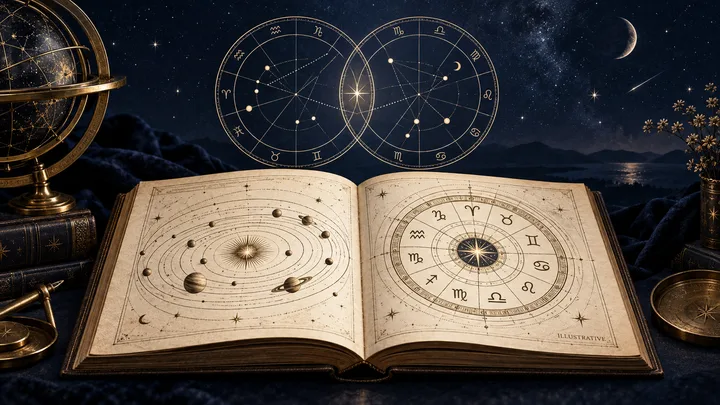
A graphical ephemeris verifies when a moving planet reaches a natal degree and shows applying, exact, separating, retrograde, and repeated contacts. It is a timing tool, not a replacement for synastry. Synastry identifies whose Moon, Venus, or Mars is activated and how that planet connects with the partner’s chart. Use the graph for dates and motion, then use synastry for meaning. If you only know supplied signs, stay at sign level and do not claim an exact calculated transit. Collect degrees, check the dates, compare the activated planets, and turn the theme into a practical conversation. That sequence keeps the timing precise and the relationship reading grounded.
The graph answers when, while synastry answers what
A graphical ephemeris maps planetary motion across time and zodiac degrees. A transit is a moving planet making an aspect to a natal factor. Synastry compares two charts and shows their interaspects and overlays. The graph can show a line approaching a natal degree, reaching exactitude, turning retrograde, and separating. It cannot tell you whether that degree belongs to your Moon, your partner’s Venus, or a house cusp. Use the image as a timing check, then identify the natal target and return to the relationship comparison.
A crossing is evidence of contact, not a finished interpretation. The same line may cross your Moon, your partner’s Venus, an angle, or a point you did not include in the comparison. Write the target beside the date before you assign meaning. That one note changes the reading from ‘something is happening’ to ‘this moving planet is reaching this supplied point, which already has this connection with the other chart.’
The practical payoff is a better question. A personal Moon activation may call for emotional naming. A shared Venus pattern may call for a values decision. A Mars contact may call for a pace agreement. Those are different tasks, even when the relationship feels charged in all three cases.
Sources: Graphical Ephemeris, Astrodienst Astrowiki; Synastry, Astrodienst Astrowiki
Read the axes and display
Time runs horizontally and zodiac position vertically. A 45-degree display can reveal several aspect families, so a crossing is not automatically a conjunction. Check the legend and the additional aspect table. Hide unrelated planets when the image becomes crowded. Astrodienst describes graphical ephemerides as quick visual overviews and notes that tables can provide exact dates for contacts less obvious in the graphic.
Use the broad view first. Look for clusters, a line that changes direction, and several passes over the same reference degree. Then zoom in. The published guide to reading graphic ephemerides recommends moving from an overview to exact dates, and describes retrogrades as a slowdown, reversal, and forward station. Don’t begin by chasing every small crossing. Begin by locating the period, then narrow the question.
The 45-degree view deserves special care. It compresses the zodiac so several angular relationships can occupy the same visual field. That makes it good for spotting a family of hard aspects, especially when you want to notice a cluster instead of one isolated contact. It also asks more of the reader. Go back to the ordinary degree view or the aspect table before you name the exact relationship. If you see lines crossing near one another, check whether they represent the same moving planet making several aspects, several planets reaching one target, or an overlay created by the display. These are different stories. The picture helps you find them. It doesn’t choose among them.
Remember what the folded display leaves out of the eye’s first impression. A 45-degree graphic makes conjunctions, oppositions, squares, semi-squares, and sesquisquares visible as intersections because those angles share the folded scale. A trine or sextile may not appear as a crossing there, even though the data sheet lists its date. If your question concerns a Venus trine to a natal Moon, go straight to the table rather than deciding that no contact exists because no line intersects. The display is selective by design. Its selectivity is useful only when you know what it selects.
Use a two-pass note. On the first pass, record only the broad shape: a slow line, a loop, a cluster, or a quiet stretch. On the second, record one target and its dates from the table. This keeps the overview useful without letting a crowded picture turn every intersection into an event.
Sources: Graphical Ephemeris, Astrodienst Astrowiki; How to Read a Graphic Ephemeris, Astrodienst; Overview Special Charts, Astrodienst
Test the transit claim
A useful claim names the moving planet, natal target, aspect, and time window. Imagine Maria has Venus at 22 degrees Taurus and a reading says a transit will square it in late spring. Mark the degree and check the line, exact date, orb, and direction of motion. If the planet crosses the degree three times, read the passes as one sequence. The graph verifies timing. It does not prove which human choice follows.
Make the claim testable in your notes. Write the target as a degree and sign, not merely as “Venus.” Write the aspect as an angle. Write the dates you expect to inspect. Then compare the visual line with the exact-date table. If the two disagree, pause and check the display setting, time zone, and whether the line represents a transit or another dynamic relationship.
Now check the source of the natal degree. If Maria supplied only Venus in Taurus, you can read the sign and its style, but you can’t select 22 degrees because it makes the example convenient. If she supplied 22 degrees from an existing chart, you can work from that input. A sign tells you the placement’s mode. A degree lets you test a close aspect and date it. Keep those kinds of knowledge separate.
After the line reaches the target, inspect the dates instead of treating the whole shaded area as one moment. The beginning of an orb describes approach. Exactitude gives the tightest contact. Separation shows the movement away. A station can change the rhythm before a return or renewed direct motion. Match each date to the question: a return pass may matter when a conflict comes back, while an applying pass may be the useful window for raising a delicate subject.
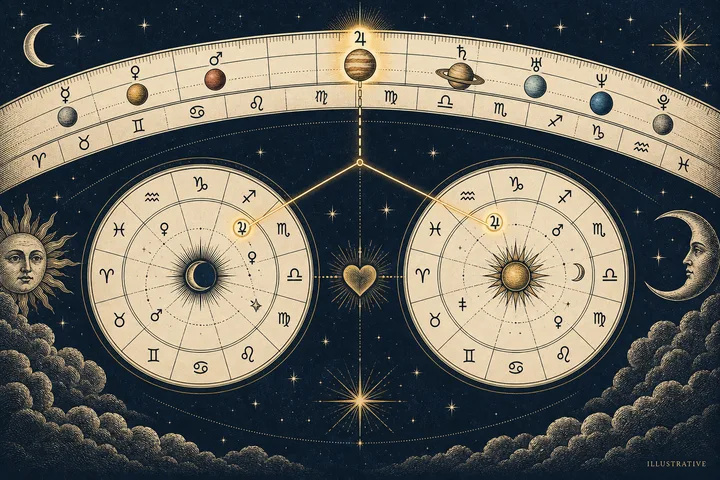
Sources: How to Read a Graphic Ephemeris, Astrodienst; Applying Aspect, Astrodienst Astrowiki; Transit, Astrodienst Astrowiki; Aspect, Astrodienst Astrowiki
Read applying and repeating contacts
An applying aspect forms toward exactitude. A separating aspect moves away afterward. Retrograde motion may return a planet to the same degree. Consider an example: Saturn approaches your Moon, perfects, retreats, and perfects again while your partner’s Venus contacts that Moon in synastry. The graph gives timing. Synastry shows the care exchange. Rank a close repeated contact first, then interpret the planets involved.
Treat repeated passes as one arc. Ask what the first pass introduces, what the return reopens, and what the final pass clarifies. If the relationship behavior stays the same, repetition may show persistence rather than a new event. The useful record is not three predictions. It is one pattern with three chances to observe its expression.
Repeated contacts don’t require repeated drama. A first pass may be quiet because the couple is still naming the issue. A retrograde pass may bring the same matter back through a different circumstance. The final pass may feel ordinary because the work has already been done. That is still a meaningful sequence. The astrological emphasis can move from recognition to revision to consolidation. If nothing changes, the repetition can show that the pattern remains available and unresolved. If something does change, describe the change in behavior. “They talked again” is less useful than “They agreed on a weekly check-in and kept it through the return.” The transit gives the timeline. Their action gives it substance.
The planet’s speed helps set the scale. A Moon pass can mark a brief emotional swell. Venus or Mars can describe a shorter period of attraction, choice, pursuit, or irritation. A slow planet can make the same degree a longer chapter. Don’t flatten all repeated contacts into one mood. Read the pace of the planet alongside the meaning of the natal target and the closeness of the synastry aspect.
Sources: Applying Aspect, Astrodienst Astrowiki; Transit, Astrodienst Astrowiki; How to Read a Graphic Ephemeris, Astrodienst
The natal planet changes the meaning
The Moon brings safety, habits, and emotional rhythm. Venus brings affection, pleasure, values, and attraction. Mars brings desire, assertion, anger, initiative, and conflict. If her Moon receives a transit while his Venus contacts it, the period may activate care and affection. If his Mars squares it, timing and irritation may matter more. The moving planet is the weather. Synastry shows which room has the windows open. Use [Moon, Venus, and Mars layer comparison](/journal/summarize-synastry-when-emotional-affection-desire-layers-disagree) when degrees are unavailable.
A transit can enter the relationship through one person first. It may change availability, appetite for closeness, or the speed of a response. The synastry contact shows where that change meets the partner. Start with the natal planet’s job, then ask what the existing interaspect adds. This keeps the interpretation relational without pretending both people receive the transit in the same way.
Suppose a moving planet reaches her Moon while his Venus is closely connected to it in synastry. Start with her experience of safety and response. Then ask how his affection meets it. Does he offer steadiness, touch, beauty, reassurance, or a value she can feel? The Venus contact may make the Moon more relationally visible. It doesn’t guarantee that he expresses care in the form she wants.
If his Mars is square her Moon, the same transit may bring a faster, sharper exchange. His initiative may wake her up, excite her, or irritate her. Her emotional timing may feel slow to his action, while his action may feel intrusive to her. The square isn’t a verdict. It’s a tension that needs a workable form. Ask whether they can name the pace, ask for consent, and repair after a clash.
Sources: Synastry, Astrodienst Astrowiki; Transit, Astrodienst Astrowiki
The orb ranks closeness
An orb measures distance from exact aspect. This publication uses a stated six-degree orb for selected major aspects when degrees are supplied. One degree is tighter than five. Speed, repetition, applying or separating motion, and planetary nature also matter. Astrodienst notes that astrologers use different orb rules. State yours, rank the contacts, and explain what uncertain degrees would change.
Don’t use the orb as a switch that turns a relationship on or off. Use it as a ranking tool. A one-degree contact usually deserves attention before a five-degree contact between the same kinds of points. A slower planet can keep a theme active for longer. A faster planet may bring a brief emphasis. A repeated contact can make a wider aspect more noticeable over time.
The aspect itself matters. A conjunction combines planet jobs directly. An opposition pulls them across an axis and asks for balance. A square creates friction that demands a response. A trine can make a pattern flow with less effort, while a sextile may offer an opening that needs participation. Don’t infer a square from any visual intersection. Verify the angular distance.
A ranking can include an exception without becoming vague. A one-degree fast-planet contact may be exact but brief. A five-degree slow-planet contact may be wider yet return several times. If the latter deserves more attention, explain why. A close Moon contact may also outrank a wider outer-planet contact because the question concerns immediate emotional exchange. Or the outer planet may lead because it frames the whole period and the Moon pass supplies the daily trigger. The rule is not “tight always wins.” The rule is “state the reason for priority.” That gives the reader a way to repeat the judgment with their own supplied placements.
If the degree is uncertain, lower the rank instead of deleting the placement. A possible contact can remain a question. “If the Moon is near this degree, check whether the transit reaches it” is honest and useful. It tells the reader what information would change the interpretation. It also keeps a placement-only report from pretending to be a full calculated chart.
Sources: Aspect, Astrodienst Astrowiki; Transit, Astrodienst Astrowiki; Comparative Astrology, Astrodienst Astrowiki
Worked example with supplied placements
Consider an example. Maria reports Moon at 18 degrees Libra. Daniel reports Venus at 20 degrees Libra and Mars at 4 degrees Capricorn. No birth times or other degrees are supplied. Mark Maria’s Moon and check the chosen transit. The 2-degree Moon-Venus contact is a close supplied synastry contact. A transit activates that existing pattern; it does not create it. If only her Moon is reached, begin with her rhythm. If Daniel’s Venus is also reached, include affection. The practical result may be a conversation about care or availability.
The known layer is simple. Maria’s Moon and Daniel’s Venus form a supplied two-degree conjunction. Their signs support a comparison of emotional balance and affection. The unknown layer matters just as much. We don’t know houses, angles, other natal aspects, or the actual moving planet unless the reader names one. The next research step is clear: supply the transit planet and date range, then check the graphic.
The transit layer changes the emphasis. If the moving planet reaches only Maria’s Moon, begin with her emotional rhythm. Ask what helps her feel met and what makes her withdraw. If Daniel’s Venus is also reached, include the affection exchange. They might discuss how reassurance is offered and whether keeping peace hides disagreement. If Daniel’s Mars is reached instead, shift toward initiative, pressure, work, timing, and conflict.
Now imagine the date check returns three passes over Maria’s Moon but only one pass near Daniel’s Venus. That difference matters. The Moon story may describe the longer emotional season, while the Venus pass marks a shorter opening for affection or agreement. If Mars is not contacted, don’t import a conflict reading simply because the couple feels tense. Use the placement that the verified transit actually reaches, then ask what the synastry connection contributes to that layer.
Notice what we don’t say. We don’t calculate a house. We don’t announce a compatibility percentage. We don’t turn the graph into evidence that Daniel will commit or Maria will stay. The chart shows a pattern and a period of emphasis. The couple still has to recognize that pattern in lived behavior.
Keep the scenario imagined and labeled. Its purpose is to show method, not to stand in for a private couple’s chart. Replace Maria and Daniel with the actual supplied inputs when you work. If one person knows only a sign, write “degree unknown.” If the other person knows a degree but not a birth time, preserve the degree and remove houses and angles. If the transit source gives a date but not the display settings, record the date as a check to investigate, not as a fully explained event. These small labels make the article reusable. They also keep a reader from mistaking an illustrative pattern for a calculated personal report.
When timing should lead
When a date is urgent, let the graphic lead. It may show that a proposed future transit already passed, reveal a retrograde return, or expose a cluster of contacts. Record the time zone and the display range before you interpret the line. Then identify the natal target and the synastry contact it belongs to. A missing birth time blocks houses and angles, but it does not erase a supplied Moon, Venus, or Mars sign. The exception changes the material you can name, not the value of checking the date.
The graph is especially useful when a forecast has collapsed several moments into one. Mark the orb’s beginning, exact contact, station, return, and final separation. Keep the source time zone beside each timestamp, especially near midnight. Then compare the sequence with the couple’s actual conversation without moving an event to the wrong calendar day.
Timing should lead when the question is narrow or urgent. If someone says a transit peaks on Friday, verify Friday first. If the date holds, bring the result back to the relationship chart. The graphic finds the appointment. The comparison tells you who is in the room and what kind of conversation the appointment can support.
A past transit can sharpen the next reading. Compare the recorded pass with what actually changed, then ask which layer carried the experience. A Moon contact may have shown up as a need for reassurance. Venus may have exposed a value mismatch. Mars may have made timing or conflict impossible to avoid. Keep the observation that fits the supplied chart inputs, and discard the story that only fits because it sounds dramatic.
Sources: Graphical Ephemeris, Astrodienst Astrowiki; Overview Special Charts, Astrodienst; Synastry, Astrodienst Astrowiki
What the graph cannot tell you
A graphical ephemeris is a map of motion. It can’t recover a natal degree that was never supplied, add houses when birth time is missing, or make every crossing equally important. It also can’t decide whether you need synastry, a composite, or a Davison chart. Choose the chart method before you read the picture, because each method answers a different relationship question.
Use synastry when you want to see how two natal charts meet through interaspects and overlays. Use a composite when you want to read the relationship as its own symbolic field. Use a Davison chart when that distinct construction is the method you have chosen. For the question here, begin with the two natal placements and their synastry, then place the moving planet beside that comparison.
The graph can’t replace natal context either. A transit to Venus doesn’t mean the same thing for every Venus. Sign, house, dignity, natal aspects, motion, and the rest of the chart matter. In a placement-only report, you may not have all those layers. Say what you do have. Known Moon, Venus, and Mars signs can support a clean comparison. Optional degrees can support selected major aspects under a stated orb.
The graph also can’t choose the response to a difficult contact. A square may ask for a skill, an opposition for balance, and a conjunction for conscious use of intensified energy. Let the chart name the pressure point. Let the couple’s listening, requests, boundaries, and repair show how that pressure is being lived.
Sources: Synastry, Astrodienst Astrowiki; Free Charts and Data, Astrodienst; Comparative Astrology, Astrodienst Astrowiki
Use the result and decide
Write down the supplied Moon, Venus, and Mars signs and degrees, then mark what is missing. Choose one transit question and one date range. Record the moving planet, natal target, aspect, orb, exact dates, and stations before you interpret the pattern. Our [Synastry Comparison Report](/compatibility-test) uses supplied placements and optional degrees with a six-degree orb. It does not calculate natal positions from birth details. Bring the verified transit beside that supplied comparison, then choose one observable step: a care conversation, a values agreement, a conflict plan, or a boundary.
Keep the final decision small enough to observe. Don’t ask the transit to settle the whole relationship. Ask what it highlights this week or this pass. One person can request a clearer form of reassurance. Both can agree on how to handle a conflict pause. They can decide whether a promised action happened. If the pattern is supportive, repeat the behavior that makes support tangible. If it is difficult, name the boundary before the next pass.
Your decision point is clear. If the date doesn’t verify, revise the claim. If it verifies but the relationship layer is unknown, gather the missing placement instead of guessing. If the contact is clear, choose the behavior that would express its best use and the behavior that would show its strain. A Moon contact might need a reassurance request. Venus might need a shared spending or affection agreement. Mars might need a rule for direct speech and a pause. Make the choice visible.
Before you finish, run five checks. Can you point to the moving line and its natal target? Can you name the aspect without relying on the picture alone? Can you say whose planet is activated? Can you explain the synastry contact in ordinary language? Can you name one behavior the couple can observe? If one answer is no, stop and repair that part. If all five are yes, stop adding meanings. Keep the next step close to the contact, and let the couple’s response decide how the symbolism lives. That is the point where a checked chart becomes a useful conversation.
Sources: Graphical Ephemeris, Astrodienst Astrowiki; How to Read a Graphic Ephemeris, Astrodienst; Synastry, Astrodienst Astrowiki
A little more clarity
Can a graphical ephemeris show a synastry transit?
It can show a moving planet’s contact with a natal degree. You still need both charts to interpret the relationship meaning.
What if I know signs but not degrees?
Use placement-level Moon, Venus, and Mars themes. Don’t claim an exact transit or orb-based aspect until degrees are supplied and checked.
Why can one transit have several dates?
A planet may apply, perfect, retrograde across the degree, and return. Treat the passes as one developing sequence.
Does one transit prove a couple will stay together?
No. A transit highlights a theme and synastry shows how the charts connect around it. Decide through conversation and mutual action.
Sources & further reading
- Graphical Ephemeris, Astrodienst Astrowiki
Supports graphical layout, movement lines, natal reference lines, and crossings.
- How to Read a Graphic Ephemeris, Astrodienst
Supports axes, planetary lines, stations, retrogrades, clusters, and dates.
- Overview Special Charts, Astrodienst
Supports 45-degree graphics and additional tables for exact dates.
- Synastry, Astrodienst Astrowiki
Supports synastry as chart comparison showing interaspects and overlays.
- Comparative Astrology, Astrodienst Astrowiki
Supports distinctions among synastry, composite, and Davison methods.
- Applying Aspect, Astrodienst Astrowiki
Supports applying and separating aspect language.
- Transit, Astrodienst Astrowiki
Supports transits as moving planets aspecting natal factors.
- Aspect, Astrodienst Astrowiki
Supports major aspects and orb as distance from exactitude.
- Free Charts and Data, Astrodienst
Supports chart drawings, current transits, and custom ephemerides.
Synastry Comparison Report
Enter known placements for two people. Get an input-by-input comparison, selected aspect calculations and a clear record of what remains uncertain.
Compare our placements