The short answer: the center changes the question
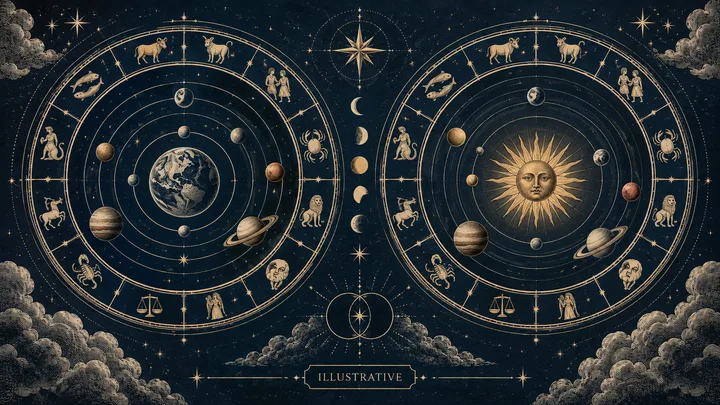
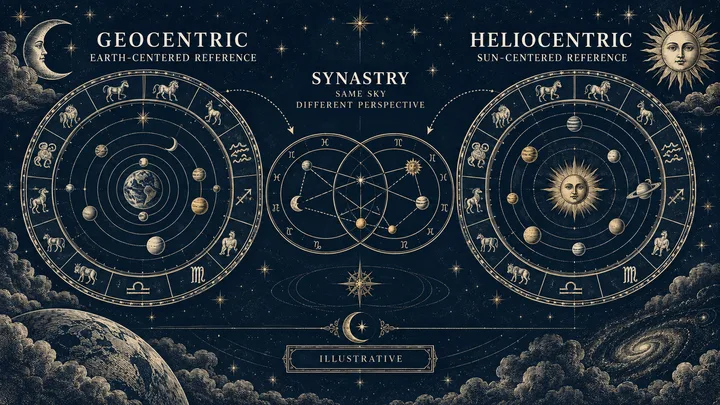
When two synastry reports disagree, the first question isn't which chart is more romantic. It's which center the calculation used. A geocentric chart is read from Earth. A heliocentric chart is read from the Sun. The planets haven't changed their paths, but their reported longitudes change with the viewpoint.
That distinction matters in synastry because a relationship reading asks how two people meet, respond, desire, comfort, challenge, and share life. Those are human experiences. The geocentric chart gives them an Earth-based frame. Modern astrology usually works from that frame, and a standard synastry chart places two natal charts together so you can inspect inter-chart aspects and, when birth data is available, house contacts. Astro.com describes its ordinary synastry chart in exactly this practical way: two partners' horoscopes shown together with aspects between them.
Heliocentric astrology asks a different question. What do the planets show from the Sun's center? In that view, the Sun is no longer one moving body among the others. It is the vantage point. The Earth becomes a planetary point opposite the geocentric Sun, while the usual horizon and meridian disappear. The chart is no longer a map of a person standing on Earth at a particular place. It is a solar-system perspective that some astrologers read as transpersonal, developmental, or soul-centered.
Neither frame is a spelling variation of the other. A geocentric Venus in Taurus and a heliocentric Venus in Gemini are placements calculated from two reference points, each inside its own interpretive system. The sign change doesn't tell you which placement to keep until you know which question the report is asking.
For the reader asking how two charts fit together in a relationship, geocentric synastry is the sound starting point. Heliocentric work earns its place when the question is specifically solar, developmental, or spiritual and the report identifies that tradition. Before interpreting any result, check the center, the bodies included, and whether both longitudes came from the same frame.
Sources: Astrodienst Astrowiki: Heliocentric Model; Astrodienst Astrowiki: Heliocentric Horoscope; Swiss Ephemeris Documentation 2.10
What a geocentric synastry report actually needs
A geocentric synastry report begins with two Earth-based charts. To calculate planetary positions for a specific moment, the astrologer needs each person's birth date and birth time. To calculate the local orientation, including the Ascendant, Midheaven, and houses, the astrologer also needs the birthplace and a stated house method. If the report uses only supplied placements, it should say so. It should not imply that a natal chart was recalculated from missing details.
The basic comparison has three layers. First come the signs: where the Moon, Venus, and Mars are placed in each chart. Signs describe the style of a function. A Moon sign gives the tone of emotional response. Venus describes attraction, affection, pleasure, and relational values. Mars describes pursuit, heat, initiative, and the way desire moves into action. A sign-pair overview can be useful, but it stays broad until degrees and aspects refine it.
Second come the degrees and aspects. A conjunction brings two points together. An opposition creates a polarity. A square presses for adjustment. A trine and sextile can make exchange easier, though ease is not the same as depth. The aspect's meaning depends on the planets involved, the signs, the direction of the contact, and its closeness. If a report uses a six-degree orb, it should state that scope and apply it consistently. A contact at two degrees and a contact at six degrees may share a category while carrying different force.
Third come the houses and angles. These are local and personal because they depend on the Earth-based place and time. One person's Venus falling in the other's seventh house can bring partnership themes into focus. A planet near the other's Ascendant can make the contact immediate and visible. Those statements require calculated house positions. They cannot be responsibly supplied from two sign lists alone.
This is why a geocentric report is more than a default setting. It preserves the chart features most readers mean when they ask about compatibility. It keeps the Moon in view and, when the birth data supports it, lets the report describe place, timing, embodiment, and the way one person's planets land in the other's houses.
Consider an example. Imagine Maria has supplied her Moon, Venus, and Mars signs, while Daniel has supplied his, and both have optional degrees. A placement-only report can compare sign elements, modalities, and close planet-to-planet aspects if the degrees are present. It cannot claim their Ascendants, house overlays, or angles unless those were actually calculated. The geocentric method defines the kind of chart the report would need, but it does not give the report data it was never supplied.
The decision follows from the inputs. If you have known placements and optional degrees, use a geocentric comparison for those placements and call the result a placement-based synastry reading. If you have complete birth data and a stated calculation method, you can add houses and angles. If the center is not identified, pause. A precise answer starts with a precise chart scope.
Sources: Astrodienst Astrowiki: Heliocentric Model; Swiss Ephemeris Documentation 2.10; Astrodienst FAQ: Overview of Available Chart Types
What heliocentric calculation removes and reveals
Heliocentric calculation changes more than the name at the top of the page. It changes the geometry of the chart. The Sun becomes the center, so the Sun is not shown as an ordinary planet in the same way it is in a geocentric horoscope. The Earth appears as the opposite point to the geocentric Sun. The Moon is usually not represented as a separate body, because the heliocentric view treats the Earth-Moon system as a unit for this purpose.
The usual houses disappear. Houses depend on a horizon and meridian tied to a location on Earth. From the Sun, there is no earthly birthplace setting the Ascendant or dividing the sky into local houses. Astro.com's heliocentric reference also notes that chart angles and retrograde motions are not part of the usual heliocentric presentation. A heliocentric synastry report therefore cannot quietly carry over a seventh-house or Ascendant story from the geocentric chart.
The inner planets can move in ways that feel especially striking. Mercury and Venus are no longer constrained by their apparent relationship to the Sun from Earth's viewpoint, so their heliocentric signs may differ from their geocentric signs. The heliocentric chart can also show aspects between Mercury and Venus that a geocentric chart does not show in the same way. The outer planets generally shift less, but 'less' does not mean 'never.' The exact difference depends on the date and the body.
This creates a tempting mistake. A reader sees a new Venus sign and treats it as a hidden love language that overrules the natal Venus. That skips the method. A heliocentric Venus belongs to a Sun-centered reading. It may be used to discuss a broader expression of value, a developmental direction, or a symbolic layer of the bond, depending on the astrologer's school. It does not erase the Earth-based Venus that describes the person's ordinary relational field in a geocentric reading.
Swiss Ephemeris makes the technical point cleanly. It supports heliocentric, geocentric, barycentric, and planetocentric positions. Heliocentric positions are measured from the center of the Sun rather than the center of Earth. That is a coordinate choice with interpretive consequences. It isn't a decorative chart option.
There is also a methodological limit worth respecting. Astrodienst's reference notes that relatively few astrologers work with heliocentric horoscopes and that agreement about interpretation is limited. That does not make the method useless. It means the report must name the tradition or interpretive purpose it is using. A heliocentric Venus cannot carry one universal meaning simply because it sits in a different sign.
Use this layer for a distinct question, not as a replacement vocabulary for ordinary relating. A heliocentric Venus may invite reflection on shared values or direction within a stated tradition. The geocentric chart still carries the Moon, houses, angles, and the daily texture of contact.
Sources: Astrodienst Astrowiki: Heliocentric Horoscope; Swiss Ephemeris Documentation 2.10
A worked comparison without inventing a personal chart
A good comparison can be concrete without pretending to calculate two people's charts. The safest example begins with a supplied placement rather than a fabricated birth date. Consider an example: a report receives a geocentric Venus placement for each partner and optional degrees, but it does not receive birth details or a heliocentric calculation. What can the report say? It can compare the supplied Venus signs. If the degrees are supplied, it can check the stated aspect rule. It can describe attraction, affection, and shared values through that geocentric layer. It cannot announce a heliocentric Venus sign, because no heliocentric positions were calculated.
Now imagine the same two planetary positions are calculated in both frames by an astrologer who states the ephemeris and zodiac. The report may find that one person's Venus changes sign in the heliocentric chart. The first reading remains the geocentric Venus: how affection is offered, received, and recognized in the human relationship. The second reading asks what the heliocentric Venus adds. Does it suggest a different way of valuing, a wider creative or spiritual orientation, or a theme that becomes visible when the relationship is viewed as a field of growth? The answer depends on the chosen heliocentric school, so the interpretation must be labeled as such.
Here is the comparison in plain language. Geocentric Venus answers, 'What kind of affection do I bring into contact with you, and how does it meet your way of receiving love?' Heliocentric Venus asks, 'What value or form of love becomes visible when this chart is read from a solar center?' The questions overlap. They aren't identical.
The same discipline applies to aspects. Suppose a geocentric Mars of one person makes a close square to the other person's Venus under a six-degree orb. That contact can be read as a strong meeting of desire and attraction, with friction that needs conscious handling. If the heliocentric calculation produces a different Mars-Venus relationship, don't average the two. First interpret the geocentric contact in its own frame. Then ask whether the heliocentric contact adds a second theme. The two contacts may reinforce each other, tell different stories, or make one layer more prominent than the other.
Do not turn the difference into a score. A new aspect isn't automatically stronger, and a changed sign isn't automatically truer. In synastry, the contact that helps two people name an actual pattern of closeness, conflict, desire, or repair has more practical weight than an exotic contact with no lived counterpart.
Record the inputs beside the interpretation: zodiac, center, bodies, degrees, orb, and house scope. Then ask whether the contact exists under those settings and whether it answers the reader's question. If a report changes several settings at once, separate the results before drawing a meaning.
Geocentric calculation should anchor a basic synastry report. It places both people in an Earth-based frame, so the Moon, Venus, Mars, aspects, signs, and houses can describe how the connection is experienced and expressed. Heliocentric calculation shifts the center to the Sun. That changes planetary longitudes, removes the usual houses and chart angles, treats Earth as the point opposite the geocentric Sun, and usually leaves the Moon out of the working chart. It can add a symbolic, soul-centered layer for astrologers who use it, but it shouldn't replace the relationship chart. The practical rule is simple: compare geocentric placements first, label the reference frame, and use heliocentric contacts only as a secondary question. If your report contains supplied signs and optional degrees rather than a full birth-data calculation, it cannot honestly choose between the two methods for you. Ask which frame produced every placement before interpreting it.
Sources: Astrodienst Astrowiki: Heliocentric Model; Astrodienst Astrowiki: Heliocentric Horoscope; Swiss Ephemeris Documentation 2.10
How to rank conflicting interpretations
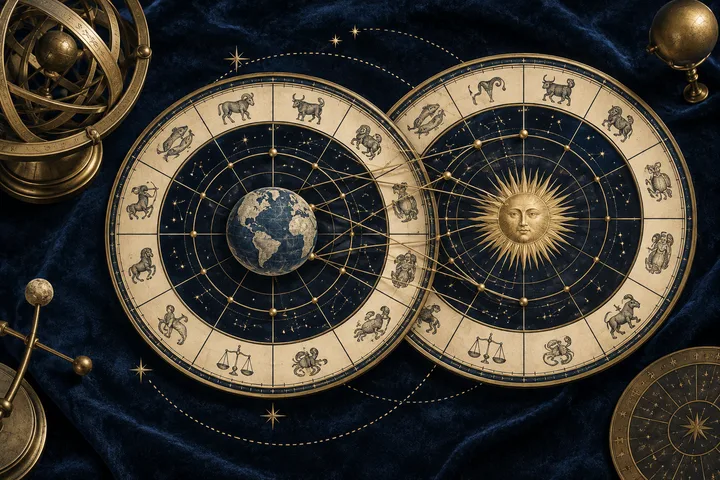
When the two frames point in different directions, rank them instead of blending them into fog. The geocentric chart comes first for a relationship report. It has the clearest connection to an Earth-based person, an actual birth place, the Moon, the angles, and the houses. It is also the chart most readers expect when they ask about synastry. That makes it the working foundation.
The heliocentric chart comes second. It can qualify a geocentric pattern by showing how an astrologer who uses the method understands a broader or less personal layer. It may be especially interesting when the geocentric reading feels familiar but the couple also shares a strong sense of purpose, creative direction, or spiritual development. Those are interpretive possibilities, not guaranteed outcomes.
The third rank belongs to any dramatic contact that appears only after several unannounced changes. A report might switch from geocentric to heliocentric, from tropical to sidereal, add an asteroid, widen the orb, and then present the most striking aspect as though it were part of the original method. That isn't richer analysis. It's a moving target. One method at a time.
Use four questions to sort the result. First, does the contact exist in the stated frame? Second, is the body part of the agreed report scope? Third, is the degree close enough for the stated orb? Fourth, does the interpretation match the question the reader asked? A heliocentric Earth-Mars contact might matter in a tradition that reads Earth symbolically, but it cannot answer a question about one person's Moon needs if the Moon is absent from the heliocentric chart.
The strongest exception is a dedicated heliocentric reading. If two people specifically want to study a solar or evolutionary layer and work with an astrologer who knows that tradition, heliocentric synastry may become the main method for that appointment. The exception doesn't weaken the general rule. It proves the rule's real point: method follows question. A specialized question can justify a specialized chart.
Astro.com also gives a useful reminder through its chart selection pages. A synastry chart is a particular chart type, while a composite chart calculates a different relationship chart from the two horoscopes. Changing the chart type already changes the question. Changing the center does too. Don't stack these differences together and call the result one seamless answer.
A clear report can state the ranking in one paragraph. 'We read the supplied geocentric Moon, Venus, Mars, and close aspects first. We then note any heliocentric contacts as a separate symbolic layer. Houses and angles are omitted unless birth data and a house calculation are available.' That sentence protects the reader from both false certainty and needless mystery.
Sources: Astrodienst Astrowiki: Heliocentric Model; Astrodienst Astrowiki: Heliocentric Horoscope; Swiss Ephemeris Documentation 2.10; Astrodienst FAQ: Overview of Available Chart Types
What to ask, then how to read the result
You don't need every ephemeris setting before you can read a synastry report. Start with four labels: center, zodiac, bodies, and orb. Is the chart geocentric, heliocentric, or both? Are the sections separated? Does the report use the Moon, Venus, and Mars, and does it state a six-degree orb? A polished wheel can still mix two questions if those labels stay hidden.
Read the supplied signs first, then close aspects, then houses or angles only when the required birth data and calculation are present. Read the planets as a conversation between functions. Venus-Mars can describe attraction meeting friction. A Moon contact can show how comfort is offered and received. Consider an example: if supplied placements show a Venus-Mars square and a Moon contact, ask how desire, irritation, and reassurance meet in ordinary life. Don't turn the pattern into a verdict.
If a second chart frame is available, name the change before interpreting it. A Venus or Mercury sign may differ. The Moon may not appear separately, and houses and angles don't carry over. Ask what distinct theme the solar-centered layer contributes within the astrologer's stated tradition. If it only repeats the first reading in grander language, set it aside.
For a placement-based comparison, use the Moon, Venus, and Mars signs you actually have, plus optional degrees for supported aspects. Don't invent houses, angles, or heliocentric positions. If you want those layers calculated, choose a report that names the data and method it uses. The Synastry Comparison Report is built for supplied placements and optional degrees, so it keeps the chart scope visible from the first sign to the last aspect.
Now make the strongest pattern practical. A Venus-Mars contact can open a talk about desire and pacing. A Moon contact can prompt a question about what helps each person feel received. A heliocentric theme can point to a shared value or project. Let the chart name the subject. Let both people answer from experience. Choose one question to discuss, and notice what changes in the next real exchange.
Sources: Astrodienst Astrowiki: Heliocentric Model; Astrodienst Astrowiki: Heliocentric Horoscope; Swiss Ephemeris Documentation 2.10; Astrodienst FAQ: Overview of Available Chart Types
A little more clarity
Can heliocentric synastry replace a geocentric synastry report?
Usually, no. Geocentric synastry should anchor a relationship reading because it preserves the Earth-based frame, Moon, houses, and angles when the required birth data is available. Heliocentric synastry can add a separate solar or developmental layer. It may lead a specialized reading when that is the explicit question and the astrologer works within a clear heliocentric tradition. It shouldn't silently replace the ordinary chart or supply missing geocentric houses.
Why do Venus or Mercury sometimes change signs in a heliocentric chart?
The center has changed from Earth to the Sun. From the solar viewpoint, the planets' ecliptic longitudes are recalculated, and Mercury and Venus can shift notably because their apparent Earth-based relationship to the Sun no longer limits the picture in the same way. Read the new placement as part of the heliocentric method. It doesn't erase the geocentric Venus or Mercury used for the ordinary relationship reading.
Sources & further reading
- Astrodienst Astrowiki: Heliocentric Model
Explains why modern astrology commonly uses an Earth-based viewpoint and how the heliocentric chart changes the Sun, Earth, houses, and planetary signs.
- Astrodienst Astrowiki: Heliocentric Horoscope
Supports the distinctions about the missing Moon, Earth opposite the geocentric Sun, absent houses and angles, and changed inner-planet positions.
- Swiss Ephemeris Documentation 2.10
Defines geocentric and heliocentric planetary positions and documents that heliocentric positions use the center of the Sun rather than the center of Earth.
- Astrodienst FAQ: Overview of Available Chart Types
Supports the description of a standard synastry chart as two partner horoscopes shown together with inter-chart aspects.
Synastry Comparison Report
Enter known placements for two people. Get an input-by-input comparison, selected aspect calculations and a clear record of what remains uncertain.
Compare our placements