
The mismatch changes the rhythm, not the relationship verdict
You can feel the difference before you know the vocabulary. One person wants to book the trip, define the relationship, and settle the question tonight. The other wants to see how the next few weeks feel. A third version appears when someone keeps changing the plan because a better option has appeared. None of these responses is automatically careless, controlling, or uncommitted. They describe different relationships to movement.
In astrology, cardinal, fixed, and mutable are called modalities, qualities, or quadruplicities. They divide the twelve signs into three groups of four. Aries, Cancer, Libra, and Capricorn are cardinal. Taurus, Leo, Scorpio, and Aquarius are fixed. Gemini, Virgo, Sagittarius, and Pisces are mutable. The traditional seasonal picture gives the groups their timing language: cardinal begins, fixed holds the middle, and mutable closes one phase while preparing for the next. These are useful verbs, not verdicts. They describe how a placement tends to meet movement.
That shorthand becomes useful in synastry when you translate it into shared life. A cardinal person may create momentum. A fixed person may make momentum dependable. A mutable person may keep the relationship responsive when the original plan no longer fits. The friction comes when one rhythm is treated as the only mature rhythm. Fast is not always brave. Slow is not always loyal. Flexible is not always evasive.
A modality mismatch is most useful as a negotiation about sequence. It shows who opens the door, who wants proof that the room will still be there tomorrow, and who notices when the room needs rearranging. The practical question is simple: which pace is asking for attention, and what shared rhythm would answer it?
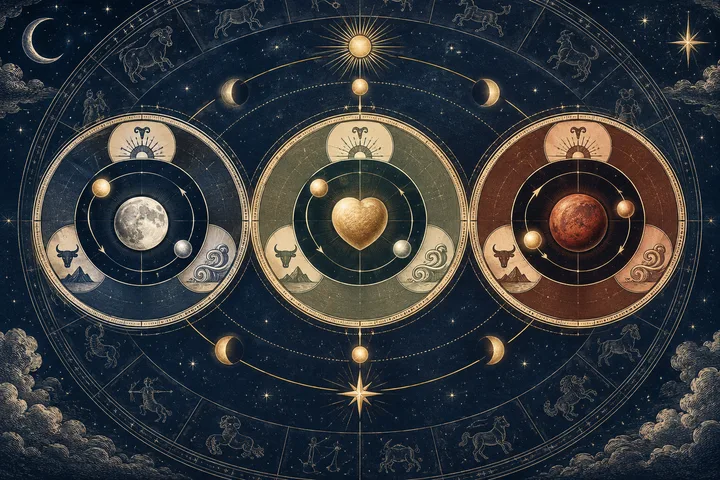
The reading starts with supplied Moon, Venus, and Mars signs. Optional degrees sharpen the aspect layer, using the report's six-degree orb.
A mismatch in cardinal, fixed, and mutable placements usually changes how a couple moves through a relationship, not whether the bond can work. Cardinal placements want a beginning and a decision. Fixed placements want continuity and proof. Mutable placements need room to adjust as circumstances change. Put them together and one person may ask, "Where is this going?" while another is still building trust or revising the plan. Start with the signs of both Moons, Venuses, and Mars placements, then count the repeating modalities. Read the planet's job before judging the pace. Moon shows the rhythm of comfort, Venus the rhythm of affection and values, and Mars the rhythm of pursuit and action. Exact degrees and major aspects can sharpen or redirect the picture. If you have only sign placements, you can compare tendencies, but you cannot claim a calculated aspect pattern. The useful next step is simple: name the pace each person needs, then agree on one observable rhythm for plans, contact, and repair.
Sources: Skyscript Beginners Astrology Course, Lesson 8: The Signs as Quadruplicities; Astrology.com: Modalities
Why the seasonal sequence explains the feeling of pace
The easiest way to remember the modalities is to watch a season move. Cardinal signs mark the turn into a season. Fixed signs occupy its settled middle. Mutable signs arrive at the edge, when the existing pattern is being completed, adjusted, or released. This is not a ranking. A season needs all three movements. A relationship does, too.
Cardinal energy asks for a beginning. It can look like a first message, a direct invitation, a conversation about exclusivity, or a decision to solve the problem now. The gift is movement. The risk is pushing the relationship into its next chapter before both people have arrived in the current one.
Fixed energy asks for continuity. It can look like keeping a promise, repeating a reassuring ritual, protecting shared resources, or staying with a hard conversation after the first emotional charge has passed. The gift is endurance. The risk is mistaking persistence for progress when the old arrangement no longer serves either person.
Mutable energy asks what needs to change so the relationship can keep living. It can look like changing the weekend plan, finding a third option, naming a new detail, or accepting that the same repair will not work every time. The gift is adaptation. The risk is leaving every choice open until the other person feels they are dating a cloud.
The seasonal meanings give you a strong first reading, but they are still broad. The same cardinal quality moves differently through Aries fire, Cancer water, Libra air, and Capricorn earth. The same fixed quality can protect a value, a feeling, an idea, or a practical structure. The same mutable quality can revise through words, service, belief, or emotion. That is why modality belongs beside element, planet, and aspect. It should never carry the whole interpretation alone.
So the question is not, "Which modality is best?" Ask, "Which phase does each person instinctively protect?" The answer tells you where the couple may get out of step. One may protect the beginning, another the middle, and another the transition. That is the heart of the mismatch.
Sources: Skyscript Beginners Astrology Course, Lesson 8: The Signs as Quadruplicities; Astrology.com: Modalities
Start with the placements that actually govern the question
A modality count can be helpful, but a pile of sign labels is not yet a reading. Start with the Moon, Venus, and Mars because they give you three different clocks. Then ask which clock is actually running the disagreement you can observe.
The Moon describes the rhythm of safety and emotional response. A cardinal Moon may need a feeling to move somewhere. A fixed Moon may need the feeling to settle and become familiar. A mutable Moon may need space to talk, reinterpret, or change its response as more information arrives. These are tendencies in the way comfort is sought and offered. They are not a promise that someone will always behave well.
Venus describes the rhythm of affection, pleasure, attraction, and value. A cardinal Venus may show love by creating shared experiences or naming what the bond could become. A fixed Venus may show love through loyalty, consistency, and tangible preference. A mutable Venus may show love through curiosity, variety, humor, or the willingness to meet a changing need. The same person can be bold in pursuit and cautious in attachment because Mars and Venus are answering different questions.
Mars describes the rhythm of pursuit, assertion, desire, and conflict. A cardinal Mars may act first and solve the details afterward. A fixed Mars may build pressure slowly, then hold a position with force. A mutable Mars may change tactics, negotiate, or scatter energy across several possible approaches. When two Mars placements differ in modality, the couple often argues about timing before they argue about the subject itself.
Then look for repetition. If one person's Moon, Venus, and Mars are all fixed, the need for continuity may run through emotional life, affection, and action. If the other person's three placements are cardinal, the couple may experience a steady push toward the next step. But do not count every planet as equal. The Moon, Venus, and Mars are the assigned relationship layers here. A sign on its own does not outweigh a close aspect, a strong element pattern, or a planet's condition.
The cleanest worksheet has four columns: person, planet, sign, and modality. Add a fifth for degree when known, then a final column for the behavior you are trying to understand. Is the issue a missed call, a postponed decision, a repeated argument, or a sudden change of plan? Keep the zodiac system and aspect list consistent. When degrees are absent, stay with the sign-level pattern and use it to choose what to observe first.
Treat the count as a prompt, not a score. Three fixed placements may suggest that continuity matters, but one cardinal Mars can still dominate a quarrel about who acts first. One mutable Moon can explain why a person needs time to name what they feel, even when Venus and Mars prefer a settled routine. Mark the repeated modality, then circle the planet connected to the repeating behavior. That circled placement is where the reading begins.
You can also compare the two charts by function rather than by totals. Does one person's Moon carry the cardinal impulse while the other's Mars carries it? The couple may share initiative, but express it in different rooms of the relationship. Does one person's Venus carry fixed loyalty while the other's Moon carries fixed security? They may recognize the same need through different acts. This functional comparison is often more useful than saying that one chart is mostly cardinal and the other is mostly mutable.
Sources: Skyscript Beginners Astrology Course, Lesson 8: The Signs as Quadruplicities; Astrology.com: Modalities
Cardinal and fixed: who starts, and who makes it real?
A cardinal-fixed mismatch often creates the clearest argument about speed. Cardinal energy sees a door and reaches for the handle. Fixed energy asks whether the hinges are sound. The cardinal person may call the fixed person hesitant. The fixed person may call the cardinal person restless. Both descriptions can miss the actual gift in the pairing.
Cardinal placements bring initiation. They are often the ones that turn a feeling into a proposal: let us define this, let us move in, let us make the appointment, let us address the issue before it grows. Fixed placements bring continuation. They ask whether the proposed change can be lived, repeated, and trusted after the exciting first week. A cardinal partner can help a fixed partner leave a stale pattern. A fixed partner can help a cardinal partner finish what enthusiasm began.
The trouble starts when initiation becomes pressure or continuity becomes refusal. If the cardinal person keeps escalating every silence into a decision, the fixed person may retreat into resistance. If the fixed person treats every new request as a threat to the existing bond, the cardinal person may feel trapped in a relationship that never reaches the next room. The modality mismatch then becomes a story about character, even though the original issue was sequence.
Consider an example. Imagine Maria has cardinal Venus and Mars, while her partner has fixed Moon and Venus. Maria may experience love through movement. She plans, asks, and wants a visible sign that the relationship is advancing. Her partner may experience love through repetition. He answers, shows up, and assumes that the continued bond is already the proof. Maria reads the lack of a new step as indifference. He reads her request for a new step as doubt. Neither interpretation is forced by the placements, but the mismatch makes each one tempting.
The repair is concrete. Separate the next step from the whole future. The cardinal partner can ask for one defined action rather than a total promise. The fixed partner can offer a time-bound commitment rather than a vague reassurance. "Let us choose the date by Sunday" is better than "You need to be more spontaneous." "I am here, and I will revisit this with you next month" is better than "Why are we still talking about it?"
The strongest exception is a strong element or aspect pattern that changes the expression. Cardinal earth may move carefully while fixed fire may act dramatically. A close Moon-Venus conjunction can create warmth across different modalities. A hard Saturn contact may slow the whole relationship, even when Mars placements look eager. If the lived pattern conflicts with the modality shorthand, let the planet pair and tighter contact lead.
Sources: Skyscript Beginners Astrology Course, Lesson 8: The Signs as Quadruplicities; Astrology.com: Modalities
Cardinal and mutable: who sets the plan, and who keeps revising it?
Cardinal-mutable couples often move quickly at first. Both energies have a relationship with change, so the early bond can feel alive, responsive, and full of options. The mismatch appears later, when one person wants the new direction chosen and the other wants the right to keep adjusting it.
Cardinal placements tend to turn possibility into a route. Mutable placements tend to keep several routes available until the situation becomes clearer. In a couple, that can be a beautiful division of labor. The cardinal partner gets the train moving. The mutable partner notices the closed station, the missing detail, or the better connection. Together, they can avoid both paralysis and needless rigidity.
But a plan needs a moment when it becomes a plan. If the mutable person keeps adding conditions, the cardinal person may feel they are carrying all the decision-making. If the cardinal person treats every revision as disloyalty, the mutable person may stop sharing useful information. The conflict is not simply speed versus slowness. It is commitment to a direction versus commitment to responsiveness.
Imagine Daniel has cardinal Moon and Venus, while his partner has mutable Moon and Mars. Daniel may need a clear emotional direction before he can relax. His partner may need to talk through several versions of the problem before knowing what she feels. Daniel asks for an answer. She offers a process. He hears avoidance. She hears a demand to feel something before the feeling has finished forming.
A workable rhythm gives both modes a job. Choose the decision date first. Then allow revisions inside that container. For example, the couple can agree to decide whether to take the trip by Friday, while leaving the route and budget open until Wednesday. The cardinal person gets a real endpoint. The mutable person gets room to solve the living details. Small structures like this prevent a flexible style from becoming indefinite delay.
Before you call this a speed problem, check the element and planet. Mutable earth may revise carefully and precisely. Cardinal water may act from feeling, then need reassurance. Mars shows how revision appears in conflict, Venus whether variety feels playful or destabilizing, and the Moon how much uncertainty feels bearable. The same modality can serve very different needs.
Sources: Skyscript Beginners Astrology Course, Lesson 8: The Signs as Quadruplicities; Astrology.com: Modalities
Fixed and mutable: who protects the pattern, and who adapts it?
Fixed-mutable mismatches can look peaceful from the outside. Neither person necessarily wants to force a dramatic beginning. One person may keep the bond steady while the other keeps it breathable. The tension arrives when stability and flexibility begin to sound like opposing moral values.
Fixed placements often trust what has been repeated. They may ask for familiar rituals, clear loyalty, and a dependable shape to the relationship. Mutable placements often trust what can respond. They may ask for conversation, exceptions, and permission to change the agreement when life changes. The fixed partner says, "This is what we agreed." The mutable partner says, "Yes, but this is what is happening now."
Both statements can be wise. A relationship without fixed qualities may never develop a home. A relationship without mutable qualities may turn its first successful arrangement into a cage. The practical question is whether the couple can tell the difference between a core promise and a replaceable habit. Keep the promise. Update the habit.
Consider an example. Imagine Priya has fixed Moon and Mars, and her partner has mutable Venus and Mars. Priya may need conflict to end with a stable repair. Her partner may need the repair to stay open to new information. Priya sees repeated discussion as a failure to resolve. Her partner sees a single permanent resolution as too rigid for real life. If they name the difference, they can create a two-part repair: first restore safety, then schedule a later review of the agreement.
The same pattern can shape affection. Fixed Venus may show love by remembering preferences and keeping a ritual. Mutable Venus may show love by trying a new restaurant, changing the language of affection, or making room for a different mood. The fixed partner can hear novelty as instability. The mutable partner can hear repetition as neglect. One protected ritual and one open space each week gives both signals somewhere to land.
Turn that distinction into a design question: what must remain stable, and what may change? Keep the promise. Update the habit. That might mean firm honesty about exclusivity alongside a flexible social schedule, or a weekly check-in alongside freedom to change how the repair conversation begins.
Sources: Skyscript Beginners Astrology Course, Lesson 8: The Signs as Quadruplicities; Astrology.com: Modalities
Same modality does not mean the same pace
A common shortcut says that two cardinal people will move quickly, two fixed people will move slowly, and two mutable people will remain undecided. That shortcut is too blunt. Same-modality pairs share a style of movement, but they can still collide over direction, ownership, and timing.
Two cardinal placements may both want to lead. Aries and Cancer can both initiate, yet one may act directly while the other acts through protection and emotional timing. Libra and Capricorn can both push a relationship forward, yet one may need agreement while the other wants a workable result. Shared cardinality can produce momentum or a contest over who gets to set the agenda.
Two fixed placements may offer powerful loyalty, but they may also refuse to yield on different principles. Taurus may protect comfort and material steadiness. Scorpio may protect emotional truth and control over disclosure. Leo may protect dignity and visible appreciation. Aquarius may protect independence and a larger ideal. The bond may last, but lasting does not erase the need to negotiate.
Two mutable placements may understand one another's shifting attention, but they can also amplify uncertainty. Gemini may keep talking because another angle is available. Virgo may keep refining because the details matter. Sagittarius may keep searching because the horizon is wider than the current plan. Pisces may keep feeling because the emotional field has not settled. Shared flexibility helps only when someone eventually names the choice.
The geometry of the zodiac adds another layer. Signs of the same modality sit three signs apart and form a cross, so they can share a style while expressing pressure through different elements. A cardinal pair can both want movement, but not toward the same destination. Same modality reduces translation in one area and can sharpen disagreement in another.
Compare modality in two stages. First ask whether the couple shares a preferred way of moving. Then ask whether their elements and planets can cooperate inside it. Same modality may reduce translation while sharpening a fight over direction. Different modality may require translation while supplying a missing function. The useful pairing is the one that can name and use the difference.
This is why sign pairs inside one modality deserve their own reading. Aries and Libra are both cardinal, but Aries can begin through direct desire while Libra begins by creating agreement. Taurus and Aquarius are both fixed, yet Taurus may protect a sensory routine while Aquarius protects freedom of thought. Gemini and Pisces are both mutable, but Gemini revises through questions and Pisces through feeling. The modality supplies the shared verb. The sign supplies the accent.
A same-modality couple can therefore have plenty of movement and still feel stuck. They may both wait for the other person to yield, both assume their preferred direction is obvious, or both keep a private reason for resisting the proposed change. Ask who owns the decision, what outcome each person wants, and which part of the arrangement is negotiable. Those answers reveal whether the issue is tempo, direction, or control of the route.
Sources: Skyscript Beginners Astrology Course, Lesson 8: The Signs as Quadruplicities; Celestia: Synastry Aspects Explained
The planet changes what the modality mismatch feels like
The same cardinal-fixed mismatch lands differently in the Moon than in Mars. A count can show emphasis, but the planet tells you where the pacing issue lives.
With the Moon, the issue is emotional timing. A cardinal Moon may want reassurance through immediate engagement. A fixed Moon may want reassurance through reliable presence. A mutable Moon may want reassurance through conversation and room to process. If one person's Moon is cardinal and the other's is fixed, the first may ask to talk now while the second needs the relationship to feel calm before opening. The practical bridge is a promised return: pause without disappearing, then come back at a named time.
With Venus, the issue is affection and value. Cardinal Venus often wants love to have a visible direction. Fixed Venus often wants love to have a dependable texture. Mutable Venus often wants love to remain curious and responsive. A cardinal-fixed Venus mismatch can therefore create a complaint that sounds like, "Why are we not progressing?" versus, "Why is what we have not enough?" The answer may be a shared ritual that proves continuity while making one new choice together.
With Mars, the issue is action, desire, and conflict. Cardinal Mars may initiate a difficult conversation or physical pursuit. Fixed Mars may hold a line, sustain effort, or resist being redirected. Mutable Mars may change tactics, joke, negotiate, or move to a different problem. In a conflict, one person may be trying to start the repair, another to defend a boundary, and another to find a route around the impasse. Calling all three reactions "communication styles" is not precise enough. Name the planet's job.
The relationship question also changes by direction. Your Moon contacting their Venus is not the same story as your Venus contacting their Moon, even when the signs suggest a similar mood. Your Mars may activate their Venus differently than their Mars activates your Venus. This is why the report's order of chart inputs matters when it describes planet and partner roles. A sign-pair summary can identify a theme. The planet-to-planet layer gives it a direction.
Then add degrees if you have them. A sign-level mismatch can be broad and symbolic. A close major aspect can make the interaction sharper, more immediate, and easier to observe. In this report's stated scope, selected major aspects use a six-degree orb. If one person's degree is unknown, do not invent the aspect. Keep the interpretation at the level the data supports.
The orb is a working boundary, not a promise that every contact inside it will feel identical. A contact at one degree usually deserves closer attention than one at five or six degrees, especially when the same planet pair repeats elsewhere in the comparison. A five-degree Venus-Mars contact may still matter, but it should share the page with the tighter Moon contact if that is where the emotional story gathers. State the policy once, then let the actual closeness help rank the emphasis.
Direction matters even when the aspect name stays the same. If your Mars squares their Venus, your way of pursuing or pressing may unsettle their style of affection. If your Venus squares their Mars, their action may challenge the way you receive desire and choose pleasure. The square belongs to both people, but the planet roles tell you who is bringing which motion. That distinction turns a dramatic label into a usable question: what does each person do, and what does the other person experience?
Sources: Skyscript Beginners Astrology Course, Lesson 8: The Signs as Quadruplicities; Celestia: Synastry Aspects Explained
A worked comparison: three clocks in one relationship
Imagine Maria has Moon in Cancer, Venus in Aries, and Mars in Capricorn. Her partner, Alex, has Moon in Taurus, Venus in Aquarius, and Mars in Gemini. Treat this as a sign-level comparison used to show the method.
Maria's Moon is cardinal water. It may seek emotional movement through care, protection, and a clear sense that the bond is being tended. Alex's Moon is fixed earth. It may seek calm through consistency, physical comfort, and proof that the relationship can be trusted in ordinary life. When Maria asks to talk about a feeling, Alex may offer practical steadiness instead. When Alex repeats a familiar routine, Maria may want a more explicit emotional response. The mismatch is not a lack of feeling. It is a mismatch between movement through care and stability through repetition.
Their Venus placements add a different clock. Maria's Venus is cardinal fire. She may enjoy direct attraction, visible initiative, and the excitement of a relationship that has somewhere to go. Alex's Venus is fixed air. He may value loyalty to a shared idea, friendship inside romance, and a bond that does not need constant proof through escalation. Maria may want the next plan. Alex may believe the ongoing connection already says something important. If they never translate, Maria can feel underchosen while Alex feels pushed to perform commitment in a language he does not naturally use.
Their Mars placements create the sharpest contrast. Maria's Mars is cardinal earth. She may prefer to act with purpose, take responsibility, and move toward a concrete result. Alex's Mars is mutable air. He may think through options, change the wording, or approach the problem indirectly. In conflict, Maria may ask for the fix. Alex may keep exploring the issue. Her pressure can make him scatter. His questions can make her feel that no action will ever be enough.
Now rank the pattern. The most important practical issue is not that they have different modalities in three placements. It is that each planet asks for a different bridge. For the Moon, they need a return time after a difficult conversation. For Venus, they need one reliable ritual plus room for new experiences. For Mars, they need a rule that turns discussion into a decision. The chart does not choose the rule. It shows why the rule may be necessary.
A close aspect, strong element agreement, or natal condition could change the emphasis. A close Moon-Venus contact might synchronize the emotional and affection clocks. A Saturn contact might slow the bond for a reason the modality count misses. Check those layers when their degrees are available.
Because this is a sign-level example, it shows tendencies rather than calculated aspects. If Maria and Alex later supply degrees, the next pass would test the Moon, Venus, and Mars pairs against the stated orb. A close aspect could strengthen one clock and soften another. A missing degree leaves that question open. The honest reading can still identify the likely translation work without pretending the unknown layer has already spoken.
Notice, too, that the three contrasts don't need one grand solution. Maria's Moon may need emotional acknowledgment, her Venus visible initiative, and her Mars a concrete result. Alex may answer those needs through steadiness, friendship, and discussion. They can build three small bridges instead of arguing over which person has the correct pace. That is what a layered comparison adds: separate requests, separate evidence, and a better chance of meeting the actual need.
Rank the pacing story, then build a shared rhythm
Rank the pattern in three passes. Read the planet pair first: Moon-Mars describes emotional activation, Venus-Mars attraction and pursuit, and Moon-Venus comfort and affection. Read the aspect and orb next. A close conjunction blends functions, a square creates pressure, a trine offers ease, a sextile rewards effort, and an opposition makes two tempos face each other. Then return to modality and ask how that contact moves through time.
Use the actual degrees to decide which contact leads. A tight major aspect usually deserves more attention than a loose one, while a repeated sign-level theme can matter more than one vivid but isolated symbol. Three contacts pointing toward the same timing problem form a pattern. One attractive phrase does not.
The worked example shows the payoff. Maria's Moon in Cancer, Venus in Aries, and Mars in Capricorn meet Alex's Moon in Taurus, Venus in Aquarius, and Mars in Gemini. Her emotional style may seek care that moves toward a clear response; his may seek calm through steady routines. Her Venus may want visible initiative; his may value a loyal bond that doesn't need constant escalation. Her Mars may press toward a concrete fix; his may keep exploring options. Three mismatches, three clocks.
So rank the remedies by planet. For the Moon, set a return time after a hard conversation. For Venus, keep one dependable ritual and add one new shared choice. For Mars, give discussion a decision point. The chart doesn't choose the rule. It shows why the rule may be needed.
Now separate pace from direction. If you both want the same outcome but disagree about timing, work with modality. If you want different outcomes, a better schedule won't settle the question. Begin with the planet carrying the complaint, then make one small agreement you can observe more than once: a Sunday planning call, a named return after conflict, or a deadline for deciding whether a plan changes.
A cardinal-fixed-mutable sequence might be: choose the direction, protect the promise, revise the method. A fixed-cardinal pair may need reassurance before the next step. A mutable-cardinal pair may need the decision date before opening the field of options. The order matters because no conversation can begin, secure, and revise everything at once.
For a Synastry Comparison Report, enter both people's Moon, Venus, and Mars signs, with degrees where known. Compare the strongest modality contrast, check the selected major aspects, and identify the missing information before you draw a broader conclusion. Then test the smallest useful agreement in lived time. If it helps, repeat it. If it fails, change the agreement, not the person.
Record what is known beside what is missing. If both signs are supplied but only one degree appears, you can still discuss the sign relationship and the planet roles, but you cannot confirm a degree-based contact involving the absent value. If the source rounds degrees to whole numbers, keep that rounding visible in your notes. Don't quietly turn an estimate into an exact aspect. A clean comparison tells the reader which layer is solid, which layer is suggestive, and which question should wait for better input. That discipline keeps the pacing story useful without making it larger than the chart data allows.
Sources: Skyscript Beginners Astrology Course, Lesson 8: The Signs as Quadruplicities; Celestia: Synastry Aspects Explained
A little more clarity
Does a cardinal, fixed, or mutable mismatch mean the relationship will be difficult?
No. It means the two people may move through decisions, affection, comfort, or conflict at different speeds. Cardinal energy starts, fixed energy sustains, and mutable energy adapts. That difference can create friction, but it can also divide the work well. Read the Moon, Venus, and Mars separately, then check exact degrees and major aspects when they are available. The useful question is not whether the mismatch is good or bad. Ask what needs to be initiated, protected, and revised so both people can participate.
Which modality is the fastest in synastry?
Cardinal placements usually show the strongest impulse to begin or move a situation forward. That does not make every cardinal placement fast in every context. The element, planet, aspects, and chart context refine the meaning. Fixed placements often prefer continuity and proof through repetition. Mutable placements often need room to adjust before settling on a route. Compare the modality of the specific planet involved, not a single sign label or a total count.
Sources & further reading
- Skyscript Beginners Astrology Course, Lesson 8: The Signs as Quadruplicities
Supports the sign groups, seasonal sequence, and traditional shorthand that cardinal starts, fixed stabilizes, and mutable prepares for change.
- Astrology.com: Modalities
Supports the modern Western astrology classification of the twelve signs into Cardinal, Fixed, and Mutable modalities or quadruplicities.
- Celestia: Synastry Aspects Explained
Supports reading synastry through planet pairs, angular distance, major aspect types, orb, and repeated themes rather than one isolated contact.
Synastry Comparison Report
Enter known placements for two people. Get an input-by-input comparison, selected aspect calculations and a clear record of what remains uncertain.
Compare our placements