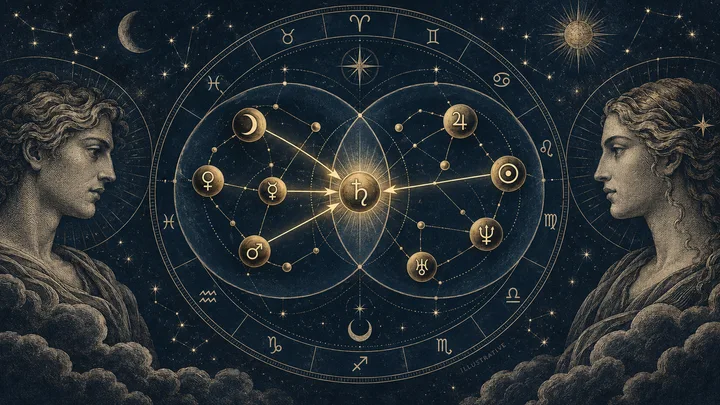
The final dispositor answers a different question from synastry
You have three strong contacts in a synastry grid. Her Moon touches his Saturn. His Venus meets her Mars. Their Mercuries fall into a lively trine. Which one leads? That is the real problem behind the question about a final dispositor. You aren't asking whether one technique is magical. You're trying to rank a crowded picture without flattening it.
A dispositor is the ruler of the sign a planet occupies. If your Mars is in Gemini, Mercury disposes Mars because Mercury rules Gemini. Follow Mercury to the sign it occupies, then follow that sign's ruler. The chain shows where the planet's expression reports. A final dispositor is the one planet in its own sign where every chain arrives. The definition sounds neat. Charts aren't always neat.
Synastry asks how two charts meet. It compares one person's planets, signs, houses, and aspects with the other person's. A final dispositor is first a natal-chart pattern. It describes an internal hierarchy in one chart, not a relationship verdict. That distinction keeps the method useful. You can use a person's final dispositor to understand how they carry a synastry contact, but the dispositor does not become a new aspect between the two people.
This gives you two different questions. What happens between the charts? Look at the interchart aspect, its planets, its sign relationship, and its degree distance. How does one person tend to organize the planet involved? Trace that person's dispositor chain. The first question gives you the interaction. The second gives you a possible route through the natal chart.
That distinction also explains why a final dispositor can seem relevant even when it never appears in the aspect grid. A planet can organize a person's response without being the planet contacted by the other chart. If Person A's Venus reports to Saturn, a partner's Moon touching that Venus may bring Saturn topics into Person A's experience: pace, trust, limits, and the proof of consistency. Person B's Moon is still the Moon. Person A's Saturn is still not secretly conjunct it. The chain describes the receiving chart's inner route, not an extra line drawn between the charts.
Separate three verbs. An aspect connects. A sign describes. A dispositor routes. When Venus squares Mars across two charts, Venus and Mars connect through tension. Their signs describe the style of that tension. Their dispositors show where each person may take the matter next. Good synastry language keeps those verbs visible. It doesn't turn routing into contact or description into destiny.
Cafe Astrology's synastry guide places aspects, signs, and the individual Venus and Mars functions inside the same reading rather than treating a single sign comparison as enough. Its overview also separates Venus as attraction and pleasure from Mars as desire, assertion, and sexual expression. That is a useful order. The cross-chart contact comes first. Dispositorship supplies context after you know what is actually contacting what.
So the supported position is clear. A final dispositor can rank themes when several planets in one person's chart feed the same endpoint. It cannot rank a synastry picture by itself. Think of it as a map of internal routing, not a scoreboard.
Yes, but only as a ranking tool. A final dispositor can show the planet through which several natal themes find their common outlet, so it can help you say why a busy synastry picture keeps returning to one subject. It cannot replace the exact aspects between two charts. Start with the tightest personal-planet contacts, read the signs and planetary condition, then use each person's dispositor chain to find the theme that organizes the pattern. If every chain ends at one planet in its own sign, you have a final dispositor. If chains end at several planets or form a loop, you don't. In that case, rank the separate branches instead of forcing one master explanation. The practical next step is simple: record the Moon, Venus, and Mars placements, add known degrees, and compare the strongest contacts before you reach for the final dispositor.
Sources: The Final Dispositor: The Planet Where All Rulership Chains End; Final Dispositor, Astrology Definition; Synastry and Relationship Astrology
Why the technique is appealing when a synastry chart feels crowded
A busy synastry chart tempts you to count. Five blue lines must be good. Three red lines must be bad. A Venus contact must matter more than a Mercury contact because Venus is romantic. The counting feels tidy, but it does not tell you which theme the couple actually keeps meeting in daily life.
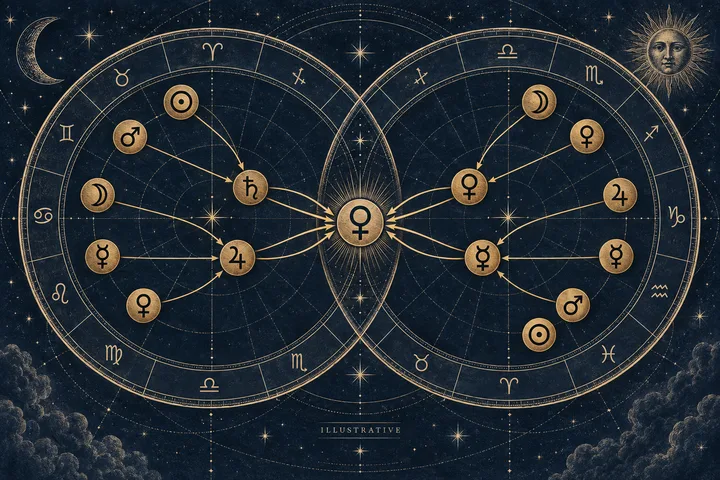
The final dispositor offers a different kind of order. Imagine Maria has the Moon in Leo, Venus in Capricorn, Mars in Pisces, Mercury in Sagittarius, and Jupiter in Sagittarius. Using traditional sign rulership, the Moon reports to the Sun, Venus reports to Saturn, Mars reports to Jupiter, Mercury reports to Jupiter, and Jupiter disposes itself in Sagittarius. If the remaining planets also feed Saturn and then Jupiter, Jupiter becomes the common endpoint. The chart has many planets, but their chains keep arriving at meaning, direction, belief, and growth.
Now place Maria in synastry with another person. Their charts may show a tight Moon-Venus conjunction, a Mars-Saturn square, and a looser Mercury-Jupiter trine. The final dispositor doesn't make the conjunction wider or the square softer. It helps you ask why Maria may experience all three through Jupiter's concerns. Does affection become a question about shared plans? Does conflict become a clash over what the relationship is for? Does conversation keep widening into questions of faith, travel, study, or a future both people can believe in? Those are interpretive possibilities, not invented facts about Maria.
This is why the technique feels like a key. It connects separate natal branches. The Moon, Venus, and Mars remain Moon, Venus, and Mars. Jupiter doesn't erase their meanings. It tells you where their sign-based authority may converge in that particular chart.
The endpoint also gives you a way to choose a headline without making the headline absolute. You might call the pattern a Saturn-led conversation about trust, or a Mercury-led pattern of naming needs. Then you can show the contacts underneath that phrase. The reader gets a memorable center and enough detail to check whether the center fits. If it doesn't, the individual aspects remain available for a better interpretation.
The appeal has a danger, too. One neat endpoint can make you stop reading. You may decide that every Venus contact means Jupiter, every argument is really about purpose, and every intimate moment must serve a grand story. That is how a helpful hierarchy turns into a slogan. The chain must remain subordinate to the planets, the aspect, and the actual question the reader brought.
A good ranking leaves room for the chart to disagree with your first impression. Begin with the contact that looks loudest, then check whether the signs, rulers, and endpoint support or complicate it. If they complicate it, keep the complication. It may be the part that makes the reading useful. The goal isn't a prettier summary. It's a truer account of why several symbols appear together and what question they ask of the people involved.
Use the final dispositor when you need a unifying sentence. Don't use it when you need proof that two people feel the same thing. A synastry contact remains directional and relational. The natal chain remains individual.
Sources: The Final Dispositor: The Planet Where All Rulership Chains End; Synastry and Relationship Astrology
Trace the chain before you interpret it
The method is simple enough to do by hand, provided you state the rulership system first. For this guide, use traditional rulers: Mars for Aries and Scorpio, Venus for Taurus and Libra, Mercury for Gemini and Virgo, the Moon for Cancer, the Sun for Leo, Jupiter for Sagittarius and Pisces, and Saturn for Capricorn and Aquarius. Uranus, Neptune, and Pluto can carry meaning in a modern reading, but including them as sign rulers changes the chain. Don't mix systems halfway through.
Start with every planet whose role matters to the question. If the question concerns affection and desire, begin with the Moon, Venus, and Mars, then include the Sun and Mercury if they connect to the pattern. Write the sign beside each planet. Put an arrow from each planet to the ruler of its sign. Continue until the chain reaches a planet in its own sign or returns to a planet already in the chain.
Consider an example. Suppose one person's Moon is in Taurus, Venus is in Gemini, Mars is in Cancer, Mercury is in Gemini, and the Sun is in Sagittarius. The Moon goes to Venus because Venus rules Taurus. Venus goes to Mercury because Mercury rules Gemini. Mars goes to the Moon because the Moon rules Cancer. Mercury goes to itself in Gemini. The Sun goes to Jupiter, and Jupiter's next destination depends on its sign. Here, the Moon, Venus, Mars, and Mercury branch into Mercury. The Sun may join that endpoint or may produce a separate branch. You cannot call Mercury the final dispositor until you trace every included planet.
Then test the endpoint. A self-disposing planet must occupy its own sign under the rulership scheme you named. A planet that merely receives many arrows is important, but it isn't automatically a final dispositor. Nor is a planet in a sign associated with its natural symbolism. Venus in Libra is self-disposing by domicile. Venus in Pisces may be powerful by exaltation in some traditions, but it is not a final dispositor on that basis.
A clean worksheet has four columns: planet, sign, dispositor, and terminal result. Add a note for mutual reception. If Mars is in Venus's sign and Venus is in Mars's sign, the two planets dispose each other. You have a loop, not a single final planet. A loop can be meaningful. It simply asks for a different reading.
When you build this worksheet for two people, keep the columns separate. Person A's Venus in Gemini reports to Person A's Mercury. Person B's Venus in Capricorn reports to Person B's Saturn. Don't combine the arrows into a relationship chain. Synastry places the charts in dialogue, but it doesn't create a third natal chart. A combined relationship chart belongs to another technique and another set of inputs.
It helps to mark the scope beside the worksheet. A complete traditional chain may include the seven visible planets and the luminaries. A focused comparison may begin with the Moon, Venus, and Mars because those are the placements the report accepts. If Jupiter appears as the endpoint of the three supplied chains, write partial endpoint, not final dispositor of the entire chart. A small word can preserve a large amount of trust.
Degree information changes a different part of the work. It lets you measure whether a contact is close, separating, or too wide for the chosen orb. It doesn't change the sign ruler. A Venus at 2 degrees of Gemini and a Venus at 28 degrees of Gemini both report to Mercury under the same scheme, although their aspects to other planets may be very different. Keep sign rulership and degree geometry in their proper lanes.
This is also where missing data matters. If you only know Moon, Venus, and Mars signs, you can trace those supplied placements, but you cannot claim a complete chart-wide final dispositor. The report offering on this site works from supplied placements and optional degrees. It doesn't calculate natal positions from birth details, houses, or every planet. Precision about scope protects the interpretation from pretending to know more than the chart data contains.
Sources: The Final Dispositor: The Planet Where All Rulership Chains End; Final Dispositor, Astrology Definition; Synastry: Planet Overlays in Houses
Rank the synastry layers in the right order
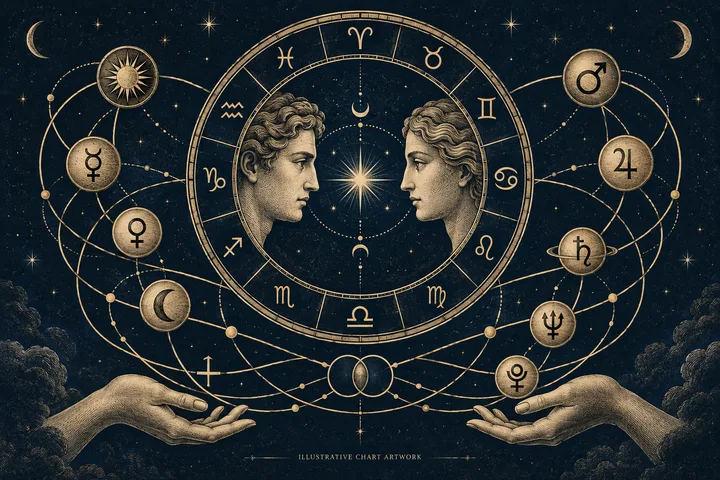
Once you have traced the chains, return to the synastry. Rank the layers in an order that preserves contact before symbolism. My recommended order has three levels, with the final dispositor used inside the third level rather than above the whole chart.
First, rank exactness and relevance. A close aspect between the Moon, Venus, Mars, Sun, or Mercury deserves attention because it describes a direct exchange between personal functions. Record the degree distance when you have it. A conjunction, square, opposition, trine, or sextile is not the same thing as two planets sharing a sign. A sign pairing can describe style; an aspect gives you geometry and a specific channel of interaction.
Second, rank the condition of the planets involved. Read the sign each planet occupies, its traditional ruler, and the relationship between those rulers. A Venus-Mars conjunction still needs its signs. A Moon-Saturn square still needs the Moon's condition and Saturn's condition. Reception can help the planets find one another, while a loop can show a closed exchange rather than a single authority. This layer tells you how the contact may operate, not whether it guarantees a result.
Third, rank repetition and convergence. If the same topic appears in several contacts, and one person's relevant planets also feed a single final dispositor, the theme deserves a higher place in your summary. Suppose three separate contacts involve Maria's Venus, Mars, and Moon, and all three chains arrive at Saturn. You might rank responsibility, time, boundaries, and the shape of commitment as the organizing theme. You still name the individual contacts. Saturn is the thread, not the whole fabric.
The order matters because a loose aspect can become inflated by a dramatic dispositor story. A tight Moon-Mars square should not lose its place because a distant planet happens to dispose one of them. Conversely, a close aspect may be one expression of a theme repeated elsewhere. Ranking means holding both truths at once.
You can score the order without turning it into a compatibility percentage. Make a short table with the contact, the orb, the planets, the sign condition, and the repeated theme. Label each row primary, supporting, or contextual. Primary means the contact itself is strong and central to the reader's question. Supporting means it reinforces a theme already visible. Contextual means the dispositor or sign relationship adds background but shouldn't carry the conclusion.
For example, a 2-degree Venus-Mars conjunction may be primary. A 5-degree Moon-Mercury square may be supporting if the question concerns how attraction becomes conversation. A final Jupiter dispositor may be contextual if Jupiter doesn't participate in the cross-chart pattern. The labels force you to show your reasoning. They also stop a grand natal symbol from overpowering a modest relationship contact.
There is another useful test: remove the dispositor paragraph and reread the contact summary. If the reading still makes sense, the hierarchy is sound. If the entire interpretation collapses, you probably asked the final dispositor to do the work of synastry. Then put the aspect back first and let the chain answer a narrower question about expression, emphasis, or repetition.
You can also compare the same contact in both directions. Person A's Venus conjunct Person B's Mars is not identical to Person B's Venus conjunct Person A's Mars. The planet owner and the planet receiving the contact matter. Read Person A's Venus through Person A's chain, then read Person B's Mars through Person B's chain. Reverse the pair only when the actual chart data shows the reverse contact. This small discipline prevents a mutual-sounding sentence from hiding two different experiences.
Cafe Astrology describes conjunctions as powerful interaction, oppositions as polarity, trines and sextiles as easier blending, and squares as friction that can require work while also creating engagement. That language supports a layered reading. An aspect's nature gives the first movement. Sign and rulership add texture. Dispositorship helps you see whether the pattern repeats inside a natal chart.
A useful final sentence might read: The tight Venus-Mars square leads this comparison because it is the closest personal contact. The shared Saturn dispositor theme comes second, showing why desire keeps raising questions about limits and reliability. The wider Mercury trine supports conversation, but it doesn't cancel the central tension. That's a ranking.
Sources: The Final Dispositor: The Planet Where All Rulership Chains End; Final Dispositor, Astrology Definition; Synastry and Relationship Astrology
A worked comparison: one endpoint, several relationship themes
Let's build a fuller example without pretending it belongs to a real couple. Consider an example in which Person A supplies these signs: Moon in Libra, Venus in Scorpio, Mars in Virgo, Mercury in Scorpio, and Sun in Capricorn. Under traditional rulership, the Moon goes to Venus, Venus goes to Mars, Mars goes to Mercury, Mercury goes to Mars, and the Sun goes to Saturn. The Venus-Mars-Mercury branch forms a loop. It has no single final dispositor. The Moon joins that loop through Venus. The Sun remains outside it unless Saturn's sign sends it back into the same network.
Now change one placement. Put Mercury in Virgo instead of Scorpio. Mercury disposes itself. Venus in Scorpio goes to Mars, Mars in Virgo goes to Mercury, and the Moon in Libra goes to Venus before arriving at Mars and Mercury. If the Sun's chain also reaches Mercury, Mercury becomes the final dispositor. The interpretation changes because the endpoint changes. The chart's organizing route moves toward language, sorting, naming, analysis, and practical adjustment.
Place that person beside Person B, whose Venus is conjunct Person A's Mars within two degrees, whose Moon squares Person A's Mercury within four degrees, and whose Mars trines Person A's Moon within five degrees. These are supplied illustrative degrees, not a calculated personal chart. The Venus-Mars conjunction leads the relationship layer because it is the tightest direct contact and joins attraction with action. The Moon-Mercury square comes next because feeling and speech may press on one another. The Mars-Moon trine offers a way to move together when emotion needs action.
Where does Mercury as final dispositor help? It offers a common route through Person A's side of the picture. The Venus-Mars attraction may need words, timing, and practical adjustment. The Moon-Mercury square may feel especially central to Person A because the Moon's chain ends at Mercury. Person B still has their own natal chain, which may produce a different experience of the same contacts. The conjunction does not become equally felt simply because Person A has Mercury as an endpoint.
The ranking therefore reads like this. One, the close Venus-Mars contact describes the immediate magnetism and friction of desire. Two, the Moon-Mercury square describes the emotional and verbal task that can interrupt that magnetism. Three, the Mars-Moon trine describes an easier action-and-feeling channel. Four, the final dispositor gives Person A's internal organizing theme, which may make the question of how to talk, plan, and adjust more important than a generic label such as chemistry.
Person B's side deserves the same care. If Person B's Venus is disposed by Mars, the Venus-Mars contact may route through action for B, while Person A's Mercury endpoint routes the same event through language and adjustment. One person may seek a clear conversation before moving forward. The other may want a concrete gesture before discussing the feeling. That is a strong example of why synastry is interactive rather than symmetrical. The aspect is shared. The processing route is not.
Now add sign condition. If Person A's Mercury is in Virgo, Mercury has domicile strength under the traditional scheme. If Person B's Mars is in Libra, Mars is in Venus's sign and may need to negotiate its action through relationship values. Those observations don't decide who is right. They tell you where each person may have skill, discomfort, or a habitual turn. Use them to write a question the couple can answer, not a verdict they must obey.
Now restore Mercury to Scorpio. The loop returns. The conclusion must change to: no single final dispositor is available for this branch, so read the Venus-Mars-Mercury loop as a closed circuit. That may show an ongoing exchange among values, desire, and speech, but it doesn't justify naming one planet as the master. This is the comparison many quick readings miss. The absence of an endpoint is information.
The strongest exception: many charts do not have one final dispositor
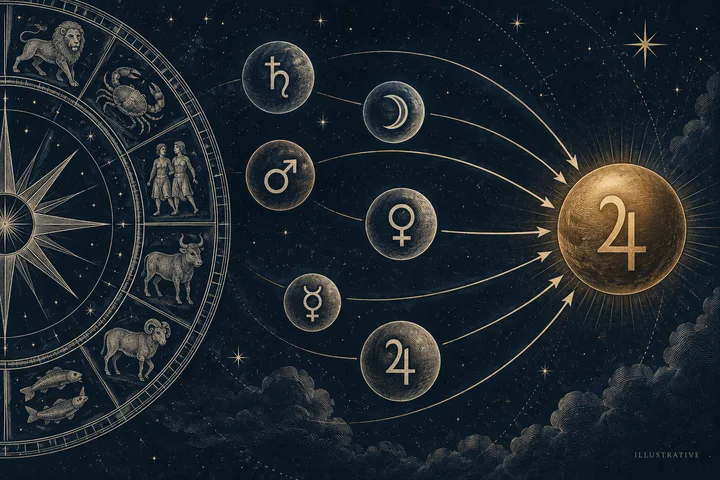
The strongest exception is also the most important correction. Not every chart has a final dispositor. Chains can end at several self-disposing planets, or they can circle through mutual reception. Zodisphere's glossary makes this explicit: multiple endpoints and closed loops rule out a single final dispositor for the whole chart. Kerykeion's traditional guide makes the same distinction and treats the no-endpoint chart as a different organizational pattern, not a failed chart.
This matters even more in synastry because you are working with two natal systems. Person A may have Venus as a final dispositor. Person B may have Saturn as a final dispositor. Their relationship may show a Venus-Mars contact, but the two people don't carry that contact through the same inner route. Person A may emphasize harmony, values, and connection. Person B may emphasize limits, time, responsibility, or endurance. Those are interpretive themes to test against the rest of each chart, not claims about what either person must feel.
A second exception is a final dispositor that lacks support from the actual synastry. Suppose every one of Person A's chains ends at Jupiter, but the cross-chart picture is a close Moon-Saturn square and a Venus-Pluto opposition, with no meaningful contact to Person A's Jupiter. Jupiter may still describe Person A's natal organizing principle, but it shouldn't become the headline of the relationship reading. The relationship is activated through the Moon, Saturn, Venus, and Pluto. Jupiter is background context unless the pattern returns to it through sign, aspect, or house information that you actually possess.
This is where a ranking sentence needs a visible reason. Say, The Saturn contact leads because it is exact and repeats the question of reliability across both charts. Say, Jupiter stays in the background because it is only an endpoint in one supplied natal branch and doesn't receive a close cross-chart contact. A reader can disagree with your emphasis, but they can follow it. That is what a reproducible method offers: not a mechanical answer, but a clear path from input to interpretation.
The path also protects the reader from romantic inflation. A final dispositor can make a relationship pattern feel coherent, and coherence can feel like confirmation. But a coherent symbol isn't the same as a promise. If the reading says the bond keeps returning to shared purpose, the next step is to ask whether the two people can name a shared purpose. If they can't, the chart has still helped locate the question. It hasn't supplied the answer for them.
A third exception concerns the rulership choice. Modern Western astrologers may use Uranus, Neptune, and Pluto as rulers of Aquarius, Pisces, and Scorpio. Traditional astrologers use Saturn, Jupiter, and Mars. A chain can end under one scheme and loop under another. Neither result should be smuggled in as universal. State the method, show the arrows, and let the reader see why the conclusion follows.
The same care applies to exaltation, triplicity, term, and face. Those are forms of essential dignity, but they don't all perform the same job as domicile rulership. A planet can be honored by several dignities without disposing the planet in the sign. If your question is specifically about a final dispositor, use domicile rulership for the endpoint test. You can discuss other dignities afterward as condition. This keeps the technical vocabulary from blurring together.
Don't confuse a chart ruler with a final dispositor, either. The chart ruler comes from the Ascendant and therefore needs a reliable birth time and house framework. The final dispositor comes from sign rulership chains and may be identified without houses, if the relevant planetary signs are known. They can be the same planet. They can also be different. A report that lacks birth times can still discuss supplied sign chains, but it should leave chart-ruler and house claims aside.
The final dispositor can also be strong without being comfortable. A planet in its own sign has authority in the chain, but its house placement, aspects, sect, and other condition still matter in a full natal reading. In a limited synastry comparison, don't invent those missing layers. Say that the endpoint organizes the supplied branch. Then return to the contacts you can actually compare.
The practical rule is blunt. If there is one endpoint, use it as a secondary ranking tool. If there are several endpoints, rank the branches. If there is a loop, interpret the exchange. If the supplied placements are incomplete, call the conclusion partial. These limits don't weaken the reading. They keep each sentence attached to an actual chart input.
And remember what the technique cannot do. It cannot tell you whether to date him. It cannot certify a soulmate. It cannot decide whether a relationship will last. It can help you name the route a theme takes through a chart. The decision still belongs to the people living the relationship.
Sources: The Final Dispositor: The Planet Where All Rulership Chains End; Final Dispositor, Astrology Definition
Turn the ranking into a useful conversation
A technical reading earns its place when it changes the next question. After you rank the contacts and check the dispositor structure, translate the pattern into something two people can observe. Don't ask, What does Saturn doom us to? Ask, Where do our plans need more time, clarity, or a boundary? Don't ask, Is Jupiter proof that we're meant to grow together? Ask, What future are we actually willing to build and revise together? Astrology gives the symbol. The couple gives it a life.
Imagine Maria sees that her Venus, Mars, and Moon all feed a final Saturn, while her partner's chart makes a close Venus-Mars contact to her Mars. She might watch for a repeating sequence: attraction opens the door, a practical limit appears, and the conversation turns toward reliability. That sequence is a useful observation to test. It is not a sentence handed down by the chart. If the couple can name the limit, negotiate it, and keep desire alive inside the agreement, the Saturn theme becomes structure rather than blockage.
If the final dispositor is Mercury, ask how the couple handles details. Do they say what they mean? Do they repair a misunderstanding before it grows? Does affection need a plan, a message, or a shared routine to remain present? If Venus is the endpoint, ask what the pair values and how they show it. If Mars is the endpoint, ask how desire, conflict, and initiative move through the bond. If the Moon is the endpoint, ask what creates emotional safety and what happens when one person needs care.
These questions work because they preserve agency. They also distinguish symbolism from evidence. A final dispositor may suggest the subject that deserves attention. The couple's repeated behavior tells you how that subject actually operates. That is a stronger reading than a planet label on its own.
Write the question so both people can answer it. A poor question asks, Which one of us is the Saturn problem? It assigns a planet to a person and closes the door. A better question asks, Where do we experience pressure around time, duty, or boundaries, and what agreement would make that pressure workable? The second question honors the symbol while leaving room for choice. It also produces something you can observe next week, not only something you can repeat in a reading.
When the pattern has a Mercury endpoint, try a repair experiment. Each person says what they heard, what they meant, and what they need next. When it has a Venus endpoint, name the value beneath the dispute. When it has a Mars endpoint, separate desire from coercion and initiative from pressure. When it has a Moon endpoint, ask what kind of reassurance actually lands. These are not prescriptions derived from a guaranteed outcome. They are grounded ways to test the theme the chart has brought forward.
A final dispositor is especially useful for choosing what not to discuss first. If the chart has many contacts but the endpoint points toward Saturn, you may not need another abstract argument about chemistry. Ask about time, responsibility, and the shape of the bond. If the endpoint points toward Mercury, don't leap to a conclusion about commitment before asking how clearly the two people can speak. Ranking is valuable because attention is limited.
For a supplied-placement report, record the data before you interpret it. Note each person's Moon, Venus, and Mars signs. Add degrees if you know them. Mark the major contacts and use a six-degree orb for the selected calculations. Then write the dispositor chain for each person using one declared rulership scheme. Mark a single endpoint, multiple endpoints, or a loop. Finally, rank the themes in plain language and tie each one to an observable question.
The Synastry Comparison Report can help you compare those supplied Moon, Venus, and Mars placements and optional degrees. It doesn't calculate a natal chart from birth details, houses, or missing positions. That boundary is useful because it tells you exactly what the comparison can answer. Start with the placements you know. Compare our placements when you want the contact map organized around the relationship question you actually have.
Sources: The Final Dispositor: The Planet Where All Rulership Chains End; Synastry and Relationship Astrology
A little more clarity
Is a final dispositor more important than a synastry aspect?
Usually no. Read the direct synastry aspect first, especially when it is a close contact between personal planets. Use the final dispositor afterward to explain how one person's natal pattern may organize or repeat the theme. It can raise the importance of a repeated pattern, but it cannot replace the aspect's planets, signs, degree distance, or direction.
What if our charts have different final dispositors?
Read both. One person's endpoint may describe how they process the contact, while the other person's endpoint describes a different route through the same interaction. Rank the strongest cross-chart contacts first, then compare the two natal organizing themes. Different endpoints don't cancel compatibility or prove conflict. They show that the same relationship theme may carry different meanings for each person.
Can I find a final dispositor from only Moon, Venus, and Mars signs?
You can trace those supplied planets, but you can't claim a complete chart-wide final dispositor unless you have traced every planet included in your chosen scope. You may find a partial endpoint or a loop among the personal placements. Label it honestly, state the rulership system, and leave houses and unprovided planets out of the conclusion.
Sources & further reading
- The Final Dispositor: The Planet Where All Rulership Chains End
Defines dispositor chains, single final endpoints, loops, and the interpretive role of the endpoint.
- Final Dispositor, Astrology Definition
Supports the distinction between one final dispositor, multiple endpoints, and mutual-reception loops.
- Synastry and Relationship Astrology
Supports reading personal planets, signs, and interchart aspects together in synastry.
- Synastry: Planet Overlays in Houses
Supports separating directional synastry roles and treating each person's chart overlay as distinct.
Synastry Comparison Report
Enter known placements for two people. Get an input-by-input comparison, selected aspect calculations and a clear record of what remains uncertain.
Compare our placements