
The fair way to disagree is to challenge the interpretation without dismissing your partner's experience. Start by asking which placements, degrees, aspects, and orb were used. Then separate three things: what the chart contact traditionally describes, what your partner feels, and what both of you observe in the relationship. A Venus-Saturn square, for example, can describe restraint, loyalty, criticism, or the work of making affection dependable. It does not choose one meaning by itself. Rank the tightest relevant contacts first, treat the Moon, Venus, and Mars as different layers, and let repeated behavior test the emphasis rather than forcing life to match a dramatic sentence. Say, I can see why that symbolism speaks to you, but I read the expression differently because this is what we keep experiencing. The goal is not to win the chart argument. It is to reach a reading you can both use.
Start with the interpretation, not the person
A synastry disagreement can become personal in one sentence. Your partner says, This Saturn contact proves you hold me back. You answer, That's ridiculous. Now the two of you are no longer discussing astrology. You are defending character, memory, and the meaning of the relationship all at once.
The fairer move is smaller. Ask what the reading actually says, what chart material it uses, and which part your partner believes. Then answer that part. You are not required to agree with a conclusion just because the conclusion came through a chart. Your partner is not required to abandon a feeling because you prefer a different interpretation. Both of you can take the symbolism seriously while refusing to treat one sentence as a final verdict.
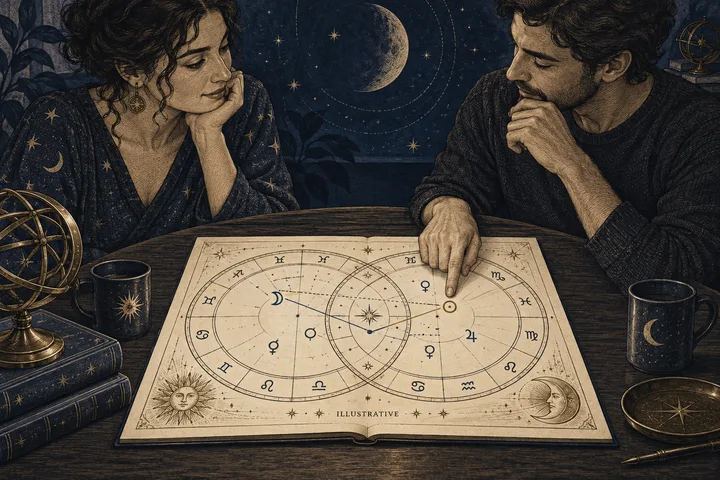
Synastry compares two horoscopes. It looks at contacts between planets, angles, and sometimes house overlays. In a bi-wheel, one person's planets are placed around the other person's chart so the astrologer can study the exchange. The method describes a field of interaction. It doesn't erase the two separate natal charts, and it doesn't turn the relationship into a single fixed object. Astro.com presents synastry as a comparison that can be used for romantic, family, friendship, and work relationships, not as a verdict reserved for couples.
That distinction gives you a useful opening. Instead of asking, Is this interpretation true about you?, ask, What interaction is this interpretation trying to name? A Saturn contact may raise questions about responsibility, timing, fear, commitment, or authority. A Venus-Mars contact may describe attraction, pursuit, irritation, or the way desire becomes action. A Moon-Mercury contact may speak to how feeling and language meet. The chart gives you symbols to investigate. The conversation decides which expression is alive.
Try this sentence: I don't want to argue with what you feel. I want to understand which part of the interpretation you think fits us. That sentence lowers the heat without surrendering your judgment. It also keeps the reading attached to a shared question rather than turning your partner into the problem.
The strongest disagreement usually has two plausible interpretations. Your partner reads a hard Venus-Saturn contact as coldness. You read it as caution that becomes loyalty once trust is earned. Neither reading should win by volume. Compare the chart contact, the exactness of the aspect, the planets' signs, the wider synastry pattern, and the repeated behavior that gives the symbolism a living form.
This is the article's central rule: disagree with the claim at the level where it was made. If the issue is an orb, discuss the orb. If it is the meaning of a square, discuss the meaning of a square. If it is a painful experience, discuss the experience before reaching for a planet. A fair reading does not use astrology to overrule a person's memory, and it does not use a person's memory to pretend the chart has no interpretive value.
Before you compare placements, agree on the question. Are you trying to understand why conflict repeats? Are you trying to name a difference in affection? Are you looking for language for a conversation that already feels difficult? A chart discussion becomes much more useful when both people know what decision or understanding they want from it. Otherwise, you may spend an hour proving that your preferred planet is more important than your partner's.
A good next question follows naturally: what counts as chart evidence, and what is only a strong sentence attached to it?
Sources: Synastry - Astrodienst Astrowiki; Synastry: Love and Relationship Astrology - Cafe Astrology
Separate chart facts from interpretive language
Astrology has facts within its own method. A planet occupies a sign at a degree. Two planets form an aspect at a measurable angular distance. An orb tells you how far the contact is from exact. A house overlay places one person's planet in a house of the other person's chart, but house work depends on accurate birth times. These are the inputs. The meaning drawn from them is the interpretation.
That separation matters because confident prose can hide a weak bridge. Venus square Saturn at a close degree is chart information. Saying, You will always feel rejected by me, is an interpretation with a very large conclusion. It may describe one possible expression of the contact, but it has moved beyond the data. Ask your partner to identify the step where the reading makes that jump.
Astrodienst shows synastry as a comparison chart with both partners and an aspect table. That gives you a practical fairness test. Before debating what an aspect means, check whether both of you are counting the same contact under the same orb rule and looking at the same chart display.
This doesn't mean a wider contact is worthless. It means it needs a lighter rank. A one-degree conjunction usually deserves more attention than an eight-degree trine when you are choosing what to discuss first, especially if the wider aspect competes with several tighter contacts. Different astrologers use different orbs and traditions, so name the rule you are using. Precision makes disagreement calmer because nobody has to pretend that an unstated rule is universal.
Ask five plain questions. Which planets are involved? Which person carries which planet? What are the exact degrees, if they are known? What is the aspect and its orb? Are signs, houses, or natal conditions being added to the interpretation? The answers won't produce one mandatory meaning. They will show you what the interpretation is built from.
The person-planet roles deserve care. If your Saturn contacts your partner's Sun, the Saturn person may be experienced as the one who sets limits, evaluates, times, or steadies. The Sun person may feel seen, shaped, restricted, or tested. Those roles can change by situation. Your partner may carry the Saturn role at work and the Sun role at home. A chart contact describes an exchange, not a permanent moral identity.
The sign changes the style. Saturn in Libra doesn't express restraint in exactly the same way as Saturn in Aries. Venus in Virgo doesn't ask for affection in exactly the same way as Venus in Leo. The aspect tells you how two functions meet. The signs tell you something about their style. The natal charts tell you how familiar and important those functions already are for each person. A reading that skips these layers may sound decisive because it has removed the details that would have made it fair.
Write the interpretation in two columns. In the first, record what is actually supplied: Moon in a sign, Venus in a sign, Mars in a sign, optional degrees, and selected major aspects calculated with the stated six-degree orb. In the second, write possible expressions and the question each expression raises. Restraint becomes, Where does affection slow down? Criticism becomes, How is feedback delivered? Loyalty becomes, What do we keep showing up for? This turns a loaded adjective into something the couple can examine.
Use a confidence ladder as you work. Put exact chart data on the bottom rung, traditional symbolism above it, and the couple's repeated observations at the top. A contact can be certain as a chart fact while its expression remains open. A vivid story from one argument can be emotionally important while still being too small to carry the whole aspect. The strongest reading keeps all three rungs visible.
Once the chart facts are visible, your disagreement can become specific. You might say, We have a close Venus-Saturn opposition, but the reading treats it as rejection. I see restraint and responsibility more than rejection. Can we compare that with how we handle affection when one of us is tired? That is a real question. It can be answered by the chart language and by life.
The next problem is rank. A synastry chart can contain many contacts, and a partner may have selected the one sentence that hurt most.
Sources: Synastry - Astrodienst Astrowiki; Partner horoscopes - Astro.com FAQ; Synastry: The Astrology of Relationships - The Astrology Podcast transcript
Rank the layers before you choose a meaning
A fair disagreement needs an order of operations. Without one, the most dramatic placement takes over. Neptune becomes the whole relationship. Pluto becomes proof of obsession. Saturn becomes proof of distance. One soft aspect gets used as a guarantee. The chart turns into a collection of slogans, and both partners can find a sentence that supports whatever they already fear.
Start with the relationship question. If the issue is emotional safety, begin with Moon contacts and the ways the Moon is met by Venus, Mars, Saturn, or Mercury. If the issue is desire and pursuit, begin with Venus and Mars. If the issue is communication, bring Mercury forward. If the issue is endurance, responsibility, or fear of commitment, study Saturn, but don't let Saturn replace the personal planets or the lived pattern.
This is not a universal scoring system. It is a reading sequence. Cafe Astrology's synastry material recommends paying close attention to inner-planet interaspects and the relationship significators in each chart, while also considering the signs and houses involved. The point is not to create a compatibility percentage. The point is to put the most relevant material near the top of the conversation.
The first layer is the natal chart context. What does each person's Moon need before it can relax? How does each Venus show appreciation and receive pleasure? How does each Mars begin, pursue, defend, and desire? A synastry contact doesn't create a planet's entire meaning. It activates a planet that already has a way of operating. If your partner says your Mars square their Moon means you make them feel unsafe, ask what else their Moon is doing and how your Mars actually enters shared life. If you regularly push during their quiet moments, the symbolism has a clear doorway. If you don't, the square may need another expression.
The second layer is the contact itself. A conjunction joins functions. An opposition creates polarity and a pull across two ends. A square creates friction that asks for work, though it can also create heat and movement. A trine often allows an easy flow, while a sextile can offer cooperation that becomes stronger when used. These are tendencies in astrological interpretation, not fixed moral labels. A hard aspect is not a bad aspect. A soft aspect is not a promise that nothing will need attention.
The third layer is the direction of experience. In a cross-aspect, the planet person and the receiving person may not describe the contact in the same language. Your Saturn may feel like care to you and judgment to your partner. Their Venus may feel like warmth to them and appeasement to you. Neither report automatically cancels the other. Ask when each expression appears, what precedes it, and what follows it.
The fourth layer is repetition. One awkward evening is not the same as a pattern that appears across months. A reading becomes stronger when a symbol has more than one observable expression and when both people can recognize it without being coached into it. Repetition doesn't mean inevitability. It means the theme is worth discussing.
The fifth layer is choice. What can the two of you do with the contact? A Venus-Mars square might need a better way to separate desire from pressure. A Mercury-Moon tension might need a pause before problem-solving. Saturn may need explicit agreements about time, money, and responsibility. If the interpretation gives you no useful question or action, it may be too abstract, too broad, or too invested in drama.
The Astrology Podcast discussion on synastry makes a similar distinction between aspects, house overlays, and later timing techniques. It recommends beginning simply with the chart-to-chart aspects, then adding houses and other techniques as detail rather than allowing the method to become endless. That is a sound rule for disagreement, too. Add one layer when it answers a real question. Stop when it only creates more material to argue over.
A useful ranking worksheet has three rows. Put the strongest close contact at the top. Put the most relevant Moon, Venus, or Mars connection next. Put the contact that best matches a repeated relationship moment third. Then ask what each row adds and what it cannot explain. Your partner may be right that the Saturn contact matters. You may be right that the Moon-Venus contact better explains how repair happens. A mature reading can hold both, with a rank.
Now you can move to the example that causes the most arguments: one person sees a difficult contact, while the other sees the same contact as a source of loyalty or growth.
Sources: Synastry: Love and Relationship Astrology - Cafe Astrology; Synastry: The Astrology of Relationships - The Astrology Podcast transcript
Work one disagreement all the way through
Imagine Maria and Daniel comparing supplied Moon, Venus, and Mars placements with optional degrees. Their reading highlights a close Venus-Saturn square. Maria believes it explains why Daniel seems to criticize her affection. Daniel believes it explains why he takes the relationship seriously and wants to build something lasting. They are tempted to decide that one of them is misreading the chart.
They begin with the contact. Venus describes attraction, taste, affection, and the way a person gives and receives pleasure. Saturn describes structure, restraint, responsibility, time, and the weight of commitment. A square asks the functions to work together without effortless agreement. That is already more precise than either coldness or forever. The contact can describe a blockage. It can also describe the work required to make affection reliable.
Next they check the orb and signs. The aspect is within their stated six-degree working orb, so it belongs in the selected report. The signs suggest that Maria reaches for warmth through frequent reassurance, while Daniel shows care through practical follow-through. Those sign meanings are illustrative within the scenario, not calculated facts about a real couple. The question is whether their actual styles fit the symbolism, not whether the symbols are allowed to sound poetic.
Then they assign roles without turning them into identities. Maria may experience Daniel's Saturn as evaluation when she offers a tender gesture and receives a correction. Daniel may experience his own Saturn as a wish to protect the relationship from careless choices. His intention doesn't erase her experience. Her experience doesn't prove that he intends control. The same contact can carry both stories, and the relationship has to decide which behavior becomes normal.
They look for repetition. Maria gives an example: when she says she misses him, Daniel often answers with a plan to solve the schedule instead of first acknowledging the feeling. Daniel gives a different example: when he asks to plan a shared expense, Maria hears a judgment about her spending and withdraws. Now the Venus-Saturn theme has become useful. It points to a sequence. Her bid for affection meets his structure. His bid for structure meets her fear of criticism. Each person's planet is entering the other's sensitive place.
They also look for the exception. Daniel doesn't dismiss every affectionate gesture. Maria doesn't reject every practical plan. When they slow down, he can offer warmth before logistics, and she can discuss responsibility without treating the question as a verdict. That exception is not a minor detail. It shows the contact has more than one possible expression and that choice changes which expression becomes familiar.
Their new interpretation might read like this: This Venus-Saturn square creates a real difference between affection and responsibility. Maria can feel judged when Daniel moves too quickly toward correction or planning. Daniel can feel that care requires structure and may feel unappreciated when structure is heard as criticism. The contact is challenging, but it also gives them a clear practice: acknowledge the feeling first, then discuss the plan. This is an interpretation they can test.
Notice what they did not say. They did not call Maria needy. They did not call Daniel controlling. They did not treat the square as proof that they are doomed, destined, or secretly incompatible. They did not use a single aspect to erase the rest of the chart. They translated a symbolic tension into a repeated interaction and a better response.
Consider a different version. One partner believes a Mars-Moon opposition means the other person is angry underneath everything. The fair response is not, You are wrong because we rarely fight. It is, Let's identify when your Moon needs quiet and when my Mars gets urgent. If the opposition shows up as different speeds, the remedy may be timing. If it shows up as sharp words, the remedy may be a pause and a boundary. The aspect does not pick the behavior for you.
Or consider a Neptune-Venus interpretation that one partner calls a soul connection and the other calls projection. Both are naming a real Neptunian question: what is felt, imagined, idealized, or not yet tested? The fair reading keeps the beauty and adds a check. What has the relationship shown over time? What is known? What is hoped for? A spiritual meaning can be honored without making it a substitute for seeing the person clearly.
The worked example gives you a repeatable path: identify the contact, verify the inputs, name at least two expressions, locate the repeated behavior, find the strongest exception, and turn the result into a practice. The next question is what to do when the interpretation still feels painful or when one partner uses the chart as evidence against the other.
Know when the reading has crossed a line
Not every disagreement is a difference between two equally useful interpretations. Some readings cross a line by claiming more than the chart or the conversation can support. A partner may say, Your Pluto proves you'll betray me. A reader may say, This aspect means you cannot be trusted. Someone may use a house overlay to declare what you secretly want. These claims ask astrology to replace consent, observation, and accountability.
You can answer clearly: I respect that this contact feels intense to you. I don't accept it as proof of an intention or an outcome. That is not an attack on astrology. It is a limit on what one symbol is being asked to carry. A chart can describe a pattern you want to explore. It cannot grant permission to accuse, monitor, punish, or pressure your partner.
The same rule applies to positive overreach. A Sun-Moon conjunction may feel familiar and nourishing. Venus-Jupiter can support generosity and goodwill. Saturn contacts can bind people through responsibility and time. None of these contacts removes the need to choose, listen, repair, or respect a no. A beautiful aspect still needs a healthy expression. A difficult aspect still deserves a fair chance to become conscious and constructive.
Astrological tradition itself gives you reasons to resist simple verdicts. Cafe Astrology's material describes squares as sources of frustration and work, but also as tension that can create excitement and growth. It describes flowing aspects as supportive without treating ease as a complete relationship. The Astrology Podcast discussion likewise emphasizes that hard aspects aren't automatically bad and that close contacts may be experienced differently by the two people. A fair disagreement belongs inside that complexity, but it still has to choose a useful conclusion.
Watch for four warning signs. First, the interpretation refuses every counterexample. If your partner says the chart proves you are cold, and every warm act is dismissed as manipulation, the reading has stopped being open to experience. Second, the interpretation turns a planet into a character judgment. Saturn may describe restraint; it does not make someone cruel. Pluto may intensify a bond; it does not make someone dangerous. Third, the interpretation predicts an inevitable outcome. No contact can make a decision for two people. Fourth, the chart is brought into an argument after the fact as a weapon rather than discussed as a shared symbol.
You can set a chart boundary without mocking the belief. Say, We can use this as a question, but not as evidence against my intentions. Or, I will discuss how this contact feels, but I won't agree that it proves what I will do. Or, Let's pause the reading and talk about the behavior that is hurting us. These sentences keep astrology in its proper place within the relationship: meaningful, but not sovereign.
Missing data changes the weight of a reading. If degrees are unknown, keep the aspect unranked until the contact can be checked. If birth times are missing or approximate, leave house overlays out of the decision. If you only have sign placements, discuss style and preference rather than presenting a precise aspect story. The publication's Synastry Comparison Report works from supplied Moon, Venus, and Mars signs, optional degrees, and selected major aspects with a stated six-degree orb. It is useful for organizing known material, not for filling gaps with guessed positions.
A partner may still feel hurt when you challenge a reading because the reading gave shape to a private fear. Respond to the fear first, but don't agree to a false conclusion just to soothe the moment. You might say, I hear that the Saturn interpretation made you worry that I don't value you. I do want to talk about the times I correct you too quickly. I don't agree that the chart proves I don't love you. That is both tender and firm.
The strongest exception is worth naming. Sometimes your partner's interpretation feels unfair because it touches a behavior you would rather not face. If several examples line up, if you become defensive each time, and if your alternative reading exists mainly to protect your self-image, the chart disagreement may be a doorway into accountability. Fairness doesn't mean splitting the difference. It means allowing the evidence of lived behavior to change your mind.
When the reading has crossed a line, use a three-part reply. Name the symbol you are willing to discuss. Name the claim you reject. Name the behavior you are willing to examine. For example: I can talk about the Pluto contact and why it feels intense. I won't accept it as proof that I mean to control you. I will talk about the messages that made you feel watched. That reply keeps the spiritual language intact while putting responsibility where it belongs.
Sources: Partner horoscopes - Astro.com FAQ; Synastry: Love and Relationship Astrology - Cafe Astrology; Synastry: The Astrology of Relationships - The Astrology Podcast transcript
Turn the disagreement into one honest conversation
A fair synastry discussion should end somewhere. Not with a score. Not with a winner. With one conversation that could improve the way you meet each other. Choose the smallest useful question raised by the reading and bring it into ordinary language.
If the interpretation centers on Saturn, ask, When does care start to feel like correction between us? If it centers on Venus and Mars, ask, How do we know when pursuit feels welcome and when it feels like pressure? If it centers on the Moon, ask, What helps each of us feel received before we try to solve the problem? If it centers on Mercury, ask, Which words make you feel understood rather than managed? The planet gives you a doorway. The question makes it livable.
Before the conversation, write down the exact chart material and the sentence you disagree with. Then write one example that supports the sentence and one example that complicates it. This keeps you from selecting only the evidence that flatters your position. It also gives your partner something concrete to answer. Say, The reading says our Mars-Mercury square makes discussion combative. I recognize that when we are rushed. I don't recognize it when we talk after dinner. What do you notice?
Use first-person language, but don't make every sentence soft. I feel judged is different from You are judgmental. I experience this as pressure is different from You always pressure me. You can be direct without handing down an identity. And if the behavior is serious, be direct about that too. Astrology should never make you speak in fog when a clear boundary is needed.
Let your partner explain what the interpretation gave them. Maybe it offered relief because a pattern finally had a name. Maybe it made them feel seen. Maybe it confirmed a worry they have carried for months. You don't have to accept the astrologer's full conclusion to understand why the sentence landed. Ask, Which part felt most true? Which part felt most frightening? What would you want me to understand about your experience even if we read the chart differently?
Then state your own reading in a way that preserves the contact. Don't replace a difficult aspect with a flattering one just to make the conversation pleasant. Say, I agree that this square creates friction. I disagree that friction means rejection. I see it as a difference in timing, and I think we can test that by slowing down before we respond. Your partner deserves an interpretation strong enough to respect the difficulty and precise enough to leave room for choice.
Choose one experiment for the next two weeks. If the issue is Moon-Mars urgency, agree to a twenty-minute pause before continuing a heated conversation. If it is Venus-Saturn affection and criticism, offer appreciation before feedback. If it is Mercury-Neptune confusion, repeat the agreement in plain words before assuming you both understood it. If it is a house overlay question, ask what the activated life area actually feels like rather than declaring what the other person wants. A small practice gives the symbolism a chance to prove its usefulness.
Return to the chart after the experiment, but don't grade your love by whether every line came true. Ask what became clearer. Did the conflict arrive less often? Did the same theme appear in a different form? Did the exception become easier to reach? Did one of you learn that the other's planet has a different need than you assumed? These are better outcomes than a dramatic confirmation because they increase understanding.
If the disagreement remains, rank the differences. You may agree on the chart fact and disagree on the meaning. You may agree on the meaning and disagree on how often it appears. You may agree that a pattern exists and disagree on what to do about it. Name the level. Many chart arguments feel endless because the couple keeps answering a different question from the one that was asked.
The conclusion can be simple. I believe this contact names a real tension. I don't believe it decides our character or our future. I want to watch how it appears, listen when you tell me how it feels, and choose a response that helps us both. That is a complete astrological position. It takes the chart seriously. It takes the relationship more seriously.
There is one more distinction worth keeping. A chart may show a theme that both people share, but it may not show the same event in the same way. A close Moon-Saturn contact can make one person seek reassurance and the other seek composure. A Venus-Mars contact can make one person feel pursued and the other feel invited. If you demand identical testimony, you will mistake difference for contradiction. Ask instead whether the two accounts describe opposite sides of the same exchange. The answer may be yes.
This is especially important when one partner knows more astrology. Expertise can make a conversation uneven. The person who knows the names of aspects may sound more certain, while the person who only knows what they felt may sound less informed. But lived experience is not a lesser source of meaning. Let the chart-literate partner explain the method briefly, then let both people describe the interaction in ordinary words. Technical fluency should clarify the conversation, not control it.
When you are ready for a structured comparison, bring the placements you actually know and mark the missing pieces. The Synastry Comparison Report can arrange Moon, Venus, and Mars layers, optional degrees, and selected major aspects into one shared reference. Use it to choose the first conversation. Don't hand it the conversation itself.
Start tonight with one question: Which part of this interpretation describes a pattern we can both observe, and what would a kinder expression of that pattern look like this week? Then listen to the answer. Let the response be specific. Let it surprise you if it needs to. A fair reading leaves both people with more room to choose.
Sources: Synastry - Astrodienst Astrowiki; Synastry: Love and Relationship Astrology - Cafe Astrology; Synastry: The Astrology of Relationships - The Astrology Podcast transcript
A little more clarity
What if my partner treats a synastry interpretation as proof?
Acknowledge the feeling behind the interpretation, then separate symbolism from certainty. Ask which placements and aspects support the claim, what orb or chart scope was used, and which repeated behavior the two of you can actually observe. You can respect the chart and still say that it doesn't prove an intention, character judgment, or inevitable outcome. Bring the discussion back to a clear behavior and a boundary if the reading is being used against you.
Can a difficult synastry aspect have a good expression?
Yes. A square or opposition can create friction, but friction can also bring energy, attraction, growth, and a reason to learn one another's style. The expression depends on the planets, signs, natal context, orb, other contacts, and the choices made in daily life. Read the difficult contact as a task or tension to understand, not as a verdict that the relationship is bad.
What should we do when our birth information is incomplete?
Stay with the placements and degrees you actually know. If degrees are missing, don't claim an exact orb. If birth times are uncertain, don't build a confident house-overlay interpretation. A comparison based on supplied Moon, Venus, and Mars signs can still organize useful questions, but it won't calculate natal positions from birth details or calculate houses. State the missing piece, then keep the reading at the level the data supports.
Sources & further reading
- Synastry - Astrodienst Astrowiki
Supports the definition of synastry as comparing horoscopes, its use across relationships, and the need to read individual charts before the comparison.
- Partner horoscopes - Astro.com FAQ
Supports the distinction between synastry charts, aspect grids, and narrower orbs used to keep partner-chart comparisons readable.
- Synastry: Love and Relationship Astrology - Cafe Astrology
Supports the layered reading of inner planets, signs, houses, flowing aspects, hard aspects, and the varied expressions of relationship contacts.
- Synastry: The Astrology of Relationships - The Astrology Podcast transcript
Supports starting with cross-aspects, ranking close contacts, separating house overlays from aspects, and treating difficult aspects as potentially constructive rather than automatically negative.
Synastry Comparison Report
Enter known placements for two people. Get an input-by-input comparison, selected aspect calculations and a clear record of what remains uncertain.
Compare our placements