The crowded report is not the whole relationship
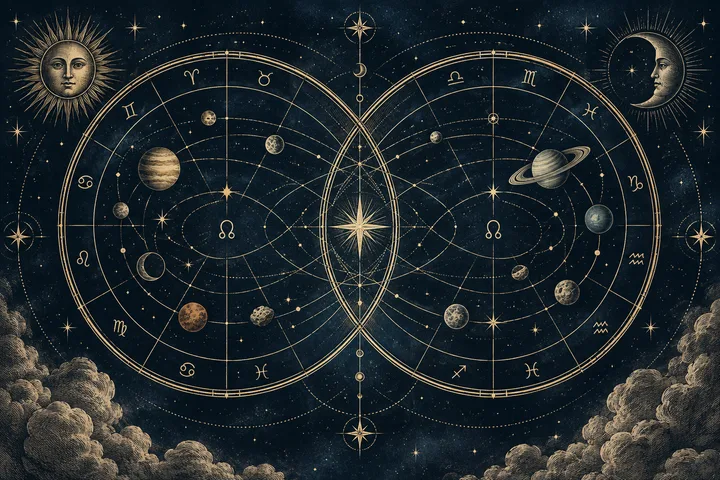
A synastry report can look like a night sky after someone has turned on every light. Planets sit beside angles. Nodes point to other points. Asteroids arrive with dramatic names. The eye jumps to the loudest word, usually fate, soulmate, or obsession, and the reading loses its order.
Here is the better question: which contacts describe the relationship's working pattern, and which ones add a finer shade to that pattern? A mixed report needs a hierarchy. Without one, ten loose contacts can drown out one exact Moon-Saturn conjunction, and a named asteroid can steal attention from the Venus-Mars exchange that you actually feel every week.
My position is firm. Read a synastry report from personal planets to structural points, then to symbolic points. Start with what two people can notice in ordinary life. Move next to the forces that shape timing, pressure, belonging, and public direction. Only then use asteroids and less familiar points as close-up lenses. This order keeps the reading human-sized. It gives the report a clear center, so a rare point can add meaning without taking over the interpretation.
Astrodienst defines synastry as a comparison of two horoscopes, including interaspects and the places where one person's planets fall in the other person's chart. Its guidance also asks the astrologer to understand each individual chart before interpreting the exchange. That principle matters even when you have only a placement list. A contact doesn't float free. The same Venus contact means something different in a chart with a strong Saturn pattern than it does in a chart led by Uranus.
Cafe Astrology makes a similar practical move. It treats Venus, Mars, the Ascendant, and the major aspects as parts of a relationship picture, not as isolated verdicts. Conjunctions can feel immediate. Oppositions can create attraction and pushback. Squares can keep a relationship alive through friction, but they still require work. A trine can soothe the exchange without supplying all the heat.
The report becomes useful when every item earns its place. A contact should tell you something about a person, an exchange, or a choice. If it can't, set it aside. More symbols don't always give you more meaning. Sometimes they only give you more noise.
This is also why a report should separate contact from interpretation. ‘Venus square Mars, 2 degrees’ is the chart statement. ‘Affection and desire may arrive with heat and disagreement about pace’ is the interpretation. ‘They are meant to be together’ is a verdict the contact cannot carry. Keeping those sentences separate lets the reader see what comes from the chart and what belongs to the astrologer's judgment.
Read a mixed synastry report from the most personal and exact contacts outward. Start with the Moon, Venus, Mars, Sun, and Mercury, then examine Saturn and the outer planets, then study angles, the lunar nodes, and asteroids as separate layers. Read the lunar nodes as an axis, not as a promise. Add asteroids only when the object is clearly named, the degree is close, and the contact repeats a theme already visible elsewhere. The report should tell you who feels which contact, what kind of exchange it describes, and what real conversation or habit it brings to the relationship. If the report gives signs without degrees, you can compare style, but you cannot responsibly rank exact aspects. This site's Synastry Comparison Report compares supplied Moon, Venus, and Mars placements, with optional degrees and selected major aspects checked against a stated six-degree orb. It does not calculate a natal chart, houses, angles, or a relationship outcome from birth details.
Sources: Synastry - Astrodienst Astrowiki; Synastry - Cafe Astrology
Begin with the planets that make the relationship tangible
The first pass should feel almost ordinary. What happens when you are together? Who feels seen? Who feels wanted? Who gets irritated? Who reaches for reassurance, and who reaches for space? The personal planets give you the clearest bridge from chart language to lived experience.
The Moon describes feeling, habit, comfort, and the need for a place to soften. Moon contacts often show how quickly two people fall into a rhythm. A Moon-Venus contact may bring tenderness and a wish to care for each other. A Moon-Mars contact can stir protection, desire, and irritation in the same room. A Moon-Saturn contact may feel steady, serious, or heavy, depending on the rest of the charts and how each person handles responsibility.
Venus describes attraction, pleasure, taste, affection, and the way a person gives value. Mars describes desire, pursuit, heat, assertion, and the urge to act. Together they make a strong first check for romantic chemistry, but they don't answer every relationship question. Cafe Astrology's synastry guide treats Venus-Mars contacts as attractive and often sexual, while also pointing out that difficult aspects can bring friction. That is the right level of confidence. Attraction is real. It isn't the same as ease.
Mercury deserves a place beside them. A couple can share intense Venus-Mars chemistry and still fail to translate a need into a sentence. Mercury contacts show how one person's mind and speech meet the other's thought process. Add the sign and the aspect. A Mercury trine may make conversation flow. A Mercury square can produce sharpness, interruption, or a productive difference in how each person names the problem.
The Sun shows identity, vitality, and the direction a person naturally takes. Sun-Moon contacts can make the connection feel personal very quickly because one person's way of being meets the other's emotional life. Sun-Saturn can add gravity and commitment, but it can also make one person feel judged. Sun-Uranus may wake up a new version of the self, while Sun-Neptune can inspire idealization. Name both the gift and the pressure.
Now add a simple rule for reading the pair. The first planet belongs to the planet person, and the second belongs to the contacted person, but the exchange runs both ways. If her Venus conjuncts his Mars, she may express affection in a way that activates his desire, while he may make her feel more attractive and alive. If the same contact is a square, the attraction may arrive with a timing problem or a difference in pace. Don't flatten that into good or bad.
Imagine Maria has Moon in Taurus, Venus in Gemini, and Mars in Leo, while Daniel has Moon in Scorpio, Venus in Cancer, and Mars in Aquarius. Without degrees, you can discuss style, not exact aspects. Maria may seek steadiness but express love through words and play. Daniel may protect his feelings and need emotional proof, while his Mars wants freedom. That is already a useful comparison. It becomes a synastry aspect only when the supplied degrees show a recognized relationship between the positions.
Your first written summary should fit in three lines: emotional tone, attraction style, and conflict or communication pattern. If you cannot write those lines, don't move to asteroids yet. The foundation isn't ready.
Notice the difference between a planet's role and a planet's sign. Venus in Gemini and Venus in Cancer describe different ways of showing affection. A Venus-Mars aspect describes what happens when affection meets desire between two charts. One is a style comparison. The other is an exchange. A strong report uses both, but it never lets a sign stereotype replace the contact itself.
You can also look for a double emphasis. If her Moon contacts his Venus and his Moon contacts her Venus, the relationship may contain a mutual language of comfort and affection. If only one person's planet makes the close contact, describe the asymmetry. The Venus person and Moon person may not experience the same exchange in the same way. That difference often explains why two people tell different stories about the same moment.
Finally, keep Mars in its proper place. Mars can show heat, initiative, irritation, and sexual energy. It can enliven a bond, but it doesn't promise tenderness, reliability, or a shared future. Pair Mars with the Moon, Venus, Mercury, and Saturn contacts around it. Then you can say whether the heat has a language, a container, and a way to repair after conflict.
Sources: Synastry - Astrodienst Astrowiki; Synastry - Cafe Astrology; Interaspect - Astrodienst Astrowiki
Use aspects and orbs to separate signal from decoration
A sign pairing tells you the language two placements speak. An aspect tells you whether they are speaking directly. That distinction keeps a report honest and readable. Two Venus placements in compatible signs may share taste, but a close Venus-Saturn conjunction has a different weight from a wide Venus-Saturn connection that appears only because the software listed it.
Astrodienst describes an aspect as an angular relationship between chart factors. The distance from exactness is the orb. Conjunction, sextile, square, trine, and opposition are the major aspects most readers need first. The closer the contact, the more insistently the two symbols meet. Yet closeness isn't the only question. The planets, point types, and wider chart pattern still matter.
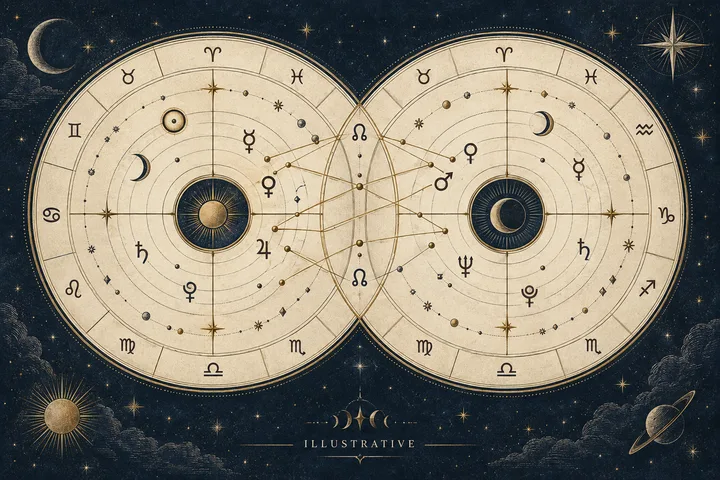
For a clean report, write every candidate contact in one line: object A, aspect, object B, exact degree difference, and whose chart holds each object. Then rank the lines. A six-degree orb can work as a stated editorial rule for selected major contacts, but you should not use it as permission to give every minor point the same volume. Angles and asteroids usually deserve tighter attention because their meaning becomes vague quickly when the contact is loose.
The report should also say what it calculated. Did it compare sign placements only? Did it use supplied degrees? Did it include the major aspects at a six-degree orb? Did it use a named nodal method? Did it include house overlays? Those are different scopes. A reader cannot interpret a missing aspect if the report never had the degrees needed to test it.
Read aspect type after you read the objects. A conjunction fuses the symbols and can be warm, intense, or difficult. An opposition creates a line of attraction and counterpressure. A square demands adjustment and may become a repeating irritation or a source of growth. A trine makes exchange easier, while a sextile offers an opening that people still have to use. These meanings are starting points, not scripts.
Consider this example. Suppose her Venus is 12 degrees of Libra and his Saturn is 14 degrees of Cancer. The square is close, so it belongs near the front of the report. It may describe a bond where affection meets caution, timing, duty, or fear of disappointment. If his Saturn were 26 degrees of Cancer, the sign relationship would still be worth mentioning as a broad style difference, but it would not deserve the same claim about a close synastry square.
Astrodienst also notes that synastry benefits from a smaller orb than a single natal chart because comparing two charts creates many possible contacts. That is a useful guardrail against a crowded report. More listed aspects do not equal more truth. A short list of close contacts often explains a relationship better than a long list of decorative ones.
Keep the uncertainty in the input, not in the prose. Say, ‘With signs only, this suggests a difference in style.’ Say, ‘With the supplied degrees, this contact falls within the report's six-degree major-aspect scope.’ Then interpret. Precision should make the reading more direct, not more timid.
A useful ranking table has four columns: contact, orb, layer, and practical question. The orb tells you how close the contact is. The layer tells you whether it belongs to personal planets, structure, or refinement. The practical question stops the list from becoming a catalogue. For Venus-Saturn, ask how affection meets responsibility. For Mercury-Mars, ask how direct speech becomes useful rather than cutting. For Moon-Uranus, ask how closeness and freedom can share a rhythm.
Don't use the orb as a mechanical score. A two-degree conjunction between a personal planet and an asteroid isn't automatically more important than a four-degree Moon-Saturn contact. The objects carry different interpretive weight. Exactness helps you rank contacts within a layer. It doesn't erase the hierarchy between layers.
The same rule protects you from a report that lists every possible aspect. If twenty contacts fall within the software's default range, select the few that organize the story. Mention the rest only when they confirm or complicate a theme. A reader should finish knowing what to watch, not feeling obliged to memorize a database.
Sources: Interaspect - Astrodienst Astrowiki; Aspect - Astrodienst Astrowiki; Synastry - Astrodienst Astrowiki
Read angles as points of impact, not extra planets
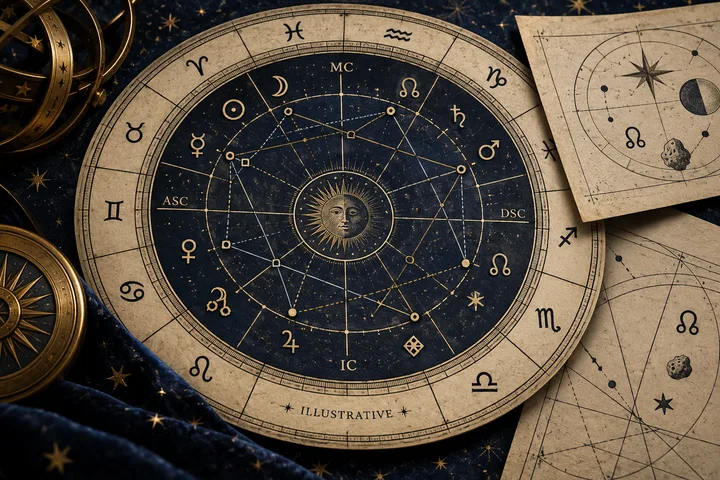
Angles change the scene. The Ascendant, Descendant, Midheaven, and IC are not planets with their own drive. They are chart axes that describe how a person meets the world, enters relationship, builds public direction, and roots into private life. When a partner's planet contacts an angle, the planet can land in a visible place in the angle person's experience.
The Ascendant speaks to presence, body language, first response, and the way a person begins. The Descendant describes the relational field and the qualities one meets through partnership. The Midheaven connects with vocation, visibility, reputation, and the direction a person takes in the wider world. The IC points toward home, ancestry, privacy, and the inner base from which a person lives.
Cafe Astrology describes the Ascendant in synastry as an immediate point of reaction. That can feel like physical recognition, but the contact reaches beyond appearance. It can touch manner, pace, and the way someone occupies space. A partner's Sun on the Ascendant may make the Ascendant person feel noticed and energized. A partner's Saturn there may feel stabilizing or restrictive. A partner's Venus may soften the meeting and make it easier to enjoy being seen.
Read the angle contact in two sentences. First, name the impact: ‘His Mars on her Ascendant can make his approach feel immediate and activating to her.’ Second, name the choice: ‘They need a clear way to distinguish playful pursuit from pressure.’ That second sentence matters. Astrology describes the exchange. It doesn't excuse behavior or decide what either person must accept.
Angles require accurate birth information in a calculated chart. This article's comparison tool does not calculate angles or houses from birth details. If you're studying an existing chart, you can discuss a stated angle contact within that chart's scope. If you have only birth dates or sign placements, the responsible move is to leave angle interpretation out rather than fill the gap with a guess.
Imagine Maria's Venus sits close to Daniel's Descendant in the chart data they already have. That may describe the way Maria's affection, taste, or social warmth fits Daniel's partnership image. It can feel pleasing. It may also invite Daniel to place an ideal role onto Maria. The contact says something about the doorway of partnership. It does not prove that Maria will perform every role Daniel wants.
The Midheaven and IC deserve the same care. A partner's planet on the Midheaven can bring support, challenge, or visibility around work and public direction. A contact to the IC may stir belonging, family memory, or the need for a private sanctuary. Don't turn every IC contact into a childhood story. Ask what the relationship makes easier or harder at home.
There is another reason to resist angle drama. The angle person may feel the contact as an immediate change in the room, while the planet person may simply feel that they are being themselves. That doesn't make one account true and the other false. It gives the report two viewpoints. Ask the angle person where the contact appears in daily life. Ask the planet person what they intend to bring. The gap between impact and intention can become one of the relationship's most useful conversations.
If the angles came from charts built under different time zones, house systems, or birth-time assumptions, record that before you interpret them. The Ascendant and Midheaven are sensitive to time and place. A report that hides those inputs asks the reader to trust a precision it has not shown. Clear scope makes the interpretation stronger. This site's Synastry Comparison Report doesn't calculate angle positions. Use this method when you're studying an existing chart, and keep the report itself to the supplied Moon, Venus, and Mars placements.
Sources: Synastry - Cafe Astrology; Synastry - Astrodienst Astrowiki; Aspect - Astrodienst Astrowiki
Treat the lunar nodes as an axis with a declared method
The nodes attract strong language because they speak to memory, direction, and the feeling that a meeting carries meaning. That symbolism belongs in a synastry reading. The mistake is turning it into a guarantee. A nodal contact can describe a powerful developmental pull. It cannot certify a soulmate, a permanent bond, or a future outcome.
This distinction protects the spiritual heart of the reading. Meaning does not become smaller because it needs a method. A connection can feel familiar, instructive, or awakening, and the couple can still ask whether their choices honor that feeling. The node gives a direction of inquiry. It does not remove the need for consent, honesty, or mutual effort.
The lunar nodes are points where the Moon's path crosses the ecliptic. The North Node and South Node always form an axis. Astrodienst's Moon's Nodes reference describes the South Node as familiar territory, inherited pattern, or a past emphasis, and the North Node as a direction of development. Read them together. A South Node contact may feel easy because it is known. A North Node contact may feel compelling and uncomfortable because it asks for movement.
A mixed report should name whether it used the mean or true node. Swiss Ephemeris documents both calculations: the mean node follows an averaged motion, while the true node describes the momentary lunar orbit and varies more visibly. The two positions can differ enough to move a close synastry contact in or out of an orb. The method is part of the interpretation.
Use the node as a modifier of a stronger contact. Venus to the North Node may intensify the feeling that affection opens a new path. Mars to the South Node may make desire feel familiar and automatic. Saturn to the nodes can bind people through responsibility, but it can also expose a pattern that needs to change. The planet tells you what is carrying the nodal lesson. The node alone doesn't tell the story.
The Swiss Ephemeris documentation gives the technical reason to name the nodal method: mean and true nodes are different calculations, and the displayed position can shift enough to change a close contact's orb. That gives you a useful interpretive contrast. A person can feel drawn in and still need to ask whether the relationship expands both lives. Magnetism is information. It is not a command.
Consider an example. Her Moon is close to his North Node, and his Saturn is close to her South Node. The first contact may make his emotional world feel significant to her direction of growth. The second may make his responsibility feel familiar, binding, or difficult to outgrow. A rushed reading might call this destined. A stronger reading asks two questions: what emotional habit is being invited forward, and what old obligation needs a new boundary?
Do not mix nodal systems silently. Write ‘Mean North Node’ or ‘True North Node’ in the report. If the source chart doesn't identify the method, say that the nodal interpretation is conditional on the displayed position. If you have signs but no degrees, discuss the axis as a symbolic theme and avoid claiming an exact conjunction.
The node section should end in a decision the couple can make. ‘Notice whether this contact helps you choose a more honest future, or only repeats a familiar pull.’ That keeps spiritual meaning alive while giving the reader something to observe in real time.
Sources: Moon's Nodes - Astrodienst Astrowiki; Asteroid - Astrodienst Astrowiki; Swiss Ephemeris Documentation
Let asteroids refine a pattern instead of creating one
Asteroids can make a synastry reading feel personal. Juno, Vesta, Ceres, Pallas, Chiron, and other named points offer mythic language for commitment, devotion, care, wisdom, and vulnerability. They can be beautiful additions. They can also become a trap, especially when a report lists dozens of them and treats every name as equally loud.
Asteroids belong in a focused layer, not as the foundation of a reading. You should be able to explain why this object is present and what broader contact it sharpens. Their names can open a rich mythic lens, but the lens still needs a clear contact and a place in the wider chart story.
Juno may refine a conversation about commitment, agreements, or the conditions under which partnership feels honorable. Vesta may illuminate devotion, sacred focus, work, or the need to keep a part of the self private. Ceres may add language around nourishment, protection, loss, and care. Chiron can describe a sensitive place where affection, desire, or identity feels exposed. These are interpretive lenses. They are not automatic labels.
Name the object before you name its myth. ‘Juno conjunct her Venus’ is useful. ‘The goddess of marriage is activated’ is too vague. Then state the contact, the orb, the planet or angle involved, and whether the theme repeats. A tight Juno-Venus contact supported by Venus-Saturn and Moon contacts deserves more attention than a wide Juno-Vertex contact standing alone.
Swiss Ephemeris documentation shows why calculation details matter. Its standard asteroid files include Ceres, Pallas, Juno, Vesta, Chiron, and other objects, while additional numbered asteroids use separate files. The existence of an ephemeris entry doesn't decide interpretive importance. It does tell you that the report should identify the object and calculation source rather than hiding a technical choice behind a mythic sentence.
Black Moon Lilith needs special care. In Swiss Ephemeris documentation, astrological Lilith refers to the lunar apogee or, in some approaches, an empty focal point. A report should state which calculation it uses. ‘Lilith’ without a definition can refer to different points. The same name does not guarantee the same degree or meaning.
Imagine a report shows Ceres conjunct the other person's Moon within two degrees, while the main chart also has a close Moon-Venus trine. Read Ceres as a refinement of care and nourishment. It may help you describe how one person's emotional needs awaken the other's protective instinct. Don't let Ceres replace the Moon-Venus contact. It gives the larger pattern a particular texture.
Here is the strongest exception to the general rule. An asteroid can move to the front when it makes an exceptionally close contact to an angle or personal planet and the same story appears elsewhere. Even then, call it a sharp accent, not the whole song. If the asteroid is the only evidence for a claim, keep the claim small.
A good asteroid paragraph answers three questions: what is the object, what does the exact contact add, and what would you watch in ordinary life? If the paragraph cannot answer all three, cut it.
You can make the threshold even clearer by using a three-part test. Keep the asteroid when the orb is close, the symbolism fits the named object, and another chart layer confirms the theme. If only one condition is present, place it in a brief note. If none is present, leave it out. A selective report feels more thoughtful because it shows that attention has a cost.
This approach also helps with unfamiliar objects. You don't need to force a meaning from a name you cannot explain. Record the object, check the calculation, and ask whether the contact repeats a pattern the reader already recognizes. If it doesn't, the honest editorial choice is to keep the point in the background until the chart offers a reason to bring it forward.
Sources: Asteroid - Astrodienst Astrowiki; Swiss Ephemeris Documentation; Aspect - Astrodienst Astrowiki
Turn the hierarchy into a report a couple can use
The final report shouldn't read like a warehouse of symbols. It should help two people notice a pattern and choose a better response. That requires a repeatable sequence, a ranked summary, and one clear next conversation.
Start with the input sheet. Record each supplied placement, degree if available, chart owner, zodiac framework if stated, nodal method if stated, and the aspects included in the report. Mark missing degrees plainly. A sign-only comparison can speak about style. It cannot establish a close conjunction, square, or opposition. If birth details and houses were not calculated, leave houses and angles out of this report. Study them separately only from an existing chart that states its inputs.
Next, build three layers. Layer one contains close personal-planet contacts: Sun, Moon, Mercury, Venus, and Mars. Layer two contains Saturn, the outer planets, angles, and lunar nodes. Layer three contains asteroids and other points. Within each layer, rank exactness and relevance. A close Moon contact usually outranks a loose asteroid contact. A tight planet-Ascendant contact may outrank a broad sign comparison. A repeated theme outranks a one-off symbol.
Then write the report in this order: the emotional pattern, the attraction and desire pattern, the communication pattern, the stabilizing or difficult structure, the angle and nodal modifiers, and finally the asteroid refinements. For each major contact, include the planet or point, aspect, degree difference, person roles, and lived expression. Add one useful question. ‘When she needs reassurance, does he offer presence or a solution?’ is better than ‘This may create emotional challenges.’
Consider an example with three contacts. Her Moon is square his Mars by two degrees. Her Venus trines his Saturn by one degree. His Juno conjuncts her Venus by one degree. The report should not begin with Juno. It should begin with the Moon-Mars heat and the way it can turn need into conflict. Then it should show Venus-Saturn as a possible container for loyalty and care. Juno can refine the commitment theme, especially if both people already describe a wish for clear agreements.
Now add the exception. A relationship may have a warm Venus-Saturn pattern and still struggle if a close Mercury square keeps turning simple requests into accusations. A nodal contact may feel unforgettable while an absent Moon connection leaves one person emotionally alone. A striking angle contact may create immediate chemistry while the actual choices remain inconsistent. Rank the whole pattern, not the most poetic line.
The reader's next action should be modest and concrete. Ask each person to name one contact that feels familiar, one that feels activating, and one that asks for a new habit. Compare answers without trying to win the interpretation. If the report includes a strong Venus-Saturn or Moon-Saturn theme, discuss reliability, time, and repair. If Mars or Uranus dominates, discuss pace, autonomy, and how each person signals consent and space. If the nodes dominate, ask whether the connection supports growth or repeats an old pull.
A report can also distinguish the person who carries the symbol from the person who receives it. When one person's Saturn contacts the other's Venus, the Saturn person may feel responsible for standards, timing, or protection, while the Venus person may feel valued, limited, or evaluated. Neither role is permanent. The couple can change the pattern by naming what support means and where control begins.
This is the governing judgment: a synastry report earns trust through order. Personal planets tell you what the relationship feels like. Angles and nodes tell you where the exchange lands and why it may feel meaningful. Asteroids tell you what fine detail to notice. Reverse that order and the report becomes theatrical. Keep it, and the chart becomes a map you can actually use.
Begin with one conversation: ‘When this pattern appears between us, what would a more honest response look like this week?’ Compare your answers with the chart open, but let the answer become a habit, boundary, or repair that you can actually observe. For supplied Moon, Venus, and Mars placements with optional degrees, you can compare the foundation directly through the Synastry Comparison Report. Compare our placements.
Sources: Synastry - Astrodienst Astrowiki; Interaspect - Astrodienst Astrowiki; Synastry - Cafe Astrology; Moon's Nodes - Astrodienst Astrowiki; Asteroid - Astrodienst Astrowiki
A little more clarity
Should planets always matter more than asteroids in synastry?
Usually, yes. Personal planets describe the emotional, mental, affectionate, and physical exchange most directly, while asteroids refine a theme. An asteroid can deserve close attention when its contact is exact, the object is clearly identified, and the same story appears through planets or angles. It shouldn't carry a large conclusion by itself.
Can I interpret angles and nodes without exact birth times or degrees?
Not precisely. In a general reading, you can discuss an angle or nodal placement when an existing chart names it and states its method. With signs alone, keep the reading at the level of broad style or symbolism. Don't claim a close conjunction, house overlay, or exact angle contact without the degrees and calculation scope that support it. This site's comparison report is limited to supplied Moon, Venus, and Mars placements with optional degrees, so it doesn't calculate or interpret angles from birth details.
What is the best first step when a report feels overwhelming?
Ignore the rare points for a moment. List the closest Moon, Venus, Mars, Sun, Mercury, and Saturn contacts, then write one sentence for emotional tone, attraction, communication, and responsibility. Add angles, nodes, and asteroids only after those four sentences make sense.
Sources & further reading
- Synastry - Astrodienst Astrowiki
Defines synastry as chart comparison and recommends understanding each individual chart before reading the exchange.
- Interaspect - Astrodienst Astrowiki
Explains interaspects and recommends a smaller orb in synastry to reduce interpretive confusion.
- Aspect - Astrodienst Astrowiki
Defines aspects, orbs, major aspect types, and the role of planets or axes in interpretation.
- Synastry - Cafe Astrology
Explains Venus, Mars, the Ascendant, and major aspect patterns in relationship astrology.
- Moon's Nodes - Astrodienst Astrowiki
Distinguishes mean and true lunar nodes and describes the North and South Node axis.
- Asteroid - Astrodienst Astrowiki
Provides context for asteroids in astrology and outlines common interpretive uses for Juno and Vesta.
- Swiss Ephemeris Documentation
Documents lunar node, lunar apogee, Lilith, and asteroid calculation distinctions relevant to chart scope.
Synastry Comparison Report
Enter known placements for two people. Get an input-by-input comparison, selected aspect calculations and a clear record of what remains uncertain.
Compare our placements