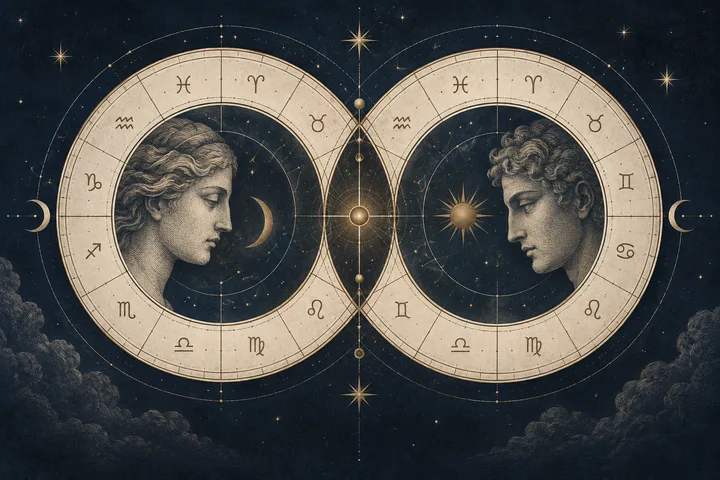
Treat an exact synastry contact as a precise clue, not a command to feel constant intensity. Start with the planets and aspect, then check the house only if the birth time is reliable. Look for the same theme elsewhere in the comparison and in the scenes you actually share: making plans, offering comfort, handling desire, or repairing a disagreement. If the contact explains a repeated pattern, keep it high in the reading even if it feels ordinary. If it stands alone and no shared situation gives it a voice, lower it. Use the signs you supplied and optional degrees. A Synastry Comparison Report can organize Moon, Venus, and Mars placements and selected major aspects within a six-degree orb, but it doesn't calculate missing natal positions or turn one exact line into a relationship verdict.
Exactness measures precision, not volume
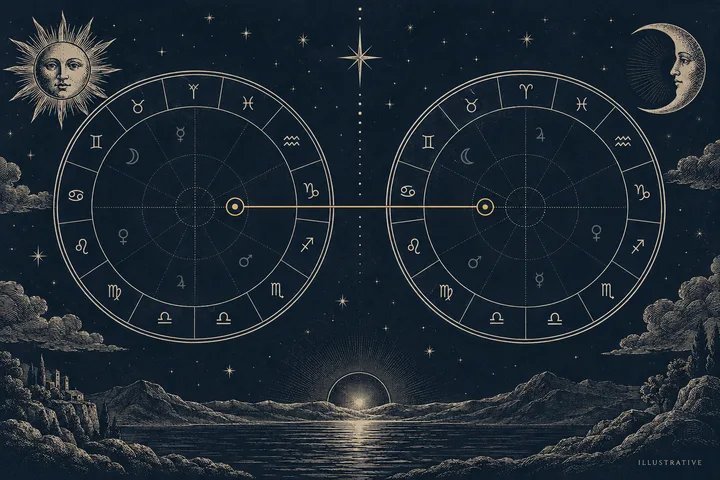
An exact contact can matter without taking over the day. In synastry, an aspect is the angular relationship between two chart factors. The orb is the distance between the actual positions and the aspect's perfect angle. A smaller orb brings the planets closer to that angle, so astrologers usually give the contact more weight. It does not decide how dramatic the experience must be.
That distinction answers the first mistake to avoid. A zero-degree conjunction isn't a volume setting. It tells you that the geometry is tight. The planets still tell you what is meeting, and the aspect tells you how the meeting moves. A close Mercury contact may live in quick messages and easy planning. A close Venus-Pluto contact may wait for intimacy, money, fear, or trust to become the subject. Both can be exact. They won't speak in the same scenes.
The aspect itself changes the feel. A trine may run so smoothly that neither person names it. A sextile often needs an invitation. A conjunction blends two functions. A square creates friction that is easier to notice, while an opposition can show a pull between two needs. Begin with a narrow question: what would this contact look like if it were active? Then look for that form instead of waiting for a grand sensation.
Cafe Astrology explains that a very small orb is close, while the planets and aspect also affect how an astrologer weighs the contact. Its numerical weighting is subjective, not a fixed rule. Astrology.com's synastry overview likewise separates planets, signs, houses, and aspects into different layers. Mark the tight contact, name its function, and test the right life area. Exactness earns attention. Expression earns rank.
Sources: What Is a Synastry Chart? Birth Chart Compatibility; Understanding the Free Natal Chart Report
Read the planets before you read the number
The planets tell you what kind of experience to watch. The Moon speaks through comfort, memory, rhythm, and the signals that say, ‘I can rest here.’ Venus describes affection, pleasure, taste, values, and the way love is offered. Mars brings desire, initiative, heat, anger, and the speed at which someone moves toward a want. Mercury covers speech, timing, questions, jokes, and the small work of coordinating a life.
The Sun shows recognition and the way one person meets the other's identity. Saturn brings duty, limits, patience, and the weight of time. Jupiter widens faith, humor, generosity, and appetite for experience. Uranus breaks routine. Neptune adds longing and imagination. Pluto presses on what cannot stay hidden. These meanings give the contact a job. They don't predict an outcome, and they don't make one person's experience the only valid one.
A quiet Moon contact may be obvious when one person is tired or frightened, not during a busy lunch. Venus may appear in shared food, gifts, taste, or the softening of a refusal. Mars may emerge when a decision needs action or a boundary meets desire. Mercury can feel invisible because it has become the plumbing of the relationship. You notice it when a message is missed, a plan changes, or two people hear different meanings in one sentence.
Astrology.com's guide uses Moon-Venus for emotional need and affection, Mercury for communication and daily tasks, and Saturn for structure and commitment. Keep that order in mind when a degree distracts you. Ask which planet is involved, what the aspect does to its expression, and who notices the contact first. Both people participate in a Moon-Venus meeting, even if one calls it obvious and the other calls it normal.
Sources: What Is a Synastry Chart? Birth Chart Compatibility; Understanding the Free Natal Chart Report
Use houses only when the birth time supports them
Houses add a location. They show where one person's planet enters the other's experience, but that layer depends on a trustworthy birth time and a chosen house system. A contact in the fourth house may speak through home, family, and private comfort. One in the tenth may surface around work, status, or ambition. The house is the room. The planet is what happens in it.
This can explain a contact that feels private or practical rather than romantic. Mercury in a partner's third house may appear as messages, errands, questions, and shared observations. Venus in the second can show through money, gifts, taste, and standards of comfort. Mars in the sixth may enter chores, work habits, health routines, or arguments about how quickly a task should be done. You may live the placement without naming it.
The fifth house makes play, flirtation, creativity, and pleasure easier to spot. The seventh can make the other person feel partner-shaped. The eighth may bring trust, sex, merging, debt, fear, or emotional exposure into focus. The twelfth can work through dreams, compassion, retreat, and reactions that take time to explain. These are places to investigate, not verdicts about the bond.
Cafe Astrology notes that house cusps cannot be determined when birth time is unknown. That boundary matters here. This report uses supplied placements and optional degrees; it doesn't calculate houses from birth details. If birth time is missing, read the planets, signs, and aspect geometry you can verify. A narrow answer is stronger than a vivid house story built on an uncertain point.
Sources: What Is a Synastry Chart? Birth Chart Compatibility; Understanding the Free Natal Chart Report
Let repeated themes outrank a lone perfect line
One contact is a clue. A repeated motif is a pattern. If Venus links with the Moon, Saturn, and Mercury, affection may be tied to comfort, steadiness, and words. If Mars is touched by Uranus and Pluto, desire may arrive with disruption, pressure, or a need to confront limits. The smallest orb still matters, but the cluster tells you what kind of relationship question the chart keeps asking.
Count meanings, not just lines. Two aspects can describe one theme, such as whether affection feels safe or how quickly conflict moves. A long aspect table can make every line look like a separate promise. Group contacts by planet and by the lived question they answer. Then ask whether the group appears in both people's experience or only in the report's vocabulary.
Imagine Maria has a Venus-Saturn trine that is exact by the degrees she supplied. She expects an unmistakable pull. Instead, a quiet month brings shared costs, reliable plans, and meals cooked together. That is not a failure of the aspect. It is Saturn speaking through consistency. If her Moon also favors practical care and her partner's Mercury supports detailed planning, the exact contact has allies. The chart and the daily habit point in the same direction.
Now change the picture. A close Venus-Neptune contact stands alone, while the pair cannot agree on time, values, or repair after conflict. It may describe tenderness, imagination, or a beautiful private ideal. It cannot carry the whole reading. Cafe Astrology recommends learning basic planets and positions before adding specialized factors. In synastry, establish the core pattern first, then let isolated symbolism support it.
Sources: What Is a Synastry Chart? Birth Chart Compatibility; Understanding the Free Natal Chart Report
Ask whether the pattern is hidden or not yet activated
A quiet contact can be hidden, or it can be dormant. A hidden pattern already leaves traces, but the traces are inward, familiar, or easy to overlook. A dormant pattern has not found the situation it describes. The difference keeps you from forcing an interpretation and from dismissing one that works below the surface.
A close Moon-Saturn contact may be hidden in the fact that one person stays steady when the other is overwhelmed. There may be no dramatic confession. There is simply someone safe to call late at night. A Mars-Uranus contact may be dormant in a calm friendship that has not shared a demanding project, sudden trip, or charged physical situation. The chart hasn't changed. The stage has.
Look for a natural trigger. What kind of choice, pressure, celebration, move, intimate conversation, or change of plan would bring the planet pair forward? Don't manufacture the event. Notice whether the relevant situation arrives on its own and whether the symbol becomes easier to recognize. If it does, the contact gains evidence. If it never does, keep it provisional.
Applying and separating language can refine an aspect, but it shouldn't rescue a reading that has no expression. For a comparison of natal placements, the first questions remain the planets, angle, repetition, and life area. If an exact contact has no matching scene, no repeated theme, and no plausible stage, lower it. A quiet line is allowed to stay quiet.
Sources: What Is a Synastry Chart? Birth Chart Compatibility; Understanding the Free Natal Chart Report
Turn the symbolism into one small observation
Daily life doesn't compete with astrology. It gives the symbolism somewhere to land. Choose one contact and one situation. For Moon-Saturn, notice what happens after one person shares a worry. Does the other soothe, organize, withdraw, or become stern? For Venus-Uranus, watch what happens when plans change or someone asks for more space. For Mercury-Mars, listen for the pace of a hard conversation.
Write down scenes, not conclusions. Who takes the lead? Who names the feeling? Who remembers the practical detail? Who turns desire into a plan? Who makes room for silence? A two-week note of ordinary moments will tell you more than trying to feel an aspect on demand. The goal isn't to prove the contact. It's to find its ordinary grammar.
Keep the observation mutual. One person may experience Saturn as steadiness while the other feels pressure to be dependable. Both accounts belong in the reading. Then ask questions that invite examples: ‘When do you feel most understood by me?’ ‘What makes you pull closer?’ ‘What kind of disagreement repeats?’ ‘What do you trust me to handle?’ Don't ask whether someone feels a Venus-Moon aspect. Ask for the lived scene.
Match the observation to the question. A Sun-Moon trine may support recognition and easy adjustment without answering a question about sexual desire. A Venus-Saturn contact may clarify how affection meets time and duty without settling whether the couple wants more time together. Astrology.com's layered approach supports this separation. One precise line can fit one lock beautifully. It doesn't open every door.
Sources: What Is a Synastry Chart? Birth Chart Compatibility; Understanding the Free Natal Chart Report
Rank the contact and choose the next conversation
Now rank the contact for the question you actually have. Rank one goes to a close contact that involves a verifiable personal planet or angle, repeats elsewhere, and matches a recurring scene. Rank two goes to a clear contact that has only one supporting layer or hasn't found its stage. Rank three goes to an isolated exact aspect that lacks reliable house data and leaves no trace in shared life. Rank three doesn't mean meaningless. It means don't let it lead.
Record the result in four lines: contact, meaning, evidence, next question. For example: ‘Venus-Saturn trine at 0 degrees 20 minutes; affection meets commitment; we show care by keeping plans; ask what kind of consistency helps each of us trust.’ This preserves the technical input and moves the reading toward a useful choice. It also makes the comparison easier to revisit if a degree or birth time is corrected.
Let the next action fit the leading planet pair. With Venus-Saturn, talk about time, loyalty, money, and the acts that make affection real. With Moon-Mars, ask what each person needs during conflict and how quickly they want to reconnect. With Mercury-Neptune, repeat important plans in plain words and check what each person heard. With Venus-Uranus, discuss novelty and personal space. The conversation should test the symbol, not perform it.
If you have signs but no degrees, keep aspect claims unconfirmed. If you have optional degrees, use selected major aspects within this report's six-degree working orb and record each orb. If birth times are unknown, leave houses and angles out. A Synastry Comparison Report can organize supplied Moon, Venus, and Mars signs, optional degrees, and selected major aspects. Use that map to decide what deserves a closer conversation. Then choose: explore the contact, hold it as background potential, or set it aside while a stronger repeated pattern leads.
Sources: What Is a Synastry Chart? Birth Chart Compatibility; Understanding the Free Natal Chart Report
A little more clarity
Does a zero-degree synastry aspect always feel powerful?
No. It makes the geometry exact, so astrologers give it close attention. Its expression still depends on the planets, aspect, reliable house information, repeated themes, and the situations the relationship enters. Treat exactness as a priority flag, not a promise of constant intensity.
What if an exact synastry contact has no matching behavior?
Check the signs, degrees, aspect type, and orb first. Then look for repetition and ask whether the relationship has entered the life area the contact describes. If it remains isolated with no matching scene, lower its rank and let a stronger pattern lead.
Can a synastry report explain why an aspect feels quiet?
It can organize clues from supplied placements and optional degrees. Compare the planet meanings, aspect, repetition, and any house information you can verify. This report uses a six-degree orb for selected major aspects, but it doesn't calculate missing natal positions, houses, or angles.
Sources & further reading
- What Is a Synastry Chart? Birth Chart Compatibility
Explains synastry as layered comparison and separates the roles of houses, signs, planets, and aspects.
- Understanding the Free Natal Chart Report
Explains close orbs, subjective weighting, missing birth-time house data, and why basic chart factors come first.
Synastry Comparison Report
Enter known placements for two people. Get an input-by-input comparison, selected aspect calculations and a clear record of what remains uncertain.
Compare our placements