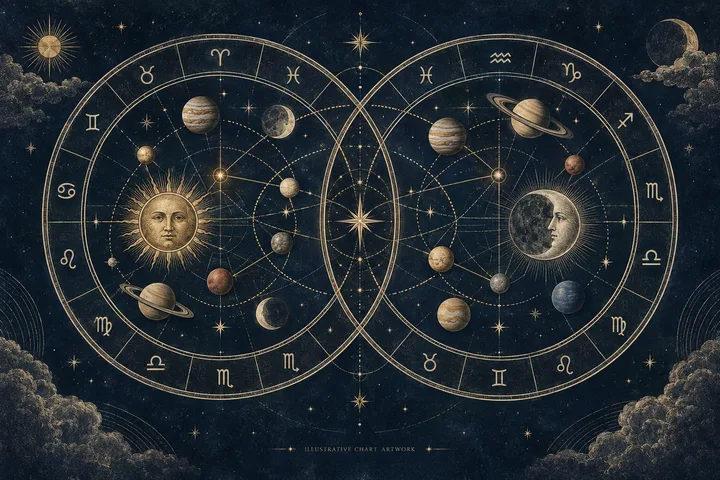
Dignity describes a planet's working conditions
Use essential dignity to ask how a planet can operate in its sign. Don't use it to decide whether a person is kind, loyal, mature, or worthy of love. Domicile and exaltation give a planet familiar or honored ground. Detriment and fall describe a less natural setting. Peregrine means the planet holds no major essential title at that degree. These are conditions of expression, not moral grades.
That matters in synastry because the two charts bring their own working conditions into contact. A strong Mars can protect a boundary or start a fight. A Venus in fall can struggle to show affection directly and still become skilled at noticing what a partner needs. The word strength means access to a planet's tools. It doesn't mean goodness.
Sources: Essential Dignity Table & Calculator, Classical Astronomy & Astrology; Understanding Planetary Dignity and Debility, Deborah Houlding
Set the chart scope before you interpret
For this comparison, start with supplied Moon, Venus, and Mars signs for both people. The Moon speaks to emotional rhythm and safety. Venus covers affection, pleasure, and values. Mars shows desire, action, defense, and conflict. Add other planets only when they answer the question in front of you.
Degrees let you test selected major aspects within a stated six-degree orb. Without degrees, you can discuss sign relationships and dignity, but you can't call an aspect exact or close. Birth time matters for houses and angles, so leave those layers out when time is missing or uncertain. Keep both charts in the same zodiac reference frame, and record what you actually have. The report uses supplied placements, optional degrees, selected major aspects, and no calculated houses.
Sources: Essential Dignity Table & Calculator, Classical Astronomy & Astrology; Synastry, Astrodienst Astrowiki
Translate the four main dignity terms
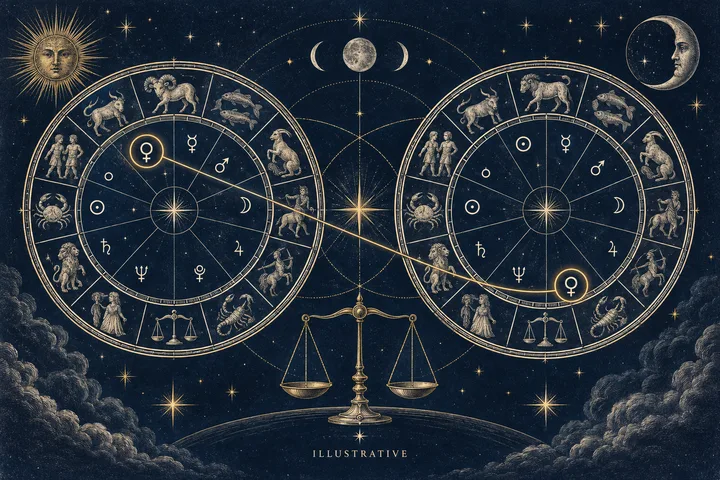
Domicile is the sign a planet rules. Venus has domicile in Taurus and Libra. Mars has domicile in Aries and Scorpio. Exaltation gives a planet a place of honor, such as Venus in Pisces or Mars in Capricorn. Detriment is the sign opposite a domicile. Fall is the sign opposite an exaltation. Triplicity, term, and face can add smaller forms of support, but they require a chosen table and, for terms, exact degrees.
Read these terms as verbs. Venus in Pisces may access affection through empathy and imagination with unusual ease. Venus in Virgo may translate affection through detail, service, and discernment. Neither is the better person. One method may feel natural; the other may have been learned through practice. The placement gives you a starting question: what does this planet know how to do, and what does it need to learn?
Sources: Essential Dignity Table & Calculator, Classical Astronomy & Astrology; Understanding Planetary Dignity and Debility, Deborah Houlding
Begin with each person's baseline
Imagine Maria has Moon in Taurus, Venus in Pisces, and Mars in Cancer. Imagine Daniel has Moon in Scorpio, Venus in Virgo, and Mars in Capricorn. These are illustrative supplied placements, not calculated personal charts. Maria's Moon and Venus are exalted in Taurus and Pisces. Daniel's Moon and Venus are in fall in Scorpio and Virgo, while his Mars is exalted in Capricorn.
Write the baseline before comparing the couple. Maria may seek steadiness, tenderness, and belonging. Daniel may seek proof through precision, useful action, and a plan. Those descriptions don't rank them. They show where each person may feel fluent and where each may need translation. A comfortable placement can become rigid. An awkward placement can develop a rare skill.
Use essential dignity to describe how a planet can operate in its sign, not to label the person who carries it. In synastry, begin with each person’s Moon, Venus, and Mars. Mark domicile, exaltation, detriment, fall, or peregrine condition. Then separate three questions: which planet rules the sign, whether the relevant planets actually aspect one another, and what that contact asks them to do. A sign-based ruler is a dispositor link. In the stricter traditional use, reception requires an aspect to the ruler, so rulership alone isn’t reception. Dignity gives the starting condition. Reception describes an active welcome or strain. The aspect shows contact. A Venus in detriment can still love with steadiness when its dispositor and a supportive contact give it a workable channel. Compare supplied signs first, add degrees only when you have them, and keep selected major aspects within a stated six-degree orb.
Sources: Essential Dignity Table & Calculator, Classical Astronomy & Astrology; Understanding Planetary Dignity and Debility, Deborah Houlding
Check the dispositor before you call it reception
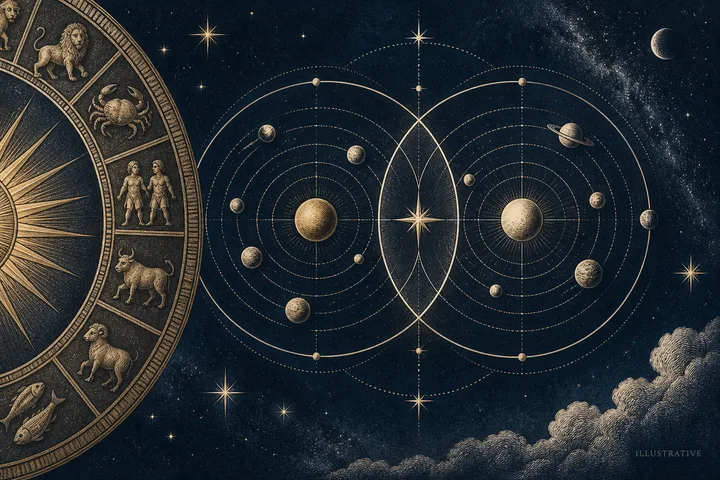
A dispositor is the traditional ruler of the sign occupied by a planet. Maria's Venus in Pisces answers to Jupiter. Daniel's Venus in Virgo answers to Mercury. That link tells you where to look next. It does not, by itself, create a relationship between Maria's Venus and Daniel's Jupiter.
Reception is narrower. In the traditional technique, one planet must occupy a sign where the other has dignity, and the two planets must aspect one another. The dignified planet receives the other, like a host making room for a guest. If Maria's Venus is at 18 Pisces and Daniel's Jupiter is at 20 Virgo, the opposition falls within two degrees, and Jupiter rules Pisces by domicile. Daniel's Jupiter can therefore receive Maria's Venus. Without that aspect, Jupiter is a dispositor clue, not a confirmed cross-chart reception.
Sources: Reception, Skyscript Glossary; Essential Dignities and Debilities with Charles Obert, The Astrology Podcast
Let the aspect show where the charts meet
The aspect is the meeting place. A conjunction brings the planets into one field. An opposition creates polarity. A square demands adjustment and action. A trine offers flow, while a sextile opens help that still needs participation. Dignity tells you what tools a planet brings. The aspect tells you what the contact asks those tools to handle.
In the example, Maria's Venus at 18 Pisces and Daniel's Venus at 20 Virgo oppose within two degrees. Maria may look for emotional atmosphere and symbolic tenderness. Daniel may show care through detail, work, or correction. That can attract them. It can also hurt if one calls the other's language excessive or cold. The aspect establishes the tension. It doesn't settle the outcome.
Now suppose Maria's Moon is at 12 Taurus and Daniel's Mars at 14 Capricorn. Their earth trine offers a practical resource. Her emotional steadiness may help his action, and his planning may give shape to her needs. The exception matters: ease can harden into a fixed division of labor, with one person always feeling and the other always fixing. A trine still needs choice.
Sources: Synastry, Astrodienst Astrowiki; Essential Dignity Table & Calculator, Classical Astronomy & Astrology
Rank the example instead of averaging it
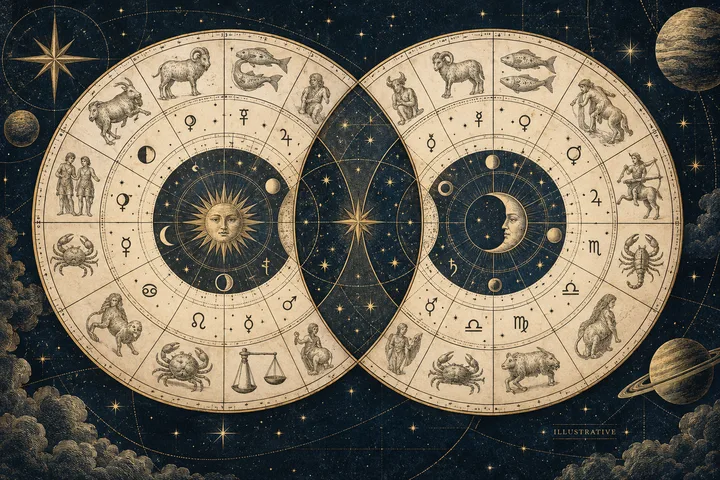
The strongest pattern in this example is the close Venus opposition because it concerns affection and has the tightest stated contact. The Moon-Mars trine comes next because it offers a way to handle ordinary needs. The differing Moon conditions come third. They suggest that reassurance may not look alike to both people. The Jupiter reception modifies the Venus theme by offering a route toward welcome, but it doesn't erase the opposition.
This ranking is the useful part. It keeps a dignified planet from overshadowing a close difficult contact, and it keeps a dramatic reception from becoming a promise. If you remove the degrees, the Venus pattern becomes a sign-level possibility. If you remove the aspect between Venus and Jupiter, the dispositor link remains, but reception no longer earns the name. Each input changes the strength of the sentence you can write.
Sources: Essential Dignity Table & Calculator, Classical Astronomy & Astrology; Reception, Skyscript Glossary; Synastry, Astrodienst Astrowiki
Add other layers only when they change the reading
Houses, angles, sect, and accidental dignity can show where a planet becomes visible and how much force it has in a chart. They don't cancel essential dignity. A Venus in Virgo that is angular may make careful, practical affection highly visible. Virgo still describes its method. The angle describes prominence. A partner's planet must actually contact that angle before you call it a synastry theme.
Keep triplicity, term, face, and point scores later in the process. Different traditional tables weigh them differently, and a score can sort notes without explaining a relationship. Add a minor dignity only if it changes the interpretation or the question you want the couple to ask. Otherwise, it is decoration.
The strongest exception is simple. A dignified planet that never contacts the other chart remains a personal capacity. A tense contact can shape daily life even when neither planet is comfortable by sign. When indications compete, rank the contact first, the dignity that supports or complicates it second, and the observable practice third.
Sources: Understanding Planetary Dignity and Debility, Deborah Houlding; Essential Dignity Table & Calculator, Classical Astronomy & Astrology
Finish with a conversation, not a verdict
Use this order in your report: record the Moon, Venus, and Mars signs; mark each dignity and dispositor; test degree-based contacts within six degrees; check reception in both directions; then name the strongest relational task. Sign-only wording should say a pattern suggests a style. Degree-confirmed wording can establish a contact. Reception adds the host-and-guest meaning only when the dignity and aspect are both present.
Bring the top-ranked pattern to a recent moment. When did one person offer care and the other miss it? What form did the offer take? What did each person need next? Then ask, "When you need love from me, what form will let you feel it, and what form can I offer without disappearing from myself?" That question gives the chart a job. It turns essential dignity into a way to name resources, differences, and repair.
Sources: Reception, Skyscript Glossary; Synastry, Astrodienst Astrowiki
Sources & further reading
- Essential Dignity Table & Calculator, Classical Astronomy & Astrology
Supports the traditional definitions, hierarchy, rulerships, exaltation degrees, debilities, peregrine condition, and distinction between essential and accidental dignity.
- Understanding Planetary Dignity and Debility, Deborah Houlding
Supports the distinction between essential and accidental dignity and the need to discriminate between textbook condition and whole-chart expression.
- Reception, Skyscript Glossary
Supports reception as a host-and-guest relationship between a planet and a ruler, including mutual reception and differing reception strengths.
- Synastry, Astrodienst Astrowiki
Supports synastry as comparison of two horoscopes with inter-chart aspects, house overlays, and constructive roles for both ease and friction.
- Essential Dignities and Debilities with Charles Obert, The Astrology Podcast
Supports the relationship between dignity, accepted planetary function, accidental condition, and reception as complementary parts of chart interpretation.
Synastry Comparison Report
Enter known placements for two people. Get an input-by-input comparison, selected aspect calculations and a clear record of what remains uncertain.
Compare our placements