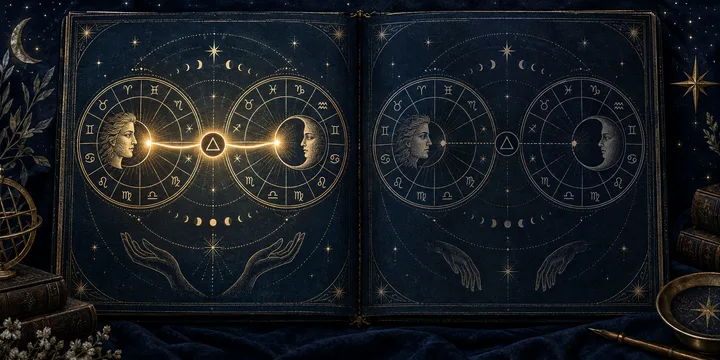
Imagine a trine that never gets used
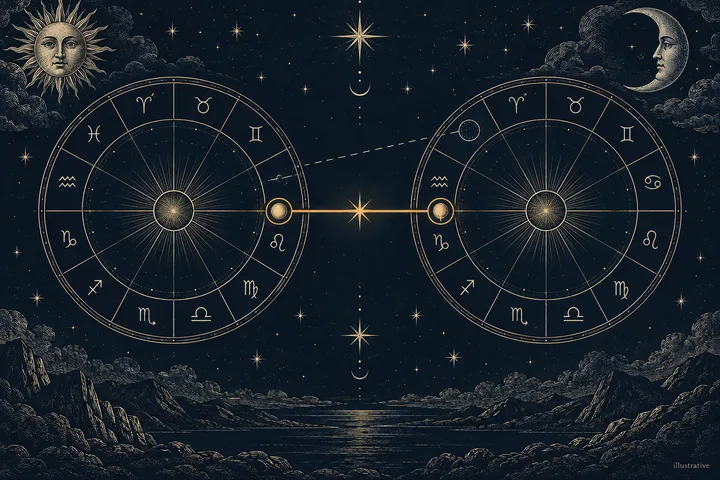
Imagine Maria and Daniel comparing a few known placements after several warm dates. Maria has the Moon at 12 degrees Taurus. Daniel has Venus at 16 degrees Virgo. Those supplied degrees sit four degrees from an exact trine, so this illustrative example falls within a six-degree working orb.
The question is what the contact does on Tuesday.
Daniel brings dinner after Maria's long day. She relaxes when he remembers the small things that make home feel settled. That could be the Moon-to-Venus trine in motion. But suppose they are equally kind in theory and rarely offer care in a form the other person can receive. Then the same contact is available, yet mostly unused. The chart shows a smooth route. It doesn't make either person take it.
That difference matters because easy contacts can disappear into the background. Nothing hurts. Nothing demands attention. A couple may call the bond natural and never ask what, exactly, feels natural. Is it emotional soothing? Affection? Conversation? Desire? Name the planets and you can name the gift. Then you can see whether the gift has become a pattern.
This article uses supplied placements and optional degrees. It doesn't calculate a natal chart from birth details, houses, or a complete synastry map. The Maria and Daniel example is illustrative, not a personal chart. The six-degree orb is the stated working rule for the comparison scope here.
Easy describes the route, not the result
Synastry compares one natal chart with another. Astrologers examine the aspects formed between the two charts' planets and angles, then consider the condition and meaning of the planets involved. An aspect is the distance between two points in the zodiac. A trine is 120 degrees. A sextile is 60 degrees. A conjunction joins two points, while a square is 90 degrees and an opposition is 180 degrees.
Trines and sextiles are commonly called easy, harmonious, or flowing. They let the planets cooperate with less friction. That is their strength. It is also their trap. A smooth contact may support a skill so naturally that nobody develops it deliberately. Astrological tradition has long treated harmonious aspects as helpful conditions that can leave potential taken for granted or not fully developed.
Unused isn't a separate aspect type. It is a judgment about expression. Call an easy contact unused when the two people have access to its cooperation but rarely recognize it, express it, or place it inside a shared activity. The geometry remains present. The life of the relationship hasn't given it a steady job.
There are three useful states. An active easy aspect appears in repeated behavior. A quiet one appears in flashes when the right circumstance opens the door. An unused one stays mostly at the level of capacity. These states can change. A new routine, a move, a family duty, or a difficult conversation may give a quiet contact something real to do.
So don't translate easy as guaranteed. Translate it as available cooperation. Then ask whether the relationship has chosen, noticed, and repeated that cooperation.
An easy synastry aspect shows a low-friction meeting between two chart functions. A trine can make care, speech, or desire move naturally. But an available connection isn't the same as a practiced one. The aspect may stay quiet when the couple doesn't notice its gift, lacks a situation that calls for it, or uses comfort to avoid a harder conversation. Read the planets first, then the aspect, the signs, and the orb. A close Moon-to-Venus trine deserves attention, but it still doesn't promise constant tenderness. Watch what happens in ordinary moments. If the contact helps you respond, repair, or cooperate, it's active. If it exists only as a pleasing description, it's unused. Name the gift and give it one repeatable place to work.
Sources: An Introduction to Aspects and Chart Shaping in Natal Astrology; Synastry - Skyscript Glossary
Read the planets, aspect, signs, and orb in that order
Start with the planets. The aspect tells you how two functions meet, but the planets tell you what meets. The Moon brings feeling, instinct, comfort, and safety needs. Venus brings affection, pleasure, values, and the way love is offered. Mars brings desire, initiative, heat, anger, and action. Mercury links thought, speech, listening, and interpretation.
Then read the aspect. A trine usually supports an easy blend. A sextile supports cooperation but often needs an invitation before its potential becomes obvious. A conjunction fuses the functions and can feel immediate. A square creates friction that asks for adjustment. An opposition sets up a polarity that calls for negotiation. None of these labels tells you whether a couple will use the contact. They describe the kind of meeting available.
Next, check the orb. The orb is the distance from exactness. A closer aspect generally speaks more clearly than a wider one. Astrologers use different orb traditions, and some give the Sun and Moon more room than the other planets. This comparison uses a six-degree working orb for selected major aspects. Keep that rule visible when you compare reports from different sites.
A four-degree Moon-to-Venus trine therefore deserves a close look when the question is everyday warmth. It doesn't become a promise. It simply gives you a stronger reason to observe the contact than a wider aspect between less personal planets would.
Finally, consider signs and repetition. Earth signs may express a trine through reliability, food, touch, and practical help. Water signs may express it through empathy, memory, and emotional attunement. Repeated contacts involving the same planets or elements can strengthen a theme. Other contacts can complicate it. A Moon-Venus trine may offer warmth while Saturn contacts slow trust or Mars contacts sharpen timing.
Keep three questions separate: Is the aspect present within the chosen orb? What kind of exchange do these planets describe? Where does that exchange appear in behavior? The first is geometry. The next two are interpretation and observation. A yes to the first doesn't force a yes to the third.
Sources: An Introduction to Aspects and Chart Shaping in Natal Astrology; Orbs (or rays) - Skyscript Glossary; What’s Your Sign? An Intro to Synastry Charts and Astrological Compatibility
The worked example is warm, but it isn't self-running
Return to the example. Maria's Moon is at 12 degrees Taurus. Daniel's Venus is at 16 degrees Virgo. The four-degree distance from an exact trine makes this a close earth-sign Moon-to-Venus contact within the stated six-degree scope.
Maria's Moon brings her emotional rhythm and comfort needs. Daniel's Venus brings his manner of affection, pleasure, and relational values. Earth gives the trine a tangible language. Care may arrive as a meal, a dependable plan, a quiet room, a remembered preference, or help that makes the day easier. That is the supported reading.
Now test it. Maria asks for company instead of saying she's fine. Daniel listens before trying to fix the evening. He remembers that food and a calm pace help her settle. She notices his effort and responds with warmth rather than treating it as an obligation. The aspect is active because the planetary exchange has become a repeated, recognizable scene.
Change one condition. Daniel assumes practical help always counts as affection, while Maria wants spoken reassurance. He keeps doing useful things. She keeps feeling unseen. The trine hasn't vanished. Its route is open, but the travelers are carrying different messages. They need to name the form of care instead of letting the word caring do all the work.
A quiet contact may still be active without looking dramatic. If two people reliably make one another's ordinary days softer, the aspect is doing its work. Lack of spectacle isn't proof of neglect. Repetition is better evidence than intensity.
Sources: An Introduction to Aspects and Chart Shaping in Natal Astrology; What’s Your Sign? An Intro to Synastry Charts and Astrological Compatibility
Why a natural contact can stay quiet
An easy contact needs an opening. Without one, it may remain a pleasant possibility. A couple with a Venus-Mars sextile may have playful attraction but little private time. A Moon-Mercury trine may support emotional understanding, yet different work schedules can leave no room for a real conversation. Circumstance doesn't cancel the contact. It limits where the contact can appear.
Some people also avoid the very quality the aspect offers. A person who is used to handling everything alone may find a gentle Moon-to-Venus exchange comforting and unsettling. Receiving care asks for trust. A person who fears direct desire may keep a Venus-Mars contact in flirtation and never say what they want.
Other chart layers can take the lead. A harmonious contact may sit beside Saturn restraint, Mars impatience, or a strong pattern of self-protection. The easy aspect can still help, but it may need a safer pace or a clearer invitation. Read the whole comparison before declaring that the trine is missing from real life.
There is also a difference between being comfortable and being available. Two people can avoid conflict so carefully that they never ask for more. Their ease becomes politeness. Watch the small scenes: a changed plan, a tired evening, a request for help, or a moment when one person wants closeness and the other wants space. Those scenes show whether the contact offers a response, waits for an invitation, or stays out of reach.
Sources: An Introduction to Aspects and Chart Shaping in Natal Astrology; Synastry - Skyscript Glossary
Tension can give an easy aspect a job
Difficult aspects create friction. That friction can be tiring, but it can also make the planets impossible to ignore. An easy contact may become most useful when another contact gives the couple a problem to solve.
Keep Maria and Daniel's Moon-to-Venus trine. Now imagine a separate Mars-to-Saturn square in their comparison. One person wants to act now. The other slows the plan, checks the risks, or carries a strong sense of responsibility. The relationship may feel blocked around timing.
The Moon-to-Venus trine can help if the pair uses its warmth to stay present during the hard talk. Maria might say, 'I know we want different timing. Let's decide without making either of us the problem.' Daniel might answer, 'Let's take twenty minutes, then choose the next step.' The trine supports the repair. It doesn't erase the square.
An easy aspect can soften tension, but it shouldn't sedate the relationship. Tenderness doesn't replace a conversation about missed commitments. It can make that conversation possible. A Mercury-Jupiter trine may bring perspective while Mercury-Saturn makes speech cautious. A Venus-Uranus sextile may keep play alive while Saturn asks for consistency. Each contact has a job.
Mild strain is enough to reveal function. Notice what happens after a delayed reply, a disagreement about money, or a plan that changes at the last minute. Does the couple reach for comfort, clear speech, humor, or shared action? If so, the easy contact has become a resource. If not, it may still be waiting for an invitation.
Sources: An Introduction to Aspects and Chart Shaping in Natal Astrology; Orbs (or rays) - Skyscript Glossary
Give the contact one repeatable place to work
A synastry reading becomes useful when it changes what you notice. Write down the two placements, their signs, their degrees if known, the aspect, and the orb you are using. Then describe the exchange without predicting an outcome. 'Moon trine Venus can make practical care easier to give and receive' is workable. 'We are meant to last' is not an aspect reading.
Find one scene where the contact already appears. What does care look like? What does affection sound like? When does desire become easier? When does conversation open? Use an observable verb: listens, brings, asks, plans, touches, repairs. If you can't name a scene, don't pretend the aspect is active.
Choose one small practice for seven days. For the Moon-to-Venus example, one person can ask directly for the kind of comfort they want, while the other repeats back what they heard before offering help. A Venus-Mercury contact might get a weekly conversation about pleasure and values. A Mars-Jupiter contact might get a shared task that needs courage and initiative.
Review the result without grading the relationship. Did the exchange feel easier? Did one person feel relieved or misunderstood? Did another chart layer interrupt it? Those details refine the interpretation. They give the symbol a shape.
If you know signs but not degrees, keep the reading broad. Similar elements can suggest a shared style, but they don't confirm a precise trine. If you know degrees, record the distance and apply the chosen six-degree scope consistently. If birth information is incomplete, leave houses and uncertain angles out.
A Synastry Comparison Report can organize supplied Moon, Venus, and Mars signs, optional degrees, and selected major aspects under a stated six-degree orb. It doesn't calculate a natal chart from birth details, add houses, or predict a relationship result. Bring one known contact and one real question.
Your decision point is clear. If the aspect is confirmed and its gift appears repeatedly, treat it as a lived resource. If it is confirmed but never appears, give it a specific invitation. If the degrees are missing, keep the claim modest and gather better inputs before naming the aspect. Easy astrology opens a door. Your repeated choices show whether anyone walks through it.
Sources: Synastry - Skyscript Glossary; Orbs (or rays) - Skyscript Glossary; What’s Your Sign? An Intro to Synastry Charts and Astrological Compatibility
A little more clarity
Is an easy synastry aspect always strong?
No. Ease and strength are separate judgments. A close major aspect between personal planets usually deserves more attention than a wide contact. The planets, signs, orb, and wider comparison still matter. A close Moon-to-Venus trine can describe a clear route for warmth, but it doesn't guarantee that either person will use it.
What does an unused trine mean in synastry?
It means the two people have an easy route between the planets, but their relationship rarely gives that route a job. The contact may appear in brief moments or remain potential. Look for a situation that invites its gift, then try one ordinary behavior that expresses it.
Can a difficult synastry aspect activate an easy one?
Yes. Friction can create a problem that a harmonious contact helps the couple meet. A Moon-to-Venus trine may provide warmth during a difficult timing conversation. Use that ease to stay present and honest. Don't use it to cover missed commitments or avoid the issue.
Can I read an easy aspect without birth times?
You can compare supplied planetary signs and degrees if you have them. Without degrees, you can't confirm a precise aspect or orb. Without reliable birth times, leave houses and uncertain angles out. Work with the placements you actually know and state the six-degree scope when it applies.
Sources & further reading
- An Introduction to Aspects and Chart Shaping in Natal Astrology
Supports the definitions and geometry of major aspects, harmonious and tense contacts, orb strength, and the idea that easy conditions can leave potential undeveloped.
- Synastry - Skyscript Glossary
Supports defining synastry as comparison between natal charts through planetary positions, angles, aspects, and the quality of the planetary exchange.
- Orbs (or rays) - Skyscript Glossary
Supports the explanation that an aspect changes with distance from exactness and that astrologers use different orb traditions, including larger planetary allowances.
- What’s Your Sign? An Intro to Synastry Charts and Astrological Compatibility
Supports reading personal-planet contacts for relationship themes and giving attention to degree closeness when comparing charts.
Synastry Comparison Report
Enter known placements for two people. Get an input-by-input comparison, selected aspect calculations and a clear record of what remains uncertain.
Compare our placements