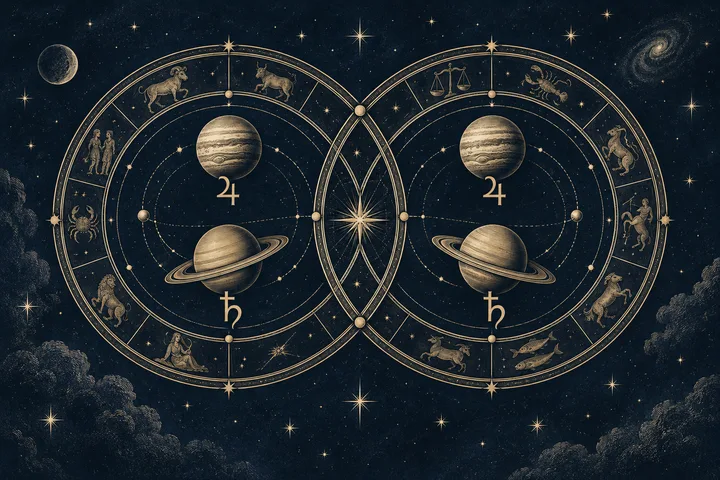
What does a double Jupiter–Saturn contact say at first glance?
A double Jupiter–Saturn contact makes growth and structure a reciprocal theme in synastry. It means A’s Jupiter forms an aspect to B’s Saturn, and B’s Jupiter forms an aspect to A’s Saturn. Record those as two separate cross-chart contacts. In The Astrology of Relationship, synastry is described as comparing two or more birth charts through planetary, sign, and house contacts. That distinction matters: a Jupiter–Saturn aspect inside one person’s own chart is not, by itself, a double contact between partners. The repeated pattern invites a focused question: how do possibility and limits meet between you? Cafe Astrology’s “Synastry: Jupiter-Saturn Aspects” describes one direction as a meeting of Jupiter’s optimism and vision with Saturn’s realism and moderation. It also notes that the exchange can feel supportive or frustrating. When the contact reverses, the planet owners reverse too. So neither partner should be assigned a permanent role as the dreamer or the brake. The same person may bring expansion in one conversation and ask for structure in another. That is the first reading, not a verdict about the bond. Two contacts make the theme mutual in the comparison; the count alone doesn’t show that it is twice as strong, lasting, or constructive. Check each contact by degree, note its aspect and closeness, then compare the pair. Finally, ask whether the symbolism helps describe a real shared decision involving timing, resources, risk, or responsibility. If the degrees aren’t available, keep the reading provisional.
Sources: The Astrology of Relationship; Synastry: Jupiter-Saturn Aspects
What makes the contact double rather than merely repeated in a list?
A double contact means the same two planets connect across the two charts in opposite directions. Write the pair as two separate lines: A’s Jupiter to B’s Saturn, then B’s Jupiter to A’s Saturn. That ownership matters. If a chart display lists one contact from each person’s viewpoint, the labels may look like two entries even though both describe the same single cross-aspect. Count the contact only after checking whose planet is whose. Synastry is the comparison of two or more birth charts. The publisher description for The Astrology of Relationship defines the practice this way and distinguishes chart comparison from a simple Sun-sign match. It also describes interpreting zodiacal contacts, house contacts, and composite charts. For this question, keep the method narrower: we’re checking two planet-to-planet contacts between two charts. A Jupiter–Saturn conjunction inside A’s own natal chart may matter to A’s individual chart reading, but it isn’t the reciprocal pair by itself. It connects planets in one chart, not Jupiter in each person’s chart to Saturn in the other’s. Use a small ledger before interpreting. Give each direction its own row, then record the planet owner, the other person’s planet, the aspect name, and the orb if degrees are available. For example, the rows might read “A’s Jupiter → B’s Saturn” and “B’s Jupiter → A’s Saturn.” Add the aspect and orb beside each arrow; don’t copy one contact into both rows. The two lines could have different aspect types or different orbs, a distinction that disappears if a reader writes only “double Jupiter–Saturn.” The article Double and Triple Whammies in Synastry describes a double whammy as inter-aspects between the same factors in both directions. Its example is one partner’s Sun aspecting the other’s Mars, with the reverse Sun–Mars contact also present. That supports the basic test: same planetary pair, two owners, opposite directions. The article goes further and says each added repetition makes a configuration more powerful. That is one astrologer’s interpretive position, not part of the definition. First establish what repeats; later, compare the actual contacts before deciding how much emphasis the repetition deserves. Keep the categories clean. A natal conjunction, a second display of the same cross-aspect, or a separate house or composite-chart connection may add context, but none substitutes for the reverse Jupiter–Saturn contact. Once both rows are verified, the reader has a genuine reciprocal pair to interpret. If the second row is missing, the chart may still contain a meaningful Jupiter–Saturn contact. It simply isn’t double in this specific sense.
A double Jupiter–Saturn contact makes growth and structure a reciprocal theme: A’s Jupiter aspects B’s Saturn, and B’s Jupiter aspects A’s Saturn. Read each direction separately, comparing aspect type, orb, and natal context before synthesizing them. Repetition alone doesn’t show that the bond is twice as strong. Test the interpretation against a real shared decision, and keep it provisional if reliable degrees are missing.
Sources: The Astrology of Relationship; Double and Triple Whammies in Synastry
What do Jupiter and Saturn contribute to the shared theme?
Jupiter gives the pair’s symbolism of growth, confidence, possibility, and meaning; Saturn brings limits, timing, structure, and responsibility. Saturn’s boundary can frustrate an idea or protect it from becoming unsustainable. Jupiter’s encouragement can open a path or overestimate what the plan can carry. Their contact describes the relationship between these functions, not two permanent personality types. The contrast has deep roots in astrological interpretation. In the transcript “The Significations of the Seven Traditional Planets,” Jupiter and Saturn appear among a series of oppositions used to clarify planetary meanings: Jupiter is associated with freedom and wisdom, while Saturn is associated with imprisonment and ignorance. The discussion also stresses that these are extremes, not a complete reading of every chart. A planet’s expression depends on its condition and relationships. That range matters here. If you reduce Jupiter to “the optimistic one” and Saturn to “the strict one,” you turn a symbolic exchange into a pair of fixed character labels. A more useful way to read the contact is to ask what happens when an opening meets a limit. Jupiter enlarges the question: What could we try? What would make this worthwhile? Saturn gives the question a frame: What can we sustain? What needs a deadline, a budget, or a clear commitment? The answer need not be a compromise where each person gives up half. A limit may preserve the larger aim by setting a workable pace; an expansive idea may help a cautious plan reach beyond mere maintenance. That is why Saturn’s part isn’t automatically obstruction, and Jupiter’s isn’t automatically good judgment. The Astrology Podcast transcript notes that traditionally difficult planetary functions can be constructive in some chart conditions, while benefic functions can become counterproductive. Applied to this pair, the symbolism asks how growth and restraint are working together in context. A boundary that protects shared resources can serve the plan. A promise that exceeds the available time or money can weaken it, even when the vision feels inspiring. The synastry guide “Synastry: Jupiter-Saturn Aspects” describes the contact as a possible balance between Jupiter’s broadening outlook and Saturn’s realism, while also allowing for frustration when their approaches clash. That is a useful starting point for one direction of the contact. But in a reciprocal pair, the chart ownership reverses in the second contact. The person whose Jupiter meets the other’s Saturn in one row may carry Saturn in the other. So “Jupiter person” and “Saturn person” name the planets involved in a particular aspect, not permanent jobs in the relationship. Translate the symbols into questions about one shared choice. What possibility entered the conversation? What constraint followed? Did that constraint clarify the plan, or shut it down before it could be considered? Did encouragement help the pair take a meaningful step, or press past a real limit? The shared theme is not “one expands while one restricts.” It is the ongoing work of giving possibility a form that can last.
Sources: The Significations of the Seven Traditional Planets; Synastry: Jupiter-Saturn Aspects
How does the aspect change the conversation?
A conjunction, trine, sextile, square, or opposition gives the Jupiter–Saturn exchange a different shape. The aspect describes how the two functions meet; it doesn’t decide whether the exchange will help or trouble a couple. In a reciprocal pair, read that shape twice. A’s Jupiter may meet B’s Saturn through one geometry, while B’s Jupiter meets A’s Saturn through another. The pair can share a theme with two distinct tones. The conjunction brings the planets together in one contact. “Synastry: Jupiter-Saturn Aspects” describes Jupiter conjunct Saturn through shared goals: Jupiter may open horizons while Saturn contributes realism. The same passage allows for friction, too. One person may experience the other’s suggestions as threatening, or their outlook as too carefree or too severe. Joining doesn’t mean effortless agreement. It means enthusiasm and limits meet in the chart and may need to find a place in the same plan. A trine or sextile is often read as a more available route to cooperation. The guide associates these aspects with natural flow, support for one another’s goals, and the capacity to think plans through. That can describe a resource: optimism and practical judgment may be easier to bring into one conversation. But ease doesn’t guarantee anyone will use it. A smooth contact cannot substitute for the couple’s decisions. A square makes the difference more active. In the guide’s account, Jupiter’s vision can feel restricted by Saturn’s caution, while Saturn may regard Jupiter’s enthusiasm as too optimistic. The same source says such challenges can prompt growth and understanding, and describes a possible balance between growth and security. Read the square as a negotiation that may ask for conscious adjustment, not as a prediction of constant disagreement. An opposition brings the functions into a polarity that calls for balance. The guide places Jupiter–Saturn opposition among the harder contacts and describes the task as balancing optimism with caution. One side may stress what could be gained; the other, what must be protected. Hear both, then decide what scale, pace, or safeguard lets the plan move forward. These are interpretive possibilities, not fixed outcomes. The publisher’s page for “Aspects in Astrology” presents aspects as relationships between planetary placements and describes the book as covering planetary combinations. That broad frame supports reading geometry as part of a larger pattern, not as a verdict by itself. Compare the two actual contacts: note the aspect in each direction, then ask whether both offer similar ease or whether one brings a more active point of adjustment. A conjunction one way and a square the other would be two different conversations, not one uniform “Jupiter–Saturn relationship.” Keep the reading provisional until you check the degrees and the orb rule you’re using. “Trine” or “square” names the geometry; closeness helps determine how much weight to give a contact under your chosen convention. Astrologers don’t all use one universal orb, so apply one stated rule consistently rather than changing it to make both contacts fit. Compare each aspect on its own before describing what the pair shares. The geometry suggests a style of exchange; the lived conversation shows whether that symbolism is useful here.
Sources: Synastry: Jupiter-Saturn Aspects; Aspects in Astrology
How should you compare the two directions fairly?
Give each direction its own line before describing the pattern. Record who owns Jupiter, who owns Saturn, the aspect, and its orb. Add natal context and the shared decision you’re comparing. This keeps a reciprocal pair from collapsing into one label, such as “strong Jupiter–Saturn synastry,” and shows where the two directions differ. An orb is the distance between an aspect’s exact angle and the measured separation of two placements. A smaller orb is closer to exact, but closeness is only one part of the reading. Aspect type matters too: a trine and a square describe different exchanges, even when both are close. Use the same orb convention for both rows. The six-degree limit used for selected major-aspect calculations in the Synastry Comparison Report is that report’s working rule, not a universal standard. Astrologers use different limits, so name yours. | Direction | Aspect | Orb | Natal context | Shared decision | | --- | --- | --- | --- | --- | | A’s Jupiter to B’s Saturn | Verified aspect | Measured orb | Both planets | Possibility and limits | | B’s Jupiter to A’s Saturn | Verified aspect | Same rule | Both planets | Same decision | With degrees, record the separation and calculate each orb from the aspect’s exact angle. With signs alone, leave the orb unconfirmed. Don’t guess a degree or treat a possibility as a verified contact. Record only the placements you have. Consider a hypothetical pair: one direction is a close trine, while the reverse is a wider square that still fits the chosen orb. The first may offer an easier channel for support; the second may bring a sharper negotiation between confidence and caution. These are interpretive possibilities, not guaranteed behavior. The pair is reciprocal in structure but uneven in texture and closeness. Counting each row as one vote would hide that difference. Rank the contacts rather than combining them into a score. First compare closeness under the shared rule. Then consider aspect type and whether natal context supports the same theme. Finally, test both readings against the same observable decision: who proposed growth, what limits shaped the plan, and how each person responded. “Balanced,” “asymmetrical,” or “unconfirmed” may describe the pair more honestly than “twice as strong.” Synastry: Jupiter-Saturn Aspects distinguishes interpretations by aspect type, while The Astrology of Relationship describes synastry as comparison across charts. Neither source offers a universal formula for adding both directions into one strength number. Let the chart details determine how much emphasis each contact earns.
Sources: Synastry: Jupiter-Saturn Aspects; The Astrology of Relationship
Why restore both planets to their natal charts?
A cross-aspect connects two planets that already have signs, houses, and relationships to other planets in their own charts. Those natal conditions shape how each person expresses Jupiter and Saturn. The same inter-chart aspect can therefore meet very different contexts. Reciprocity doesn’t erase those differences, and the pair shouldn’t be treated as the whole relationship reading. Begin with each natal chart separately. Note Jupiter’s sign and major aspects, then do the same for Saturn. Ask what each planet is already connected to before it enters the comparison, and whether those ties echo or complicate the growth-and-structure theme. This isn’t a second score to add to the synastry tally. It’s context for interpreting what the cross-contact might mean. That sequence follows a basic principle of chart reading. Aspects in Astrology describes interpretation as bringing symbols together. Its publisher’s excerpt gives an example that combines a planet, sign, house, and the houses ruled by that planet; it also says a birth chart has to be viewed as a whole. Applied here, a Jupiter–Saturn contact deserves its own reading, but its meaning changes when you return both planets to their natal surroundings. Now take the contacts in each direction: A’s Jupiter meets B’s Saturn, while B’s Jupiter meets A’s Saturn. Ask what Jupiter and Saturn connect to in each person’s chart. If a person’s Jupiter is tied to other natal planets, its search for growth may carry more than one symbolic thread. Saturn’s natal aspects may also shape its approach to limits and obligations. These are interpretive questions, not fixed personality labels or predictions. The Astrology of Relationship describes synastry as comparing two or more birth charts, with planets, houses, and signs all part of chart comparison. That supports a useful order: first establish what connects across charts, then consider what each planet represents in its own chart. The publisher’s description supports this broad sequence. It doesn’t prescribe a special Jupiter–Saturn formula, so don’t present this synthesis as a universal rule. Houses can add another layer, but only when birth time supports them. A planet’s house placement gives an area of life to consider; if the birth time is missing or uncertain, leave house claims open rather than guessing. That doesn’t automatically prevent comparison of supplied planetary positions or degrees. Keep the limits distinct: missing birth time affects the house layer, while missing degrees can leave the exact cross-aspect and orb unconfirmed. Use natal context to refine the reading, not multiply its strength. The charts may help explain why the same broad theme takes different forms in each direction. If the natal picture doesn’t support the interpretation you expected, loosen that interpretation. The contact pair is one part of synastry, and each planet belongs to a larger chart. Read both levels, then bring them together with care.
Sources: Aspects in Astrology; The Astrology of Relationship
Does repetition make the contact twice as strong?
Repetition can make a Jupiter–Saturn theme more noticeable in synastry, but the count alone can’t show that it is twice as strong. Double and Triple Whammies in Synastry takes the stronger view: it says repeated factors build a cornerstone and make a configuration more powerful. That is an interpretive position, not a rule every astrologer must apply. Its example is reciprocal: one person’s Sun aspects the other’s Mars, and the second person’s Sun aspects the first person’s Mars. Jupiter and Saturn can form the same two-way structure. The question is what repetition adds, and how much weight each contact carries.
The strongest case for added emphasis is straightforward. When the same planetary pair appears in both directions, the symbolism has a repeated place in the comparison. Both charts participate in the exchange, so it’s reasonable to read it as a shared theme worth examining. But emphasis and strength aren’t identical. The double-whammy page treats repetition as power without accounting for the details of the underlying contacts. That can flatten a pair that is visibly uneven.
Compare the two lines before combining them. A’s Jupiter to B’s Saturn might form a close trine, while B’s Jupiter to A’s Saturn forms a square near the chosen orb limit. Those aren’t equal votes for one effect. Aspect types describe different encounters, and different orbs mean different degrees of exactness under the same convention. Cafe Astrology’s Synastry: Jupiter-Saturn Aspects treats conjunctions, hard aspects, and trines or sextiles as distinct possibilities. It describes support and tension: Jupiter’s optimism may open possibilities, while Saturn’s realism can moderate them; the exchange can also feel restrictive. It’s more useful to read the contacts separately than to let “double” settle their combined weight.
Repetition can matter when both lines reinforce a common theme. If both contacts are close under one stated orb rule, their expressions point toward a related negotiation, and each planet’s natal context supports the reading, the reciprocal pattern deserves more attention. Attention isn’t proof. It doesn’t establish that the pair will plan well, stay together, or keep fixed Jupiter and Saturn roles. People may trade roles across decisions, and lived choices may not fit the reading. Don’t force the symbolism to win.
The fair verdict is mutual emphasis with potentially unequal weight. Treat repetition as a reason to investigate growth and structure, then use aspect type, orb, and natal context to judge each direction. The strongest exception is a pair whose contacts are comparably close and whose chart context repeats the same story; a concentrated reading may then be more persuasive. Even so, “twice as strong” claims too much. Keep both contacts visible, state what supports the synthesis, and leave room for the broader chart or experience to change it.
Sources: Double and Triple Whammies in Synastry; Synastry: Jupiter-Saturn Aspects
How can the two directions be tested against a real shared choice?
Choose one decision where possibility had to meet a limit: a move, shared project, spending plan, or commitment timeline. What constraint changed the plan: money, time, or capacity? Then ask how each of you responded. Who widened the options? Who named the cost or boundary? Did those roles switch as new information came in? This gives the chart symbolism something concrete to illuminate. It doesn’t let the chart decide what either person intended.
The Astrology Podcast’s discussion of the traditional planets describes Jupiter through growth and increase, while Saturn marks limits, time and containment. A boundary can frustrate movement or protect what is being built. Applied to a shared decision, those meanings suggest questions rather than labels: Did enthusiasm help you see a worthwhile possibility? Did caution make the plan more durable, or close it too soon? Did a deadline bring focus or turn delay into pressure? The answers come from choices you can both recall.
Now test both directions against that same episode. In the first contact, Jupiter belongs to one chart and Saturn to the other; in the reverse contact, their owners switch. Ask whether both people could encourage, set limits, revise, and make room for the other. Don’t assume the Jupiter person always proposed and the Saturn person always objected. Cafe Astrology’s “Synastry: Jupiter-Saturn Aspects” describes one direction as a possible exchange between optimism and realism, with support for planning as well as friction when suggestions feel threatening. Reversing the planets asks you to examine the exchange with roles changed. The comparison matters more than a stock character story.
Imagine two people weighing a move. One raises a promising possibility; the other asks about costs and timing. After checking the details, the cautious partner finds a workable route, while the first points out a risk the plan missed. It shows how roles can move. It doesn’t describe a real couple or establish chart placements. Another pair might find that every proposal becomes a veto, or that neither person wants to slow down. The symbolism should help name a pattern, not excuse behavior that hurts.
Does the reading clarify both the helpful and difficult parts? If the lived exchange doesn’t fit, don’t force it. Check that both chart directions and supplied positions are correct, then reconsider the interpretation. The pair may show mutual emphasis in the chart comparison while the decision reveals little cooperation, or one contact may describe the experience far better than the other. Keep those findings distinct. You’re looking for a useful account of how possibility and limits were negotiated, not a verdict about affection, commitment, or the relationship’s future.
Sources: The Significations of the Seven Traditional Planets; Synastry: Jupiter-Saturn Aspects
What can sign-only placements, missing degrees, and the report tell you?
Signs can suggest the kind of angle two placements might form, but they can’t confirm the exact aspect or its orb. Astrostyle’s “Synastry Chart for Couples” maps aspects by sign distance and explains that comparing chart wheels adds a house layer; accurate house reading depends on both birth times. For this comparison, degrees let you check angular contacts; birth times matter when interpreting houses.
Without degrees, don’t promote a sign-level pattern into a confirmed double contact. Record each direction as possible, then leave its exact aspect and closeness open. Sign-based descriptions can offer a first look at how placements relate, but they don’t tell you whether either contact falls within your chosen orb. Use the same zodiac framework and orb convention for both directions; the report’s selected major-aspect rule is six degrees, a working convention rather than a rule every astrologer shares. If inputs are incomplete, say what remains unknown instead of filling the gap.
The publisher description for “The Astrology of Relationship” defines synastry as comparing birth charts and describes interpreting planetary, sign, and house contacts. That supports a layered comparison, not a promise that one tool calculates every layer. The Synastry Comparison Report uses placements you supply and optional degrees; it doesn’t calculate natal positions from birth details. Check that your Jupiter and Saturn placements, with degrees if available, cover the comparison you want. Then label the result confirmed by degrees or provisional by signs.
Sources: Synastry Chart for Couples: Compare Two Charts to Make a ‘Relationship Chart’; The Astrology of Relationship
What should you do next with the double contact?
Keep two rows, not one verdict. Record A’s Jupiter to B’s Saturn, then B’s Jupiter to A’s Saturn. For each, confirm planet ownership, name the aspect, and note the orb if you have reliable degrees. Compare both under the same orb convention. Then restore Jupiter and Saturn to their natal contexts. Next, choose one shared decision involving possibility and limits. Ask how each of you raised an option, weighed time or resources, and adjusted when circumstances changed. Did the symbolism help describe a real exchange, or did the lived pattern point elsewhere? A chart offers language for reflection; it can’t decide what either person intends or what you should choose. Summarize the result as mutual emphasis when both contacts are clear and relevant, unequal emphasis when their aspects, closeness, or natal contexts differ, or an unconfirmed possibility when you have signs but not degrees. “Synastry: Jupiter-Saturn Aspects” interprets an individual contact; “The Astrology of Relationship” describes comparing charts. Read together, they support context, not a promise based on repetition. The Synastry Comparison Report can organize placements and optional degrees you supply, but it doesn’t calculate natal charts from birth details. Take the two rows into your conversation. Let your actual choices guide the next step.
Sources: Synastry: Jupiter-Saturn Aspects; The Astrology of Relationship
Sources & further reading
- The Astrology of Relationship
Supports the broad definition of synastry as comparing birth charts through planetary, sign, and house contacts.
- Synastry: Jupiter-Saturn Aspects
Supports distinct interpretive possibilities for Jupiter–Saturn conjunctions, hard aspects, trines, and sextiles.
- Double and Triple Whammies in Synastry
Defines reciprocal repetition and presents the alternative view that repeated contacts increase a configuration’s power.
- The Significations of the Seven Traditional Planets
Supports the interpretive symbolism of Jupiter as growth and increase and Saturn as limits, time, and containment.
- Aspects in Astrology
Supports the broad framing of aspects as planetary relationships interpreted within a wider horoscope.
- Synastry Chart for Couples: Compare Two Charts to Make a ‘Relationship Chart’
Supports sign-based aspect comparison and the distinction between chart comparison and house interpretation.
Synastry Comparison Report
Enter known placements for two people. Get an input-by-input comparison, selected aspect calculations and a clear record of what remains uncertain.
Compare our placements