
The dominant planet is not always the chart ruler
The easiest mistake is also the most understandable one. You find the Ascendant, name its ruling planet, and call that planet dominant. The chart ruler matters enormously. It represents the chart’s first-house direction and gives you a reliable starting point. But starting point and loudest voice are not always the same thing.
A dominant planet is the planet that keeps claiming attention when you look at the chart as a living pattern. It may sit close to the Ascendant or Midheaven. It may connect several other planets by close aspects. It may rule the Ascendant and stand in an angular house. It may have strong essential dignity, or it may be visibly prominent despite a difficult sign condition. You are weighing evidence, not reading a label. The practical question is not “Which planet sounds most like me?” It is “Which planet has the most repeated authority in this chart, and what kind of authority is it?”
That distinction changes a synastry reading. Suppose one person has Libra rising, so Venus is the chart ruler, but Mars sits within one degree of the Midheaven and aspects the Moon, Venus, and Saturn. Venus still describes the person’s way of entering life. Mars may describe the pressure that organizes the life around it. If a partner’s Venus conjoins that Mars, the relationship may feel immediately active and desirous. If the partner’s Moon squares it, the same Mars becomes emotionally provocative. Calling only Venus dominant would hide the actual meeting point.
The best working definition is simple: dominance means centrality, not goodness. A dominant Venus can bring warmth, taste, attachment, and negotiation. It can also make approval, pleasure, or comparison central concerns. A dominant Saturn can build patience and loyalty. It can also make caution and duty hard to escape. The planet’s whole symbolism gets louder.
Before synastry, write a short natal sentence for each person: “This chart is organized most strongly around…” Leave room for a second planet if the evidence is split. Astrology does not become more precise when you force a tie into a single winner. It becomes more useful when you name the leading planet, the runner-up, and the reason each one earned its place.
There is another reason to make this distinction early. People often confuse what they notice first with what actually organizes the chart. A bright Sun sign may be easy to describe because it has a familiar vocabulary. A planet near the IC may be less obvious in conversation, yet it can shape family patterns, privacy, and the emotional ground beneath every decision. A planet ruling the seventh house may become central in partnership without being the planet that dominates the person’s whole life. The reading gets cleaner when you ask two separate questions: what is loud in the person, and what becomes loud between us? The first question belongs to natal interpretation. The second belongs to synastry.
This keeps the reading from becoming a contest between planets. You are not trying to prove that one symbol has defeated the others. You are finding the chart’s main organizing thread, then noticing which other threads support or interrupt it. That is why a second-place planet can matter greatly in a couple’s chart comparison. The partner may contact the runner-up more tightly than the winner, revealing a relationship theme that the natal chart kept in the background. A good report can say both things at once: “This planet organizes the person, but that planet is where the relationship becomes most active.”
Think of the dominant planet as the chart’s strongest verb. Venus attracts and weighs. Mars initiates and cuts. Saturn tests and contains. The Moon responds and remembers. Mercury links and names. These verbs help you move from an abstract label to a reading you can observe. They also keep the synastry interpretation balanced. Your partner’s planet does not simply “hit” your dominant planet. It asks that verb to speak in a new setting.
Start with each person’s natal chart, not the relationship chart. A dominant planet is the planet that carries the most weight in one chart after you compare angularity, Ascendant rulership, aspect connections, and planetary condition. It isn’t automatically the Sun, the chart ruler, or the planet in its own sign. Rank those factors, keep the strongest two candidates, and then see which of them makes close contacts to the other person’s Moon, Venus, Mars, Sun, or angles. That sequence matters. A powerful natal Venus can describe how someone gives affection, while your Saturn contacting that Venus can make the bond feel serious, measured, or binding. The dominant planet tells you which voice is loudest in the person. Synastry tells you whether the other chart hears it, answers it, or presses against it. Use supplied placements and degrees consistently, with one stated orb policy. Then interpret the whole pattern, not a single dramatic contact.
Sources: Dignities & Debilities - Skyscript Glossary; Understanding Planetary Dignity and Debility, Part 5 - Skyscript; How to Find the Dominant Planet in a Natal Chart - Natal Chart; Relationship Charts - Astrodienst
Begin with the chart angles and the Ascendant ruler
If you have accurate birth times, begin with the four angles: Ascendant, Midheaven, Descendant, and Imum Coeli. A planet close to an angle has a direct route into the life. It is visible. It acts. It tends to become part of the person’s manner, choices, and recurring situations. The Ascendant and Midheaven usually deserve first attention because they describe presence and direction so plainly, but the Descendant and IC can be just as important in relationship work.
Use degrees when you have them. A planet one degree from the Ascendant deserves more weight than one twelve degrees away in the same house. Do not treat house membership as a magic switch. Angularity has gradations. Tight contact to an angle is the strongest signal, then a wider approach can support the picture without deciding it.
Next, identify the Ascendant ruler. Use one rulership system and state it. Traditional rulership gives Scorpio to Mars, Aquarius to Saturn, and Pisces to Jupiter. Modern astrologers may also use Pluto, Uranus, or Neptune as sign rulers. Either approach can be read coherently. The danger comes when you change systems halfway through a comparison because a different planet produces a more exciting story.
The Ascendant ruler is structurally important even when it is quiet. If Gemini rises and Mercury is in the seventh house, Mercury brings the person back to exchange, listening, naming, and partnership. If Mercury is also close to the Descendant, its role becomes louder. If it is cadent and lightly connected, it remains the chart ruler, but another angular planet may dominate the person’s observable pattern.
For a clean first pass, record three facts for each chart: the closest planet to the Ascendant, the closest planet to the Midheaven, and the Ascendant ruler’s sign, house, and major aspects. Do not interpret the couple yet. You are building the natal foundation that keeps synastry from turning one attractive contact into a complete personality.
The angles also help you tell public force from private force. A planet near the Midheaven often announces itself through ambition, visibility, vocation, or the pressure to become somebody in the world. A planet near the IC can be just as strong, but its expression may appear in family life, memory, living space, and the need for an inner refuge. A partner can activate either one. Someone’s planet on your Midheaven may draw you toward action or recognition. Someone’s planet on your IC may make the connection feel familiar, intimate, or unsettlingly close. Neither is automatically more important. They describe different rooms in the chart.
If the birth time is uncertain by a few minutes, be careful near a cusp. The Ascendant and Midheaven move, and a planet that seems exactly angular may shift away from the point. Keep the interpretation at the level the data can support. You can still read the planet’s sign and known interplanetary aspects, but mark angle-based dominance as conditional. Precision is not a performance. It is matching the strength of your language to the strength of the chart input. The same care applies to the Moon, which can change degree quickly enough to alter a close contact when the birth time is uncertain. When the time is unknown, say so plainly and remove the uncertain layer. The chart does not become less meaningful because one method is unavailable. It becomes more honest.
Sources: Dignities & Debilities - Skyscript Glossary; Understanding Planetary Dignity and Debility, Part 5 - Skyscript; How to Find the Dominant Planet in a Natal Chart - Natal Chart; Relationship Charts - Astrodienst
Then measure the planet’s connections
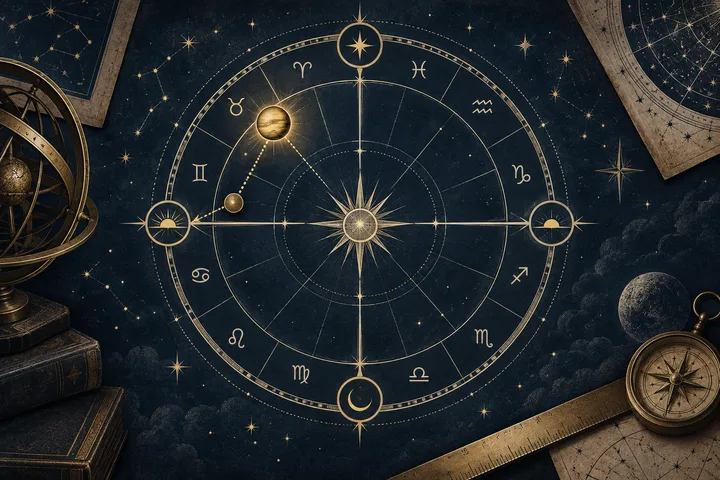
A planet can become dominant because it is a hub. Count its close major aspects to the Sun, Moon, Mercury, Venus, Mars, Jupiter, Saturn, and the angles you are using. The count is not a verdict. It tells you how many other parts of the chart speak through that planet. A planet with one loose trine may be pleasant but quiet. A planet tied into a conjunction, square, opposition, and the Ascendant has a much busier job.
Give the tightest contacts the most weight. A conjunction at one degree deserves more attention than a square at five degrees, even though both are major aspects. A six-degree orb may be useful for the comparison method in this report, but the outer edge should not outrank a close aspect. Keep your policy stable. If you widen the orb only for the aspect that supports your favorite interpretation, the chart starts serving the conclusion.
Look for aspect patterns, too. A planet connected to two other planets may act as a bridge between their meanings. Mars linking the Moon and Venus can join feeling, attraction, and action. Saturn linking Venus and the Sun can make affection answer to standards, time, and responsibility. The planet in the middle often becomes the place where the chart has to do its work.
An unaspected planet deserves a different kind of attention. It may not dominate by network, but its symbolism can operate with unusual independence. It does not automatically become the strongest planet. Instead, ask where it goes when activated by another chart. A partner’s close conjunction to an unaspected Venus may give that Venus a clear relational channel, making the contact feel vivid even if the natal Venus had been difficult to place.
Write the aspect count beside the angularity notes. If the same planet appears near an angle, rules the Ascendant, and connects several personal planets, you have a strong candidate. If three planets divide those honors, do not invent certainty. Carry the shortlist forward. The next layer, planetary condition, will tell you whether the loudest planet is also able to act with ease.
When you count, avoid counting every line on a software wheel as equal. Minor aspects, points, asteroids, and generational contacts can enrich a mature reading, but they should not drown out a close conjunction between personal planets. Start with the major aspects and the chart angles. Then add a secondary layer only when it clarifies a pattern already visible. This is especially important in synastry, where two charts double the number of possible contacts. A disciplined shortlist protects you from what looks like abundance but is really noise.
Ask what the planet connects. A planet with many aspects is not automatically dominant if all those contacts are wide or belong to slow planets in the same generation. A planet with three tight contacts to the Moon, Venus, and Mars may be more central to lived relationship experience. The count gives you a map of traffic. The kinds of planets involved tell you what the traffic is carrying. In a relationship report, that difference matters: a networked outer planet may describe a shared generation, while a tightly connected personal planet can describe the way two people actually meet.
You can make the count more useful by sorting contacts into layers. Put angles and luminaries first because they describe presence, vitality, and response. Put Venus and Mars next when the question concerns affection, attraction, or conflict. Put Mercury beside them when the relationship question is about words, timing, or interpretation. Then look at Jupiter and Saturn for expansion, commitment, limits, and long-term shape. Outer planets can intensify or transform the story, but they should enter after you understand the personal layer they are contacting. This order gives the chart a spine. It also stops one striking Pluto aspect from swallowing the Moon, Venus, or Mars contacts that describe what the two people actually do with each other.
Sources: Understanding Planetary Dignity and Debility, Part 5 - Skyscript; How to Find the Dominant Planet in a Natal Chart - Natal Chart; Relationship Charts - Astrodienst; An Introduction to Aspects and Chart Shaping - Skyscript
Separate planetary strength from planetary ease
This is where many dominant-planet guides flatten the chart. Strength and ease are different questions. Essential dignity asks how well a planet can express its nature through sign and degree. Accidental strength asks how prominently or effectively the planet is placed through house, angularity, motion, visibility, and contact. A planet can be loud but strained. It can be dignified but hidden.
In traditional language, a planet in its own sign has a strong home base. A planet in exaltation has a different kind of strength. Detriment, fall, and lack of essential dignity describe less comfortable conditions, but they do not erase the planet. A Mars in Taurus can still be angular, heavily aspected, and impossible to ignore. Its strength may show as persistence, frustration, or a struggle to act cleanly rather than as effortless initiative.
That distinction matters in synastry because a partner often meets both the planet and its condition. If a dignified Venus receives a close Moon contact, affection may have a steady language to speak through. If a difficult but dominant Venus receives the same contact, the bond can still be tender, but it may also stir questions about worth, trust, pleasure, or control. The contact activates the planet. It does not rewrite its natal story.
Use dignity as a modifier, not a contest score you must obey. Historical point systems can organize judgment, and they can help you compare several candidates, but the numbers are guides. A mechanical total cannot decide whether the planet’s prominence comes from an angle, a rulership chain, an aspect pattern, or a specific life area. Read the chart’s architecture first.
Your notes should now distinguish four things: where the planet is loud, what it rules, how it connects, and how comfortably it functions. That sentence is more useful than “Venus is dominant.” Try this instead: “Venus is the leading candidate because it rules the Ascendant, sits near the Descendant, and joins Mars within two degrees, but its expression is cautious because it is in Virgo.” Now you have something another chart can actually meet. You can also note whether the planet is applying toward or separating from a close aspect when that technique is part of your chosen method, but keep that refinement secondary to the major pattern.
Do not turn dignity into a moral ranking. A planet in detriment is not a bad planet, and a planet in domicile is not a guarantee of wise behavior. Dignity describes the planet’s resources and fit. An exalted planet may be lifted toward a purpose that asks a lot from it. A fallen planet may show a tender place where the person has had to develop skill through effort. In a relationship, the partner may bring that skill out, or may press on the difficulty. The chart gives you the condition. The people give it a form. A difficult condition can describe a lesson, a defense, or a style that needs translation. It does not describe a fixed limit on love or choice.
Also separate a planet’s ability from its visibility. A quiet planet can work well without being the chart’s loudest symbol. A visible planet can dominate attention while struggling to express itself. In synastry, the partner may notice the visible planet first, then gradually encounter the quieter one through daily life. A good reading leaves space for both experiences. This is one reason not to reduce dominance to a single percentage. The chart is a hierarchy of emphasis, not a scoreboard with a universal formula.
Sources: Dignities & Debilities - Skyscript Glossary; Understanding Planetary Dignity and Debility, Part 5 - Skyscript; How to Find the Dominant Planet in a Natal Chart - Natal Chart
Use a worked example before you compare two people
Imagine Maria with Libra rising, Venus at 3 degrees Virgo in the eleventh house, Mars at 3 degrees Capricorn within one degree of a 4-degree Capricorn Midheaven, and the Moon at 5 degrees Aries. Maria’s chart ruler is Venus. Venus describes her social instinct, her way of choosing, and her desire to create balance. But Mars is angular, exactly trine Venus, and square the Moon within two degrees. Which planet is dominant? The honest answer is not “obviously Venus.”
Give the candidates roles. Venus wins structural importance because it rules the Ascendant. Mars wins visibility because it is tightly angular. Mars also has a clear connection to the Moon, so it links emotional reaction with public action. Venus has its own story, including careful standards in love and friendship, but Mars may be the planet other people feel first. The chart has a Venus-Mars tension, not a single flat label.
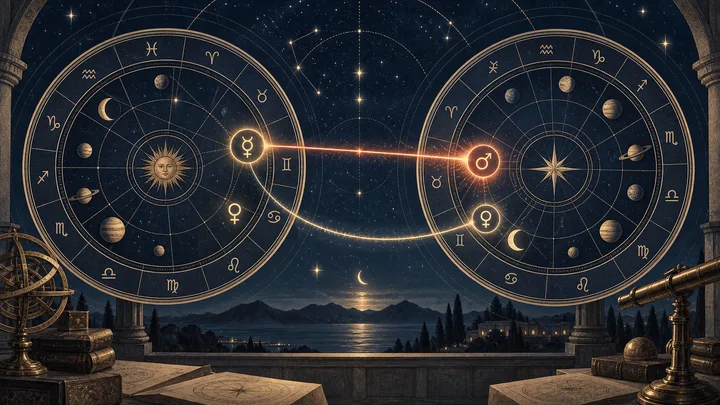
Now add a second, wholly hypothetical chart. Theo has Mercury at 3 degrees Capricorn, Moon at 4 degrees Taurus, and Saturn at 5 degrees Cancer. Theo’s Mercury exactly conjuncts Maria’s Mars. His Moon trines her Venus within one degree, while his Saturn opposes her Mars within two degrees. The contacts do not merely say “good communication,” “emotional ease,” or “conflict.” Theo’s Mercury enters Maria’s most active natal channel. His Moon offers a softer route to her Venus. His Saturn presses on the same Mars with weight and resistance. The dominant planet becomes a doorway, not a personality verdict.
Notice what this example does and does not claim. Maria and Theo are imagined names, and every placement belongs only to this worked example. The example does not say the couple must date, marry, or separate. It shows a reproducible method using stated degrees: identify a natal candidate, describe its condition, find the other person’s close contact, then read the planet-to-planet exchange.
If you do not have exact degrees, stop the example earlier. You can compare known signs and ask whether the signs form a broad elemental or modal relationship, but you cannot honestly call a conjunction, square, or trine calculated. A sign relationship may guide a first impression. It does not establish the exact aspect used in this six-degree method. Keep that boundary visible in your notes.
The worked example also shows why ownership matters. Maria’s Mars does not become Theo’s Mars simply because Theo’s Mercury touches it. Maria still carries the natal Mars pattern. Theo brings Mercury into the exchange. In practice, Maria may feel that Theo’s questions speed her up or challenge her timing, while Theo may feel that Maria’s presence makes his words more decisive. Both descriptions can be true. Synastry is not a score for who has more power. It is a map of how two planetary functions meet, with each person retaining the meaning of their own chart.
A worked example should make the method easier to repeat, not persuade you that every couple will look like Maria and Theo. Change the planet and the questions change. A dominant Moon asks about safety and response. A dominant Venus asks about attraction and value. A dominant Mercury asks about naming, interpretation, and nervous movement. The structure stays stable while the planetary language changes. That is the point of a field guide: you should be able to replace the signs and degrees with your own supplied placements without changing the reasoning.
Carry the dominant planet into synastry
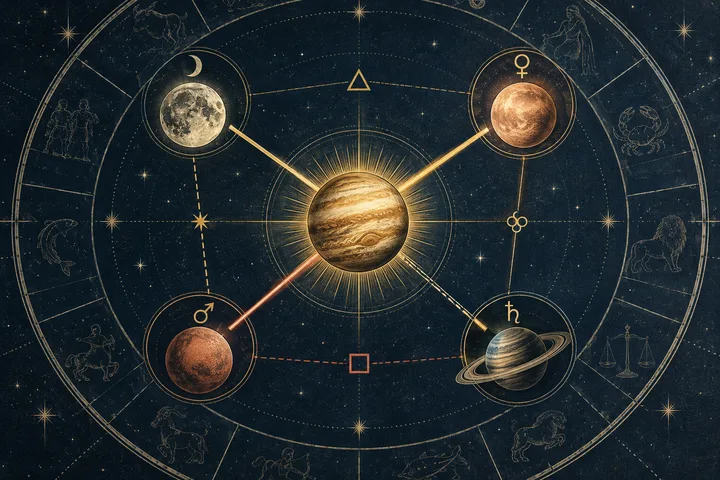
Once you have a natal shortlist, place the other person’s planets against it. Synastry compares two natal charts directly. It asks where one person’s planets contact the other person’s planets and angles, and where each person’s planets fall by house in the other chart. The dominant planet gives you a priority lens. It tells you which contacts deserve attention first.
Start with the personal planets. A partner’s Moon, Venus, or Mars contacting a dominant natal planet usually feels more immediate than a loose contact from a slow planet. The Sun and Mercury matter, too. The Moon can make the planet emotionally present. Venus can invite affection or valuation. Mars can activate desire, conflict, pursuit, or courage. Mercury can name, question, or provoke the dominant theme.
Once you find a contact, ask what it activates rather than reaching for a verdict. Mercury can turn a dominant Mars into a subject for questions, plans, arguments, and quick decisions. Venus can draw that Mars toward pleasure, preference, and pursuit. Saturn can slow it, test it, or give it a durable container. The natal owner keeps the planet’s original role; the contacting planet supplies the setting in which that role becomes noticeable.
Then check house overlays if birth times are reliable. A partner’s planet falling in the other person’s first, fifth, seventh, eighth, or tenth house can give the contact a clear life setting. But house interpretation depends on accurate angles. If a birth time is unknown, do not pretend to know the houses or angle contacts. You can still compare supplied sign placements and degrees, but your scope is narrower.
Use a six-degree maximum orb for the selected major cross-chart aspects in this editorial method, then rank the contacts within that window. A conjunction at one degree leads. A square at five degrees follows if it repeats the natal theme. A single six-degree contact should not overpower three tight contacts pointing elsewhere. The dominant planet is your opening lens, not your closing argument.
Read the exchange in both directions. If your Venus contacts your partner’s dominant Saturn, you may experience Saturn’s standards through your Venus: affection feels tested, shaped, or made serious. Your partner may experience your Venus as the part of life that Saturn must protect, limit, or commit to. Reverse the planets and the emphasis changes. This is why “her Venus on his Saturn” and “his Saturn on her Venus” are not interchangeable sentences, even when they describe the same geometric contact. Name the owner of each planet every time.
House overlays add setting, not automatic priority. A partner’s planet in your seventh house can make partnership themes vivid, while a tighter aspect to your dominant planet may describe the sharper exchange. Read the overlay beside the aspect. If the two layers agree, the interpretation gains coherence. If they diverge, keep both meanings visible instead of using the house to rescue a weak aspect or using a dramatic aspect to erase the life area it falls in.
Sources: Relationship Charts - Astrodienst; An Introduction to Aspects and Chart Shaping - Skyscript; Orbs (or rays) - Skyscript Glossary
Rank the contact instead of chasing the loudest story
A dominant planet can make one synastry contact look more important than it is. You see Pluto on Venus, Saturn on the Moon, or Mars on the Ascendant and the reading starts to orbit the dramatic image. Resist that pull. Rank the pattern by natal prominence, aspect exactness, planet function, repetition, and the behavior the contact actually describes.
First, ask whether the contact reaches the leading planet or only a minor candidate. A close Moon contact to the chart’s dominant Saturn deserves attention. A wide outer-planet contact to an otherwise quiet point may be secondary. Second, ask whether the aspect repeats a natal theme. If a person’s Mars already links the Moon and Venus, a partner’s Mars contact may intensify an existing pattern. If it appears nowhere else, treat it as an important encounter, not the whole identity.
Third, separate harmony from ease. Trines and sextiles can help two people cooperate, but they may not demand attention. Squares and oppositions can create friction, yet friction can make a bond active, honest, and growth-producing. A close aspect tells you that energy moves. It does not tell you whether the movement is pleasant or destructive. The planets and their condition supply that meaning.
The strongest exception is a chart with no single dominant planet. Perhaps the Ascendant ruler is angular, Venus rules the seventh house, and Saturn holds the tightest aspect pattern. In that case, use a three-part reading. Name the structural ruler, the relationship significator, and the network hub. Then ask which one the partner activates most closely. A tie is not a failure. It may describe a person whose identity, relating style, and life pressure pull in different directions.
In the hypothetical Maria-Theo example, the ranking is clear. First comes Theo’s Mercury conjunct Maria’s Mars at zero degrees, because it activates her angular planet through direct speech, questions, and decisions. Second comes his Moon trine her Venus at one degree, because it offers emotional ease to the chart ruler. Third comes his Saturn opposite her Mars at two degrees, because it adds pressure and pacing to the same active channel. This does not make Saturn “bad.” It tells you which contact to examine first, which one supports it, and which one complicates it.
Ranking also prevents the word intense from doing too much work. Intensity may describe closeness, pressure, fascination, fear, desire, or simple repetition. Replace it with the planetary action you can name. Saturn makes a contact weighty. Mars makes it active. Venus makes it evaluative and affectionate. Mercury makes it verbal and interpretive. The Moon makes it immediate and felt. Pluto may deepen or concentrate a theme, but it should not erase the personal planets carrying the daily relationship. When you name the action, the reading becomes less theatrical and more accurate.
A useful ranking ends with a test, not a prophecy. Look at the top contact and ask whether it appears in actual behavior. If Saturn is central, do you see time, duty, boundaries, or fear of failure? If Venus is central, do you see preference, tenderness, comparison, or a need for reciprocity? If the supposed theme never appears, lower its rank and inspect the next candidate. Astrology is interpretive, but interpretation still benefits from attention. The test is not meant to cancel the chart. It helps you decide which expression deserves the next question. That keeps the report curious without making it vague.
Sources: Dignities & Debilities - Skyscript Glossary; Relationship Charts - Astrodienst; An Introduction to Aspects and Chart Shaping - Skyscript; Orbs (or rays) - Skyscript Glossary
Turn the method into a useful conversation
A synastry reading becomes valuable when it changes what you notice between people. The dominant planet gives you a question to carry into real life. If Saturn leads, ask how responsibility, timing, and expectations enter the bond. If Venus leads, ask what each person values and how affection is shown. If Mars leads, ask how desire, initiative, anger, and repair move between you. The chart names the field. Your choices shape the play.
Keep the conversation concrete. Instead of saying, “Your Saturn controls my Mars,” say, “When I want to move quickly, do you feel pressured? When you ask for a plan, do I hear support or criticism?” The astrology stays present, but it stops floating above experience. A planet’s symbolism becomes useful when you can recognize its expression in a decision, a habit, or a repeated exchange.
If the dominant planet receives supportive contacts, ask how to use the ease deliberately. A Venus-Moon connection may support tenderness, but you still need to say what makes each person feel cared for. A Mars-Sun trine may make action easy, but you still need a shared goal. If the dominant planet receives hard contacts, ask what practice would give the energy a better channel. A Saturn-Moon square may need patience and emotional reassurance. A Mars-Mercury square may need rules for disagreement.
This is also where you protect the limits of the method. A chart comparison can describe symbolic contact. It cannot decide consent, safety, shared values, or whether someone is willing to repair harm. Those questions belong in the relationship itself. Astrology can help you ask better questions. It cannot make another person answer them.
End with one specific conversation. “When my need for action meets your need for caution, what would a fair pace look like for both of us?” That question respects the chart’s tension without turning it into fate. It also keeps the reading pointed toward a decision you can actually make.
You can build this conversation from the dominant planet in three steps. Name the pattern without blame. Describe the moment when it appears. Ask for a shared practice. With a dominant Moon, that might sound like, “I need reassurance before I can think clearly. When plans change without warning, I withdraw. Can we tell each other sooner?” With a dominant Mars, it might be, “I move toward problems quickly. When you need more time, I read it as refusal. Can we agree on when we will return to the issue?” The chart supplies the language of the pattern. The question supplies a way out of repetition.
Let the information you have shape the conversation. With Moon, Venus, and Mars signs, ask about comfort, affection, desire, and pace. With degrees, ask about the closest selected aspects and how they show up in a real exchange. With reliable birth times, ask what house setting makes the pattern visible. A narrower reading can still be rich. It earns trust by turning known symbols into a question you can actually answer together, instead of stretching missing layers into certainty.
That is the right place to finish. You do not need a soulmate verdict, a compatibility percentage, or a dramatic promise. You need a ranked picture of what each person brings, where the charts meet, and which pattern deserves care. The dominant planet gives the reading a center. The synastry contact gives it a relationship. The conversation gives it a choice. It is enough to begin with one honest question and one observable change. Start there, and let the chart become a guide to attention rather than a substitute for it. That is where interpretation becomes useful in daily life and shared choices, with care and clarity.
Sources: Relationship Charts - Astrodienst; An Introduction to Aspects and Chart Shaping - Skyscript; Orbs (or rays) - Skyscript Glossary
A little more clarity
Can I identify a dominant planet without an exact birth time?
You can make a partial comparison, but you cannot confidently use the Ascendant, Midheaven, house position, or angle contacts without a reliable birth time. Start with sign placement, known degrees, major aspects, rulership, and any clearly repeated pattern. Call the result a shortlist rather than a final dominant-planet judgment. Then keep synastry to the placements you actually know. Do not infer houses or angle contacts from a guessed time.
Sources & further reading
- Dignities & Debilities - Skyscript Glossary
Supports the distinction between essential dignity by sign and accidental strength through angularity, house, motion, and other conditions.
- Understanding Planetary Dignity and Debility, Part 5 - Skyscript
Supports using dignity tables as guides to planetary strength while preserving discretionary judgment instead of treating scores as final.
- How to Find the Dominant Planet in a Natal Chart - Natal Chart
Supports comparing angularity, Ascendant rulership, aspect connections, and sect when identifying a leading natal planet.
- Relationship Charts - Astrodienst
Supports the scope of synastry as a comparison of two natal charts through inter-chart aspects and house placements.
- An Introduction to Aspects and Chart Shaping - Skyscript
Supports distinguishing major aspects, aspect patterns, angular contacts, and the stronger effect of closer aspects.
- Orbs (or rays) - Skyscript Glossary
Supports defining an orb as distance from exactness and treating applying or separating contacts with different strength.
Synastry Comparison Report
Enter known placements for two people. Get an input-by-input comparison, selected aspect calculations and a clear record of what remains uncertain.
Compare our placements