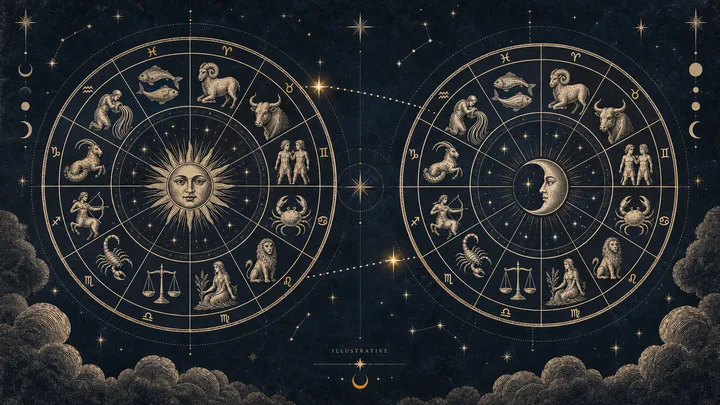
Imagine a close contact that does not behave like its label
Imagine Maria has Venus at 28° Leo and her partner has Mars at 2° Sagittarius. A chart program may call this a square because the planets sit 94 degrees apart, just 4 degrees from 90. But Leo and Sagittarius make a trine by sign, not a square. The signs share fire, yet they carry different ways of moving through desire, pride, and freedom. This is the kind of contact astrologers call dissociate, or out of sign.
The scene is easy to recognize. Maria may want warmth, visible affection, and a proud, wholehearted response. Her partner may act directly, speak candidly, and need room for movement rather than a carefully staged moment. The degree contact can describe heat or friction. The sign pairing describes why the same moment may land differently for each person.
That does not make the aspect meaningless. It makes it layered. The strongest reading is not ‘this is a square, so the relationship is difficult.’ It is ‘these planets are close enough to press on one another, but they speak through signs with different rules.’ That difference is the useful information.
Sources: Dissociate Aspect - Skyscript Glossary; Aspect - Skyscript Glossary; TAP Ep. 323 Transcript: Aspects in Astrology: The Five Major Configurations
What dissociate means in a synastry chart
An aspect is an angular relationship between two chart points. A conjunction is near 0°, a sextile near 60°, a square near 90°, a trine near 120°, and an opposition near 180°. An orb measures how far the contact sits from the exact angle. A planet at 28° Leo and another at 2° Sagittarius are 94° apart, so a degree-based reader may consider them within square orb. Yet Leo and Sagittarius form a trine by sign. The degree relationship and the sign relationship disagree.
That disagreement is the definition of a dissociate aspect. The word does not mean that the planets have no relationship. It means that the relationship is not cleanly expressed by one layer of the chart. The contact crosses a boundary, usually because one planet is late in its sign and the other is early in the next or another sign reached by the angle.
The term is most useful when it prevents a false choice. You do not have to pretend the degree is irrelevant, and you do not have to erase the signs because the degree is close. Record both facts. Then decide which one carries more weight for this chart comparison. That judgment should be visible in the reading, not hidden behind a single aspect label.
A square by degree across signs with a trine relationship isn't simply a softened square. It can bring pressure through a sign pairing that supplies shared energy. The couple may agree that something is happening and still disagree about what it means.
A dissociate synastry aspect is an aspect that exists by degree but crosses a sign boundary, so the signs do not form the usual pairing for that angle. Read both layers. The degree tells you that the two planets are close enough to interact. The signs tell you how that interaction is colored, supported, or interrupted. In practice, a very tight contact deserves attention, but it should not outrank a clear in-sign contact simply because a software report prints a familiar aspect name beside it. Start with the exact degree distance, then identify the signs’ actual relationship, then ask what the two planets mean in the comparison. If the contact is Venus-Mars, for example, discuss attraction and pursuit through the signs involved rather than calling it automatic chemistry. A supplied-placement report can compare those signs and optional degrees, but it cannot calculate missing natal positions or houses. The useful next step is to bring the contact into a conversation about one observable pattern: how you show desire, ask for space, or repair tension.
Sources: Dissociate Aspect - Skyscript Glossary; Aspect - Skyscript Glossary; TAP Ep. 323 Transcript: Aspects in Astrology: The Five Major Configurations
Why the sign pairing changes the interpretation
Signs give the planets a language. Aries acts directly. Cancer protects and responds. Leo expresses with warmth and pride. Sagittarius seeks room, meaning, and movement. These are interpretive principles, not fixed verdicts about a person. When two planets meet across signs, the signs show the style in which the contact arrives.
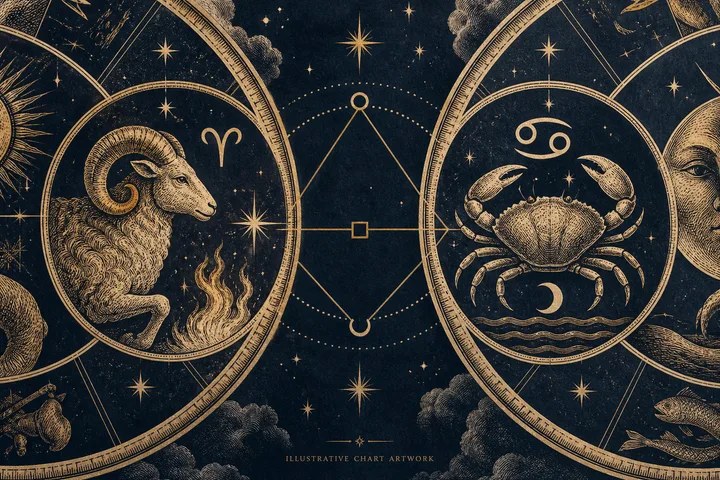
The usual major aspects carry sign logic. A trine joins signs of the same element. A square joins signs of the same modality. An opposition joins signs across the zodiac. A conjunction joins the same sign in a sign-based approach. If the degree says square while the signs say trine, the contact contains two stories. The square describes pressure at the level of the angular distance. The trine describes a sign-based affinity, or at least the sign relation that the planets actually occupy.
This is why the sign pairing still matters. It tells you whether the planets recognize one another through shared element, shared mode, polarity, or some other relationship. It can also show the barrier. A close contact that crosses into signs with no familiar major relationship may feel present but hard to use. The planets touch, yet the people do not automatically know what to do with the touch.
The cleanest order is planet first, geometry second, sign relationship third, repetition fourth. Start by asking what the two planets signify in a synastry comparison. Then state the degree contact. Then describe the actual signs and their relationship. Only after that should you decide whether the contact is prominent, qualified, or peripheral.
The label alone has no relationship story inside it. Venus-Mars, Moon-Venus, and Mercury-Mars each ask different questions, even when the angle and orb are identical.
Sources: Dissociate Aspect - Skyscript Glossary; Aspect - Skyscript Glossary; TAP Ep. 323 Transcript: Aspects in Astrology: The Five Major Configurations
A worked Venus-Mars example without a compatibility score
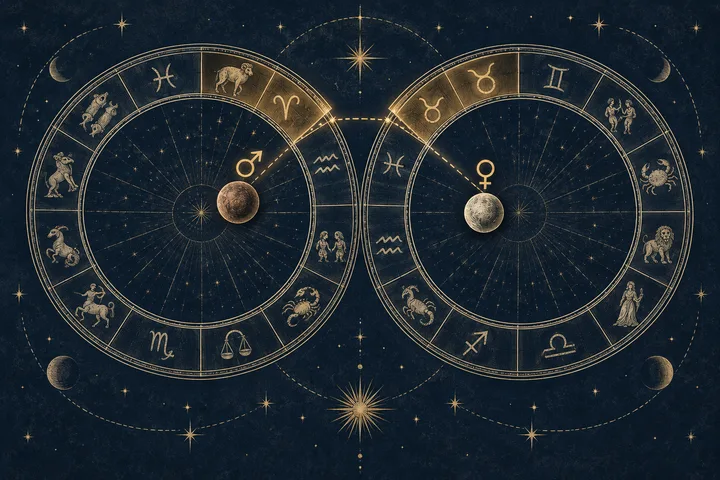
Consider an example with Venus at 1° Pisces and Mars at 29° Aries. The planets are 58° apart, within 2° of a sextile by degree. Pisces and Aries, however, are adjacent by sign rather than sextile signs. A reader who stops at ‘Venus sextile Mars’ may expect an easy meeting of affection and desire. A reader who ignores the degree may miss a genuine spark. The fuller picture holds both.
Venus in Pisces tends to value tenderness, imagination, and emotional merging. Mars in Aries moves through direct action, heat, and quick initiative. The near-sextile can make the two planets responsive to one another. The sign relation can make the timing uneven. Venus may want atmosphere and softness. Mars may want a clear opening and an immediate answer.
In daily life, that could look like one person planning a quiet evening and the other asking first whether the relationship feels secure. The affection is not absent. The route to it differs. The dissociate quality is the gap between contact and translation. Read it as a bridge that needs a shared vocabulary, not as a promise of effortless romance.
This ranking protects the reader from two opposite errors. The first is software literalism, where every printed aspect is treated as equally clear. The second is sign-only dismissal, where a close contact is thrown away because the signs do not cooperate with the label. Both errors remove information. A ranked reading keeps the information and gives it the right volume.
Read the example as a method, not a forecast. These placements demonstrate the calculation and the interpretive split; they don't stand in for a complete natal chart.
Sources: Dissociate Aspect - Skyscript Glossary; TAP Ep. 323 Transcript: Aspects in Astrology: The Five Major Configurations; What’s Your Sign? An Intro to Synastry Charts and Astrological Compatibility
How traditional and modern approaches weigh the contact
Astrologers do not all give the same answer to an out-of-sign aspect. A sign-first or traditional reader gives the signs’ relationship priority: if the signs do not form the named figure, the degree contact may be partial, weakened, or not a complete version of that aspect. A degree-first reader keeps the contact because the planets sit near the exact angle, then qualifies it through the sign boundary. Neither method is careless. They are answering different questions about what it means for planets to regard one another.
That difference matters when two reports disagree. ‘Venus and Mars make a square’ may mean a full in-sign square in one report and an out-of-sign degree contact in another. Check the zodiac, aspect list, and orb before arguing about the interpretation. A clean report names its convention in one sentence, then applies it consistently. The reader should never have to reverse-engineer the rule from the adjectives.
A sign-first reading is especially helpful when the couple wants to know why a supposedly tense aspect doesn't feel like constant conflict. A degree-first reading is helpful when the couple keeps returning to a charged subject that the sign pairing alone would overlook. In both cases, the interpretation improves when it says what each method sees and where each method stops.
Use the approach that matches the question. Degrees tell you whether the contact is close. Signs tell you why its expression may feel natural, awkward, or mixed.
Sources: Dissociate Aspect - Skyscript Glossary; Aspect - Skyscript Glossary; TAP Ep. 323 Transcript: Aspects in Astrology: The Five Major Configurations
The orb decides how much attention the contact gets
The orb is the distance between the actual planetary positions and the exact aspect angle. A 1° contact and a 5° contact do not ask for the same attention. The synastry guidance opened for this article gives smaller orbs greater strength and describes six degrees or less as a useful close range, while also acknowledging that astrologers work with different limits.
For this report, six degrees is the working boundary. It is a boundary, not a universal law. A contact at 1° can lead the discussion if the planets matter to the reader’s question. A contact at 5° may deserve a sentence and support from another pattern. A contact at 7° should not be pulled back into the reading because its label sounds appealing.
Write the arithmetic plainly. Venus at 1° Pisces and Mars at 29° Aries sit 58° apart, so the distance is 2° from a sextile. Venus at 29° Pisces and Mars at 29° Aries sit 30° apart, which is a semi-sextile by degree, not a sextile. Both pairs are adjacent by sign, but only the first makes a close sextile case. The numbers change the volume; the signs change the tone.
A useful report can call these contacts primary, qualified, or background. Those labels keep a crowded list readable. Primary means close and relevant, with support elsewhere. Qualified means close but altered by the sign boundary. Background means wide or unreinforced. The labels help the reader follow the argument, but the explanation must still name the planets and signs.
The useful sentence carries both weight and limit: ‘This is a close Venus-Mars contact, but its adjacent signs make the approach less automatic.’ That is firmer than vague chemistry and more careful than a promise.
Sources: TAP Ep. 323 Transcript: Aspects in Astrology: The Five Major Configurations; What’s Your Sign? An Intro to Synastry Charts and Astrological Compatibility
A dissociate aspect can contain help and friction at once
Dissociate aspects resist clean words such as easy or difficult. The degree can create insistence while the signs offer cooperation. Or the degree can look smooth while the signs demand translation. That is why the aspect can feel compelling and awkward in the same week.
Imagine a Moon at 1° Pisces and Venus at 29° Aries. The planets sit 58° apart, near a sextile, but Pisces and Aries are adjacent. The Moon may need tenderness and retreat; Venus may show affection through direct warmth and quick appreciation. They can enjoy each other and still miss the form of reassurance the other person can feel.
Now change the pair. Imagine Mars at 28° Leo and Venus at 2° Sagittarius. The planets sit 94° apart, near a square, while Leo and Sagittarius share a trine by sign. The charge may show up as a disagreement about attention and freedom, not as a lack of desire. The degree supplies pressure. The signs show where that pressure travels.
Keep the boundary visible. A late-degree planet still carries its sign, while an early-degree planet has entered another. Rounded data can't support minute-level confidence, especially near an orb limit.
Sources: Dissociate Aspect - Skyscript Glossary; Aspect - Skyscript Glossary
What to check before you call an aspect dissociate
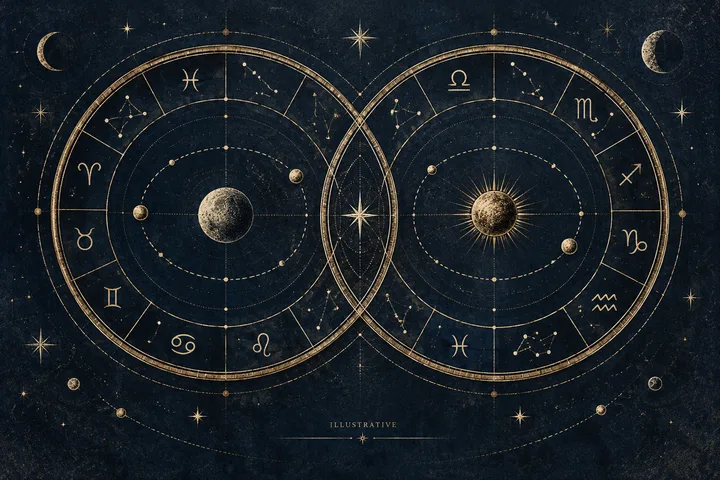
Before you call a contact dissociate, check five things. Confirm both degrees. Calculate the shortest distance around the zodiac. Compare that distance with the target angle. Check the actual sign relationship. Then look for repetition elsewhere in the comparison.
Check the scope, too. A supplied-placement comparison can cover Moon, Venus, and Mars signs, optional degrees, and selected major aspects within six degrees. It doesn't establish houses, angles, asteroids, declinations, or missing natal positions. A neat wheel can't supply data that wasn't entered.
Finally, ask whether another close contact repeats the same planet or relationship need. If it does, raise the contact's rank. If it stands alone, keep it as a clue.
Sources: TAP Ep. 323 Transcript: Aspects in Astrology: The Five Major Configurations; What’s Your Sign? An Intro to Synastry Charts and Astrological Compatibility
How the case changes when the orb or signs change
Return to the example and change one input at a time. If Venus moves from 1° Pisces to 3° Pisces while Mars stays at 29° Aries, the distance becomes 56°. The sign pairing is unchanged, but the sextile case weakens. Mention it if the rest of the comparison supports attraction; don't make it the lead contact.
If Venus moves to 29° Aquarius while Mars stays at 29° Aries, the pair becomes an exact 60° sextile by degree, and the signs now hold that sextile relationship as well. If Venus moves instead to 29° Pisces, the planets sit 30° apart, a semi-sextile by degree, while Pisces and Aries remain adjacent signs. These two changes show how both the degree angle and the sign relationship can alter the reading.
If Mars moves to 29° Taurus, Venus at 1° Pisces and Mars at 29° Taurus sit about 88° apart, near a square, while Pisces and Taurus form a sextile by sign. The question shifts from direct desire meeting tenderness to pressure meeting practical adjustment. Same planets. New conversation.
A chart can name a recurring pattern, but it can't decide what another person intends or whether a bond should continue. If the contact describes different pacing, ask whether both people can name the pace and negotiate it. If another close contact offers emotional ease, treat it as a resource, not an eraser. If nothing supports the theme, let the unusual line remain small.
Test the reading over one ordinary week. Note what starts the pattern, each person's first response, and what helps the moment settle.
Sources: Dissociate Aspect - Skyscript Glossary; Aspect - Skyscript Glossary; What’s Your Sign? An Intro to Synastry Charts and Astrological Compatibility
Turn the interpretation into a question you can use
A synastry reading earns its place when it helps you notice a pattern and speak about it. The dissociate aspect offers a precise kind of question: where do we feel the contact, but fail to share the same language for it? That question keeps the astrology close to lived experience.
For a Venus-Mars contact, ask: ‘When one of us reaches for closeness, what tells the other person that the approach is welcome?’ For Moon-Saturn, ask: ‘When one person needs comfort, does the other offer warmth, structure, or advice?’ For Mercury-Mars, ask: ‘When a conversation becomes urgent, do we move toward clarity or toward defense?’ The planets name the subject. The signs suggest the style. The couple supplies the evidence.
Then start one conversation: ‘When I reach for closeness, what helps you feel invited rather than rushed?’ Let the chart give that moment language. Let your answer come from what you both do next.
Bring the chart to the conversation as a question, not a verdict. Ask what each person experiences and what response would feel welcome.
Sources: Dissociate Aspect - Skyscript Glossary; What’s Your Sign? An Intro to Synastry Charts and Astrological Compatibility
A little more clarity
Is a dissociate aspect weaker than an in-sign aspect?
Often, astrologers read it as less direct or less pure because the signs do not support the named aspect in the usual way. A very tight degree contact can still matter, especially between personal planets. The right rank depends on the orb, the planets involved, the sign pairing, and whether another contact repeats the same theme. ‘Weaker’ doesn't mean absent. It means the contact may need more context before it becomes a leading interpretation.
Can a dissociate synastry aspect create attraction?
It can describe a strong pull or repeated activation, but it does not guarantee a particular outcome. With Venus and Mars, read the degree contact alongside the signs. The aspect may bring desire, while the signs show different ways of approaching closeness, safety, pace, or pursuit. Look for the lived form of that pull. Does it appear as invitation, impatience, play, or a need to clarify consent and timing?
Do I need exact birth degrees to identify one?
Yes. You need both planetary degrees to calculate an orb and compare the contact with the exact aspect angle. If you only know the signs, you can interpret the sign pairing, but you should not claim that a dissociate aspect is present. Houses and other chart layers also need their own complete inputs. If the degrees are rounded, say so, especially when a placement sits near a sign boundary or orb limit. The sign reading can begin now; the aspect judgment can wait.
Sources & further reading
- Dissociate Aspect - Skyscript Glossary
Defines a dissociate aspect as a degree-based aspect whose signs do not share the same aspectual relationship.
- Aspect - Skyscript Glossary
Supports the standard degree angles and the traditional sign relationships of the major aspects.
- What’s Your Sign? An Intro to Synastry Charts and Astrological Compatibility
Supports reading synastry through two natal charts, planet meanings, aspects, signs, and degree-based orb strength.
- TAP Ep. 323 Transcript: Aspects in Astrology: The Five Major Configurations
Supports distinguishing sign-based aspects from close degree-based aspects and giving tighter orbs greater intensity.
Synastry Comparison Report
Enter known placements for two people. Get an input-by-input comparison, selected aspect calculations and a clear record of what remains uncertain.
Compare our placements