What does a missing aspect actually tell you?
A missing major aspect tells you that the supplied planetary degrees did not meet one of the selected angular relationships within the stated orb. It doesn't tell you that the planets have nothing to say to one another.
That distinction matters in synastry. An aspect is a geometric contact between a factor in one chart and a factor in the other. A dispositor link is a rulership relationship. It asks whose sign each planet occupies and where that ruler is placed. These are different chart layers, so one cannot quietly replace the other.
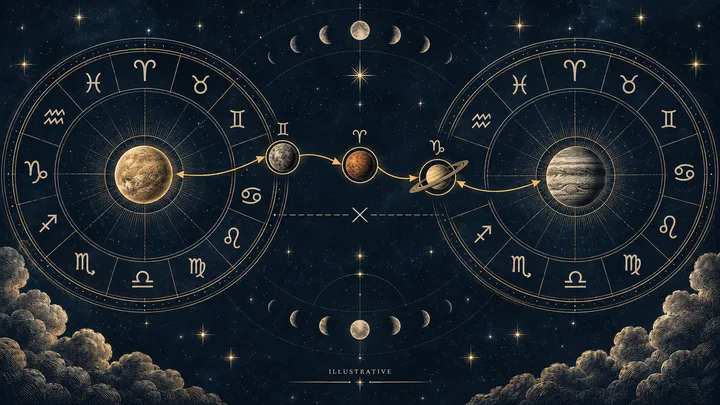
The right question is not, 'Where is the hidden Venus-Mars aspect?' Ask instead, 'What planet carries Venus's expression, what planet carries Mars's expression, and do those carriers meet elsewhere?' That wording gives the indirect link a useful job without giving it the weight of a direct contact.
Consider an example. Maria's Venus is in Gemini, and her partner's Mars is in Capricorn. No degrees have been supplied for this hypothetical comparison, so no claim about a qualifying Venus-Mars aspect can be made. The sign rulers can still be named: Mercury disposits Venus in Gemini, and Saturn disposits Mars in Capricorn. The possible theme is quick exchange meeting deliberate action. Whether that theme matters depends on the rest of the supplied placements and on what the couple actually recognizes in daily life.
Sources: Introduction to Relationship Astrology 2: Synastry, Philip Graves; Synastry Aspects Explained: How Two Charts Connect, AstroAk
What is a dispositor?
A dispositor is the planet that rules the sign occupied by another planet. Under traditional domicile rulership, Mercury disposits a planet in Gemini or Virgo, Venus disposits a planet in Taurus or Libra, Mars disposits a planet in Aries or Scorpio, Jupiter disposits a planet in Sagittarius or Pisces, and Saturn disposits a planet in Capricorn or Aquarius. The Sun rules Leo, and the Moon rules Cancer.
The ruler is often described as a manager, but the older guest-host image is more exact. The planet in the sign is the guest. The dispositor provides the setting and carries responsibility for what happens there. Its own sign, condition, and contacts change how the guest can express itself. The dispositor does not become a second Venus or Mars in the comparison.
Trace the logic with arrows. Venus in Gemini -> Mercury. If Mercury is in Capricorn, continue to Saturn. If Saturn is in Aquarius, the traditional chain stops because Saturn is in its own domicile. If the next planet's sign is not among the placements supplied, stop at that known endpoint. A partial chain is still a valid observation; an invented endpoint is not.
Choose the rulership scheme before tracing. The traditional scheme gives every sign one clear ruler. Many modern astrologers add Uranus, Neptune, or Pluto as co-rulers, but that creates a second interpretive layer. Name it if you use it. Don't switch systems halfway through because the modern chain produces a more dramatic conclusion.
Sources: Dispositor, Skyscript Glossary; Sign Rulers, Skyscript Glossary; The Tradition 4, The Tradition Journal
How should you check the direct planets first?
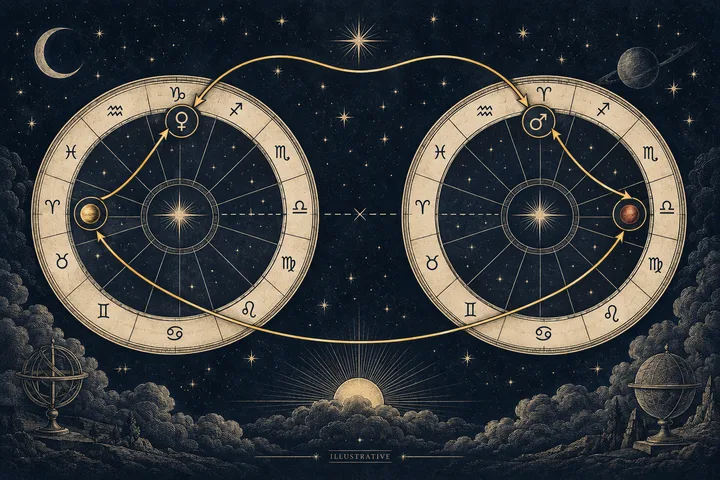
Start with the two planets the reader is trying to understand. Record their signs and their exact degrees when those degrees are available. Convert the positions to one zodiac circle, find the shortest angular separation, and compare it with the declared aspect set and orb.
This publication's comparison method uses a six-degree ceiling for selected major synastry aspects. That is a method choice, not a reason to stretch every contact to six degrees. A close contact generally deserves more emphasis than a loose one, and different aspect types may be given different working limits in other traditions. State the method you are using.
The synastry grid is useful because it makes the calculation visible. A relationship astrology guide recommends listing signs and degrees for both charts, calculating the separations, and limiting the number of contacts interpreted so the main picture does not disappear under minor details. The same discipline applies before you begin a dispositor reading.
If one planet is given by sign only, keep the sign-level interpretation and mark the degree aspect as unknown. Do not call the planets unaspected. 'No qualifying aspect in the supplied degrees' and 'aspect cannot be checked because a degree is missing' are two different results.
Sources: Introduction to Relationship Astrology 2: Synastry, Philip Graves; Synastry Aspects Explained: How Two Charts Connect, AstroAk
What does the first ruler layer add?
Read the planet first, then its sign, then its dispositor. Venus still describes attraction, affection, taste, and value. Mars still describes desire, initiative, heat, and pursuit. The signs show style. Their dispositors describe the planetary route through which that style is managed.
Return to the hypothetical example. Venus in Gemini may seek lively conversation, wit, and room for movement. Mercury, its dispositor, tells you what kind of exchange supports that Venus. Mercury in Capricorn would make words more selective and practical than the Gemini placement alone suggests.
Mars in Capricorn may approach desire through effort, timing, and a tangible result. Saturn, its dispositor, shows the deeper condition placed on that action. Saturn in Libra, for example, could make fairness, negotiation, and agreed terms part of the way the Mars expression works. This is an illustrative chain, not a supplied chart result.
Now the reading has a concrete shape. One person may want the conversation to stay open while the other wants a plan that can be kept. The dispositor layer doesn't decide who is right. It helps you ask what each style needs before closeness feels real.
Yes. A dispositor link can explain how a synastry theme is carried, even when the two planets do not form a major aspect by degree. It comes from sign rulership: a planet acts through the sign it occupies, and that sign points to its ruler. Read the ruler as a supporting channel, not as a hidden conjunction. Check the supplied degrees against the chosen six-degree major-aspect orb first. Then name each sign ruler, trace the chain only as far as the data allows, and look for a shared dispositor or mutual domicile exchange. The link deserves more attention when it repeats a theme already shown by the planets' signs or by another contact. If it stands alone, keep it in the background. A placement comparison can use supplied Moon, Venus, and Mars signs, plus optional degrees, but it does not calculate natal positions or houses from birth details.
Sources: Dispositor, Skyscript Glossary; The Tradition 4, The Tradition Journal
When does a dispositor link become mutual reception?
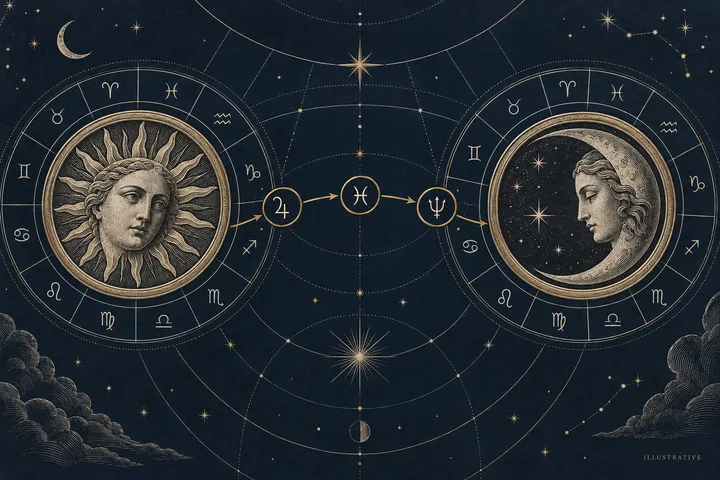
Mutual reception, in the narrow domicile sense used here, occurs when two planets occupy one another's signs. Venus in Aries is in Mars's domicile, while Mars in Taurus is in Venus's domicile. The planets exchange signs, even if their degrees do not form a major aspect.
That exchange is stronger testimony than two unrelated chains pointing to different planets. It joins the management systems of the two planets. But it does not erase the difference between Venus in Aries, which may act directly and quickly, and Mars in Taurus, which may move slowly and hold its ground.
There is an important vocabulary choice. Historical discussions describe reception in several ways, often involving a planet in another planet's dignity and an aspect or application between them. Some astrologers use the term more broadly for an exchange of signs. To keep the interpretation reproducible, write 'mutual domicile exchange' when that is all the chart shows. Add whether an aspect is also present.
The strongest exception to the usual ranking is a mutual domicile exchange supported by another clear testimony, such as an aspect between the rulers or a repeated Moon, Venus, or Mars theme. Then the exchange can move into the main interpretation. Without that support, it remains meaningful but should not be called a hidden aspect.
Sources: A brief comparison of the use of reception by historical authors, Deborah Houlding; The Tradition 4, The Tradition Journal
What can a longer chain show?
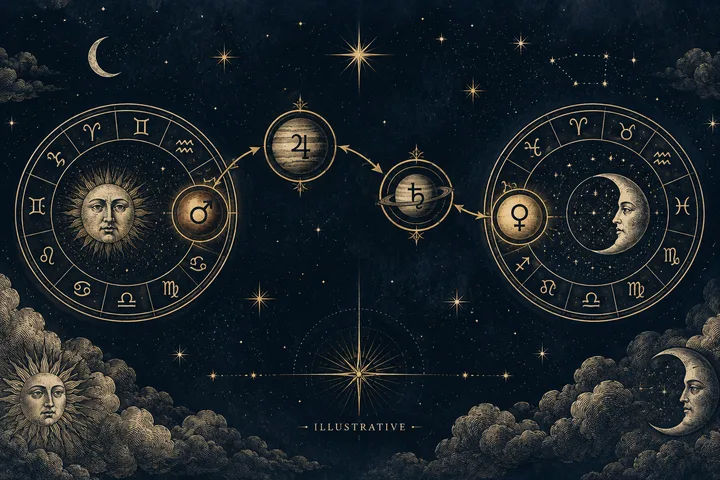
A longer chain shows where a placement's meaning travels. Venus in Gemini leads to Mercury. Mercury in Capricorn leads to Saturn. Saturn in Libra leads to Venus. The loop connects attraction, language, structure, and agreement.
Don't give every planet in the loop equal volume. A chain is most useful when it reaches a shared endpoint, connects the two immediate dispositors by a known aspect, or repeats a theme already visible in the direct signs. A long chain with none of those features is descriptive, not decisive.
A final dispositor is a planet in its own domicile that ends a chain. In a complete chart, several placements may converge on it. In a supplied-placement synastry comparison, identify it only for the planets and ruler scheme you actually have. It is not automatically the ruler of the whole relationship.
The same rule prevents double-counting. If Venus and Mars already have a close aspect and both chains lead to Jupiter, the shared Jupiter theme is confirmation, not a second promise. Use repetition to raise confidence in one interpretation, then ask what Jupiter changes about the way it is lived.
Sources: Dispositor, Skyscript Glossary; The Tradition 4, The Tradition Journal
How should you rank the evidence?
Use one ranking and apply it once. First, weigh a close major aspect between the relevant personal planets. Next, read the sign relationship and any dispositor contact that reinforces it. Then consider mutual domicile exchange without a major aspect, a shared dispositor or short chain, and finally a long isolated chain.
This ranking keeps direct geometry in the lead while giving rulership its proper value. A close Venus-Mars aspect describes the two principles meeting by degree. A Mercury-Saturn dispositor link may explain whether that meeting is carried through conversation, planning, caution, or delay. The indirect layer adds texture. It doesn't redraw the aspect table.
A missing aspect can therefore leave three possible conclusions. The link may be a strong supporting theme if it repeats other testimony. It may be a useful background note if the sign symbolism fits but nothing confirms it. Or it may be too thin to use if the chain is long, the inputs are incomplete, and no lived question matches it.
The reader's report can compare supplied Moon, Venus, and Mars signs, plus optional degrees and selected major aspects under the stated orb. It does not calculate natal positions from birth details, add houses, or produce a compatibility score. Those boundaries keep the ranking tied to the evidence in hand.
Sources: Introduction to Relationship Astrology 2: Synastry, Philip Graves; Synastry Aspects Explained: How Two Charts Connect, AstroAk
How can the interpretation become a real question?
A dispositor theme earns its place when it changes what you notice. Don't stop at 'communication and responsibility.' Name the scene. One person wants an answer while the other wants time to make a sound decision. The useful question becomes, 'What does a clear answer look like while we're still thinking?'
That question lets both planets participate. Mercury gets exchange. Saturn gets structure. A couple might agree that a delayed answer still includes a time to return to the conversation. The astrology has become a practice rather than a label.
If the chain ends in Venus, ask what care looks like in ordinary terms: a message, a plan, a favor, touch, or a promise kept. If it ends in Mars, ask how each person starts difficult work and how they want conflict to stop. If Saturn carries the pattern, ask what commitment requires in time, money, and boundaries.
Keep the question mutual. Synastry can feel stronger for one person than the other because each person's natal chart receives the contact through a different pattern. Describe the interaction. Don't turn one partner into the cause of everything, and don't use the chart to infer an intention the person has not expressed.
Sources: Introduction to Relationship Astrology 2: Synastry, Philip Graves
What should you do when the link is the only connection?
Keep it, but place it correctly. A dispositor link can explain an undertone when no aspect joins the planets, especially when the chain is short and the sign symbolism matches the question. If it is the only testimony, call it a background theme.
Use this compact sequence. Gather the supplied signs and degrees. Declare the ruler scheme and orb. Check the direct planets. Trace each dispositor only as far as the known data supports. Look for mutual domicile exchange, a shared manager, or a confirmed contact between the managers. Then choose the ordinary behavior the pattern might help you discuss.
The final decision is about emphasis. If the pattern repeats, bring it forward. If it is plausible but isolated, keep it brief. If it depends on a missing degree or an undeclared modern ruler, mark that dependency and stop. A restrained reading is not an empty reading. It tells you exactly what the chart layer can carry.
So yes, a dispositor link can explain a synastry theme without a direct aspect. It can show how a planet's agenda is carried and where two indirect routes may meet. It cannot replace degree-based evidence. Check the contact, name the ruler, rank the testimony, and turn the strongest pattern into one conversation the couple can actually have.
Sources: Dispositor, Skyscript Glossary; A brief comparison of the use of reception by historical authors, Deborah Houlding; Synastry Aspects Explained: How Two Charts Connect, AstroAk
A little more clarity
Can a dispositor link matter when the planets are in signs that do not aspect each other?
Yes. The link comes from sign rulership rather than angular distance. It can show how each planet's expression is carried, especially when the rulers are shared, in mutual domicile exchange, or connected by another clear testimony. It remains different from a degree-based aspect, so keep it supporting unless the pattern repeats strongly.
Should I use traditional or modern rulers for a synastry dispositor chain?
Choose one system before tracing the chain. Traditional domicile rulers give every sign one clear ruler and make a supplied-placement comparison easier to reproduce. If you add Uranus, Neptune, or Pluto as co-rulers, label that as a secondary layer and don't switch systems simply to reach a preferred conclusion.
Sources & further reading
- Dispositor, Skyscript Glossary
Defines the dispositor as the ruler of an occupied sign and explains its manager-like role and effect on planetary condition.
- Sign Rulers, Skyscript Glossary
Lists the traditional seven-planet domicile rulers and distinguishes modern outer-planet co-rulers.
- Introduction to Relationship Astrology 2: Synastry, Philip Graves
Explains cross-chart aspect grids, degree separation, tighter synastry orbs, reciprocal experience, and the need to limit interpretation.
- A brief comparison of the use of reception by historical authors, Deborah Houlding
Compares historical meanings of reception and distinguishes rulership-based relationships from aspectual reception and application.
- The Tradition 4, The Tradition Journal
Discusses dispositor function as a guest-host or steward relationship rather than a simple master relationship.
- Synastry Aspects Explained: How Two Charts Connect, AstroAk
Describes synastry as cross-chart aspect comparison and emphasizes angular contacts, tighter orbs, reciprocal experience, and repeated patterns.
Synastry Comparison Report
Enter known placements for two people. Get an input-by-input comparison, selected aspect calculations and a clear record of what remains uncertain.
Compare our placements