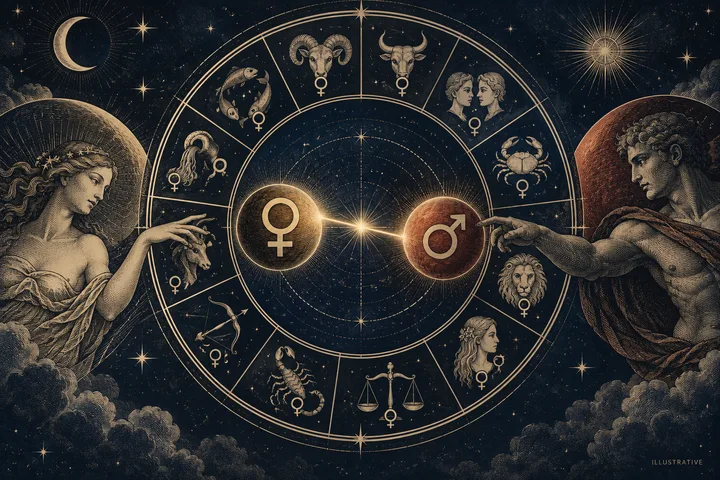
Imagine the spark is easy, but the love language is not
Imagine Maria has Venus in Taurus. She likes affection that feels steady, embodied, and unhurried. Her partner, Leo, has Mars in Taurus. He pursues through touch, persistence, and the simple pleasure of being close. For this illustrative scene, assume their supplied chart comparison identifies a close Venus-Mars conjunction; no personal degrees are being claimed here. When they sit together, the attraction is plain. He reaches for her hand. She notices. Neither has to stage the moment.
But Leo's Venus is in Gemini, while Maria's Mars is in Leo. That second layer speaks in a different rhythm. Leo may show love through questions, jokes, messages, and mental movement. Maria's Mars wants warmth, confidence, and a clear invitation to act. The relationship can be full of chemistry and still produce small misunderstandings. She may want him to stay with a feeling. He may want to keep the conversation light. He may expect playful banter to count as closeness. She may hear avoidance.
That is the case this article is built to read. It's a clearly illustrative scene, not a personal chart presented as fact. The contact describes the attraction between Venus and Mars. The separate Venus signs describe what each person finds pleasing, reassuring, and worth repeating. Those are related questions, but they aren't the same question.
Astrology gives each planet a job. Venus speaks for pleasure, attraction, taste, relating, and the way love becomes tangible. Mars speaks for desire, initiative, heat, anger, and the act of moving toward what one wants. When one person's Venus touches the other's Mars, the planets recognize each other. One person feels wanted. The other feels drawn toward the Venus person's style of receiving.
Start there. The aspect matters. So does the sign. Neither cancels the other.
Sources: Synastry; Synastry: Venus-Mars Aspects Between Two Charts; Aspect - Astrodienst Astrowiki
What a close Venus-Mars aspect actually adds
A synastry aspect is the relationship between two chart positions by degree. A conjunction brings them to the same part of the zodiac. An opposition places them across the circle. A square creates a ninety-degree tension. A trine links the same element. A sextile links signs that can cooperate when the people choose to engage. These names tell you how to inspect the contact before you decide what it means in the couple's daily life.
Close means the planets are near the exact degree of the aspect. In this publication's report scope, a selected major aspect uses a six-degree orb. The orb is the distance between the exact aspect and the actual planet positions. A Venus at 12 degrees Taurus and Mars at 15 degrees Taurus are three degrees apart, so the conjunction is close within that scope. A Venus at 12 degrees Taurus and Mars at 27 degrees Taurus are in the same sign, but the distance is fifteen degrees. That is not the same contact.
A tight contact gets your attention because it describes a concentrated exchange. A close square may feel more immediate than a wide trine, while a close trine may flow so naturally that the couple barely names it. The aspect tells you how the planets meet. The orb tells you how tightly. The signs tell you what material they bring.
This is why the phrase close Venus-Mars synastry needs two checks. How many degrees separate the planets, and which aspect do they make? A conjunction, square, trine, sextile, or opposition can all be close. First identify the geometry. Then read the signs and ask what kind of situation the aspect creates: recognition, flow, invitation, friction, or polarity.
Astrodienst's aspect reference treats the conjunction, opposition, square, trine, and sextile as principal major aspects and says to interpret each through the planets involved. Name the geometry first. Then let Venus and Mars speak through their signs.
If you only know signs, keep the reading at sign level. If you know degrees, include the orb. The Synastry Comparison Report accepts supplied Moon, Venus, and Mars placements with optional degrees; it organizes those inputs rather than calculating a natal chart from birth details. That scope keeps the conclusion matched to the evidence.
The six-degree boundary is a reading tool, not a command to treat every contact inside it as equally loud. A Venus-Mars aspect at zero degrees is exact; one at five degrees remains within this selected scope but may feel less concentrated. If several contacts are present, note the order. Exact is a sound reason to begin, not a verdict about the whole relationship.
Degree counting also protects you from a common shortcut. Two planets can sit in signs that look naturally compatible while missing a major aspect by degree. Two planets can also form a close geometric aspect while sitting across a sign boundary. In the first case, don't manufacture a contact from a pleasant sign story. In the second, don't discard the contact just because the signs make the symbolism less tidy. State both layers and explain the tension.
Read a close Venus-Mars contact as four facts in sequence: Venus's sign, Mars's sign, aspect type, and orb. Venus in Libra opposite Mars in Aries within two degrees suggests attraction across harmony and directness. Venus in Libra trine Mars in Aquarius within five degrees suggests social ease and shared ideas. The degree sharpens the reading. It doesn't replace the sign.
Imagine Maria has Venus in Taurus and her partner has Mars in Taurus, while his Venus is in Gemini and her Mars is in Leo. The close Venus-Mars contact can describe strong attraction, but it doesn't erase their different Venus styles. Read the chart in order: identify whose Venus meets whose Mars, name the aspect and orb, compare both Venus signs, then check the Moon and Saturn for emotional safety and continuity. A conjunction, square, trine, sextile, or opposition changes how desire moves. Missing degrees limit the precision of the orb reading, not the value of the sign comparison. Start with one practical question: what does each person call loving, and what behavior would make that visible?
Sources: Aspect - Astrodienst Astrowiki; Synastry - Astrodienst Astrowiki
Read the two Venus signs before you call the pair mismatched
Different Venus signs do not mean different capacities for love. They mean different preferences in the art of relating. Venus in Taurus may value steadiness, touch, loyalty, and sensory pleasure. Venus in Gemini may value conversation, variety, wit, and the feeling that the relationship stays mentally alive. Venus in Cancer may seek tenderness, memory, and emotional shelter. Venus in Sagittarius may need honesty, room, laughter, and a shared horizon. Use these as clues about what feels nourishing, not as verdicts about character.
Those descriptions are starting points, not cages. A Venus sign does not tell you that someone will always act well. It shows the style through which affection may feel natural. The question is not which sign loves more. The question is whether the couple can recognize love when it arrives in an unfamiliar form.
In Maria and Leo's example, Maria's Taurus Venus may ask, quietly, whether the bond is dependable. She may measure love by follow-through. Leo's Gemini Venus may ask whether the bond remains curious. He may measure love by attention, talk, and responsiveness. If he sends three funny messages during a busy day, he may feel present. If she wants a scheduled evening and a calm touch, she may still feel alone. Neither is necessarily withholding. They are offering different currencies.
The practical mistake is to use the Venus-Mars contact to answer a Venus question. It can show why two people move toward each other, but it doesn't tell you which gestures each person will recognize as care. Let Venus answer that narrower question. Compare the signs, then test the comparison against repeated behavior rather than against the intensity of the first attraction.
Compare the Venus signs on four practical questions. What kind of attention feels affectionate? What kind of pace feels safe? What form of pleasure feels restorative? What behavior makes appreciation visible? Aries Venus may prefer direct pursuit. Libra Venus may want mutuality and graceful exchange. Virgo Venus may notice care in useful details. Pisces Venus may respond to softness, imagination, and emotional permeability. The signs differ, but the editorial task stays the same. Translate preference into behavior.
Cafe Astrology's synastry guide makes a similar distinction when it describes Venus-Venus contacts: easy aspects can bring comfort, while difficult aspects may attract people whose styles and needs leave each feeling unappreciated. That insight belongs here even when the Venus signs themselves don't form the chosen aspect. The comparison is useful only when it becomes observable behavior.
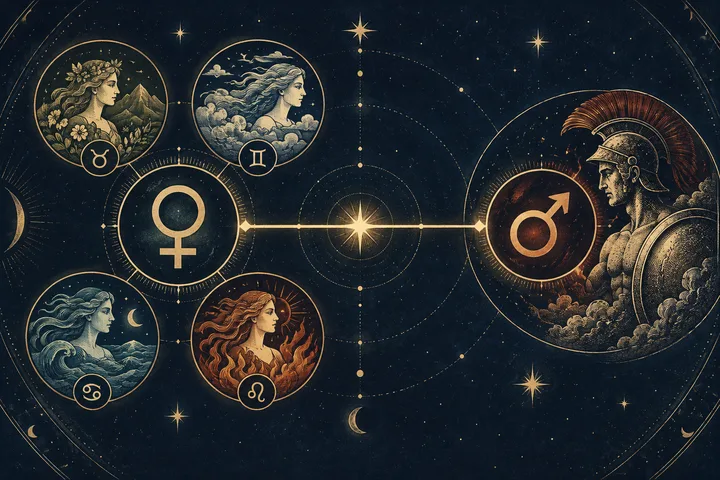
Synastry has direction. Venus conjunct another person's Mars isn't a vague cloud called mutual chemistry. It's an exchange between a Venus person and a Mars person, and each may experience it through a different door.
The Venus person may feel seen as desirable. Their style, softness, beauty, taste, or way of receiving pleasure draws the Mars person forward. The Mars person may feel activated. The Venus person makes pursuit feel worthwhile, and Mars wants to act, touch, initiate, protect, compete, or make something happen. These roles are symbolic, not gender rules. Either person can carry Venus or Mars in the contact, regardless of identity or relationship shape.
Suppose Maria's Venus in Taurus is conjunct Leo's Mars in Taurus. She may feel that his presence confirms her desirability. His Mars may feel calm and purposeful around her. He wants to be near her, and she can feel his wanting without needing a speech. Yet suppose Leo's Venus in Gemini is square Maria's Mars in Leo. Now her way of pursuing may press against his way of loving. Her Mars may be proud, warm, and direct. His Venus may want play, flexibility, and room to change the subject. He may enjoy her confidence one day and find it too forceful the next.
Reverse the contact and the emphasis changes. If Maria's Mars aspects Leo's Venus, Maria may feel driven toward Leo's charm and manner of receiving. Leo may feel admired, pursued, or stirred by her initiative. If Leo's Mars aspects Maria's Venus, Leo may carry more of the initiating charge while Maria notices how his action lands on her values and body. This is not about assigning blame. It is about locating the sensation.
Ask three questions before interpreting the aspect. Who owns Venus? Who owns Mars? Which person feels wanted, and which feels compelled to act? Then check the behavior. The chart can describe a pull, but the people still set the pace and show the care.
Sources: Synastry; Synastry: Venus-Mars Aspects Between Two Charts
How the aspect changes the story: conjunction, trine, sextile, square, opposition
The aspect is the verb in the sentence. Venus and Mars conjunct say, we meet in the same place. Venus and Mars trine say, desire and affection can move together with less resistance. Venus and Mars sextile say, an opening exists and becomes meaningful when both people use it. Venus and Mars square say, attraction and timing can collide. Venus and Mars opposition say, the other person stands across from me, compelling and different.
With a conjunction, the chemistry can be immediate. The Venus person may embody exactly what the Mars person wants to approach, while Mars gives Venus a vivid sense of being desired. The risk is fusion. They may mistake intensity for agreement. In Maria and Leo's Taurus conjunction, touch and proximity could become their quickest route back to each other after tension. That helps, until physical closeness starts covering a conversation that still needs words.
With a trine, the exchange tends to feel more natural. If Maria's Taurus Venus trines Leo's Virgo Mars, her steadiness can support his practical initiative, and his actions can make her feel cared for. But ease has a blind spot. A couple can enjoy a pattern without examining it. The trine may keep the relationship warm while leaving a difficult desire unnamed.
A sextile has a quieter promise. It can show attraction that grows through shared activities, invitations, and small acts of response. If one person's Venus is in Gemini and the other person's Mars is in Aries, conversation and initiative may spark each other. Still, someone has to make the first move. The sextile is an available door, not a person walking through it.
A square is not the absence of chemistry. It is chemistry with friction. Venus may want a gentler pace while Mars pushes ahead. Mars may feel rejected when Venus is simply trying to feel comfortable. The couple can become caught in a loop: pursuit, retreat, offense, renewed pursuit. The repair is not to remove desire. It is to give desire a safer rhythm and a clearer yes.
An opposition can create a strong pull through contrast. Each person may see qualities in the other that feel both attractive and disruptive. Venus wants connection in one style. Mars acts from another. They can learn balance, but only if they stop treating difference as proof that the other person is wrong. Opposition is a meeting across a line. It needs exchange, not conquest.
Cafe Astrology's Venus-Mars synastry material names attraction across the major aspects, then separates smoother contacts from the friction of squares and oppositions. That ranking is more helpful than calling one aspect good and another bad. The question is what the contact asks the couple to practice.
Sources: Synastry; Synastry: Venus-Mars Aspects Between Two Charts
The sign mismatch matters most in ordinary moments
A chart reading becomes useful when it reaches Tuesday night. Venus signs show up in choices that look small until they repeat. Who plans the date? How much notice feels respectful? Does a gift need to be useful, beautiful, funny, handmade, or surprising? How do you ask for more affection without making the other person guess? What happens after one person says, not tonight?
Imagine the close Venus-Mars contact is between a Venus in Libra and a Mars in Capricorn. The attraction may be clear, but the approach differs. Libra Venus may want an atmosphere of mutual invitation, charm, and visible consideration. Capricorn Mars may approach through planning, reliability, and controlled effort. Libra may think, why doesn't he flirt? Capricorn may think, isn't the fact that I arranged everything obvious? The aspect is alive. The love languages still need subtitles.
Now change the Venus signs but keep the same close aspect. Venus in Scorpio with Mars in Leo may make desire more dramatic, loyal, and personally charged. Venus in Aquarius with Mars in Leo may create a more striking tension between independence and display. Venus in Virgo with Mars in Pisces may join practical care to a softer, less linear pursuit. The geometry doesn't change, but the scene does.
Use the sign elements as a second layer. Fire Venus often wants warmth, enthusiasm, and a feeling of aliveness. Earth Venus may trust consistency, patience, and tangible care. Air Venus may need exchange, perspective, and mental space. Water Venus may seek emotional attunement, tenderness, and depth. Mars carries the same four elemental styles into action. Fire Mars acts quickly. Earth Mars builds. Air Mars strategizes or debates. Water Mars moves through feeling, instinct, and protection.
The element comparison can show why the attraction works and where it catches. Earth Venus may appreciate Earth Mars's reliability, but feel little surprise. Air Venus may be intrigued by Water Mars's emotional depth, but struggle to read an indirect move. Fire Venus may welcome Air Mars's wit, while wishing it would commit to a clear act. Water Venus may soften Earth Mars, while wondering whether practical effort includes emotional presence.
Then check modality. Cardinal signs initiate. Fixed signs hold, deepen, and resist sudden change. Mutable signs adapt, combine, and keep options open. A close Venus-Mars contact between fixed signs may be tenacious and sensuous, but stubborn when the pattern turns sour. Cardinal Venus with fixed Mars may push for movement while Mars digs in. Mutable Venus with cardinal Mars may enjoy the chase until it feels rushed. These are interpretive possibilities, not scripts.
A useful comparison keeps the two Venus signs in separate columns. Under the first, write what makes affection feel real: time, touch, words, help, novelty, privacy, or public warmth. Under the second, write what makes affection feel threatened: pressure, silence, criticism, inconsistency, boredom, or too much exposure. Then compare those needs with the Mars sign's preferred way of moving. A Venus in Cancer may need continuity while Mars in Aquarius needs room to improvise. The question isn't which need wins. It's whether the couple can design a pattern that honors both without asking either person to disappear.
The practical test is simple. Name the preferred behavior, not the astrological label. Say, I feel loved when you make a plan and keep it. Or, I feel close when we talk without trying to solve me. The sign pair has done its job when it gives the couple a clearer request. If the same request keeps failing, change the question from style to willingness: is the person able and willing to meet it?
Make the comparison more exact by watching an interaction in sequence. Venus judges whether a gesture feels pleasing or respectful. Mars supplies the motion, pressure, courage, or heat. The mismatch often appears between those moments. One person thinks, I showed interest. The other thinks, you came at me too fast.
Take Venus in Cancer with Mars in Aquarius as an example. Cancer Venus may experience care through emotional continuity, familiar rituals, and a sense that private feelings matter. Aquarius Mars may act through problem-solving, independence, or a surprising change of plan. The attraction may thrive on difference. The hurt may come when one person offers distance as respect and the other receives it as absence. Naming that pattern gives the couple a choice.
Or take Venus in Virgo with Mars in Sagittarius. Virgo Venus may look for care in accuracy, help, and attention to what needs doing. Sagittarius Mars may pursue through candor, movement, humor, and an appetite for the next experience. Their contact can be lively and generous. It can also turn a small correction into a feeling of criticism, or a spontaneous invitation into a feeling that the details don't matter. The signs don't condemn the pair. They show where translation must happen quickly.
When you write your own comparison, keep one sentence for the gift and one for the snag. The gift is what the difference makes possible. The snag is where the same difference may hurt. Then add the repair behavior. Libra Venus may invite a fair exchange, Capricorn Mars may make the plan real, and the couple may agree to do both. That's a reading with a future in it. It leaves room for choice.
Sources: Synastry; Synastry: Venus-Mars Aspects Between Two Charts
Rank the rest of the chart before the spark takes over
A close Venus-Mars aspect deserves attention. It doesn't deserve the whole reading. If the couple asks how their charts fit together, rank the layers by the question they need answered instead of counting attractive contacts like points in a contest.
First, confirm the contact. Use the supplied Venus and Mars signs, the aspect, and the degrees when available. In the report scope, a six-degree orb can be used for selected major aspects. Record whether the aspect is within sign or out of sign, because the zodiac signs add their own color. A close geometric contact across unexpected sign boundaries may need a more careful reading than a same-sign conjunction.
Second, read Venus and Mars in their own natal context. A Venus sign doesn't operate alone. Is Venus supported by Saturn, which may add patience or reserve? Does Mars have a strong connection to the Moon, making action more emotionally charged? Are either planets retrograde in the supplied chart information? The synastry contact describes the meeting, but the natal planet describes the person carrying it.
Third, check the Moon. Venus-Mars can make the room hot. The Moon shows what helps it feel safe after the heat passes, especially when someone is tired, worried, quiet, or hurt. A [Moon, Venus, and Mars comparison](/journal/summarize-synastry-when-emotional-affection-desire-layers-disagree) can reveal that sequence more clearly than a single headline aspect.
Fourth, check Saturn for responsibility and the weight of promises. Saturn doesn't make a relationship automatically lasting. It shows where time, duty, limits, and commitment become part of the bond, which is different from the immediate pull of Venus-Mars.
Fifth, compare repeated themes. If Venus-Mars is close and the same signs or planets repeat elsewhere, the contact gains a louder voice. If Moon, Venus, and Mars tell different stories, don't force a single verdict. A relationship can be tender in one layer, provocative in another, and hard to soothe in a third. The useful task is to rank those experiences, not average them into a score.
When several contacts compete, use a three-question filter. Which contact is tightest by degree? Which one repeats the same planet or sign story elsewhere? Which one describes the decision the couple is actually facing now? A close Venus-Mars square may rank first for sexual timing, while a Moon-Saturn contact ranks first for emotional reliability. If the question is why they keep returning to each other, Venus-Mars leads. If the question is whether they can make a dependable plan, Moon and Saturn may lead. The ranking should follow the reader's real question, not the most dramatic symbol. That keeps a vivid contact in proportion without making it meaningless.
Cafe Astrology's broader synastry guide places Venus among several relationship indicators and describes Moon, Venus, Mars, Saturn, and other interaspects as distinct contributors. Astrodienst likewise describes synastry as a comparison of two horoscopes that reveals interaspects and planet-to-chart placements. In plain terms, the aspect is a chapter. It isn't the whole book.
If you need a wider view, use the [Synastry Comparison Report](/compatibility-test) with supplied Moon, Venus, and Mars placements and optional degrees. It organizes that comparison within its stated scope. It doesn't add houses or angles, calculate a natal chart from birth details, or turn the reading into an outcome.
A practical ranking keeps the report readable. Give the closest major contact the first look, then look for repetition. If the same Venus-Mars story appears elsewhere, explain it once and move to its consequence. Don't count one symbol twice.
Also separate attraction from ease. A hard aspect can be more visible because it creates events, arguments, choices, and repair. A soft aspect can be more dependable because it helps the couple cooperate. Ask which contact describes the couple's most important decision, then place that contact first.
For example, a close Venus-Mars square may explain why a couple keeps circling the subject of sex, timing, or pursuit. A wider Venus-Saturn trine may explain why they keep showing up when life gets difficult. The square names the heat. Saturn names the container. If the article only celebrates the heat, it misses the relationship. If it only praises the container, it misses the reason the couple feels pulled together.
Missing data changes the level of detail. Without degrees, compare the supplied signs and use an aspect only when its source is known. Without a birth time, leave out houses and angles. State what the available placements show, then name which missing input would change the ranking.
This is also why an editorial chart image should remain illustrative. The meaningful work is in the stated placements and the interpretation that follows them. A pretty wheel cannot replace a degree, and a dramatic symbol cannot replace a conversation. Let the chart support attention. Let the couple supply the lived evidence.
Sources: Synastry; Aspect - Astrodienst Astrowiki; Synastry - Astrodienst Astrowiki
The strongest exception: a tight aspect can be real and still not run the relationship
Here is the exception that keeps the reading honest. A close Venus-Mars aspect can describe genuine attraction without becoming the relationship's governing force. The couple may feel the contact clearly and still choose different lives, different boundaries, or different forms of commitment. Chemistry is an astrological layer. It is not a substitute for mutual action.
Consider an example. Maria and Leo have a close Venus-Mars conjunction. They reach for each other after a long day. They also disagree about exclusivity. Leo's Venus in Gemini wants to keep the conversation open. Maria's Venus in Taurus wants a stable agreement. Their attraction is not fake because their needs differ. Their needs are not solved because the attraction is strong.
The same exception appears when the contact is one-sided in experience. The Venus person may feel cherished while the Mars person feels challenged. The Mars person may feel an urgent pull while the Venus person feels pressured. Or both may feel the chemistry, but one person lacks the time or willingness to build a relationship around it. The chart can name the current. The people still decide how to live.
Another exception is a wider but symbolically relevant contact. A six-degree orb is a defined working boundary for this report, but astrologers may weigh planets, angles, applying or separating motion, sign condition, and the rest of the chart differently. A wider Venus-Mars aspect may sit behind a tighter Moon-Saturn contact that shapes daily life more strongly. A close contact may repeat a pattern already visible elsewhere. Use the six-degree rule to keep the report consistent, then use the rest of the chart to decide what deserves the reader's attention.
Out-of-sign aspects deserve care as well. Astrodienst's aspect material notes that the usual sign relationships can change near sign cusps and describes such contacts as dissociate or out-of-sign aspects. If Venus is at the end of one sign and Mars at the start of another, degree geometry and sign symbolism may tell slightly different stories. Don't erase either. Describe the blend plainly.
The question underneath all these exceptions is not, does the aspect count? It is, what does the aspect help you notice that you might otherwise miss? Perhaps it shows why a quiet person becomes bold around a partner. Perhaps it explains why affection turns into argument at the same moment desire rises. Perhaps it simply names the warmth that brought two people close. That is already useful.
The strongest interpretation is therefore conditional but not vague. The contact matters most when the couple also has room for its expression, a shared understanding of consent and pace, and other chart layers that support emotional safety and practical continuity. Without those conditions, the aspect can remain powerful and still remain only a spark.
Sources: Aspect - Astrodienst Astrowiki; Synastry - Astrodienst Astrowiki
Turn the reading into one conversation about desire and care
The useful endpoint is a behavior you can discuss. Read the aspect for the style of contact, the Venus signs for preference, Mars for pursuit and action, the Moon for comfort, and Saturn for the work of time.
For Maria and Leo, the clearest conclusion is specific. Their close Taurus Venus-Mars contact may make touch, presence, and bodily affection easy. Their Gemini and Leo Venus-Mars differences may make pace and reassurance less obvious. Maria shouldn't have to guess whether playful attention includes commitment. Leo shouldn't have to guess whether a request for steadiness means he has failed. They need a shared sentence that honors both styles.
Try this: I feel most desired when you ____. I feel most loved when you ____. When I pull back, it usually means ____. When you pursue me, the approach that helps is ____. The sentence should end in behavior. Not more chemistry. Not a label. Behavior.
If the contact is a conjunction, ask how to keep closeness from replacing honesty. If it's a trine, ask what the couple is enjoying so naturally that they haven't named it. If it's a sextile, ask what invitation would bring the potential to life. If it's a square, ask where timing or pressure turns desire into defensiveness. If it's an opposition, ask what each person sees in the other that they haven't learned to carry together.
You can also compare the contact in both directions. What does Person A's Venus receive from Person B's Mars? What does Person B's Venus receive from Person A's Mars? Where does one person feel admired and the other feel activated? Where do the signs agree, and where do they ask for different pacing? If degrees are missing, keep the answer at the sign-and-aspect level. If degrees are known, include the orb and rank the contact accordingly.
Before you talk, make two short columns. In the first, write each person's Venus preference: the gesture, pace, setting, or words that make affection land. In the second, write the Mars response that helps rather than overwhelms: a clear invitation, more time, a practical act, or room to initiate. Then add one observed example under each column. This keeps the reading honest. You're not asking whether Taurus or Gemini is better at love. You're checking whether a real gesture reached the person it was meant for, and what adjustment would let it land next time.
Start the conversation tonight with one question: when you say you feel loved, what would I actually see you doing? Then agree on one small behavior you can repeat in practice.
That gives the chart a job. It helps you name the pattern, test it in ordinary life, and revise the reading when the lived evidence asks you to.
Sources: Synastry; Synastry: Venus-Mars Aspects Between Two Charts; Aspect - Astrodienst Astrowiki
A little more clarity
Do different Venus signs weaken Venus-Mars synastry?
No. Different Venus signs change the style of affection, pleasure, and reassurance. A close contact can still describe strong attraction. Compare the signs by asking what each person notices, requests, and repeats when they feel cared for.
Which matters more, the Venus-Mars aspect or the Venus signs?
They answer different questions. The aspect describes the geometry of the meeting, while the signs describe the style each planet brings. Start with the aspect and degree, then ask how each Venus sign receives affection and how each Mars sign acts on desire.
Can a close Venus-Mars aspect prove a relationship will last?
No. Venus-Mars describes attraction, pursuit, and romantic charge. For continuity, compare the Moon, Saturn, repeated themes, and the choices the couple makes when desire meets a real limit.
Sources & further reading
- Synastry
Supports the layered reading of Venus, Moon, Mars, Saturn, Venus-Venus, and Venus-Mars interaspects in relationship comparison.
- Synastry: Venus-Mars Aspects Between Two Charts
Supports the distinction between Venus-Mars conjunction, opposition, square, trine, and sextile expressions and the role of conflict handling.
- Aspect - Astrodienst Astrowiki
Supports the major aspect geometry, applying and separating language, and the need to interpret an aspect through the planets involved.
- Synastry - Astrodienst Astrowiki
Supports defining synastry as comparison of two horoscopes that reveals interaspects and cross-chart placements.
Synastry Comparison Report
Enter known placements for two people. Get an input-by-input comparison, selected aspect calculations and a clear record of what remains uncertain.
Compare our placements