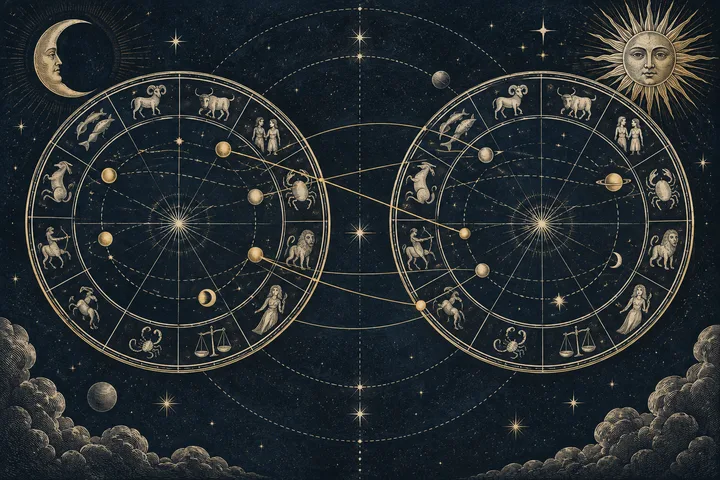
Imagine the usual aspect grid leaves one part of the story unnamed
Imagine Maria and Daniel comparing their charts after a few months of dating. Their ordinary synastry already gives them a story: Maria's Moon and Daniel's Venus make a close trine, so ease and affection have a visible place in the reading. But arguments create another kind of intensity. The attraction doesn't disappear when they disagree. It becomes sharper.
Maria checks the declination table. Her Venus is 18°12' north. Daniel's Mars is 18°48' north. The difference is 36 minutes, and both planets sit north of the celestial equator. They form a parallel.
That contact doesn't prove a romance or replace the trine. It gives the Venus-Mars story another line. Venus describes affection, pleasure, taste, and receptivity. Mars describes desire, pursuit, heat, and action. Their parallel can make those functions meet directly, while the signs still describe how each person gives and receives them.
This is the useful question: does declination show another relationship between the same planets, and does that relationship help you name what you already experience? That question is better than asking whether one hidden aspect proves that two people belong together.
Declination is a second coordinate system. Longitude places a planet around the zodiac. Declination measures its distance north or south of the celestial equator, much as latitude measures distance north or south of Earth's equator. A planet can be far away by zodiac position and still share a north-south band with another planet. citeturn2view0
The method earns its place when it sharpens a pattern. It becomes noise when a reader collects every minor contact and gives each one the same volume.
Sources: Declinations in Synastry: The Astrology of Relationships; Right Ascension & Declination: Celestial Coordinates for Beginners
What exactly counts as a parallel or contraparallel?
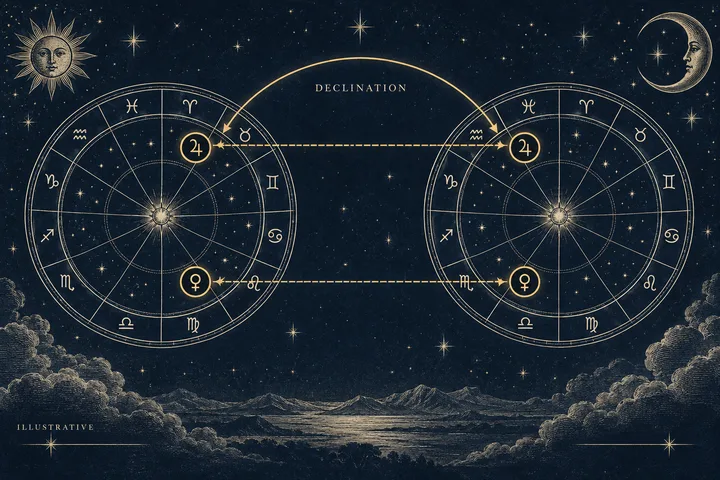
Start with the numbers and the direction. Two planets are parallel when their declinations are close and both are north or both are south. They are contraparallel when their distances are close but one is north and the other is south. Cafe Astrology gives the same distinction and notes that a one-degree orb is typically used. citeturn0view0
Maria's Venus at 18°12' north and Daniel's Mars at 18°48' north are 0°36' apart. That is a Venus-Mars parallel. Change Daniel's value to 18°48' south. The numerical distance stays 36 minutes, but the direction changes. The contact becomes a contraparallel.
Astrologers often read a parallel in the family of a conjunction, where two functions blend or reinforce each other. A contraparallel belongs more naturally to the family of an opposition, where attraction and difference face each other. Neither label decides whether the contact is easy. A conjunction can overwhelm. An opposition can create awareness and balance.
Keep declination separate from ecliptic latitude. The terms sound alike, but they use different reference planes. For a clean reading, write down each planet, its declination, its north or south marker, and the other planet it contacts. Don't infer the contact from sign compatibility alone.
The calculation is simple. For same-side values, subtract the two distances and take the absolute difference. For opposite-side values, compare the distances across the equator. A result within your chosen orb qualifies. Cafe Astrology's worked examples use Sun at 1°51' north with Saturn at 1°32' north, and Moon at 3°00' south with Uranus at 2°42' north. The first is parallel. The second is contraparallel. citeturn0view1
Yes. Declination parallels can add useful information because they compare planets by their distance north or south of the celestial equator, not by zodiac longitude. A parallel links planets on the same side at nearly the same declination. A contraparallel links similar distances on opposite sides. Read this layer after the signs and ordinary aspects, then ask whether it repeats a theme already visible in the chart. A close Venus-Mars parallel may add weight to attraction. A Moon-Saturn contraparallel may describe care that also feels demanding. But an isolated contact is a clue, not a complete story. Start with a one-degree working orb, rank close personal-planet contacts, and turn the useful ones into questions a couple can answer.
Sources: Declinations in Synastry: The Astrology of Relationships; Determining Parallels and Contra-Parallels in Synastry
Set the orb before the story gets persuasive
An orb is the distance between an exact contact and the contact you are willing to read. Use one degree as a clear working rule. A contact at 0°04' is tighter than one at 0°58', even though both fall inside that rule. State the orb before you interpret the table.
Then rank the results. Put close contacts involving the Sun, Moon, Venus, or Mars first. Check whether the same pair also forms a close longitude aspect. Finally, ask whether the contact repeats a theme elsewhere. A Venus-Mars parallel beside a trine may reinforce ease and attraction. The same parallel beside a square may show desire that needs negotiation.
Don't widen the orb because a description feels compelling. Keep the insight, correct the label. The relationship may still be meaningful through signs, ordinary aspects, or what the couple actually lives. It just isn't a declination contact under the rule you chose.
Minutes matter near the boundary. A rounded value such as 18° can hide a contact just inside or just outside the orb. Record unrounded values when available, and show the arithmetic. A reader should be able to follow the path from input to aspect name to interpretation.
A precise Moon contact deserves precise underlying data. If a birth time or planetary value is uncertain, keep the claim narrow. Use the placements you can support, and don't let an elegant interpretation rest on a number you cannot verify.
Sources: Determining Parallels and Contra-Parallels in Synastry; Right Ascension & Declination: Celestial Coordinates for Beginners
What can the second coordinate add to ordinary synastry?
A parallel usually does one of three jobs. It reinforces an aspect already present. It reveals a planet-to-planet link that longitude does not show. Or it gives a sharper name to a pattern that otherwise feels vague.
Suppose Maria's Venus and Daniel's Mars form a close trine by longitude, and their declinations are parallel within 30 minutes. The trine describes ease between affection and desire. The parallel says that the same pair also aligns in the declination frame. Read together, the contact deserves priority.
Now suppose Maria's Moon and Daniel's Venus have no close major longitude aspect, but their declinations are parallel within 20 minutes. The parallel can describe emotional need meeting affection in a direct way. It doesn't erase their signs or invent a complete relationship pattern. It connects two facts that might otherwise sit apart.
A mixed contact can help too. A close Mercury-Saturn square may make communication careful or heavy. A Mercury-Jupiter parallel may add a wish to explain the whole idea or be understood before the conversation moves on. The parallel doesn't cancel Saturn. It adds another channel for Mercury.
Cafe Astrology highlights Sun-Moon, Venus-Mars, Moon-Venus, and Moon-Mars contacts as useful places to begin, while also discussing personal planets with the outer planets. Start with the planet pair that matches the question. Move outward only when the contact is close and the broader chart gives it a personal route. citeturn0view0
A good sentence might be: the ordinary aspect shows the pattern, and the parallel makes that pattern harder to ignore. That's enough.
Sources: Declinations in Synastry: The Astrology of Relationships; Determining Parallels and Contra-Parallels in Synastry
A worked comparison: one change turns a parallel into a contraparallel
Consider an example. Maria has Venus at 22° Taurus and a declination of 18°12' north. Daniel has Mars at 7° Cancer and a declination of 18°48' north. Their Venus and Mars do not make a close major longitude aspect, but their declinations differ by only 36 minutes. Under a one-degree rule, they form a parallel.
The signs still matter. Maria's Venus may seek steadiness, touch, and proof through consistency. Daniel's Mars may move through protection, mood, and emotional timing. The parallel adds immediacy to the attraction, but it doesn't decide how that attraction will be expressed.
Now add a close Mars-Saturn square. Desire meets a gate. Maria may need reliability before she relaxes. Daniel may feel that his initiative gets measured or slowed. The Venus-Mars parallel keeps the pull visible, while Saturn names the work required to express it well.
Change one input. Daniel's Mars is now 18°48' south. The same numerical distance makes the contact a contraparallel. Venus and Mars can still draw each other in, but the mode has more polarity. The pair may disagree about pace, privacy, or reassurance.
Change it again. Daniel's Mars is 16°55' north. The difference is 1°17'. Under a one-degree rule, there is no parallel. The attraction may still appear through signs, other aspects, and lived experience. The declination label must come off.
That is the discipline of the example. Move from value, to aspect name, to planet meaning, then to a question. For Maria and Daniel, the question might be, ‘When attraction is strong, what makes each of you feel safe enough to act?’ The chart gives them a pattern to discuss. It doesn't hand either person an excuse.
The numbers don't tell you who keeps a promise or whether desire is welcome in a particular moment. They describe an astrological relationship between two planets. The people decide how to live it.
Sources: Declinations in Synastry: The Astrology of Relationships; Determining Parallels and Contra-Parallels in Synastry
When should the parallel lead, support, or disappear?
Let the parallel lead when it is close, personal, repeated, and relevant to the question. If the couple asks why the connection feels magnetic, a tight Venus-Mars contact deserves attention. If they ask why care feels warm but demanding, a Moon-Saturn contact may belong near the center.
Let it support the reading when it repeats an ordinary aspect. Give the major longitude aspect its interpretation first, then explain what the declination contact adds. If the two layers describe different tones, name both. A trine with a contraparallel can show ease in one setting and difference in another.
Let it disappear from the main reading when the orb is wide, the planets are generational, or the contact repeats nothing else. A technically exact outer-planet contact may describe a shared era more than a personal bond.
Use the reader's question to choose the planet pair. Attraction points you toward Venus, Mars, the Moon, and the luminaries. A stalled conversation points you toward Mercury, Saturn, and the Moon. The same table can serve both questions, but not every contact deserves equal space.
A quick test helps. Remove the declination contact from the paragraph. If the reading still answers the question, the parallel may be supporting detail. If the paragraph loses its missing bridge, move the contact forward. The issue isn't whether the aspect sounds dramatic. It is whether it does necessary work.
Sources: Declinations in Synastry: The Astrology of Relationships; Determining Parallels and Contra-Parallels in Synastry; Right Ascension & Declination: Celestial Coordinates for Beginners
The practical answer: use parallels as a second look
So, can declination parallels add information to synastry? Yes. They can reinforce a close zodiac aspect, reveal a link the usual wheel doesn't show, or give a name to a feeling that has been hard to place. Their value comes from the way they clarify the main chart, not from their rarity.
Use this order: begin with the placements and the couple's question. Read the signs and major longitude aspects. Check the declinations with a stated one-degree orb. Rank the closest personal-planet contacts. Then write one sentence about the repeated theme and one question about how it appears in daily life.
A close personal-planet parallel can matter even without a close longitude aspect when it explains a pattern the standard grid leaves unclear. The exception has a boundary: a close contact still isn't automatically the center of the reading. Planet symbolism, sign condition, ordinary aspects, available data, and lived experience all matter.
For this publication's Synastry Comparison Report, the supported handoff is narrower. Bring the Moon, Venus, and Mars signs, plus optional planet degrees. The report compares those supplied placements and uses a stated six-degree orb for selected major aspects. It doesn't calculate a natal chart from birth details, calculate houses, or promise a declination comparison. If you are studying declinations separately, keep the values and method in your own notes.
Maria began by asking whether a hidden parallel proved the connection. She has a better question now: what does the contact add to the pattern she can already see, and what conversation does it invite? Write down the closest supported contact, compare it with the ordinary aspect, and ask what each person needs from that pattern. That's where the second look becomes useful.
Sources: Declinations in Synastry: The Astrology of Relationships; Determining Parallels and Contra-Parallels in Synastry; Right Ascension & Declination: Celestial Coordinates for Beginners
Sources & further reading
- Declinations in Synastry: The Astrology of Relationships
Defines parallels and contraparallels, gives the typical one-degree orb, and outlines common planet-pair meanings.
- Determining Parallels and Contra-Parallels in Synastry
Shows how to compare declination values, retain north or south direction, and identify cross-chart contacts within one degree.
- Right Ascension & Declination: Celestial Coordinates for Beginners
Explains declination as the sky's latitude-like coordinate measured north or south of the celestial equator.
Synastry Comparison Report
Enter known placements for two people. Get an input-by-input comparison, selected aspect calculations and a clear record of what remains uncertain.
Compare our placements