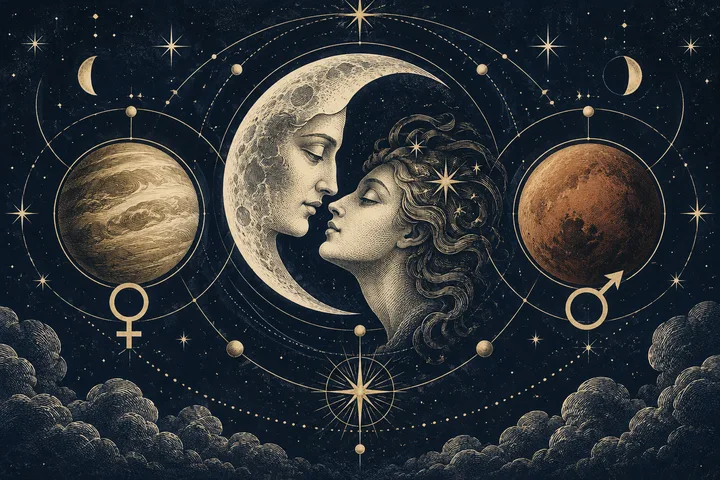
Does one day's horoscope describe every couple the same way?
No. The sky is shared, but a daily horoscope does not give every couple the same personal story. On December 22, the Moon and Mars form a close square in the transiting sky. In this reading, that pairing sets a brief tone of emotional quickness meeting practical action: a wish to talk or react can meet an urge to correct a detail or get something done. That is the day’s common weather. Whether it lands close to either person’s chart depends on that person’s known natal degrees.
This distinction matters because “the Moon squares Mars” and “the transiting Moon contacts your natal Mars” describe different comparisons. In the first, two moving planets form an aspect with each other on the date. In the second, a moving planet forms an aspect to a placement in one person’s birth chart. The first gives the shared sky pattern; the second asks whether it touches a particular chart point. A transit-to-transit square can describe the day’s general relationship atmosphere without telling you which partner will feel it most, or how either person will behave.
In Tetrabiblos, Book IV, section 7, Ptolemy distinguishes enduring affinities from occasional meetings or quarrels and discusses moving planets reaching places in the nativities. That ancient framework is not identical to a modern placement comparison, and it does not supply a rule for judging this day. It clarifies why a shared transit and a personal chart contact should not be collapsed into one claim. The modern explainer How Astrology Shapes Your Love Life assigns different relationship functions to the Moon, Venus and Mars, giving readers a vocabulary for asking which placement is involved.
The tempting assumption is that one daily transit describes every couple in the same way. It feels plausible because the date and sky are the same for everyone. But a shared sky is only one layer. One person may have a natal placement close to a passing planet’s degree; another may not. A sign resemblance can suggest a broad theme, yet it cannot establish a close contact. Degree comparison lets you move from a general daily description toward a more personal interpretation.
Keep the horoscope, but give it the right job. Start with the day’s shared Moon–Mars tension. Then check whether a moving planet makes a close contact to either person’s known Moon, Venus or Mars. The Moon can frame immediate feeling and response, Venus affection and preference, and Mars initiative or assertion. Those are interpretive roles, not fixed descriptions of someone’s character. This ranking is an applied reading method for the date, not a claim that one transit decides a relationship. If the relevant degrees are unknown or no close contact appears, let the message remain general. Use it to approach a conversation with care, not to issue a verdict about the couple.
For December 22, 2026, the tropical, geocentric sky at 12:00 UTC places the Moon at 8°27′ Gemini and Mars at 8°18′ Virgo, a close square. In a love reading, that shared pattern can frame quick emotional responses meeting practical action or correction; it does not predict an argument or describe every couple’s private experience. The Sun is at 0°38′ Capricorn and Venus at 14°22′ Scorpio, adding broader practical and affection themes. To see whether the day’s sky speaks more directly to you, compare these moving degrees with each person’s known natal Moon, Venus and Mars. A close contact can make one layer more relevant, while a sign resemblance alone is not enough. If you do not know the degrees, keep the reading general and use it to start a thoughtful conversation.
Sources: Tetrabiblos, Book IV, section 7; Astrology: How to Make and Read Your Own Horoscope; How Astrology Shapes Your Love Life and Relationship Patterns
What was actually in the sky at 12:00 UTC?
The reference sky for this reading is the tropical, geocentric sky at 12:00 UTC on December 22, 2026. At that moment, the Sun is at 0°38′ Capricorn, the Moon at 8°27′ Gemini, Mercury at 24°52′ Sagittarius, Venus at 14°22′ Scorpio and Mars at 8°18′ Virgo. Those positions, reported in the December 2026 Ephemeris by Astrian, give the article a fixed point for the day. They are not a chart for any one reader or couple. The Moon and Mars are especially close by degree. Gemini and Virgo form a square by sign, and the listed positions put them about 89°51′ apart, roughly nine arcminutes short of an exact 90-degree square. That is a tight contact at noon, not a claim that the aspect stays exact all day. The Moon moves quickly, so its degree and its relationship to Mars change noticeably as the hours pass. A reader comparing a local morning or evening with this reference should keep the stated time in view. The daily reading uses the UTC date and noon positions as its common reference, rather than quietly shifting the forecast to each reader’s local midnight. A second ephemeris helps make that timing choice clear. The December 2026 Ephemeris by AstroAk gives its daily positions at 00:00 UTC; for December 22 it lists the Moon at 0°57′ Gemini and Mars at 8°12′ Virgo. This does not conflict with Astrian’s noon row. It is a different observation time: over those twelve hours, the Moon advances through more than seven degrees while Mars moves only a few minutes of arc. Comparing the two rows shows why a daily Moon reading needs a reference hour. It also confirms the signs used here at both midnight and noon. The sign remains Gemini in these cited positions; the Moon’s precise degree, and therefore its closeness to a degree-based contact, does not remain fixed. The slower bodies provide context without creating a second headline. At noon, Venus is in Scorpio and Mars is in Virgo, while the Sun has just begun its passage through Capricorn. AstroAk records the Sun’s Capricorn ingress at 20:51 UTC on December 21. It records the Moon’s Gemini ingress at 22:28 UTC that same day. Both events precede the assigned UTC date. The December 22 reading therefore uses the signs already occupied; it should not present either ingress as something happening on December 22. Cafe Astrology’s 2026 Moon Calendar also places the Moon’s Gemini passage on December 21 and its following Cancer passage on December 23. Its calendar presents multiple time-zone blocks, so the date sequence is a cross-check, while AstroAk supplies the UTC times used here. Neither sign change is a special event to assign to the forecast date. These are daily positions, not promises about what will happen between two people. The Moon–Mars square is the article’s astrological interpretation of the verified geometry; the ephemeris establishes where the bodies were at the stated reference time. Readers in other time zones can use that map while remembering that their local calendar day may begin or end at a different point in the UTC day. The map makes the next step reproducible: first read the shared transits at the same stated time, then ask whether either person’s known natal degrees receive a close contact.
Sources: December 2026 Ephemeris: Daily Planet Positions · Astrian; December 2026 Ephemeris · AstroAk; 2026 Moon Calendar
What does the close Moon–Mars square emphasize in love?
At 12:00 UTC on December 22, 2026, the Moon is at 8°27′ Gemini and Mars at 8°18′ Virgo. Their separation is about 89°51′, nearly an exact square. The daily table in “December 2026 Ephemeris — Daily Planetary Positions” gives those noon positions; AstroAk’s “December 2026 Ephemeris” lists the Moon at 0°57′ Gemini and Mars at 8°12′ Virgo at 00:00 UTC. The difference matters. The Moon moves quickly, so the square tightens through the day; a noon snapshot describes a moment in a changing sky, not a fixed condition that lasts all day. In astrological language, the Moon speaks to immediate feeling and the way a person seeks comfort. Mars describes initiative, assertion and the urge to act. The contemporary guide “Venus, Moon and Mars: How Astrology Shapes Your Love Life and Relationship Patterns” also frames the Moon through emotional security and processing, and Mars through desire, pursuit and responses to conflict. Put them together with the actual signs and aspect: Gemini tends to work through words, questions and shifts of attention; Virgo seeks a usable response, often by sorting details and improving what can be improved. A square puts these modes into active tension. It can press a couple to respond, but it doesn’t dictate how either person will respond. That contrast can sound familiar. One partner starts explaining why a remark hurt; the other begins proposing exactly what to change. The first may hear the advice as a refusal to listen. The second may feel that talking around the detail leaves the problem untouched. Neither reaction is built into anyone’s chart, and the example isn’t a prediction. It shows how the symbols can describe two different approaches to the same moment: name the feeling, or repair the practical issue. The less graceful expression is easy to spot. A quick question becomes an interruption. A useful correction turns into nitpicking. Someone tries to fix the situation before hearing the whole concern, while the other keeps adding words because the response missed the point. Then a small disagreement grows legs. The square’s friction is real in the symbolism, but an argument isn’t inevitable. The same combination can make a conversation lively and productive: one person finds language for a need, and the other helps turn that need into a workable change. Keep the timing modest. The Moon is the fast-moving part of this picture, so the emphasis is brief and changes as the Moon moves away from the exact angle. It doesn’t support a week-long forecast or a claim that every couple will feel a difficult day. Mars gives the comparison its practical, action-oriented side, but this section reads only the shared transiting Moon–Mars aspect. Whether the day makes a close contact to either partner’s natal Moon, Venus or Mars is a separate question that depends on their known placements and degrees. For this day, try one small pause between hearing a concern and offering a fix. Ask, “Do you want me to listen first, or would it help to work out a next step?” That question respects both sides of the square: the need to put a feeling into words and the wish to do something useful with it. If the answer is “listen,” let the explanation finish. If it’s “help me solve it,” agree on one concrete change instead of correcting everything at once. This is a way to use the day’s symbolism, not a rule for every conversation. The shared sky offers a prompt; the two people in the conversation decide what they make of it.
Sources: December 2026 Ephemeris: Daily Planet Positions · Astrian; December 2026 Ephemeris · AstroAk; How Astrology Shapes Your Love Life and Relationship Patterns
How might the day's transits meet a known natal Moon?
A natal Moon contact makes the day's emotional tempo more personally relevant. Check whether either partner's known Moon degree is close to the transiting Moon at 8°27′ Gemini or to Mars at 8°18′ Virgo. A close conjunction, square or opposition brings the clearest immediate activation in this example; a trine or sextile may describe easier movement. The natal sign supplies the style, while degree closeness decides whether this date makes a direct contact. Start with the sky at the article's stated reference time, 12:00 UTC. Astrian's December 2026 ephemeris places the transiting Moon at 8°27′ Gemini and Mars at 8°18′ Virgo. They form a close transit-to-transit square, the day's shared pattern. A transit-to-natal contact asks whether either moving planet also makes a close angle to one person's birth-chart Moon. AstroAk's December table lists positions at 00:00 UT, when the Moon is at 0°57′ Gemini and Mars at 8°12′ Virgo. That midnight row confirms the signs, but its Moon degree cannot stand in for the noon position. The Moon moves quickly, so use the same stated reference time when comparing degrees. For geometry, treat the zodiac as a 360-degree circle. A conjunction is near the same degree, a square about 90 degrees apart, and an opposition about 180 degrees apart. Trines sit about 120 degrees apart, and sextiles about 60. For this worked method, use the report's six-degree working orb for major aspects: compare the exact separation with the nearest major angle, and call it a close contact only when the difference is within six degrees. Sign resemblance suggests a broad theme, not a close degree contact. Consider an example, using hypothetical placements rather than a real couple. If a person's natal Moon is near 8° Gemini, the transiting Moon is close to a conjunction with it. This may make feelings or changes of tone more noticeable. If the natal Moon is near 8° Virgo, it squares the transiting Moon in Gemini and is close to a conjunction with transiting Mars in Virgo. Two contacts reach that placement, bringing response and action into sharper focus. A natal Moon near 8° Sagittarius opposes the transiting Moon and squares transiting Mars. The aspect geometry differs, even though each example uses a close degree contact. In “How Astrology Shapes Your Love Life and Relationship Patterns,” the Moon concerns emotional security and response, while Mars concerns desire, assertion and tension. A lunar contact can focus attention on what helps someone feel heard and settled. It offers a prompt for asking rather than assuming what a partner feels. The contact may frame a constructive exchange about needs, or a strained moment of quick reaction and correction. The chart offers a lens for reflection, not a script. If a known natal Moon falls near one of the example degrees, compare the exact distance rather than stopping at the sign label. The supplied interpretation uses a six-degree orb, so a natal Moon at 8° Gemini is much closer to the transiting Moon than one at 20° Gemini, even though both carry the Gemini sign. A natal Moon at 8° Virgo closely ties to transiting Mars; another Virgo Moon may not. If the natal degree is unknown, don't guess from a Sun sign or birth date. Keep the reading general. This distinction between a shared sky and a particular natal contact has a long history in astrology, though methods have changed. In Book IV, section 7 of Ptolemy's Tetrabiblos, the text treats enduring relationship sympathies and occasional contacts as separate questions, and describes some occasional events through moving planets reaching places in the nativities. That ancient framework is not the same as this modern three-placement comparison, and it shouldn't be used to claim a specific outcome. It does support a useful discipline: don't collapse the day's sky and a person's natal chart into one statement. Verify the transit, test the natal contact, and interpret with care. Use the comparison to choose a gentle question, not to label either person. If a close natal Moon contact appears, ask, “What kind of response helps you feel supported when we need to talk something through?” If no close contact appears, the Moon–Mars square remains the day's general relationship theme, and ordinary attention to each other's words is enough. A contact can focus a conversation about comfort and response, but it can't tell you what the other person intends or settle the meaning of a whole relationship.
Sources: December 2026 Ephemeris: Daily Planet Positions · Astrian; December 2026 Ephemeris · AstroAk; How Astrology Shapes Your Love Life and Relationship Patterns; Tetrabiblos, Book IV, section 7
What does the day's sky add to a known Venus placement?
Venus adds the affection-and-preference layer to December 22's sky. The noon UTC ephemeris in “December 2026 Ephemeris — Daily Planetary Positions” places transiting Venus at 14°22′ Scorpio. That is the moving Venus position for the day’s shared chart. It is not either partner’s natal Venus, and its sign alone cannot tell you how personally relevant the date is. The immediate Moon–Mars square describes the day’s faster emotional and action tension; Venus moves more slowly and supplies a background question about what feels caring, valued or pleasing. Start by keeping the two Venuses separate. Your natal Venus describes a relationship function in your own chart, while transiting Venus describes the current sky moving across the zodiac. To see whether this date touches a known natal placement, compare 14°22′ Scorpio with the degree of each person’s natal Moon, Venus and Mars. “How Astrology Shapes Your Love Life and Relationship Patterns” uses Moon, Venus and Mars to discuss emotional security, attraction and pleasure, and desire or tension. Those are useful interpretive functions, not fixed personality labels. A contact can bring one of them into focus; it cannot establish what a partner intends or promise how a conversation will end. For a practical comparison, use a stated six-degree working orb for major aspects, as the supplied report does. This is a working boundary for this reading, not a universal rule that every astrologer must use. A natal placement from 8°22′ to 20°22′ of Scorpio falls within six degrees of a conjunction to transiting Venus at 14°22′ Scorpio. A natal placement around 14° Taurus is opposite it; around 14° Leo or Aquarius, square it; around 14° Pisces or Cancer, trine it; and around 14° Virgo or Capricorn, sextile it. These are approximate sign-and-degree examples, not calculated placements for a real person. For a precise check, compare the full degrees and minutes, then measure the angular distance. The closer the contact, the more exact the aspect under this chosen method. The angle gives a more useful starting point than “we’re both water signs.” A conjunction brings the Venus symbolism close to the natal placement being contacted. A square or opposition can make different preferences, needs or ways of showing care more noticeable, while a trine or sextile can describe easier movement between them. None guarantees harmony or conflict. If transiting Venus touches a natal Moon, the question might concern what helps someone feel cared for; if it touches natal Venus, what each person enjoys or values; if it touches natal Mars, how affection and initiative meet. “Astrology: How to Make and Read Your Own Horoscope” offers historical context for Venus as a love and pleasure significator, but its period and methods differ from this modern, bounded comparison. Treat the symbolism as a prompt, not a verdict. If the degrees do not make a close major aspect, keep Venus at the general level: the sky carries a Scorpio Venus tone, but this check has not shown a direct contact to the placements you know. Even a close Venus contact does not prove that the day will soften the Moon–Mars friction or repair anything. It adds a different relationship question beside that faster pattern: what feels caring, valued or wanted, and how can you say so plainly? You might ask each other, “What small gesture would help you feel appreciated today?” Listen to the answer before guessing what should count as affection.
Sources: December 2026 Ephemeris: Daily Planet Positions · Astrian; December 2026 Ephemeris · AstroAk; How Astrology Shapes Your Love Life and Relationship Patterns; Astrology: How to Make and Read Your Own Horoscope
When does a known Mars placement make the day's action theme more personal?
A known natal Mars makes December 22’s action theme more personal when the moving Moon, Mars or Sun forms a close major aspect to its degree. At noon UTC, Mars is at 8°18′ Virgo and the Moon at 8°27′ Gemini, a square separated by about nine minutes of arc. The Sun is at 0°38′ Capricorn. These are shared positions, not placements calculated for either person. Compare natal Mars by sign and degree with those moving positions. The sign gives a starting point; angular distance shows whether the contact is close. It describes a temporary emphasis in initiative, desire or tension, not what either partner wants or how the relationship will fare.
The day’s Moon–Mars square is a quick, mutable pattern: Gemini moves through words and changing attention, while Virgo Mars directs effort toward a task, detail or adjustment. That’s an interpretation, not a prediction that everyone will argue. Natal Mars describes a person’s mode of assertion and action; a transit contacting it can make that mode more noticeable for a time. “How Astrology Shapes Your Love Life” describes Mars through desire, pursuit and tension, alongside the Moon’s emotional-security role and Venus’s attraction themes. Those meanings name the relationship function, not an outcome.
Use the report’s six-degree orb for selected major-aspect calculations as a practical guide. It is a working limit, not a universal rule. Natal Mars near 8° Virgo is close to transiting Mars by conjunction; near 8° Gemini it squares Mars and is close to the transiting Moon by conjunction; near 8° Sagittarius it opposes the Moon and squares Mars; near 8° Pisces it opposes Mars. The angle changes the reading: conjunction concentrates the functions, while square or opposition brings a more demanding exchange. Trine or sextile can describe easier movement. Measure degrees; a sign match alone may fall outside the working orb.
Consider this example, with invented placements used only to show the method. One partner has natal Mars at 8° Gemini; the other, at 22° Taurus. The first degree sits close to the day’s Moon, linking that person’s action style with the quick conversational tone. The second makes no close major aspect to the listed Moon, Mars or Sun. Both people share the transits, but the chart supports a specific Mars contact for only one. That isn’t a forecast that one will react while the other stays calm. It raises a useful question: does talking quickly help this person act clearly, or would a pause help?
A close transit-to-natal contact is one layer, not the whole relationship reading. “Tetrabiblos,” Book IV, section 7, distinguishes enduring sympathies from occasional contacts and considers multiple natal factors. Its historical method differs from this modern guide, but one day’s contact cannot stand in for a complete comparison. The near-exact Moon–Mars square is the leading shared signature at noon UTC. A close contact to natal Mars makes that person’s Mars layer more relevant; without one, keep the reading at shared atmosphere.
If a close contact appears, use it to choose a response, not label a partner: pause before correcting, state the request plainly, then agree on one next step. Without one, don’t force the square into a personal Mars story. “How Astrology Shapes Your Love Life” supplies modern relationship vocabulary, while “Tetrabiblos” reminds us to keep one contact in proportion. The day can bring initiative and friction into focus, but a natal degree contact gives the Mars reading a specific chart hook. It cannot tell you what your partner intends. Ask, “Would a pause, a clearer request, or one agreed next step help us handle this?”
Sources: December 2026 Ephemeris: Daily Planet Positions · Astrian; December 2026 Ephemeris · AstroAk; How Astrology Shapes Your Love Life and Relationship Patterns; Astrology: How to Make and Read Your Own Horoscope
What is the strongest exception to this day's reading?
The strongest exception is simple: the close Moon–Mars square may be the clearest shared signature at noon UTC, but it need not be the strongest factor in either person’s relationship or whole chart. Astrian’s noon table places the Moon at 8°27′ Gemini and Mars at 8°18′ Virgo, nearly exact by square; AstroAk’s separate table places them at 0°57′ Gemini and 8°12′ Virgo at 00:00 UT. Those two readings show why the reference time matters, and why a fast lunar contact should be treated as a brief emphasis rather than a description of the whole day. If neither person’s known Moon, Venus or Mars degree receives a close contact, keep the square at the level of shared atmosphere. It can suggest a day when feeling and action pull in different directions, but it doesn’t establish that either person will feel unusually stirred, argue, or need to repair anything. A broader comparison can change the ranking. In Book IV, section 7 of Ptolemy’s Tetrabiblos, relationship inquiry looks across significant places in both nativities. The text distinguishes more lasting sympathies from occasional acquaintances and quarrels, and then treats timed planetary movements to natal places as relevant to those occasional contacts. That is a historical framework with its own techniques and assumptions, not the method used by this daily guide or by the Synastry Comparison Report. Still, it makes a useful point: a single passing sky pattern cannot stand in for the entire comparison. Sepharial’s Astrology: How to Make and Read Your Own Horoscope likewise describes transits as planets moving over places in the birth chart, placing a timed transit in relation to natal factors rather than treating it as a universal story. Neither historical source proves what a couple will experience. They support a distinction between a shared transit and its possible personal contact. For this date-specific reading, keep the conclusion bounded. The close Moon–Mars square leads because it is a verified, tight feature of the noon sky; natal degree contacts decide whether that feature deserves emphasis for either person. A six-degree orb can serve as a practical working limit for the major-aspect examples here, consistent with the report’s stated scope, but it isn’t a universal rule of astrology. Start with the aspect and its closeness, then check which natal function it reaches: the Moon’s emotional response, Venus’s affection and preference, or Mars’s initiative and tension. If the contact is absent, don’t personalize the transit from a shared sign label alone. If it is present, read it briefly alongside the wider charts and what is actually happening between you. That wider context is the strongest exception, and it can change the day’s emphasis. The same caution applies when the relationship already has a clear, ongoing concern. A daily transit can help name a moment or choose a gentler pace, yet it cannot replace the couple’s own history, current needs, or direct words. If those point elsewhere, let the lived situation lead the conversation and keep the transit in proportion.
Sources: December 2026 Ephemeris · AstroAk; December 2026 Ephemeris: Daily Planet Positions · Astrian; Tetrabiblos, Book IV, section 7; Astrology: How to Make and Read Your Own Horoscope
What should you compare—and what can you ask each other today?
Compare degree contacts first, then name the relationship function they touch: emotional response (Moon), affection and preference (Venus), or initiative and tension (Mars). Astrian’s December 2026 ephemeris places the noon UTC Moon at 8°27′ Gemini, Mars at 8°18′ Virgo and Sun at 0°38′ Capricorn. To see whether the transits make a close contact, you need each known placement’s sign and degree. If degrees are missing or no close major aspect appears, keep the reading general. A sign resemblance alone doesn’t establish a personal contact.
The shared picture pairs Gemini Moon conversation with Virgo Mars action under a Capricorn Sun that favors practical follow-through. Astroscope’s “How Astrology Shapes Your Love Life” describes the Moon through emotional security, Venus through attraction and pleasure, and Mars through desire and tension. Use those functions to frame a conversation, not to decide compatibility or infer a partner’s intentions.
Ask: “When one of us gets frustrated, what response would help us feel heard and move toward a solution?” The Synastry Comparison Report can compare Moon, Venus and Mars placements you supply, with optional degrees. It doesn’t calculate natal charts from birth details or forecast this particular day. Let the sky suggest a useful question; decide together what to do with the answer.
Sources: December 2026 Ephemeris: Daily Planet Positions · Astrian; How Astrology Shapes Your Love Life and Relationship Patterns
A little more clarity
What time does this horoscope use?
It follows the UTC date and uses the tropical, geocentric positions at 12:00 UTC as its reference.
Does the Moon–Mars square mean a couple will argue?
No. It is a shared astrological theme that can describe tension between quick emotional response and practical action. It does not make conflict inevitable.
What information helps show whether the transits contact my chart?
Known Moon, Venus and Mars placements with their degrees let you compare the moving planets with your chart. A sign alone cannot establish a close degree contact.
Does the Synastry Comparison Report calculate my birth chart?
No. It compares supplied Moon, Venus and Mars placements, with optional degrees; it does not calculate natal positions from birth details.
Sources & further reading
- December 2026 Ephemeris: Daily Planet Positions · Astrian
Provides tropical, geocentric planetary positions for December 22, 2026 at 12:00 UTC, including the close Gemini Moon–Virgo Mars square.
- December 2026 Ephemeris · AstroAk
Provides December 22 positions at 00:00 UTC and UTC ingress times for the Sun entering Capricorn and Moon entering Gemini on December 21.
- How Astrology Shapes Your Love Life and Relationship Patterns
Offers a contemporary interpretive framework for Moon, Venus and Mars in relationship readings, including emotional security, attraction and desire.
- Tetrabiblos, Book IV, section 7
Provides historical context distinguishing enduring relationship affinities from occasional contacts involving planetary movements to natal places.
- 2026 Moon Calendar
Cross-checks the Moon's sign sequence around December 22, with displayed time-zone blocks requiring care when using exact times.
- Astrology: How to Make and Read Your Own Horoscope
Provides historical practitioner context for planetary significations and transits to natal chart places.
Synastry Comparison Report
Enter known placements for two people. Get an input-by-input comparison, selected aspect calculations and a clear record of what remains uncertain.
Compare our placements