One bond can need two different charts
It is easy to assume that one relationship should have one chart. The bond feels singular. You share a room, a private language, and a growing set of habits. A single wheel seems like the cleanest answer.
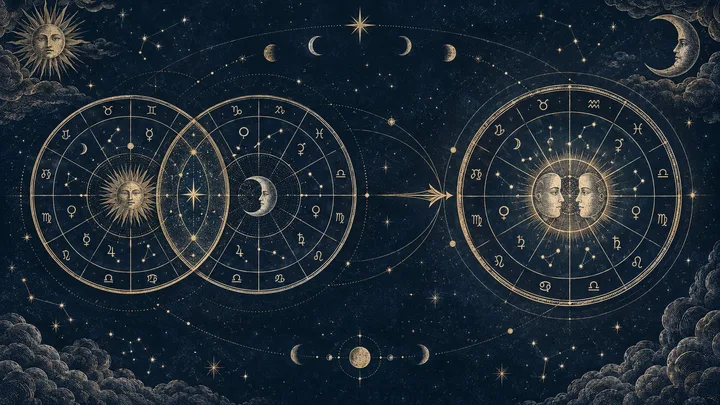
That instinct is useful, but it skips the first question. Are you asking how you affect each other, or what the relationship becomes when you act together? Synastry answers the first. Davison answers the second.
Synastry keeps two natal charts visible. Your Venus can touch their Moon. Their Saturn can press on your Sun. The reading can name the direction of the contact and return to the natal chart behind it. That matters when you want to understand attraction, sensitivity, resistance, or the exact place where a conversation turns difficult.
Davison takes a different step. It finds a midpoint in the two birth moments and places, then casts a chart for that derived moment. The result is a relationship chart with its own planets, angles, and houses. It describes the shared field rather than assigning every feeling to one person.
So the best answer isn't that Davison is deeper or synastry is more romantic. The better chart depends on the question. Start with synastry for the exchange. Add Davison for the pattern that gathers around the exchange. A composite chart belongs in a separate lane because it averages corresponding planetary positions instead of casting the sky for a time-space midpoint.
The chart that looks most like one relationship entity isn't automatically the best place to begin. It may show the atmosphere beautifully while hiding who is initiating, receiving, or feeling exposed. Keep both levels in view.
A synastry comparison shows how two people affect each other. A Davison relationship chart shows the relationship as a shared field, built from the midpoint in time and place between two births. That makes synastry the better first chart for attraction, emotional fit, friction, and the way one person's planet lands on the other's. Use Davison afterward when you want to study the bond's own themes, angles, houses, or timing possibilities. The methods complement each other, but they aren't interchangeable. A placement-based report can compare supplied Moon, Venus, and Mars signs, plus selected major aspects within a six-degree orb when degrees are provided. It doesn't calculate a Davison chart from birth details. That requires both complete birth records and a named midpoint and house method.
Sources: Davison Charts: Time-Space Relationship Charts; Davison Relationship Chart, spherical midpoint; Free Davison Chart Calculator | Relationship Midpoint Chart
What synastry lets you see clearly
A synastry comparison lays one natal chart against another. It asks what happens when the symbols in one chart meet the symbols in the other. The method is relational by design.
Begin with the personal planets when the question concerns closeness. The Moon describes instinctive comfort and emotional habit. Venus describes affection, pleasure, values, and the way love is offered. Mars describes desire, pursuit, initiative, anger, and the way each person moves toward what they want. Then add the Sun, Mercury, Saturn, angles, and the tight major aspects that give the story structure.
The direction changes the reading. If Maria's Venus contacts Daniel's Moon, Maria's style of affection may reach Daniel's emotional nature directly. If Maria's Moon contacts Daniel's Venus, the emphasis shifts. A blended relationship chart can show Venus or Moon themes, but it can't replace that person-to-person distinction.
Aspect geometry comes before sign shorthand. A conjunction fuses functions. A square creates a task. A trine lets energy move with less resistance, while an opposition makes each side aware of the other. The orb tells you how closely the pattern is formed. For this publication's placement comparison, selected major aspects use a six-degree orb when degrees are supplied.
Imagine Maria has Venus in Taurus and Daniel has the Moon in Taurus, but neither degree is known. You can read a shared earth-sign language around steadiness, touch, comfort, and reassurance. You can't call it a conjunction. The planets might sit far apart in the sign. That tells you whether you are reading a sign resemblance or a measured contact.
Synastry preserves asymmetry without turning it into blame. One person may feel pursued while the other feels generous. One may experience Saturn as commitment; the other may feel the delay. Read the aspect, the planets, the signs, and each natal context together. Then ask how the pattern appears in ordinary life.
Sources: Davison Charts: Time-Space Relationship Charts; Davison Relationship Chart, spherical midpoint
How a Davison relationship chart is built
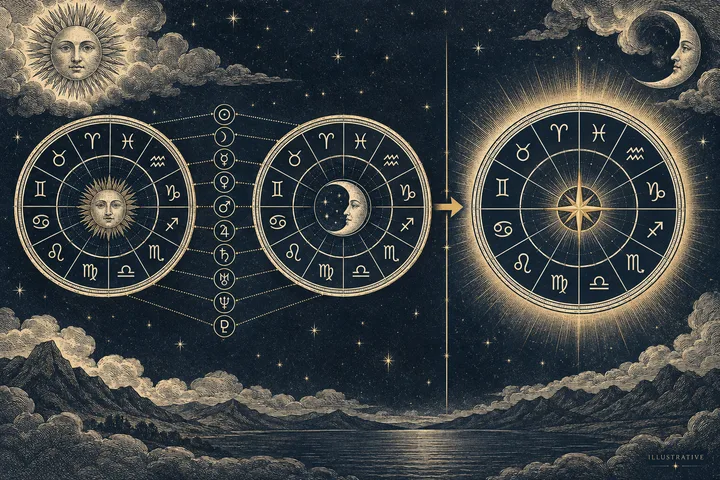
A Davison chart starts with two recorded births. Normalize both birth moments, find the temporal midpoint, find a midpoint between the birth locations, and cast an ordinary horoscope for that derived date, time, and place. The chart's planets occupied those positions at that midpoint moment.
That is different from a composite chart. A composite averages the corresponding planetary longitudes from the two natal charts. Davison averages the births first and then reads the sky at the resulting moment. Both make a single relationship chart, but they use different arithmetic and carry different interpretive assumptions.
The location needs a named convention. One method averages latitude and longitude. Another uses a spherical midpoint along the shortest path between the birthplaces. Astrodienst also lists corrected and reference-place versions. When the places are far apart, these choices can move the angles and house cusps. Record the method rather than letting the software setting disappear behind a polished wheel.
Birth-time accuracy matters most for the derived time, Ascendant, Midheaven, and houses. If either birth time is approximate, the Davison chart can still offer a useful relationship layer, but exact angle and house claims need a lighter touch. A chart's precision should come from its inputs, not from the number of symbols printed around it.
The midpoint place may be somewhere neither person has visited. It is the reference location used to erect the chart. The midpoint date isn't automatically the day you met, your first date, or your wedding. It is a calculated moment between two births.
Read the finished chart in natal style, but keep the subject relational. The Sun can describe the bond's center and vitality. The Moon can show its emotional weather. Angular planets and house emphasis can show where the relationship becomes visible, private, demanding, or purposeful.
Sources: Davison Charts: Time-Space Relationship Charts; Free Davison Chart Calculator | Relationship Midpoint Chart
One shared tension, read through both methods
Consider an example. A couple says, ‘We feel tender in private, but practical talks become tense.’ That sentence contains a lived pattern and a useful astrological question.
Synastry asks where the tenderness and tension sit between the two people. Perhaps one person's Venus meets the other's Moon, so affection reaches a place that feels safe and familiar. At the same time, a hard Mercury-Saturn contact may make planning feel slow, careful, or easily judged. The reading can ask who speaks first, who hears criticism, and what each person does when the conversation gets heavy.
Now bring in the Davison chart. A strong fourth-house emphasis could describe a bond organized around privacy, home, family, or emotional shelter. A prominent Saturn might make the relationship itself feel serious, duty-bound, or built through endurance. This doesn't replace the synastry contacts. It shows the environment in which they play out.
The layers can reinforce each other without saying the same thing. Synastry may explain why Daniel feels Maria's affection as immediate comfort. Davison may explain why the couple keeps returning to questions of home, responsibility, or what they are building together. One chart names the contact. The other names the shared subject.
They can also disagree. A soft Davison Moon doesn't cancel a difficult Moon-Saturn contact. It may show that the bond has a capacity for care even while one person feels guarded in the exchange. A tense Davison Mars doesn't cancel warm Venus contacts. It may show that the relationship needs direct action when desire, anger, or competing priorities surface.
When the symbolism repeats, rank it rather than count it. Suppose synastry shows Venus-Saturn contacts and Davison places Saturn on an angle. Reliability, commitment, delay, and responsibility deserve serious attention. The same theme can become devotion or obligation. The chart tells you what to examine. The couple's habits tell you which expression is present.
Sources: Davison Charts: Time-Space Relationship Charts; Davison Relationship Chart, spherical midpoint; Free Davison Chart Calculator | Relationship Midpoint Chart
The strongest exception: a relationship chart can't hide the relationship
The most important exception is simple. A compelling Davison chart cannot overrule what the relationship is doing in front of you.
If someone ignores a boundary, the boundary remains the fact. If both people return to a hard subject, tell the truth, and change a repeated behavior, that repair remains the fact. Astrology can give either pattern meaning. It shouldn't make a clear pattern harder to see.
This matters because relationship charts invite large words. A heavy Saturn can feel karmic. A glowing Venus can feel blessed. A charged Mars can feel fated. Those impressions may belong to the spiritual life of the bond, but none of them settles consent, respect, availability, or the willingness to repair. Read the chart with conviction, then read the conduct with equal attention.
Timing deserves the same care. Because a Davison chart has a derived date and place, astrologers may study transits, secondary progressions, or returns against it. A transit to the Davison Moon can suggest a period when shared routines or feelings become more visible. It is a timing hypothesis, not a guaranteed event. Stronger timing work looks for agreement between the Davison chart, the natal charts, and the circumstances already unfolding.
There is a second exception for method. Different midpoint conventions, house systems, and birth-time estimates can produce different angles. If an interpretation depends on a cusp or exact Ascendant, preserve the inputs that created it. When those inputs are uncertain, lower the claim before you enlarge the story.
The mature reading is neither ‘the chart decides’ nor ‘the chart says nothing.’ The chart reveals a pattern worth meeting. The people decide how that pattern becomes a life.

Sources: Davison Charts: Time-Space Relationship Charts; Free Davison Chart Calculator | Relationship Midpoint Chart
Choose the chart by the conversation you need
Choose synastry when you need to understand the exchange: who activates whom, where affection lands, what creates desire, and which contact makes conflict personal. Choose Davison when you need to study the shared field: the bond's center, emotional climate, public direction, house emphasis, or a timing pattern that can be tested with complete inputs. Choose composite only when its planetary midpoint symbolism answers a distinct question.
For a placement-based comparison, begin with the information you actually possess. Supplied Moon, Venus, and Mars signs can describe emotional style, affection, pleasure, desire, and initiative. Optional degrees can support selected major-aspect checks within a six-degree orb. That report doesn't cast natal charts, calculate houses, or produce a Davison chart. Its value is its clear boundary.
If you later commission a full Davison calculation, keep a small record: both birth dates, exact times if available, birth locations, time-zone handling, midpoint convention, zodiac, house system, and aspect orb. If the two places are widely separated, ask whether the chart uses a simple geographic average, a spherical midpoint, or a reference place. A second reader should be able to retrace the setup.
Then ask your partner one question before opening another wheel: ‘Which part of our bond are we trying to understand?’ If the answer is ‘Why do I feel so affected by the way you speak to me?’ start with synastry. If it is ‘Why does this relationship keep gathering around home, work, or a shared purpose?’ the Davison layer may be the better next lens.
Make the next conversation specific. ‘What does reassurance look like this week?’ ‘How do we want to handle plans when one of us needs more time?’ ‘Where do we feel the pattern most clearly, and what would a better expression look like?’ Let the answer name a behavior. Then use the chart to sharpen the question, not to avoid it.
The clean reading order is practical: compare the people, study the exchange, then study the field they create. Start with synastry. Add Davison when its inputs and question are ready.
Sources: Davison Charts: Time-Space Relationship Charts; Davison Relationship Chart, spherical midpoint; Free Davison Chart Calculator | Relationship Midpoint Chart
Sources & further reading
- Davison Charts: Time-Space Relationship Charts
Supports Davison time-space midpoint mechanics, calculation choices, relationship-chart interpretation, and cautious timing use.
- Davison Relationship Chart, spherical midpoint
Supports Astrodienst's listed Davison variants, geographic midpoint methods, and the effect of midpoint choices on houses.
- Free Davison Chart Calculator | Relationship Midpoint Chart
Supports the required birth inputs, natal-style reading sequence, house sensitivity, and use of transits or progressions on a Davison chart.
Synastry Comparison Report
Enter known placements for two people. Get an input-by-input comparison, selected aspect calculations and a clear record of what remains uncertain.
Compare our placements