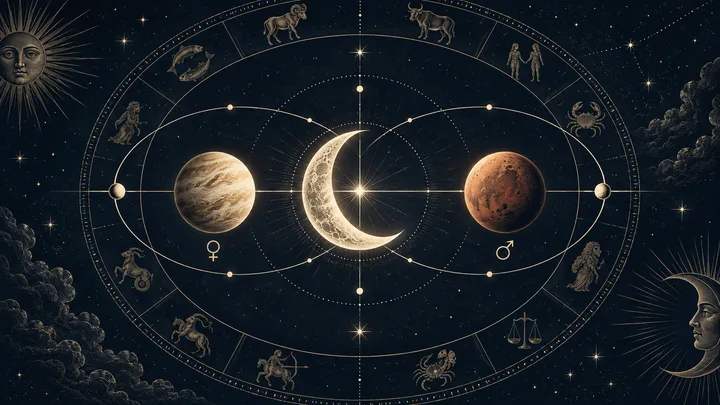
On December 21, 2026, the Moon stays in Taurus for most of the UTC day, squares Jupiter at 17:26, then enters Gemini around 22:28. Venus in Scorpio and Mars in Virgo provide a slower backdrop of intimacy, trust, and practical effort. Read these placements as shared transits, not a forecast of either partner’s behavior. To relate them to your known Moon, Venus, and Mars, compare each moving planet with each person’s natal placements separately. Sign-level matches offer broad symbolism; naming a conjunction, square, trine, opposition, or sextile requires degrees and a stated orb. The late Moon shift changes the day’s timing, while Venus and Mars remain the wider context. Use the reading as a conversation prompt. A Synastry Comparison Report can compare supplied signs and optional degrees, but it does not calculate natal charts from birth details.
Which sky are we reading on December 21 in UTC?
Start with the UTC clock. “December 21” here means the interval from 00:00 to 23:59 UTC, and the reference snapshot is noon UTC. In the day-specific table, “21 December 2026 — name days, holidays and the day's sky,” the Sun stands at 29°38 Sagittarius, the Moon at 23°34 Taurus, Venus at 13°28 Scorpio, and Mars at 8°06 Virgo. AstroAk’s “Ephemeris December 2026” identifies its positions as geocentric and tropical, and its daily rows are set at 00:00 UT. The independent “Daily planetary positions 21 December 2026” page also reports tropical, geocentric positions, rounded to whole degrees, and confirms the sign placements at midnight. These are views of the moving sky, not calculations of either reader’s natal chart. A daily table is a snapshot, not a full-day description. That distinction matters most for the Moon, which changes signs during this UTC date. The day-specific calendar times the Moon’s square to Jupiter at 17:26 UTC, the Sun’s entry into Capricorn at 20:50 UTC, and the Moon’s entry into Gemini at 22:27 UTC. AstroAk lists the Sun ingress at 20:51 and Moon ingress at 22:28, so call both “about” those times. The Moon spends most of this UTC day in Taurus; Gemini describes only its late hours. Keep Venus in Scorpio and Mars in Virgo as the slower relational and action-oriented background. For a reader elsewhere, convert the UTC event times to local time before deciding which lunar phase of the day they mean. With the clock, zodiac and reference moment clear, you can read the day’s symbolism without mistaking a shared transit for a personal placement.
Sources: Ephemeris December 2026: Daily Planet Positions · AstroAk; 21 December 2026 — name days, holidays and the day's sky; Daily planetary positions 21 December 2026
What does a transit compare, and what stays synastry?
A daily transit compares a planet's current position with one person's natal placement. Synastry compares one partner's natal placements with the other's. The same December 21 sky can be checked against both partners, but it cannot say which natal point is contacted until that person's placements are known; an exact aspect needs degrees. Start with the transit: fix the date and time, then identify the moving planet and its position. Choose one person's known natal point. A transit-to-natal comparison asks how the moving planet relates to that point. Astrology University's “What Do Transits Mean in Your Birth Chart?” names the moving planet, natal point, aspect, and house context as parts of a fuller reading. This comparison uses known Moon, Venus, and Mars placements; no houses are supplied. Next, compare at the level your information supports. Signs offer broad symbolic context. To call a contact a conjunction, square, trine, opposition, or sextile, compare positions by degree and state the orb. Cafe Astrology's “Transits in Astrology: Predictions” illustrates that an aspect depends on the moving planet's relation to a particular natal degree, not just a shared sign label. The report's selected major aspects use a maximum six-degree orb; closer contacts carry more weight within that method. If you know only signs, stay at sign level. Repeat the transit-to-natal check for the other partner, then set the readings beside each other. Only after that should you turn to synastry, the comparison of the partners' natal placements with one another. A transit Moon contacting one person's natal Venus differs from one partner's Moon contacting the other's Venus. The first describes a current sky-to-chart relationship; the second belongs to the pair's natal comparison. Read a symbol as a question to explore, not a script for either person. For December 21, this sequence keeps the shared Taurus Moon, its late change to Gemini, and the slower Venus and Mars backdrop in their proper place. Compare each with placements you already know, and name only contacts supported by the available degrees. Use it as a prompt for conversation.
Sources: What Do Transits Mean in Your Birth Chart?; Transits in Astrology: Predictions
What does the Taurus Moon make easier to notice?
For most of December 21 in UTC, the Moon’s transit through Taurus gives the shared emotional weather a grounded, sensory tone. The Moon moves quickly compared with Venus and Mars, so this is a brief daily emphasis, not a lasting description of either partner. AstroAk’s December 2026 Ephemeris places the Moon in Taurus at 00:00 UTC and records its entry into Gemini at 22:28 UTC. That leaves most of the UTC date under Taurus symbolism. If you’re reading from another time zone, convert 22:28 UTC before deciding when the shift arrives locally. Astrology.com’s “The Moon in Taurus” describes this earth sign as fixed and links its lunar symbolism with comfort, steadiness, and keeping a commitment. In a relationship, that vocabulary can make small, observable forms of care easier to notice: keeping a plan, making space to rest together, or following through on a promise. These are examples of how the symbolism might guide attention, not events the transit guarantees. The same fixed quality has another side. A preference for a familiar rhythm can become resistance when one person wants a change, so steadiness is most helpful when both people can say what feels reassuring. Late in the day, the Moon enters Gemini, an air sign with a mutable quality. Astrology.com’s “The Moon in Gemini” connects this placement with sociability, conversation, and shifting attention. The contrast is useful: Taurus symbolism leans toward staying with a settled feeling; Gemini symbolism gives more room to talk, ask, and move between ideas. A lively exchange can help a couple name what they need. It doesn’t automatically replace the comfort or follow-through that may matter earlier in the day. Use the change as a prompt, not a label. Neither the transiting Taurus Moon nor the late Gemini Moon is either partner’s natal Moon. A person’s known natal Moon, Venus, or Mars must be considered separately, and a specific transit-to-natal aspect requires the actual degrees. For the day’s broad sign-level reading, ask: would comfort, reliable follow-through, or an open conversation meet us better right now? Then check the answer against what each of you actually prefers.
Sources: Ephemeris December 2026: Daily Planet Positions · AstroAk; The Moon in Taurus; The Moon in Gemini
What is the day's turning point? The Moon-Jupiter square
At 17:26 UTC on December 21, the Moon squares Jupiter while the Moon is still in Taurus and Jupiter is retrograde in Leo. This is an aspect in the shared sky, not a verdict about a couple or a personal contact in either chart. In a love reading, it brings steadiness into conversation with enthusiasm. A calm, dependable plan may meet a wish for warmth, celebration, or a larger gesture. That can feel generous, provided both people welcome the same scale of attention. A square is a 90-degree relationship between two planets. Astrology University’s “What Do Transits Mean?” describes squares as friction or adjustment, not simply good or bad. Taurus Moon symbolism gives emotional needs a grounded, comfort-seeking tone. Jupiter’s expansive quality in expressive Leo can enlarge the wish to share, praise, or make an occasion of something. This combination is an interpretation, not a promise about anyone’s behavior. A grand gesture may delight one person and feel like too much to another. The useful question is whether it fits the relationship and the other person’s expressed preference. AstroAk’s December 2026 ephemeris lists the square at 17:26 UTC and treats it as the Moon’s last aspect before a void-of-course period in Taurus. Book of Horoscopes independently lists the square at the same time. AstroAk’s void period follows a traditional timing convention; it doesn’t predict silence, delay, or a failed plan. The event marks a point in the ephemeris. Keep its symbolic weight proportionate to its brief timing, especially beside the day’s broader Venus-in-Scorpio and Mars-in-Virgo context. Keep this sky-to-sky square separate from a transit-to-natal comparison. The Moon and Jupiter aspect each other in the sky; that doesn’t establish an aspect to your natal Moon, Venus, Mars, or Jupiter. Astrology University’s transit guidance and Cafe Astrology’s “Transits” explain transits through their relationship to a person’s natal points. A personal comparison needs the relevant natal placement and, for a specific aspect, its degree. Without those inputs, stay with the shared symbolism. A closer natal contact, relationship history, or a clearly stated preference may matter more to your practical choice than this short-lived square. There’s a generous reading, too. Jupiter can enlarge joy, and a square can bring energy to act rather than leave affection abstract. A celebration, honest compliment, or offer of help may suit the moment when it feels mutual and grounded. Before promising more time, attention, or certainty than you can give, ask: “What would feel generous and still comfortable to both of us?” The chart frames the conversation. What each person says and chooses gives you the next useful answer.
Sources: Ephemeris December 2026: Daily Planet Positions · AstroAk; 21 December 2026 — name days, holidays and the day's sky; What Do Transits Mean in Your Birth Chart?; What Do Transits Mean?
How can each partner read the Taurus and late Gemini Moon against a natal Moon?
Compare the moving Moon with each partner's natal Moon, one person at a time. For most of December 21 in UTC, the transiting Moon is in Taurus; at about 22:28 UTC it enters Gemini. A Taurus natal Moon shares the earlier sign symbolism, while a Gemini natal Moon shares the late lunar tone. This gives you a way to ask when each person's emotional language may feel more familiar. It doesn't tell you how either person will behave.
Astrology.com’s “The Moon in Taurus” describes this sign through steadiness, comfort, loyalty, and sensory ease. Applied to the transiting Moon, those themes make the earlier part of the day a prompt about emotional pace: does reassurance come through a settled plan, a familiar setting, or reliable follow-through? A partner with a Taurus natal Moon may recognize those themes as familiar symbols. The comparison remains symbolic. It isn't proof that this person needs comfort in one particular way, or that a different Moon sign cannot value security.
After the ingress, Astrology.com’s “The Moon in Gemini” offers a contrasting vocabulary of conversation, mental activity, and changing attention. For someone with a Gemini natal Moon, that late window shares the natal Moon's sign; for either partner, it can prompt a check on whether talking, asking questions, or trading ideas feels more welcome than staying with one settled mood. The shift happens late in the UTC date, so readers elsewhere should convert 22:28 UTC to local time. The transit sets a shared clock, not a schedule for a specific conversation.
Astrology University’s “What Do Transits Mean in Your Birth Chart?” explains that a transit is read through a moving planet's contact with a natal point, with the natal chart supplying personal context. It describes the Moon as fast-moving and suited to daily developments. The Moon's sign changes within the day, but a contact belongs to the natal Moon of one person. Make one note for each partner. Don't merge both natal Moons into a single response, or let the shared transit stand in for their natal synastry.
Same sign is a broad conjunction-by-sign idea, not proof of an exact conjunction. If a natal Moon degree is known, compare it with the transiting Moon's degree at the relevant time; only then can you describe the angular distance and check it against a chosen orb. Without a natal placement or degree, stop at the sign-level comparison. Birth time can affect confidence in a natal Moon placement, so use a Moon sign the reader already knows reliably rather than guessing. The useful result is a question, not a label: which reassurance or exchange would each person prefer that day?
Sources: What Do Transits Mean in Your Birth Chart?; The Moon in Taurus; The Moon in Gemini
What does Venus in Scorpio add to the relationship question?
Transit Venus in Scorpio gives December 21 a relational backdrop centered on trust, intimacy, and exchange. AstroAk's “Ephemeris December 2026: Daily Planet Positions” places Venus in Scorpio; the supplied noon calendar gives its position as 13°28 Scorpio. For the symbolic reading, Astrology.com's “Venus in Scorpio: All or Nothing” connects this placement with intimacy, trust, and what partners give and receive. Ask what helps each person feel affection is honest and mutual. Keep three chart layers separate. Transit Venus is the moving planet in the shared sky. A transit-to-natal comparison asks how it relates to one person's natal Moon, Venus, or Mars; then you repeat the check for the other person. Venus-to-Venus synastry is different: it compares one partner's natal Venus with the other's. Cafe Astrology's “Transits” explains the transit method as a moving planet's relationship to a natal planet or point. So Venus in Scorpio doesn't, by itself, describe your shared Venus pattern or either person's usual way of loving. It gives you a current symbol to compare with placements you already know. At sign level, Scorpio's fixed-water symbolism can suggest a wish for emotional depth and candor. Use that as an invitation, not a label. If one of you values privacy while the other wants reassurance, ask what trust looks like in a concrete moment: keeping a confidence, naming a need, or following through on an agreement. A chart sign can't establish whether someone is honest, ready for intimacy, or willing to reciprocate; listen to what each person says and does. There is a sharper expression to consider. Astrology.com's “all or nothing” framing allows for intensity that can harden into rigidity or possessiveness. That's an interpretive tension, not a forecast. Candor can invite closeness; pressure can make the same exchange feel controlling. The strongest use of this transit is to ask what makes affection feel deep and freely given. If you know Venus's degree, compare it with each partner's natal degree before naming a conjunction, square, trine, opposition, or sextile. Cafe Astrology's transit guide explains: an aspect is an angular relationship, not simply two planets sharing a sign or theme. The supplied report uses a six-degree maximum orb for selected major aspects, with closer contacts carrying more weight. Without degrees, stay with the broad Scorpio-Venus theme; don't claim an exact personal contact. Then ask each other: “What helps you feel trusted and valued, and what kind of affection feels freely given?”
Sources: Ephemeris December 2026: Daily Planet Positions · AstroAk; Venus in Scorpio: All or Nothing; Transits in Astrology: Predictions
What does Mars in Virgo add to the relationship question?
Transit Mars in Virgo puts practical effort, details, and correction in the day's action-oriented background. For a couple, that can make care easier to see in what someone does: keeping a plan, handling a small task, or noticing what would make a shared routine work better. The December 2026 ephemeris from AstroAk places Mars in Virgo throughout the month, including December 21. This is the sky's transit placement, not either partner's natal Mars, and it doesn't tell us what a particular person will do. Astrology.com describes Virgo as mutable earth and links Mars in Virgo with diligence, precision, and attention to detail. In relationship terms, that symbolism can favor useful effort over grand display. A practical offer can say, “I noticed this would help, so I took care of it.” The same eye for detail has another expression. Astrology.com also describes the placement's possible shift from helpfulness to nitpicking or fault-finding. The difference lies in how the effort is offered and received: a solution that answers a stated need can feel supportive; an unsolicited correction can land as criticism. These are interpretive possibilities, not predictions about either partner. Mars moves more slowly than the Moon, so its Virgo backdrop extends beyond the Moon's brief Taurus-to-Gemini change late on December 21. Astrology University distinguishes the Moon's quick, daily scale from Venus and Mars, which can activate chart themes over days or weeks. The Moon describes a passing tone; Mars in Virgo describes a broader style of initiative and follow-through. The lunar shift doesn't switch off that practical theme, though it may change how a couple talks about it. To personalize the symbolism, compare transit Mars with each person's known natal Mars, Venus, and Moon separately. A sign comparison can suggest a broad theme, but it cannot establish a specific aspect. If the natal degrees are available, compare them with Mars's actual degree and name a major contact only when it falls within the declared orb. Astrology University's guide to transits stresses identifying the exact aspect to a natal point before interpreting it; it also notes that a full reading depends on chart context. Here, the supplied-placement scope leaves houses and wider natal-chart condition out. Without degrees, keep the reading at sign level. For December 21, the useful expression is simple: make care visible through one practical gesture, then ask before turning a detail into advice. A plan that works for both people is a better expression of Virgo's care than a perfect plan imposed on one of them.
Sources: Ephemeris December 2026: Daily Planet Positions · AstroAk; Mars in Virgo; What Do Transits Mean in Your Birth Chart?
When do signs tell enough, and when do degrees change the reading?
Signs tell enough when the question is broad: what tone might this transit bring to a placement we know? On December 21, the Moon is in Taurus at the 12:00 UTC reference point, with Venus in Scorpio and Mars in Virgo. If one partner has a known Taurus Moon, compare the day's lunar symbolism with that placement and talk about steadiness, comfort, or pace. That is a sign-level reading. It doesn't establish an exact contact to that person's Moon. Degrees answer a narrower question. They show how close two planetary positions are to an aspect, measured around the zodiac. A conjunction is near 0 degrees of separation; an opposition, 180; a square, 90; a trine, 120; and a sextile, 60. “Transits in Astrology: Predictions” from Cafe Astrology illustrates this by comparing a moving planet's degree with a natal planet's, then naming the aspect from their angular relationship. “What Do Transits Mean in Your Birth Chart?” from Astrology University also advises identifying the exact aspect to a natal point before interpreting it. The ephemeris gives today's position; the person's chart gives the other. At noon UTC, the Moon is at 23°34 Taurus and Venus at 13°28 Scorpio, according to “21 December 2026 — name days, holidays and the day's sky.” These positions let a reader check an existing chart with degrees. The Moon moves quickly, so a lunar contact may be closer at one time than another; use the relevant UTC time. Sign labels alone can't show whether a natal planet is close enough for a major aspect. The Synastry Comparison Report uses a maximum six-degree orb for selected major aspects. An orb is the distance from exactness: a planet 3 degrees from a square is closer than one 5 degrees away. This is the report's rule, not a universal law. Astrology University notes that astrologers often use tighter orbs for fast planets and wider ones for slow planets, so state the orb you use. Signs sharing an element or mode can offer a symbolic comparison, but they don't automatically form an exact major aspect. Sharing a sign doesn't prove a close conjunction either; planets can sit many degrees apart. Keep the claims in order. With signs only, describe broad symbolism. With reliable degrees, find the angular distance and name an aspect only if it falls within the chosen orb. If a natal Moon's sign or degree is uncertain, leave it out rather than guess. The chart can guide a conversation without pretending to settle it.
Sources: Transits in Astrology: Predictions; What Do Transits Mean in Your Birth Chart?; Ephemeris December 2026: Daily Planet Positions · AstroAk
How should the couple weigh the Moon, Venus, and Mars together?
Weigh these placements by giving the Moon the day’s timing role, Venus the relationship-values role, and Mars the action role. On December 21, the Moon squares Jupiter at 17:26 UTC while still in Taurus, then enters Gemini late that evening. AstroAk’s December 2026 Ephemeris gives this sequence. Venus in Scorpio and Mars in Virgo move more slowly, so they form a broader backdrop than the Moon’s brief change of tone. Start with the shared sky, then ask whether either person’s known chart makes one part of it more personal. Astrology University’s “What Do Transits Mean in Your Birth Chart?” explains why the Moon comes first in a daily reading: it moves quickly and can describe passing moods or daily developments, while Venus and Mars activate themes over days or weeks. That difference is about timing, not importance. A brief lunar trigger may shape one conversation; Venus and Mars give it a wider context around affection and initiative. The Moon-Jupiter square is an aspect between two transiting bodies, though. To say it also touches someone’s natal Moon, Venus, or Mars, you need that person’s actual placement and degree. Read the symbols as questions, not a verdict. Taurus asks what feels steady and reassuring. The late Gemini Moon shifts attention toward speaking, listening, and curiosity. Venus in Scorpio brings trust, closeness, and what each person gives and receives, as Astrology.com’s “Venus in Scorpio Wants All or Nothing From You” describes. Mars in Virgo adds a practical register: what can be done or made more workable. Together, the day’s symbolism can suggest care that feels emotionally honest and visible in action. Consider this an illustration, not a report of a real couple. One partner might want a quiet, dependable plan; the other might want a deeper conversation about the relationship. An offer to handle a shared task could express care, yet unsolicited corrections might land as criticism. That is one possible reading of Scorpio’s desire for depth alongside Virgo’s attention to detail. The signs don’t tell us either person will act this way. They give the couple language to ask what closeness feels welcome and what help is useful. There’s a generous reading, too. Astrology University notes that Jupiter can bring growth and opportunity, while excess enthusiasm can overextend; it frames squares as friction calling for adjustment, not as automatically bad. So the Moon-Jupiter square may enlarge warmth, celebration, or a wish to give. The question is whether the gesture fits both people. Practical care can support emotional intensity, and strong feeling can leave room for steadiness. The fairest comparison is between the same sky and each person’s known placements, considered separately. First ask which theme is visible in your experience: reassurance, deeper exchange, or practical effort. Then check whether a supplied natal Moon, Venus, or Mars has a relevant sign or degree contact. Without degrees, stay with broad symbolism; don’t turn a shared transit into a claim about someone’s intentions. The day’s strongest reading is a chance to bring steadiness, candor, and useful effort into one conversation.
Sources: Ephemeris December 2026: Daily Planet Positions · AstroAk; What Do Transits Mean in Your Birth Chart?; Venus in Scorpio: All or Nothing; Mars in Virgo
What conversation should you carry into December 21?
Carry one question into December 21: “What would feel both reassuring and exciting to us today, and what practical gesture would show it?” Let each person answer in their own words before reaching for a chart. The question holds the day's symbols together: the Taurus Moon's wish for steadiness, the Moon-Jupiter square's generous reach, and the practical effort associated with Mars in Virgo. AstroAk's December 2026 Ephemeris gives the shared transit timing; Cafe Astrology's “Transits in Astrology: Predictions” explains why a transit becomes personal only when compared with a natal point. Neither source tells you what your partner intends. Your conversation does that work. If you already know your Moon, Venus, and Mars signs, compare them one at a time with the day's transits and notice which theme gives you a useful way to speak. Keep the reading at sign level when degrees are missing. To name a conjunction, square, trine, opposition, or sextile to a natal placement, you need its degree and a stated orb. The Synastry Comparison Report can compare supplied Moon, Venus, and Mars signs, optional degrees, and selected major aspects within its six-degree maximum orb. It doesn't calculate natal charts from birth details or predict an outcome. Bring the placements you have, then ask each other what kind of care would feel clear today.
Sources: Ephemeris December 2026: Daily Planet Positions · AstroAk; Transits in Astrology: Predictions
A little more clarity
What time does the Moon enter Gemini on December 21, 2026?
The Moon enters Gemini at about 22:27–22:28 UTC. Convert that time to your local time zone before using it to locate the shift in the day.
Can I identify a transit aspect from sign placements alone?
No. Signs support a broad symbolic comparison. To identify a specific major aspect to a natal placement, you need its degree and a stated orb.
Does the Synastry Comparison Report calculate our birth charts?
No. It compares supplied Moon, Venus, and Mars signs, optional degrees, and selected major aspects using a six-degree maximum orb. It does not calculate natal charts from birth details or predict relationship outcomes.
Sources & further reading
- 21 December 2026 — name days, holidays and the day's sky
Provides a noon UTC tropical sky snapshot and timed events, including the Moon-Jupiter square and sign ingresses.
- Ephemeris December 2026: Daily Planet Positions · AstroAk
Lists daily geocentric tropical positions and UTC event timings, including the Moon-Jupiter square and Moon sign change.
- Daily planetary positions 21 December 2026
Cross-checks the tropical geocentric sign placements at 00:00 UTC, with positions rounded to whole degrees.
- What Do Transits Mean in Your Birth Chart?
Explains transit-to-natal comparison, the Moon's short daily scale, and interpreting squares as adjustment rather than simply good or bad.
- Transits in Astrology: Predictions
Explains degree-based transit-to-natal aspects and why the natal point contacted matters to interpretation.
- The Moon in Taurus
Describes Taurus Moon symbolism associated with grounding, comfort, steadiness, and persistence.
- The Moon in Gemini
Describes Gemini Moon symbolism associated with conversation, curiosity, and changing attention.
- What Do Transits Mean?
Supports distinguishing a transit-to-natal contact from an aspect between transiting planets in the shared sky.
- Venus in Scorpio: All or Nothing
Provides general Venus-in-Scorpio symbolism around intimacy, trust, and exchange, not a forecast for December 21.
- Mars in Virgo
Describes Mars-in-Virgo symbolism around practical effort, detail, and the possible shift from diligence to criticism.
Synastry Comparison Report
Enter known placements for two people. Get an input-by-input comparison, selected aspect calculations and a clear record of what remains uncertain.
Compare our placements