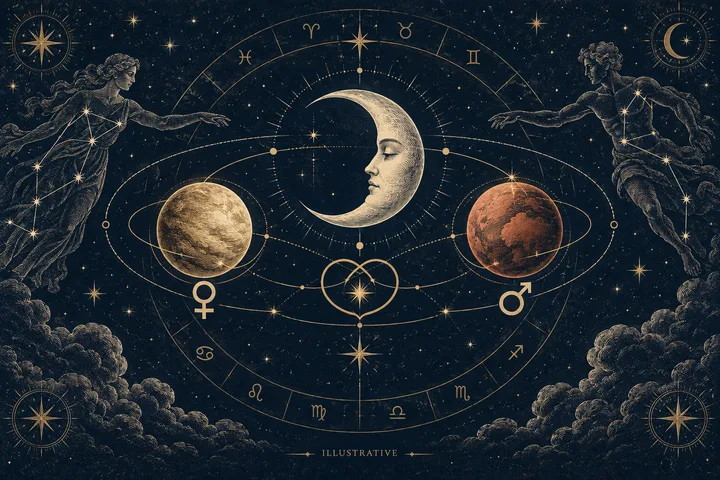
On December 17, 2026, the Moon is in Pisces at the 12:00 UTC reference point and enters Aries at 14:34 UTC. The first-quarter Moon is exact in Pisces at about 05:43 UTC. Together, these verified positions suggest a shared symbolic sequence: notice what needs care, make the need clear, then choose a proportionate next step. Venus in Scorpio and Mars in Virgo provide broader relationship-astrology context, but their signs alone do not show how either planet contacts your chart. Known Moon, Venus and Mars signs can help frame reflection; a personal transit claim needs the moving and natal degrees and their angular relationship. Use the day's symbolism to start a clear conversation, not to infer a partner's feelings or predict compatibility.
What does December 17 ask of a couple?
December 17 favors a two-step response: notice what feels tender or unclear while the Moon is in Pisces, then turn that feeling into a direct request. The first-quarter square marks a decision point, not a promise of conflict or a verdict on the relationship. That is the day’s useful love question: what needs to be felt honestly, and what needs to be said plainly? The date-specific sky here uses the tropical zodiac and geocentric positions referenced to Universal Time. In “Ephemeris for December 2026: Daily Planet Positions,” the Moon is at 22°16′ Pisces at 00:00 UT on December 17, and the listed first-quarter phase occurs at 05:42 UT. “Moon on 17 December 2026 Thursday” gives the phase time as 05:43 UTC and identifies it as first quarter in Pisces. The one-minute difference doesn’t change the reading: both sources place the turning point early in the UTC day, while the Moon remains in Pisces at noon. Astrologically, a first-quarter square can describe pressure to respond or adjust. In Pisces, read that pressure through feeling, receptivity and compassion. This is an interpretation of the shared sky, not a claim that every couple will experience the same mood. The Moon changes signs later that day, so the common lunar tone isn’t fixed from morning to night. A natal Moon, Venus or Mars sign can add a symbolic lens; calling the day a personal transit requires comparing degrees. Start with the shared weather, then personalize only as far as the known chart information allows. Use the moment to ask one honest question or make one clear request, not to test compatibility.
Sources: Ephemeris for December 2026: Daily Planet Positions; Moon on 17 December 2026 Thursday
What is actually in the December 17 sky at noon UTC?
At 12:00 UTC on December 17, 2026, the tropical Moon is in late Pisces. The Sun is in Sagittarius, Venus is in Scorpio, and Mars is in Virgo. That is the shared sky for this reference moment, not a calculation of either partner’s birth chart. The time matters: the Moon moves quickly enough to change signs later in the same UTC day, so a single date label can hide a real shift in the lunar backdrop.
Here, tropical means the zodiac measured from the seasonal equinox points. Geocentric means the positions are described from Earth’s center, using ecliptic longitude: the planet’s measured place along the Sun’s apparent yearly path, expressed in degrees and signs. The December 2026 ephemeris from Umbriel Astrology states that its positions are geocentric ecliptic longitudes at 00:00 Universal Time. Its December 17 row places the Sun at 25°02′ Sagittarius, the Moon at 22°16′ Pisces, Venus at 9°30′ Scorpio, and Mars at 7°01′ Virgo. The same table’s hourly Moon positions put it around 27° Pisces at noon. These are date-specific sky positions; the meanings attached to them belong to astrological interpretation.
A second opened table, Daily planetary positions 17 December 2026 – Astrological Ephemeris (00:00 UTC), provides a useful cross-check. It shows the Moon in Pisces at 12:00 and still near the end of the sign by 18:00, when its rounded display places it at 0° Aries. It also lists Venus in Scorpio and Mars in Virgo. Because that table rounds positions to whole degrees, it supports the sign-level check, not minute-level precision. For the finer time and degree figures above, use the explicitly timed Umbriel table.
The Moon supplies the day’s quick-changing emphasis. Venus and Mars move more slowly, so their Scorpio and Virgo placements describe a broader backdrop across more than this noon snapshot. In a love reading, those signs offer symbolic context for affection and desire, but a personal transit claim requires comparison with a known natal placement. A sign label alone doesn’t establish an exact contact. Readers in another time zone can keep the same 12:00 UTC reference, then convert it for their local clock; a local calendar may show a neighboring date even though it describes this same moment.
Sources: Ephemeris for December 2026: Daily Planet Positions; Daily planetary positions 17 December 2026 – Astrological Ephemeris (00:00 UTC)
Why does the Moon's sign change matter within one UTC day?
The Moon remains in Pisces until 14:34 UTC on December 17, then enters Aries. That shift makes the hour part of the reading. At noon UTC, the Moon is still in late Pisces, so a midday reading describes the first tone; a conversation later in the day falls under the Aries ingress. Umbriel Astrology’s Ephemeris for December 2026 lists the ingress at 14:34 UT. Its December 17 row places the Moon at 22°16′ Pisces at 00:00 UT, while the December 18 row places it at 5°04′ Aries at 00:00 UT. The transition happens between those reference points, not at midnight for every reader.
A second check supports the sign sequence. Daily planetary positions 17 December 2026 from Zodiac Astrology Horoscopes shows the Moon in Pisces at 00:00, 06:00 and 12:00 UTC, then at 0° Aries by 18:00. Those hourly degrees are rounded to whole degrees, so they confirm the boundary’s general timing rather than the precise minute. For that, use the explicitly timed ephemeris. Cafe Astrology’s Moon Calendar 2026 is useful for seeing why copied times can appear to disagree: it presents ingress tables in selected local time zones, including Eastern Time, and explains that its dates and times are timezone-specific. A local clock label or detached snippet cannot replace an explicitly stated UTC time. Once the time zone is clear, the sources describe the same progression.
Astrologically, the sign change shifts the collective emphasis, not anyone’s character. Pisces symbolism leans toward sensing, empathy and attending to what has not yet been said. Aries symbolism leans toward initiating, directness and naming a next step. These are interpretive tones for the moving Moon, not fixed instructions for every couple. A Pisces-to-Aries day can therefore be read as a sequence: first notice the tender or uncertain feeling; later, put a clear request or proposal into words. The Moon’s change does not establish that either partner will feel a particular way, and it does not turn a general forecast into a personal chart reading.
For a conversation before 14:34 UTC, begin with what has been felt and ask whether you have understood it. After the ingress, directness may help: say what you are asking for, then leave room for an answer. The practical difference is small but useful. “I’ve felt distant and would like more time together” names both an emotion and a request; it does not assume the other person’s motive. If you know only your natal sign, keep the reading at this symbolic level. A specific Moon-to-natal-planet transit requires comparing positions by degree, a separate step from noting that the sky’s Moon changes signs. The timezone difference is a matter of clock conversion, not a competing relationship message.
Sources: Ephemeris for December 2026: Daily Planet Positions; Daily planetary positions 17 December 2026 – Astrological Ephemeris (00:00 UTC); Moon Calendar 2026
What does the first-quarter square add to the relationship reading?
The first-quarter Moon is exact at about 05:43 UTC on December 17, while the Moon is in Pisces. The Sun and Moon form a square, a 90-degree angle in the zodiac, as lunar light grows. The lunar calendar “Moon on 17 December 2026 Thursday” gives 05:43 UTC and labels the phase First Quarter in Pisces. Umbriel Astrology’s December ephemeris lists it at 05:42 UT, at 25°16′ Pisces. Both place the turning point before dawn UTC. These are sky details; their relationship meaning is astrological interpretation.
In this interpretation, a square brings two principles into contact. The Sun–Moon square marks a point when intention and feeling may call for adjustment. Pisces gives the Moon a receptive, compassionate quality. Together, the symbolism asks: what are you feeling, and what response would give that feeling a clear place in the relationship? The answer needn’t be an argument. Friction can sit inside one person as uncertainty, or between two people as a mismatch in timing. The useful reading isn’t “something is wrong,” but “something needs to be named, understood, or chosen.”
Daily Ephemeris’s “First Quarter in Pisces” interpretation links the phase with decision, friction, and commitment, then places it in Pisces themes of feeling, intimacy, and empathy. Its love guidance is to let tenderness speak without expecting another person to decode it. This is symbolic guidance, not a report of couples' experiences. Some readers may use the phase as a prompt; others may not notice a shift. It offers a lens, not a required mood or event.
Consider this example. One partner hints that they need reassurance before a difficult week. The other asks for a plan: should they talk tonight, or check in tomorrow? The first hoped the hint would be understood. The second thinks a practical offer answers the need. A Pisces first-quarter reading makes room for both: the tender feeling and the choice about what care looks like. The first person can say, “I’m feeling unsettled, and reassurance would help. Could we talk for ten minutes tonight?” The second can answer instead of guessing.
This imagined scene uses no personal chart and makes no claim about a real couple. It shows how to translate symbolism into a choice. Listen, check what you heard, name the need, and ask for a response. The tension is the distance between a feeling and an action that can meet it. A clear request can close that gap better than waiting for a partner to infer what hasn’t been said.
The symbolism can also support quiet repair, a boundary, or a private decision about what you need before speaking. Not every feeling requires an immediate conversation, and not every tension belongs to both partners. Pisces can invite softness without vagueness or self-erasure. If the need is unclear, put it into words. If it’s clear, make the request plainly. The phase doesn’t decide which action is right; the situation does.
Treat the first-quarter square as a prompt to clarify, not evidence that a relationship is in trouble. Notice the feeling, identify the choice it raises, and say what would help. If the conversation reveals a different need, respond to that. What you learn guides the next step.
Sources: Moon on 17 December 2026 Thursday; Ephemeris for December 2026: Daily Planet Positions; First Quarter in Pisces
Which known placement should you bring into the reading first?
Start with the natal Moon when the question is emotional: how do you take in a moment, seek comfort, or respond when something feels unsettled? Bring Venus forward when you want to understand affection, pleasure, and the style through which care is offered. Look to Mars when the live question is initiative, desire, pursuit, or how energy moves through disagreement. These placements describe different parts of relationship life. None is a stand-alone score, and no one can tell you whether two people belong together. That distinction matters on December 17. The moving Moon is in Pisces at the 12:00 UTC reference point, while Venus is in Scorpio and Mars is in Virgo, according to Umbriel Astrology’s “Ephemeris for December 2026.” Those are positions in the shared sky. They do not establish that the transiting Moon makes an exact contact to your natal Moon, Venus, or Mars. First choose the placement that fits your question. If the exchange is about feeling heard, begin with the Moon. If it is about affection, consider Venus. If it is about initiative, desire, or tension becoming action, bring in Mars. Astrology.com’s “Astrological Compatibility: Venus and Mars” treats these as separate relationship lenses, describing Venus through affection and relating, Mars through drive and desire, and the Moon through emotional needs. That division gives you an order of inquiry, not a ranking of importance. A couple discussing reassurance may learn more by looking first at Moon symbolism, even if one partner wants to jump to Mars. Another couple may understand its emotional habits and need to discuss different ways of showing affection, making Venus the better starting point. Let the concern choose the placement. Then compare sign symbolism carefully. If your natal Moon is in a water sign, the transiting Pisces Moon may feel symbolically familiar: both sides speak the language of water, with its emphasis on sensitivity and emotional response. A fire-sign natal Moon offers a different contrast, often read through directness, warmth, or momentum alongside Pisces’ receptive tone. This is a broad elemental comparison. It can help name a possible style, but it cannot establish a personal transit or predict how either partner will act. Astrology.com’s “Moon in Pisces” describes the sign through receptivity, compassion, and imagination, while also noting a possible pull toward idealization or vagueness. Hold both sides in view. Sensitivity can make space for tenderness; it can also leave a need unstated. Keep the day’s Venus and Mars placements in the same careful frame. Venus in Scorpio and Mars in Virgo add current-sky context to closeness, desire, and practical response. Their signs may invite reflection on depth, trust, care, or useful effort, but they do not show that either planet contacts a particular person’s natal placements. For that, you need degrees and an aspect comparison. Until then, use these placements as symbolic prompts, not personal claims. Ask which part of the conversation needs attention, then choose its matching lens: Moon for emotional response, Venus for affection, or Mars for initiative and desire. That keeps the reading specific without treating all three placements as equally activated.
Sources: Astrological Compatibility: Venus and Mars; Moon in Pisces; Ephemeris for December 2026: Daily Planet Positions
When does a daily transit become personal to your chart?
A daily transit becomes personal when you compare the moving planet with a known position in a birth chart. A sign can describe the shared symbolism of the day; it cannot, by itself, show that the Moon is making a particular aspect to your natal Moon, Venus, or Mars. For that claim, you need both longitudes, the angular distance between them, and the orb you are using. A natal position is the zodiac longitude of a planet in a birth chart. A transiting body is a planet at its current position in the sky. An aspect is a defined angular relationship between two positions. Astrodienst’s help page, “Transits,” illustrates the distinction with a moving Moon square a natal Moon: the moving body is compared with a position in the birth chart. That is the useful test here. It is a comparison of two chart positions, not a conclusion drawn from a shared sign label. The comparison follows a simple sequence. Put each position on the zodiac circle, find the smaller angular separation between them, then compare that distance with the major aspect angles: 0 degrees for a conjunction, 60 for a sextile, 90 for a square, 120 for a trine, and 180 for an opposition. The orb is the difference between the measured separation and the exact angle. If, for example, a hypothetical moving Moon and hypothetical natal Venus were 88 degrees apart, the separation would be 2 degrees from an exact square. The Synastry Comparison Report uses a six-degree orb for its selected major-aspect calculations. Treat that as the report’s stated setting, not a rule that every astrologer or every transit must use. The setting tells you how close a contact must be before the report includes it. A tighter orb describes a closer approach to exactness; a wider one includes a broader range. When you compare known placements, keep that setting attached to the result instead of turning it into a universal standard. Timing matters especially for the Moon. The “Ephemeris for December 2026: Daily Planet Positions” gives the Moon’s position at 00:00 UT and lists its Aries ingress on December 17 at 14:34 UT. The date-specific table “Daily planetary positions 17 December 2026 – Astrological Ephemeris (00:00 UTC)” also shows the Moon moving through Pisces during the day, with rounded hourly values. The Moon’s longitude therefore changes across the UTC day. A personal contact may be closer to exact at one hour than another, so an hour-specific reading needs an actual reference time and the Moon’s position at that time. There is one more distinction: sign symbolism remains useful when degrees are unavailable. You can read the day’s Pisces Moon as a shared emotional tone, or notice how that symbolism sits beside a known natal placement. Just keep the claim at that level. To call it a square, trine, or other personal transit, you need the natal degree as well as the moving Moon’s degree. If you have only signs, keep the interpretation sign-based; if you have both positions, state the aspect, orb, and time checked.
Sources: Transits; Ephemeris for December 2026: Daily Planet Positions; Daily planetary positions 17 December 2026 – Astrological Ephemeris (00:00 UTC)
How can Pisces Moon symbolism guide a useful love choice?
Use the Pisces Moon as an invitation to listen closely, not as a claim that everyone feels the same way. Astrology.com’s “The Moon in Pisces” links this symbolism with compassion, sensitivity to others’ emotions and imagination. It also names a shadow: feelings can become vague, or an idealized picture can crowd out ordinary facts. Make room for what feels tender, then check what was said and what is being asked.
The first-quarter phase gives that listening a direction. Daily Ephemeris’s “First Quarter in Pisces” joins the phase with decision, friction and commitment, and says tenderness in love should speak without asking the other person to decode it. That’s an interpretive prompt, not a promise of an argument. On December 17, the phase is exact at about 05:43 UTC while the Moon is in Pisces. The symbolism can turn an emotional impression into a choice: clarify the need, then decide on one response. Friction may be the gap between a feeling and a workable request.
Consider this example. One partner says, “I guess we’ll see each other when you have time,” and the other hears criticism, then defends a busy week. The chart can’t tell us which. A better exchange starts with a check: “I hear that you’re unsure when we’ll see each other. Is that what you mean?” The speaker can name the need: “I’d like us to choose a night now.” The listener can answer, ask a question, or say what’s possible.
Compassion needs a boundary with guesswork. Empathy means taking a feeling seriously; it doesn’t mean treating an impression as confirmed knowledge of a partner’s mind. Astrology.com’s Pisces Moon page offers both sides: receptivity and kindness, alongside confusion or idealization. Daily Ephemeris frames Pisces as flexible and compassionate, but advises giving tenderness an honest shape. Reflect what you heard, invite correction, and speak from your own experience. “I felt hurt when the plan changed” is clearer than “You don’t care.” Neither sentence proves what the other person intended.
The outcome doesn’t have to be a sweeping romantic talk. This symbolism can support quiet repair, reassurance, or a kind boundary. If the subject is sensitive, ask one open question and let the answer arrive before proposing a fix. If the need is clear, make one request that can be answered: choose a time to talk, agree on a plan, or say when you’ll revisit the question.
Use the test that matters: did you understand each other, and is there one observable next step? Matching Moon signs aren’t required. A shared sign can offer language for reflection, but it can’t establish that two people interpret a moment alike. On this Pisces first-quarter day, let compassion open the conversation and clarity finish the sentence. If the response shows different needs, name that plainly. If it brings understanding, agree on one small action.
Sources: Moon in Pisces; First Quarter in Pisces
What changes after the Moon enters Aries?
After 14:34 UTC, the Moon is in Aries. What was felt under Pisces can become a request, a proposal, or a first step. The ingress changes the Moon's sign, not the relationship itself. Natal placements, history, Venus-in-Scorpio and Mars-in-Virgo remain as they were. Treat Aries as a brief change in emphasis, not a command to act before you're ready. Astrology.com’s “The Moon in Aries” links this placement with fresh starts, bold expression, and quick reactions. In a relationship conversation, the useful side is candor: say what you want next instead of hoping the other person will infer it. The interpretation names defensiveness and acting before thinking as possible expressions of Aries Moon energy. These are symbolic possibilities, not a forecast of how every couple will behave. A direct request leaves room for an answer. “Could we set aside an hour tomorrow to talk?” gives the other person something clear to accept, decline, or adjust. “You never make time for me” turns a need into a charge about character. Aries favors initiative; it doesn't require force. Start plainly, then listen. Quick action and useful action aren't the same. If a concern has been building, the ingress may feel like permission to address it. Pause long enough to name the issue. Are you asking for more time together, a clearer plan, or an honest answer? One concrete question is easier to answer than old grievances. The day's symbolism can prompt a conversation, but it can't tell you what the other person intends. “Ephemeris for December 2026: Daily Planet Positions” lists the Aries ingress at 14:34 UT on December 17 and shows Venus in Scorpio and Mars in Virgo at midnight. Those slower placements remain the background as the Moon changes signs. The ingress alone doesn't establish a personal contact to your natal Moon, Venus, or Mars. A specific transit reading requires comparing the moving Moon's position with a known natal degree. Without that comparison, keep the Aries reading at the collective sign level. A known degree contact is the strongest exception. If the Moon forms a close major aspect to one of your supplied natal placements, that contact may make the lunar passage more personally salient. But the degree and aspect must be checked; a sign alone can't establish the contact. Even then, a chart contact describes an astrological emphasis, not another person's intentions or a certain outcome. Readers without degrees can use sign symbolism while avoiding claims of an exact personal transit. Use the post-ingress hours for one proportionate move: state the request, suggest a next step, or ask the question waiting for a clear opening. If the conversation is heated, take time to settle before responding. Directness works best when it stays considerate. The Moon's move into Aries can mark a turn from sensing toward initiative; the relationship's meaning rests in what the two people say and do.
Sources: Ephemeris for December 2026: Daily Planet Positions; The Moon in Aries
What is the fairest verdict for the day's love reading?
December 17 supports a practical sequence: feel, clarify, act. The ephemeris “December 2026” places the first-quarter Moon at 25°16′ Pisces at 05:42 UT and lists the Moon's entry into Aries at 14:34 UT. At noon UTC, then, the Moon is still in late Pisces; later, the sign changes. Read the first part of the day as an invitation to notice an emotional need, and the later hours as a prompt to name a next step. That is the day's shared astrological frame, not a verdict on a couple. The distinction matters. Venus in Scorpio and Mars in Virgo are also part of the sky's background on December 17, but their signs alone don't establish a personal transit to either partner. In “What are transits?”, Astrodienst defines a transit through the moving planet's relationship to a position in a birth chart; its example names the moving Moon first and the natal Moon second. So a claim that this Moon contacts your Venus, for instance, needs both positions and their angular relationship. A natal sign can suggest a symbolic theme. It cannot show whether a close contact is occurring. That degree-based exception can refine the reading. If you know a natal Moon, Venus or Mars degree, compare it with the Moon's position at the relevant UTC time and identify the aspect before calling the transit personal. Without degrees, keep the language at sign level. You can still work with Pisces as a symbol of receptivity and emotional sensitivity, then Aries as a movement toward initiative, without claiming the sky has singled out your chart. Sign symbolism can be meaningful on its own. The opened “Astrological Compatibility Can Tell You If Your Love Is Written in the Stars” treats Venus and Mars as distinct relationship lenses. Here, the day's transiting signs describe a shared tone; a personal transit requires comparison with a natal placement. Neither layer tells you what your partner intends. The fairest verdict is therefore clear: listen for what needs care, make the need understandable, then choose one proportionate action. If a verified natal degree forms a close contact, let that add a personal layer. If it doesn't—or you don't have the degree—use the sign-level reading as a reflection prompt. What changes the interpretation is a real chart contact, not a stronger guess about the relationship's future.
Sources: Ephemeris for December 2026: Daily Planet Positions; Transits; Astrological Compatibility: Venus and Mars
What should you do with the reading today?
Start with the placements you know. Write down each person’s Moon, Venus and Mars signs, adding degrees when available. Keep the shared sky’s timing in view: the Moon is in Pisces at 12:00 UTC and enters Aries at 14:34 UTC, according to the December 2026 ephemeris. That gives the day a changing tone; it doesn’t tell you what your partner feels. Next, check whether you have enough information to call anything a personal transit. Astrodienst’s explanation compares a moving planet with a position in a birth chart. A sign resemblance can guide reflection, but a specific Moon-to-natal-planet contact needs both degrees and their angular relationship. If you only know signs, keep the reading symbolic. Don’t turn it into a claim about the other person or the relationship’s future. Then choose one observable next step. Ask, “What would help us feel clearer about this?” Or say what you need and listen to the answer. Notice the conversation, not whether the day confirms a forecast. The Synastry Comparison Report compares supplied Moon, Venus and Mars placements and optional degrees. It doesn’t calculate natal positions from birth details or promise a personal December 17 transit result. Use the symbolism to speak and listen with care. Let the people involved decide what comes next.
Sources: Transits
A little more clarity
What time does the Moon enter Aries on December 17, 2026?
The opened UTC ephemeris lists the Aries ingress at 14:34 UTC. The Moon is still in Pisces at the 12:00 UTC reference point.
Can I tell whether the Moon transits my natal Venus from signs alone?
No. A personal transit requires the moving Moon's degree, your natal Venus degree, and their angular relationship. Signs can guide a symbolic reading, but they don't establish an exact contact.
Sources & further reading
- Ephemeris for December 2026: Daily Planet Positions
Provides geocentric ecliptic positions at 00:00 UT, the Moon's Aries ingress at 14:34 UT, and the listed first-quarter timing.
- Daily planetary positions 17 December 2026 – Astrological Ephemeris (00:00 UTC)
Cross-checks the Moon's Pisces-to-Aries sign progression and the day's Venus and Mars signs using rounded hourly positions.
- Moon Calendar 2026
Presents Moon ingress times in timezone-specific tables, supporting the need to label the reference time zone.
- Moon on 17 December 2026 Thursday
Lists the first-quarter phase in Pisces at 05:43 UTC on December 17.
- First Quarter in Pisces
Interprets the first-quarter phase with Pisces themes as a prompt to make tenderness and relationship needs clear.
- Transits
Defines transits by comparing moving planets with birth-chart positions and illustrates a moving Moon square natal Moon.
- Astrological Compatibility: Venus and Mars
Describes Moon, Venus and Mars as distinct relationship-astrology lenses, supporting their use for different interpretive questions.
- Moon in Pisces
Offers Pisces Moon symbolism including receptivity, compassion and imagination, with possible idealization or vagueness.
- The Moon in Aries
Provides Aries Moon symbolism used to frame initiative and directness alongside the possibility of quick reactions.
Synastry Comparison Report
Enter known placements for two people. Get an input-by-input comparison, selected aspect calculations and a clear record of what remains uncertain.
Compare our placements