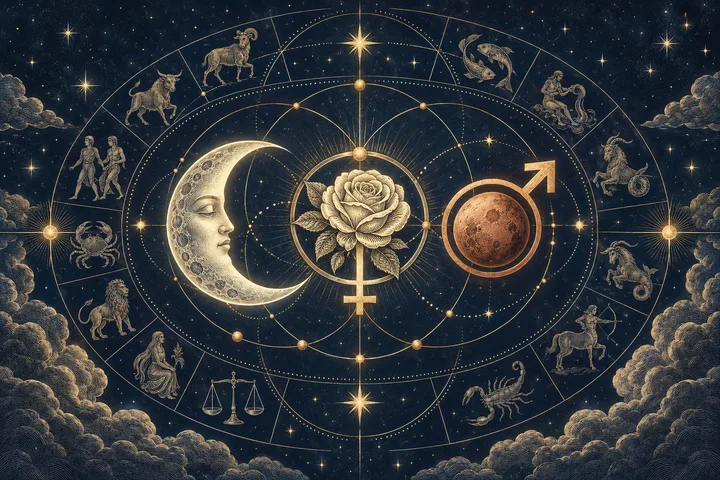
What December 10 can—and cannot—say about your love life
December 10’s sky gives every reader the same astrological backdrop, but it doesn’t give every couple the same forecast. The Moon begins the UTC date at 28°26′ Sagittarius and enters Capricorn at 03:08 UT; Saturn turns direct in Aries late that day. The December 2026 Ephemeris identifies its positions as geocentric ecliptic longitudes at 00:00 Universal Time, while its Moon-change list gives the ingress time. Cafe Astrology’s “Saturn Turns Direct in Aries” places Saturn’s station at 7°56′ Aries on December 10, with its listed local time converting to 23:31 UTC. Read these as two different clocks: the Moon brings a brief shift in tone, while Saturn marks a turn in a longer cycle. To make either transit personal, compare the moving planet’s degree with the degrees of your natal Moon, Venus, or Mars. A close contact can give the day’s symbolism a more specific place in your reflection; a sign resemblance alone stays broad. The chart inputs here are known natal placements and, when available, degrees. Without birth times and places, this reading doesn’t interpret houses or angles, and it doesn’t invent either person’s chart. Check the UTC timing, note which placements are actually contacted, then ask what the symbolism helps you notice or discuss. A transit can focus a conversation about feelings, affection, or desire. It can’t decide whether a relationship should continue.
On December 10, 2026 (UTC), the Moon moves from Sagittarius into Capricorn at about 03:08 UTC, and Saturn stations direct in Aries late in the day, near 7°56′. These are shared sky events; they do not describe every couple in the same way. To see whether either transit has a more personal connection, compare its degree with each person’s known natal Moon, Venus, and Mars. A close degree contact can focus reflection on emotional needs (Moon), affection and relating (Venus), or desire and initiative (Mars). A sign match alone suggests only a broad symbolic theme; it cannot confirm an aspect. Treat the Moon’s shift as brief daily weather and Saturn as a slower-cycle marker. Use any supported contact to choose a conversation, not to predict the relationship’s outcome.
Sources: Ephemeris for December 2026; Saturn Turns Direct in Aries; What are transits?
What is actually moving in the love sky on December 10?
At 00:00 UT on December 10, the Moon is at 28°26′ Sagittarius. It enters Capricorn at 03:08 UT, so the UTC day begins under one lunar sign and continues under another. Venus is at 3°54′ Scorpio and Mars at 5°01′ Virgo. The Sun is at 17°55′ Sagittarius, Mercury at 5°32′ Sagittarius, and Saturn at 7°55′ Aries, still retrograde at the midnight reference. These are positions in the shared sky, not placements in either partner’s birth chart. The two ephemerides agree on the central picture. “Ephemeris for December 2026” from Umbriel Astrology lists the same midnight positions and gives the Moon’s Capricorn ingress at 03:08 UT. “December 2026” from The Working Sky independently lists the daily positions at 00:00 UT in the tropical zodiac, including Venus in Scorpio, Mars in Virgo, and Saturn in Aries. Its row confirms that Saturn is retrograde at the day’s start. The Moon’s midnight degree is useful as a reference, but it doesn’t describe the Moon’s position for every hour that follows. By the next midnight, its listed position is 10°17′ Capricorn. Venus and Mars move more slowly across the zodiac: their listed positions shift to 4°40′ Scorpio and 5°19′ Virgo at 00:00 UT on December 11. The reference hour belongs beside every degree. A date label can hide that motion. Saturn’s station direct is the day’s notable slow-planet event. Umbriel Astrology places it at 23:26 UT at 7°55′ Aries. “Saturn turns direct in Aries” from Cafe Astrology gives the station at 7° Aries 56′ and lists 6:31 pm EST, which converts to 23:31 UTC. The sources differ by five minutes and one arcminute, so the grounded description is a late-UTC-day station near 7°56′ Aries. Saturn is retrograde at 00:00 UT and direct after the station; the turning point is not an extra personal placement. That distinction matters when you bring the day into a love reading. The Moon’s move from Sagittarius to Capricorn and Saturn’s station are date-specific facts. Whether either one speaks closely to your natal Moon, Venus, or Mars depends on the degrees in your chart and the contact they form. A sign label alone can suggest a broad symbolic theme, but it can’t establish a precise aspect. Nor does Venus being in Scorpio or Mars being in Virgo mean those are either partner’s natal signs. First note the moving sky and its timing; then compare it with placements you actually know. Keep the interpretation conditional until that comparison supports a personal reading.
Sources: Ephemeris for December 2026; December 2026; Saturn Turns Direct in Aries
Why doesn’t the same daily horoscope fit every couple?
A daily horoscope describes the moving sky. A personal transit reading asks how that sky relates to a particular birth chart. That difference matters on December 10: the Moon’s sign is part of the shared day, but it does not tell you by itself what either person may feel, want, or need. To make the reading personal, compare a moving planet’s position with a known natal planet or point, then check whether their angular relationship forms an aspect. Without that comparison, you have a general symbolic weather report, not a specific transit to your Moon, Venus, or Mars.
Astrodienst’s “What are transits?” defines a transit as a moving planet entering a relationship with planetary positions in the birth chart. Its example, “Moon Square Moon,” makes the distinction concrete: the moving Moon in the sky forms a square to the Moon in a natal horoscope. A square is a 90-degree aspect. Astrodienst also explains the order of the terms: the moving planet comes first, and the natal planet comes second. So “transiting Moon square natal Venus” would mean the day’s Moon is the moving body and Venus belongs to the person’s birth chart. It would not mean that their natal Venus has changed signs, or that the two partners’ Venuses are square to each other.
A sign label alone cannot establish that contact. Two people may both have Venus in Scorpio, for example, but that shared sign does not prove that the December Moon or Saturn forms an aspect to either Venus. The degrees matter because aspects describe angular distance, not merely matching sign names. A sign-only comparison can still offer a broad interpretation within astrology: it can suggest themes to reflect on. But it cannot confirm a close personal contact. If the natal degrees are unknown, keep the language at that broad level instead of making the reading sound exact.
This also separates two questions that can easily blur together. A transit-to-person reading compares today’s moving sky with one person’s natal placements. You can do that for each partner, one chart at a time. Synastry, by contrast, compares the two natal charts with each other. A transit touching one person’s Venus may be relevant to that person’s experience, but it does not automatically describe the other person or prove what is happening between them. Astrodienst’s explanation supports the first comparison: moving planet against natal position. This section uses that method for each person; it does not claim to calculate a shared relationship chart.
For a careful daily reading, ask three questions in order: Which body is moving? Which natal placement might it contact? What aspect do their degrees support? When the degrees do show an aspect, name the moving and natal planets clearly. Then treat the interpretation as a way to notice a theme or open a conversation, not as a verdict about the couple. The chart comparison becomes personal through the contact; what the two people say and choose gives that symbolism its lived meaning.
Sources: What are transits?; Transit
How does the Moon’s shift from Sagittarius to Capricorn change the tone?
The Moon’s sign change makes December 10 a two-part day . At 00:00 UT, the ephemeris lists the Moon at 28°26′ Sagittarius; it enters Capricorn at about 03:08 UT. So the early hours carry Sagittarius symbolism, while the rest of the UTC date carries Capricorn symbolism. Read this as a change in the day’s emotional weather, not a switch that turns one person into someone else. The Moon moves quickly, and its passage through a sign is brief. As Cafe Astrology’s “Transits of the Moon” explains, lunar transits are temporary influences; a closer reading asks what natal planet the Moon contacts, if any. In a love reading, Sagittarius offers a language for candor, curiosity, and room to explore. Capricorn shifts the emphasis toward steadiness, limits, and what can be followed through. These are symbolic themes, not sourced claims about how every Sagittarius or Capricorn person behaves. Nor does the ingress prove that a couple will move from carefree talk to serious planning. It gives you two lenses for noticing the day: first, whether there is room to speak openly; later, whether the conversation can land in a practical next step. That sequence can be useful without becoming a prediction. Early in the UTC day, a couple might use the Sagittarius image to ask, “What have we been avoiding saying plainly?” After the ingress, the Capricorn image can sharpen the follow-up: “What would help us act on what we’ve said?” Those questions are an illustrative way to use the symbols, not a report about any pair. The second question doesn’t cancel the first. A practical plan works better when both people have had room to speak. The Moon’s sign alone doesn’t make the transit personal. To see whether the shift directly touches your chart, compare its moving position with the known degrees of your natal Moon, Venus, and Mars. Astrodienst’s astrology help page explains transits as relationships between moving planets and natal positions. Cafe Astrology’s lunar-transit guide likewise frames the Moon’s aspects through natal contacts. If you only know the sign, you can reflect on the broad symbolism, but you can’t confirm a degree-based contact or aspect. And a contact to one person’s natal planet describes that person’s transit; it doesn’t automatically speak for their partner. The UTC boundary matters, too. At 03:08 UTC, the Moon’s ingress may fall on a different local civil date for readers in other time zones. A horoscope that labels the entire date with one Moon sign can therefore flatten a change in the sky, while a local calendar label may place the ingress on the prior or following date. Keep the reference zone visible when comparing readings. For December 10, the approach is simple: treat Sagittarius and Capricorn as successive symbolic tones, check degrees before calling either contact personal, and let the imagery suggest a question rather than define either person. You might begin with openness, then ask what small, steady act of care would make the exchange feel complete.
Sources: Ephemeris for December 2026; Transits of the Moon; What are transits?
What does Saturn turning direct add to a relationship reading?
Saturn stations direct at 7°56′ Aries on December 10, 2026, late in the UTC day. The opened references differ by five minutes: Cafe Astrology’s “Saturn turns direct in Aries” gives 6:31 p.m. Eastern Standard Time, or 23:31 UTC; the December 2026 Umbriel Astrology ephemeris lists 23:26 UT. Both place the event on December 10 in Aries, close to eight degrees. In astrology, a station marks a turn in a planet’s apparent motion as seen from Earth. Saturn’s direct turn shifts the phase of a longer cycle; it does not mean every couple experiences a sudden change that day.
Saturn’s traditional themes include responsibility, limits, patience, and the structures that let commitments hold. Cafe Astrology’s event page connects this station with obligations, long-term aims, and boundaries. Read through Aries, those themes raise a relationship question: how can we begin or act plainly while honoring what we owe each other? That is an astrological interpretation, not a claim about what everyone will do. A conversation may need both the courage to name a need and the steadiness to agree on what happens next.
To make the station personal, compare Saturn near 7°56′ Aries with each person’s known natal Moon, Venus, and Mars degree. A close conjunction, square, opposition, trine, or sextile gives a clearer reason to explore a planet’s theme than a sign label alone. The Moon can bring emotional security into view; Venus, affection and reciprocity; Mars, desire, initiative, or friction. These are separate contacts in separate charts. One person’s Saturn contact does not establish the other person’s experience or describe the bond as a single fate. Without natal degrees, you can reflect on Saturn’s broad symbolism, but you can’t confirm an exact contact. A same-sign placement is a broad resemblance, not proof of an aspect.
Give a close degree contact more attention than a loose sign resemblance, but keep that ranking within this day’s limited comparison. No universal orb is established here, and a full chart could change the emphasis. Astrodienst’s “What are transits?” defines a transit through a moving planet’s relationship to a natal position. The sky supplies Saturn’s position; the natal chart supplies the point it may contact. If you know only a sign, keep the reading symbolic and leave the contact unconfirmed.
Use the symbolism to open a conversation, not announce an outcome. If Saturn closely contacts one partner’s Venus, ask what dependable affection looks like to each of you. A Moon contact might prompt a question about the support that feels steady; a Mars contact, a talk about making a direct request without turning urgency into pressure. Even without a confirmed contact, the station can offer a shared prompt: what responsibility have we postponed, and what boundary would make our care more sustainable? Name one task, expectation, or limit, then agree on a small next step. Saturn direct can focus attention on making care workable. It cannot decide whether you should stay, leave, commit, or wait.
Sources: Saturn Turns Direct in Aries; Ephemeris for December 2026; What are transits?
Which of your Moon, Venus, and Mars placements should you check first?
Start with the placement that matches the question, then check whether December 10’s moving sky actually contacts it. The natal Moon speaks to emotional needs, habits of comfort. Venus describes attraction, affection, and how someone gives care. Mars shows how desire becomes action: pursuit, initiative, anger, and the style of handling friction. If reassurance is the question, begin with the Moon; for affection, Venus; for a direct request or conflict, Mars. Astrodienst’s “What Are Transits?” explains the key distinction: a moving planet forms a relationship to a position in a natal chart, and the moving planet is named first. So December 10’s transiting Moon or Saturn is compared with one person’s natal Moon, Venus, or Mars. It does not automatically describe the other person. Use the same reference frame for every comparison. The Working Sky’s “December 2026” ephemeris labels its daily positions tropical, geocentric, and set at 00:00 UT. Its December 10 row places the Moon at 28°26′ Sagittarius, Venus at 3°55′ Scorpio, Mars at 5°01′ Virgo, and Saturn at 7°55′ Aries, retrograde at that midnight snapshot. The event list says the Moon enters Capricorn at 03:09 UT and Saturn stations direct at 23:31 UT. Compare Saturn near 7°56′ Aries at the station with natal degrees. Make a short list for each person: natal Moon, Venus, and Mars, with sign and degree if known. Compare those points with the transiting Moon’s late-Sagittarius position before 03:09 UT and its Capricorn position afterward, then with Saturn’s station near 7°56′ Aries late in the UTC day. The Moon’s contact is brief, while Cafe Astrology’s “Transits of the Moon” describes lunar transits as short-lived and interprets them through contacts to natal planets and points. Name a conjunction, opposition, square, trine, or sextile only when the actual degrees support that angle. Astrodienst’s transit guide defines a square as 90 degrees and uses “Moon Square Moon” to show how the moving and natal planets are paired. A sign alone cannot confirm a contact. If you know only that someone has a Moon, Venus, or Mars in Aries, you can consider the sign symbolism of Saturn in Aries, but you cannot claim a close Saturn aspect without the natal degree. Apply the same rule to the Moon’s Sagittarius-to-Capricorn passage. Use the sign layer second, as a symbolic prompt. Element and modality offer context, not a substitute for planet and degree. A transit to Venus may focus that person on relating; Mars may frame initiative or conflict. Neither tells you what a partner feels or how either person will act. Tie the interpretation to the placement, then ask: “What would help you feel cared for today?” for a Moon question, “What kind of affection would feel welcome?” for Venus, or “How can we make this request directly and calmly?” for Mars. If no degree contact is confirmed, keep the reading at the level of the shared sky and a useful question.
Sources: What are transits?; December 2026; Transits of the Moon
Which reading is fairer: a shared sign forecast or a natal contact?
A shared sign forecast and a natal-contact reading serve different purposes. The first describes the sky available to everyone on December 10; the second asks how a moving planet meets one person’s known chart. For a couple trying to understand why the day feels personally relevant, the natal-contact method is the fairer guide. It uses actual placements rather than assuming that everyone with the same Sun sign, or everyone in a relationship, receives the same message. That distinction follows the technical meaning of a transit. Astrodienst’s “What are transits?” describes moving planets entering relationships with positions in a birth chart. Its example, “Moon Square Moon,” identifies the moving Moon first and the natal Moon second, with the square marking a 90-degree aspect. So a daily Moon in Capricorn is not automatically a Capricorn Moon person’s personal transit. You would compare the Moon’s current degree with that person’s natal Moon, Venus, or Mars and check whether the angular relationship is close. The same moving planet can contact one partner’s chart and leave the other’s placements untouched. For December 10, that comparison matters because the Moon changes signs during the UTC day. The “Ephemeris for December 2026” lists it at 28°26′ Sagittarius at 00:00 UT and records its Capricorn ingress at 03:08 UT. A sign-only forecast can describe the shift from expansive Sagittarius symbolism toward Capricorn’s steadier tone, but it cannot tell you which partner’s natal relationship planets the Moon actually touches. Degree data turns that broad weather into a more specific question. Specificity still has a limit. Cafe Astrology’s “Transits in Astrology: Predictions” recommends reading slower-moving cycles first to establish context, then using faster inner-planet transits to refine the picture. That makes Saturn’s December 10 station relevant to the background, while the Moon supplies a short-lived daily emphasis. But without the full chart, including birth-time-based houses, you cannot rank a Moon, Venus, or Mars contact as the couple’s dominant story. Even a close contact is one layer of an interpretation, not a verdict on the bond. Use this order: begin with the shared forecast to understand the day’s sky; then check each person’s known natal degrees for close contacts; finally ask what the wider chart might add before deciding how much weight to give the contact. If you know signs but not degrees, stay with the symbolic theme and keep the conclusion broad. If you know degrees, you can make the comparison more precise, but don’t turn precision into certainty. The useful result is a focused reflection: which placement is touched, what theme does it raise for that person, and what would help you understand each other today?
Sources: What are transits?; Ephemeris for December 2026; Transits in Astrology: Predictions
How can you turn the transit reading into a useful conversation?
Use a transit to frame a question, not to settle a disagreement. First, confirm what is moving and what it contacts: note the transit’s date and degree, then compare it with each person’s known natal Moon, Venus, or Mars degree. Astrodienst’s astrology help page explains a transit as a moving planet entering a relationship with a natal position. That distinction matters here. A sign resemblance can suggest a broad theme, but it doesn’t establish a personal contact. If you know only the signs, keep the reflection general; don’t claim the transit has reached either person’s chart in a specific way. Next, name the planet’s symbolic topic, then turn it into a first-person question. If a close Moon contact is present, ask, “What would help each of us feel heard today?” The Moon’s Transits describes lunar contacts as brief, which suits a check-in about the day’s emotional tone, not a lasting label for either partner. If Venus is involved, try, “What kind of affection or appreciation would feel welcome?” If Mars is involved, ask, “How can I make this request directly and still leave room for your answer?” These are prompts for reflection, not claims about what either person must feel. For Saturn’s station, keep the question practical: “What commitment or boundary would help us follow through?” Saturn Turns Direct in Aries gives the station a general frame of responsibility and limits; it doesn’t tell you what agreement a particular couple should make. Compare each person’s contact separately. One person may have a close contact while the other has none, and that difference doesn’t speak for the whole relationship. Consider an illustrative example: one partner knows Saturn is close by degree to their natal Venus, while the other has no close contact to Moon, Venus, or Mars. They might ask what care and reliability look like to each of them this week, then listen to the answers. The placement can focus attention; the conversation supplies the people’s actual meaning. Check the contact, choose the question, and let the response guide what you discuss next.
Sources: What are transits?; Transits of the Moon; Saturn Turns Direct in Aries
A grounded next step for December 10
The December 2026 ephemeris from Umbriel Astrology places the Moon in late Sagittarius at 00:00 UT and records its move into Capricorn at 03:08 UT. Cafe Astrology’s Saturn station entry places Saturn’s turn direct in Aries on December 10, late in the UTC day. That distinction keeps a passing mood separate from a longer question of commitment and structure. Check the local time, then compare the moving positions with natal degrees you actually know. A sign match can suggest a theme, but it can’t confirm an aspect. A close degree contact gives you a focused question, not a verdict about the relationship.
Keep the next step small. If a contact involves a natal Moon, ask, “What would help each of us feel heard today?” For Venus, ask what kind of affection would feel welcome. For Mars, ask how to make a direct request with care. For Saturn, name one responsibility or boundary: “What can we follow through on this week?” The chart can help you choose a subject; the conversation tells you what matters between you. If you want a structured comparison, the Synastry Comparison Report uses placements you supply and optional degrees. It doesn’t calculate natal charts from birth details. Start with what you know, and leave uncertain details unclaimed.
Sources: Ephemeris for December 2026; Saturn Turns Direct in Aries
A little more clarity
What time does the Moon enter Capricorn on December 10, 2026?
The opened ephemerides place the Moon’s Capricorn ingress at about 03:08 UTC on December 10. Local civil dates can differ by time zone.
Can I tell whether these transits affect my relationship from signs alone?
Signs offer broad symbolic themes. To confirm a personal transit aspect, compare the moving planet’s degree with the degree of a known natal placement.
Sources & further reading
- Ephemeris for December 2026
Lists December 10 planetary positions at 00:00 UT, the Moon’s Capricorn ingress, and Saturn’s station timing.
- December 2026
Provides an independent daily tropical ephemeris for December 10 and confirms the positions used as the day’s midnight reference.
- What are transits?
Defines transits as moving planets in relation to natal positions and illustrates a Moon square Moon contact.
- Transit
Provides technical background for reading a moving planet’s relationship to a birth-chart position.
- Transits of the Moon
Describes lunar transits as brief and explains interpreting them through contacts with natal planets.
- Saturn Turns Direct in Aries
Gives Saturn’s December 10 station direct near 7°56′ Aries and its listed local time, converted to UTC in the article.
- Transits in Astrology: Predictions
Recommends using slower cycles for context before refining a transit reading with faster inner-planet movements.
Synastry Comparison Report
Enter known placements for two people. Get an input-by-input comparison, selected aspect calculations and a clear record of what remains uncertain.
Compare our placements