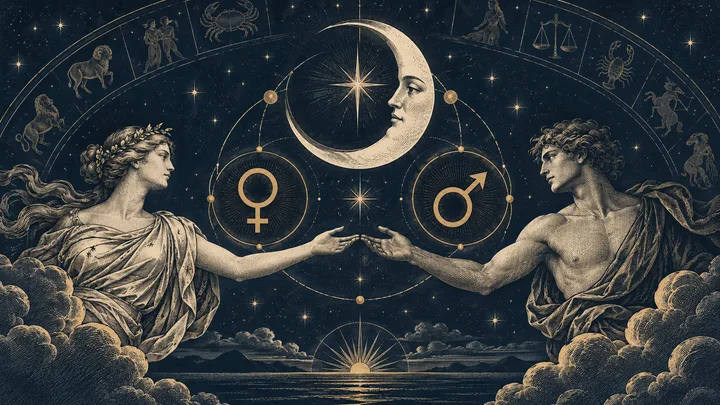
What was actually in the sky on December 7?
For December 7, read the sky at a stated hour before giving the day a single mood. At 12:00 UTC, the tropical geocentric position table on “7 December 2026 — name days, holidays and the day's sky” places the Moon at 28°26′ Scorpio, Venus at 2°07′ Scorpio, and Mars at 4°13′ Virgo. The table is a noon snapshot, not a claim that those degrees hold all day. Book of Horoscopes lists the Moon’s Sagittarius ingress at 15:06 UTC; AstroAk lists 15:07 UTC, a one-minute difference between the opened sources. Use 15:06 UTC as the working time below, while treating the ingress as occurring around 15:06–15:07 UTC. Umbriel Astrology’s ephemeris supplies midnight positions, not an ingress time. The UTC day in this reading runs from 00:00 through 23:59 UTC. A reader whose local date differs should keep that boundary in mind when comparing a conversation or meeting with the sky.
The date ledger has a useful cross-check. Umbriel Astrology labels its daily positions 00:00 UT and lists the Moon at 22°20′ Scorpio, Venus at 1°45′ Scorpio, and Mars at 4°02′ Virgo. “December 2026 Ephemeris: Daily Planet Positions” from AstroAk gives the same day-start signs and degrees to the displayed precision, with Mars at 4°03′ Virgo; it separately lists the Sagittarius ingress at 15:07 UTC. These midnight entries and the noon table are different snapshots; together they support the sign sequence and noon placements without making the Moon stand still. Swiss Ephemeris documentation explains that planetary positions depend on stated calculation and reference conventions, which is why a timestamp and coordinate frame belong beside a degree. One opened daily table gave conflicting day-start values, so its figures are excluded rather than averaged with the corroborating tables.
That distinction shapes the love reading. The Moon moves quickly enough to change signs during this UTC date, making its emotional symbolism the brief, shifting layer. Venus in Scorpio and Mars in Virgo provide steadier sign-level themes across the day. Yet the shared sky is only the starting map. To see whether its symbolism is personally emphasized, compare each moving planet’s position with the known natal Moon, Venus, or Mars degrees for each person. These positions alone establish no personal contact and tell no partner what to feel or do. First get the clock and placements right; then ask which natal degrees the transits actually reach.
Sources: 7 December 2026 — name days, holidays and the day's sky; Ephemeris for December 2026; December 2026 Ephemeris: Daily Planet Positions; Swiss Ephemeris documentation
How do daily transits meet a known birth-chart placement?
A transit is a moving planet's relationship to a point in a natal chart. To read December 7 personally, compare that day's Moon, Venus and Mars with each person's known natal Moon, Venus and Mars, then identify the aspect and orb. The sky is shared; contacts are individual. Cafe Astrology describes this moving-to-natal comparison. A sign resemblance suggests a theme, not an exact contact or a person's actions.
A natal placement is where a planet stood in a birth chart. A transiting placement is where a planet is now, moving in relation to that chart. The natal point stays fixed; the transiting planet changes. Ask whether the moving Moon, Venus or Mars aspects a known natal placement, and how closely. December 7's noon positions give one snapshot. The Moon's later sign change makes the hour relevant.
An aspect is an angular relationship between chart positions. The major aspects used here are conjunction (0 degrees), sextile (60), square (90), trine (120) and opposition (180). Skyscript describes aspects as relationships formed by divisions of the zodiac circle. Measure the positions' separation from an exact angle. These names identify geometry; meaning depends on the planets and chart context.
The distance from an exact aspect is its orb. If two positions are 63 degrees apart, they are three degrees from an exact sextile. This is a mathematical illustration. A tighter orb means a closer contact. Orbs can vary; the Synastry Comparison Report uses six degrees for selected major aspects. That's its working rule, not a universal law. State the orb behind “close.”
A contact may be applying or separating. Applying means it moves toward exactness; separating means it has passed exactness and moves away. The Yes Astrology personal transit calendar explains this distinction alongside natal positions and orb. It shows whether a contact is building or fading at the reference time. Keep the chosen orb consistent.
Sign-only and degree-based readings differ. Knowing that a natal Venus is in Scorpio may support a broad reflection under a Scorpio transit. But a sign spans thirty degrees. Without the natal degree, you cannot tell whether the transit is conjunct that Venus, near another major aspect, or outside the report's orb. A sign narrows possibilities, not geometry. This comparison does not invent houses or angles.
Transits and synastry answer different questions. Synastry compares two natal charts; a transit compares a moving planet with a natal placement over time. The same sky can activate different placements for each partner. The Moon may contact one person's natal Venus while another receives no close contact. That is a chart difference, not a ranking of affection. Cafe Astrology supports the transit framework; Skyscript explains aspect geometry.
For a clear reading, record the moving planet, natal planet, aspect, orb and time. Interpret each person's contacts before comparing them. If degrees are missing, stay with sign-level possibilities and name what's unknown. The Synastry Comparison Report organizes supplied placements and selected major aspects within its six-degree rule; it does not calculate natal charts from birth details or add houses and angles.
Sources: Transits in Astrology: Predictions; An Introduction to Aspects and Chart Shaping in Natal Astrology; Personal Transit Calendar
What changes when the Moon leaves Scorpio during the UTC day?
At noon UTC, the Moon is at 28°26′ Scorpio. Book of Horoscopes lists its Sagittarius ingress at 15:06 UTC, while AstroAk lists 15:07 UTC; treat the one-minute difference as timing precision, and use 15:06 UTC as the working reference in this article. Umbriel Astrology’s December ephemeris independently places the Moon at 22°20′ Scorpio at 00:00 UT and 4°29′ Sagittarius at the next midnight, supporting the sign sequence but not an exact ingress time. So “the Scorpio Moon today” describes only its earlier phase, not late evening. The hour matters.
In modern Western astrology, the natal Moon is read through needs, instinctive responses, habits and emotional comfort. Cafe Astrology’s Moon reference and Astrology.com’s Moon entry describe this responsive layer. A transiting Moon can bring it into the day’s foreground, but its sign and its natal contacts answer different questions. The sign describes the passing atmosphere; an aspect to a natal placement identifies a specific contact. Before the listed ingress, late Scorpio can suggest depth, privacy and concentration. After the ingress, Sagittarius shifts the symbolism toward openness, movement and a wider view. These are themes, not reports of what every person will feel.
A shared sign does not establish a personal transit. Someone with a natal Moon in Scorpio does not automatically receive a specific contact just because the moving Moon is also in Scorpio. Compare degrees and angles. If a known natal planet sits near the transiting Moon’s degree, check whether they form a major aspect, how close the orb is, at the hour that matters. Without natal degrees, keep the reading at sign level. The noon position cannot answer a question about a late-evening meeting: after the ingress, the Moon is in Sagittarius, and an aspect check needs its later position. Convert local appointment time to UTC, because civil dates vary by time zone.
Consider an illustrative example. One person knows their Moon sign but not its degree, and wants to reflect on an evening conversation. They can use the broad shift from Scorpio’s inward focus toward Sagittarius’s more outward, exploratory tone as a prompt. They cannot claim an exact lunar aspect, orb or timing from a sign label alone. Another person may have a natal point near a degree the Moon crosses, while their partner has no close lunar contact during the period they care about. This conditional contrast shows how one shared sky can emphasize two charts differently; it is not a claim about an actual couple. A natal Moon contact may frame questions about emotional response or comfort. The Moon’s sign by itself offers a wider, less individualized description. Neither reveals a partner’s intentions or guarantees how a conversation will go.
For a real exchange, name its hour and time zone, then identify which phase of the UTC day contains it. The noon degree is not an evening stand-in: after the ingress the Moon is in Sagittarius. A broad sign reading can still prompt reflection, but it cannot establish an exact aspect or forecast the exchange. Check each person's known placements separately; the ingress gives the sign-change time, while natal degrees show whether the passing Moon makes a close contact.
Sources: 7 December 2026 — name days, holidays and the day's sky; Ephemeris for December 2026; Moon in Astrology; Moon Planet Meaning in Astrology
What can Venus in Scorpio emphasize in love?
Venus remains in Scorpio on December 7, 2026. At 12:00 UTC, it stands at 2°07′ Scorpio. “7 December 2026 — name days, holidays and the day’s sky” gives that noon position; Umbriel Astrology’s December ephemeris places Venus at 1°45′ Scorpio at 00:00 UT. These entries establish the sign and movement through the day. They don’t tell us what either person will feel. Ask whether transiting Venus forms a close aspect to a known natal placement.
In modern astrology, Venus describes affection, attraction, pleasure, values and how we relate. Astrology.com’s “Venus Planet Meaning in Astrology” lays out those themes. Scorpio gives Venus a searching, private and intense quality. It can draw attention to trust, loyalty, vulnerability and what feels worth investing in. That’s an interpretation, not anyone’s hidden motives.
Read the symbolism in three steps. First, ask what Venus signifies: relating, attraction, pleasure and values. Next, consider Scorpio’s style: depth, emotional honesty and looking beneath the surface. Then check moving Venus against a person’s natal Moon, Venus or Mars by degree. Cafe Astrology’s “Transits in Astrology: Predictions” describes transits as moving planets contacting natal chart factors. Without that contact, Scorpio Venus describes shared astrological atmosphere, not a specific person’s experience.
The kind of contact changes the question. A conjunction brings planetary themes together. A sextile or trine can suggest easier exchange; a square or opposition can describe sharper tension. These are interpretations, not fixed outcomes. A challenging aspect can prompt a needed conversation, while an easy one still calls for presence and choice. Sign names alone don’t establish an aspect. You need natal and transit degrees and their angular distance. A Venus sign alone suggests broad symbolism, not a close contact.
Consider this example, as an illustration only. If a supplied natal Venus sits near early Scorpio, transiting Venus at 2°07′ Scorpio may be close enough for a conjunction under the report’s six-degree orb. Venus themes may then be prominent: what affection means or what feels valuable. If natal Venus lies far away by degree, the shared sign label doesn’t establish a close conjunction. Another major aspect might apply, or none may fall within the orb. The exact comparison determines which reading is justified.
Don’t collapse supportive and challenging contacts into “good” and “bad” love. An easier contact may describe warmth or shared values. A tense one may make differences in attachment, desire or priorities visible. Either can offer something useful to notice. Neither predicts a declaration, reunion, argument or commitment. Astrology can frame a question; it doesn’t reveal a partner’s intentions. Name the planet pair and aspect, then tie the interpretation to that chart relationship.
Venus moves more slowly than the Moon, so its sign and degree provide a steadier background. The Moon changes signs during this UTC date, while Venus remains in Scorpio. Venus can describe a broader relational theme and the Moon a quicker emotional rhythm. Yet “steady” doesn’t mean personal by default. Natal placements determine whether Venus makes a close contact and what topic comes forward. One partner might have a Venus-to-Moon contact while the other has none.
Ask what kind of relating Scorpio Venus brings into view, then check whether its degree connects with either person's natal Moon, Venus or Mars. Note each aspect and orb separately; a Venus-to-Moon contact in one chart does not imply the same emphasis in the other. If degrees aren't known, keep the reading at sign level. The chart can suggest a subject worth exploring, but it cannot speak for a partner.
At 12:00 UTC on December 7, 2026, the Moon is at 28°26′ Scorpio, Venus at 2°07′ Scorpio and Mars at 4°13′ Virgo. Book of Horoscopes lists the Moon’s Sagittarius ingress at 15:06 UTC and AstroAk at 15:07; use 15:06 as a working reference, so a Scorpio Moon reading applies only to the earlier part of the UTC day. Venus is moving toward a sextile with Mars, exact December 12, a shared-sky background rather than a personal transit that day. To relate these placements to love, compare each person’s known natal Moon, Venus and Mars degrees with the transiting degrees and record close aspects and orbs. Sign-only placements suggest broad themes but cannot establish exact contact or partner intention. Use the Moon’s phase at the relevant UTC hour, then compare charts separately; the report applies a six-degree orb.
Sources: 7 December 2026 — name days, holidays and the day's sky; Ephemeris for December 2026; Venus Planet Meaning in Astrology; Transits in Astrology: Predictions
What can Mars in Virgo emphasize in desire and action?
At 12:00 UTC on December 7, Mars stands at 4°13′ Virgo in the tropical geocentric sky. It remains in Virgo throughout the UTC date. The noon position appears in the date table on Book of Horoscopes, while the midnight table in Umbriel Astrology places Mars at 4°03′ Virgo at the day-start snapshot. The noon degree is the reference point here. It describes the shared sky, not either person's birth chart.
In astrology, Mars shows how energy moves into action: assertion, initiative, desire, and the way a person handles resistance. Astrology.com's “Mars Planet Meaning in Astrology” gives this planet that active, driving role. Virgo adds a practical, selective style. It notices what needs doing and prefers effort that can be made useful. In love, that can focus attention on follow-through and small acts of care. It doesn't tell us what a partner intends. The chart offers a symbolic lens; the person's choices remain theirs.
To make the date personal, compare Mars at 4°13′ Virgo with a known natal placement. A transit is a moving planet's relationship to a fixed birth-chart point, as Cafe Astrology explains in “Transits in Astrology: Predictions.” Mars contacting a natal Moon can bring effort into the emotional-response layer: what helps someone feel met, or what makes a request feel pressing? A contact to natal Venus brings action into affection and preference: does care arrive in a form the person values? A contact to natal Mars brings two expressions of drive together, making initiative, pace, or disagreement style more noticeable. These are interpretive questions, not predictions.
The geometry matters. An aspect is an angular relationship between chart points, so compare degrees as well as sign labels. For this reading, the report uses selected major aspects and a six-degree orb as its working rule. That rule belongs to the report; it isn't universal. If a supplied natal degree falls within the chosen orb of a conjunction, opposition, trine, square, or sextile to transiting Mars, the contact is more specific than a loose sign resemblance. If the degree is unknown, a Virgo placement may suggest a possible connection by sign, but cannot establish an aspect or its orb. Don't fill that gap by guessing a birth time, house, or angle.
A close Mars contact has constructive and more demanding possibilities. Virgo's attention to detail may support practical help or a clear request. Under strain, the same exacting attention can become fault-finding, while urgency can crowd out listening. Even then, a chart doesn't prove that criticism will occur or that a partner will take initiative. Look at what happens between you. If the reading raises a question, ask it plainly: “What kind of help would feel useful to you today?” Then listen to the answer instead of treating the symbol as evidence for it.
The same Mars transit can matter differently to two people. One person's natal Venus may receive a close contact, while the other's natal Moon or Mars does, or neither may have one among these three placements. The shared Virgo sky stays the same; the natal points it touches do not. Compare charts separately, naming the planet pair and aspect. Mars in Virgo can focus attention on how desire becomes effort, how requests become action, and how disagreement is handled. Whether that effort feels caring, intrusive, or ordinary is something to learn from conversation and conduct, not a sign label alone.
Sources: 7 December 2026 — name days, holidays and the day's sky; Ephemeris for December 2026; Mars Planet Meaning in Astrology; Transits in Astrology: Predictions
How does the day's wider pattern qualify those three contacts?
The wider pattern adds a slower theme, but it does not erase the differences between Moon, Venus and Mars contacts. Venus and Mars are moving toward a sextile that becomes exact on December 12 at 09:14 UTC. The date calendar, “7 December 2026,” lists the aspect as in orb from November 30 through December 19. It belongs to the background, not the exact-hour event list. Astrologically, a Venus-Mars sextile can describe affection and initiative finding easier expression. It is a reading, not a promise that every couple will agree.
The distinction between an aspect among moving planets and a transit to a natal planet matters. The date calendar shows Venus sextile Mars in the sky shared by everyone. It does not show contact to a particular person's natal Moon, Venus or Mars. For that, the natal degree must complete the relevant angle within the stated orb. “Transits in Astrology: Predictions” describes moving planets forming relationships to planets and points in an individual natal chart; that gives the personal comparison its proper object. The Venus-Mars climate frames the day; a close transit-to-natal contact shows which chart is stirred. The shared configuration alone is not a relationship verdict.
Prioritize close degree-based contacts to each natal Moon, Venus or Mars, then read them through the planet involved and the relevant Moon phase. The Venus-Mars sextile is context: it may symbolize easier exchange between affection and initiative, but it is shared background unless it also contacts a natal placement. As Skyscript notes, an applying aspect grows closer to exactness; a sextile offers an opportunity, not a guaranteed outcome.
For two people, make separate lists of close contacts, aspects, orbs and relevant UTC windows. One chart may show a Venus contact while the other shows a Moon contact, or neither may have a close contact among these placements. Missing degrees limit the comparison to sign-level reflection; they cannot establish exactness or personal activation. Use the themes to ask what kind of care or effort would feel welcome, then let the answer come from the people involved.
For two people, make two lists rather than combining the sky into one couple-level score. Record each person’s close contacts, aspect names, orbs and relevant UTC windows separately. One person might have a natal Venus contact while the other has a Moon contact, or neither chart may show a close contact among these three placements. The shared sextile describes the same sky, but cannot make responses identical. A sign-only resemblance remains useful as a broad symbolic prompt when degrees are unavailable; it cannot establish exactness, timing or personal activation. The conclusion is conditional: the sextile invites reflection on affection and initiative, while close natal contacts and lunar timing show whether the theme is personally emphasized. Use it to ask what kind of care or effort would feel welcome today, then let the answer come from the people involved.
Sources: 7 December 2026 — name days, holidays and the day's sky; Ephemeris for December 2026; Transits in Astrology: Predictions; An Introduction to Aspects and Chart Shaping in Natal Astrology
How should two people compare the same day without turning it into a verdict?
Read the same UTC sky against each person's natal placements separately, then compare the themes. One partner may have a close Moon contact while the other has a Venus or Mars contact. Neither may have a close contact. These differences can give the day distinct symbolic emphasis, but they cannot establish attraction, intention or relationship success. A transit describes a moving planet's relationship to a natal point; it doesn't tell you what another person will choose. Cafe Astrology's “Transits in Astrology: Predictions” explains transits as moving planets forming relationships to points in an individual's natal chart. Keep the shared sky and each person's chart distinct.
Make a short list for each person: natal Moon, Venus and Mars signs, plus degrees when known. Mark missing degrees; don't guess them. Set the lists beside December 7's reference positions: Moon at 28°26′ Scorpio at 12:00 UTC, Venus at 2°07′ Scorpio, and Mars at 4°13′ Virgo. The Moon’s Sagittarius ingress is listed at 15:06 UTC by Book of Horoscopes and 15:07 UTC by AstroAk, so the noon snapshot doesn't represent every hour.
Compare each moving degree with the natal degrees. Record the planet pair, aspect, orb, and whether the contact is applying or separating. The selected major aspects are conjunction, opposition, trine, square and sextile. An orb measures distance from exactness. Skyscript's “An Introduction to Aspects and Chart Shaping in Natal Astrology” defines aspects by angular distance and distinguishes contacts moving toward exactness from those moving away. This report uses a six-degree orb for selected major aspects. That's its working rule, not a universal standard.
Keep the planet meanings distinct. A Moon contact raises questions about emotional response or comfort. Venus points to affection, preference and relating. Mars brings initiative, desire or friction into view. Cafe Astrology's transit guide treats contact with a natal planet as the point of individual activation, not simply a general sign forecast. Interpret each contact through the planets involved, then consider sign and aspect. Don't let one contact erase the others.
Consider this illustration, not a personal chart: if someone's natal Venus were near early Scorpio, the day's Venus near 2° Scorpio might form a close conjunction, depending on the exact degree and orb. That could make Venus themes more prominent in the reading. It wouldn't show that the person is falling in love or feels more than a partner. If the other person's natal Moon instead formed a close aspect to the moving Moon near noon, each chart would emphasize a different lane. The contacts don't cancel each other, and they can't be added into a relationship percentage.
A sign-only reading still has a place. If you know only that someone's natal Venus is in Scorpio, you can reflect on that shared sign emphasis. But the sign alone can't show the degree distance, closest major aspect or exact Moon-contact timing. A sign gives a broad field of meaning; degrees narrow the question. Skyscript notes that astrologers use different orbs, so name the working rule instead of presenting one boundary as the only valid choice.
Compare the lists for overlapping and different themes, and note whether the Moon's ingress changes the time window. Personal emphasis comes from each person's actual contacts, not a couple-level score. Use the result to suggest a conversation: ask what helps each of you feel heard, what affection feels welcome, or how you handle disagreement. A chart can frame that question; a partner's words and actions provide the answer.
Compare the two lists. Which themes overlap? Which differ? Does the Moon's ingress change the time window you care about? Mark missing degrees, since they prevent an exact aspect check. The verdict is conditional: both people share the moving sky, but they don't share the same natal map. Personal emphasis comes through each person's actual contacts. A shared transit is a clock; each natal chart shows where it reaches. Neither chart decides what the couple should do.
Let the comparison suggest a conversation. For a Moon contact, ask what helps each of you feel understood when plans shift. If Venus stands out, ask what kinds of affection feel welcome. If Mars is clearest, talk about how you raise requests or handle disagreement. Keep the question open. A chart can suggest a theme for reflection, but it can't report a partner's private intentions. What they say and do remains part of the picture.
Sources: Transits in Astrology: Predictions; An Introduction to Aspects and Chart Shaping in Natal Astrology; Moon Planet Meaning in Astrology; Venus Planet Meaning in Astrology; Mars Planet Meaning in Astrology
What can you check next?
Start with the question you have about December 7: an emotional response, affection, or the way effort gets expressed. Choose the matching natal placement, then compare its known degree with the dated transit. The Personal Transit Calendar guide distinguishes general sky patterns from contacts to a person's own chart. Degree and orb show how close it is.
If you know only a sign, keep the reading at sign level. You can reflect on Scorpio Venus or Virgo Mars, but can't name an exact aspect or orb without degrees. If the natal degree is known, note the transiting planet, natal planet, major aspect, approximate orb, and relevant UTC window. For the Moon, note whether you mean before or after its Sagittarius ingress.
For a couple, repeat the check separately for each person. One person's natal Moon may be the relevant point; the other's Venus or Mars may be more closely contacted. Compare the themes, then ask a grounded question: What helps each of you feel heard? The chart can give you language for that conversation, but it can't answer for your partner.
The Synastry Comparison Report can organize supplied Moon, Venus, and Mars signs, optional degrees, and selected major aspects using a six-degree orb. It doesn't calculate natal positions from birth details or provide houses. Without degrees, keep aspect conclusions open; without the relevant birth data, don't draw house-level conclusions. Name what remains unknown, then take the reading into a real conversation. If the placements are incomplete, a broader reflection is the sounder reading for this date.
Sources: Personal Transit Calendar
A little more clarity
What time does the Moon enter Sagittarius on December 7, 2026?
Book of Horoscopes lists 15:06 UTC and AstroAk lists 15:07 UTC, so the opened sources differ by one minute. This article uses 15:06 UTC as a working reference and treats the ingress as around 15:06–15:07 UTC. At 12:00 UTC the Moon is at 28°26′ Scorpio, so that noon position does not describe the entire UTC day.
Can I tell whether a December 7 transit affects my chart from sign placements alone?
Sign placements can suggest broad themes, but an exact transit-to-natal aspect requires the natal degree. Compare the transiting and natal positions, then name the aspect and orb. The report uses a six-degree orb for selected major aspects.
Sources & further reading
- 7 December 2026 — name days, holidays and the day's sky
Supplies the December 7 noon-UTC planetary positions, lists the Moon's Sagittarius ingress at 15:06 UTC, and gives the Venus-Mars aspect timing used in the date-specific reading.
- Ephemeris for December 2026
Lists December 7 positions at 00:00 UT, supporting the day-start signs and degrees used to contextualize the noon snapshot; it does not supply the ingress time cited here.
- December 2026 Ephemeris: Daily Planet Positions
Corroborates the December 7 day-start planetary signs and degrees shown in Umbriel's monthly ephemeris and lists the Moon's Sagittarius ingress at 15:07 UTC, one minute later than Book of Horoscopes.
- Swiss Ephemeris documentation
Explains position calculation and reference conventions, supporting the article's explicit time and coordinate-frame labels.
- Transits in Astrology: Predictions
Describes transits as moving planets contacting natal chart factors, supporting the distinction between shared sky and personal contacts.
- An Introduction to Aspects and Chart Shaping in Natal Astrology
Defines aspect geometry and discusses aspect strength and applying contacts, supporting the degree-based comparison method.
- Moon in Astrology
Describes natal Moon symbolism including needs, reactions, habits and emotional security, which informs the Moon-contact interpretation.
- Moon Planet Meaning in Astrology
Provides a second publisher reference for the Moon's astrological symbolism used to distinguish emotional themes from transit timing.
- Venus Planet Meaning in Astrology
Describes Venus themes of affection, attraction, pleasure and relating, supporting the article's distinct Venus interpretation.
- Mars Planet Meaning in Astrology
Describes Mars themes of action, drive, assertion and desire, supporting the article's distinct Mars interpretation.
- Personal Transit Calendar
Explains personal transit contacts, degrees, orb and applying or separating motion, supporting the practical chart-comparison steps.
Synastry Comparison Report
Enter known placements for two people. Get an input-by-input comparison, selected aspect calculations and a clear record of what remains uncertain.
Compare our placements