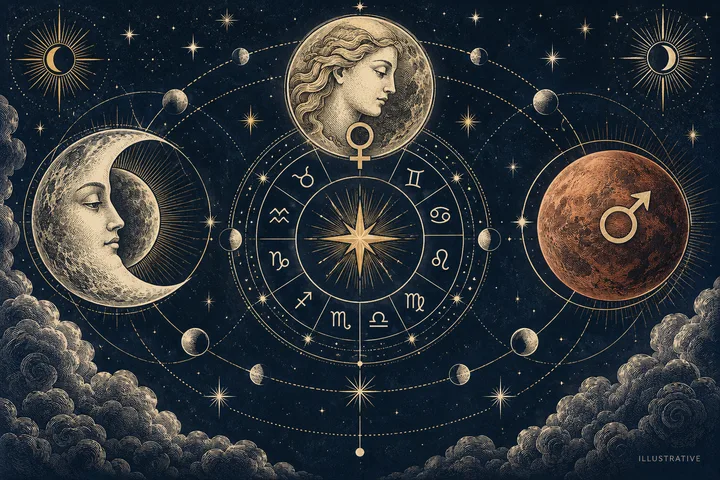
What does November 30's love forecast actually describe?
Imagine a couple deciding how to divide a small shared task after one asks for more visible appreciation. They could begin with a warm acknowledgment, offer a practical way to help, or pause before answering if plans shift. The November 30 sky gives this ordinary choice a symbolic sequence. It doesn't tell us what either person feels, or what the couple will decide. This forecast follows the tropical, geocentric sky across the UTC day. The Working Sky’s independent ephemeris places the Moon at 21°47′ Leo at 00:00 UTC and lists its Virgo ingress at 14:13 UTC; WitchcraftDaily’s “November 2026 Sky Calendar” gives the same ingress time. The calendar lists the other UTC events: a Moon-Jupiter conjunction at 08:35, Moon-Venus sextile at 10:10, Moon-Mars conjunction at 17:25, and Moon-Uranus square at 20:17. Its event times are rounded to the nearest minute. The Moon remains in Leo through noon and enters Virgo in the afternoon, shifting the reading from expressive warmth and affection toward detail, effort, and a possible change of pace. That is the shared sky: the same dated planetary events for everyone. A conjunction or square in that event list joins moving bodies to one another. It does not, by itself, show that the Moon contacts your natal Venus, your partner’s Mars, or any other birth-chart point. For that personal reading, each person’s natal placements must be compared with the moving planets. AstroAk’s November ephemeris independently lists Venus in Libra and Mars in Virgo for November 30 at 00:00 Universal Time; those are the midnight reference positions. For the couple in our illustration, the sequence offers prompts, not a script. Start by recognizing what your partner asked for. Then consider one concrete offer of help. If the plan changes, make room to adjust before replying sharply. If you know only Moon, Venus, and Mars signs, use them to reflect on broad themes; exact personal aspects require natal degrees. The useful question is not whether the sky guarantees a loving or difficult day. It is which response would make appreciation visible and practical in the situation you actually share.
Sources: November 2026 Ephemeris — The Working Sky; November 2026 Sky Calendar; November 2026 Ephemeris: Daily Planet Positions; What is synastry in astrology?; Transits of Sun Moon Mercury Venus Mars
What changes in the sky over the UTC day?
The UTC timeline makes November 30 a day in motion. The Moon begins in late Leo and enters Virgo at 14:13 UTC, according to both The Working Sky’s tropical ephemeris and WitchcraftDaily’s event calendar. The calendar lists the Sun trine Saturn at 06:02 UTC; the Moon conjunct Jupiter at 08:35 and sextile Venus at 10:10; and the Moon conjunct Mars at 17:25 and square Uranus at 20:17. Event times are rounded to the nearest minute. Thus the Moon is still in Leo at 12:00 UTC; the Virgo phase begins after the morning Moon-Jupiter and Moon-Venus contacts and before the evening Moon-Mars conjunction. The listed aspects join moving bodies; they describe the shared sky, not personal contacts to either partner’s birth chart. The Working Sky lists the Moon at 21°47′ Leo at 00:00 UTC and its sign change at 14:13 UTC. Its table gives daily positions at midnight UT, while its event list gives the crossing time. The calendar independently lists the same ingress minute. AstroAk and Upstellar list Venus in Libra and Mars in Virgo at 00:00 UT; those planetary signs are consistent across the cited ephemerides. The order matters. In the morning, the Moon's conjunction with Jupiter takes place at 26 degrees 46 minutes Leo, followed by its sextile to Venus at 27 degrees 41 minutes Leo and Libra respectively. The Moon remains in Leo at noon and enters Virgo at 14:13 UTC, after those morning contacts. The evening conjunction with Mars occurs at 1 degree 50 minutes Virgo, and the later square to Uranus occurs with the Moon at 3 degrees 28 minutes Virgo and Uranus at 3 degrees 28 minutes Gemini. That progression is why a single fixed-sign description misses part of the date: the lunar tone changes, and the contacts change with it. The Sun-Saturn trine at 06:02 UTC adds a slower backdrop to the fast lunar sequence. Its listed positions are 8 degrees 02 minutes Sagittarius and Aries. Venus remains in Libra and Mars remains in Virgo on the date; the 00:00 UT ephemerides confirm both signs. Read this as an ordered symbolic pattern: a steadier opening, expressive lunar contacts, then practical action and a later adjustment point. It doesn't promise that every couple will feel each stage. A transit calendar tracks moving planets; it does not include either person's location or natal chart. Keep the date boundary clear when reading elsewhere. The source calendar notes that local civil dates can differ because the Moon moves quickly. Convert event times for your location, but retain November 30 UTC as this forecast's date. A local clock may show a different hour or date; the aspect sequence stays the same. These events describe what the moving sky is doing together. To know whether the transiting Moon, Venus or Mars makes a close contact to your natal Moon, Venus or Mars, you need the natal degree and an aspect rule. Without them, use the shared reading as context: begin with warmth, offer practical care, and leave room for a changed plan. Notice what the other person says and does.
On November 30, 2026, the tropical Moon is at 21°47′ Leo at 00:00 UTC and enters Virgo at 14:13 UTC, according to an independent ephemeris and the event calendar. So it is still in Leo at noon; the practical Virgo portion begins in the afternoon. The day’s listed sequence includes a Moon–Jupiter conjunction, a Moon–Venus sextile, a Moon–Mars conjunction and a Moon–Uranus square. Read these as symbolic descriptions of the moving sky: warmth and affection give way to practical effort, with room to adjust plans. Venus is in Libra and Mars in Virgo at 00:00 UT. These placements do not automatically describe either partner’s birth chart or predict an outcome. Compare each person’s known Moon, Venus and Mars signs for broad themes; use natal degrees and a stated orb before calling a close personal contact. Let the timeline prompt a clear conversation, not a verdict about compatibility.
Sources: November 2026 Ephemeris — The Working Sky; November 2026 Sky Calendar; November 2026 Ephemeris: Daily Planet Positions
Which contacts belong to the shared sky, and which belong to your chart?
A sky-to-sky aspect joins two moving planets, such as the Moon sextile Venus at 10:10 UTC. A personal transit joins a moving planet to a natal position, such as that same Moon forming a close aspect to your birth Venus. The first event is dated for everyone; the second depends on your own chart and the aspect's degree. A sign match alone doesn't prove that the contact is exact. Keep these layers separate before assigning the day's meaning to either partner. An aspect describes the angular relationship between two points in a chart. A transit is a moving planet's passage through the sky, read in relation either to another moving planet or to a position in a birth chart. That birth-chart position is natal: it belongs to the chart set for a person's birth. An orb is the allowed distance from an exact aspect. Take the scheduled Moon-Venus sextile. The event calendar lists it at 10:10 UTC as a contact between the moving Moon and moving Venus. It gives the day a shared symbolic moment. To ask whether that Moon also touches your natal Venus, you need the Moon's position and your Venus's natal degree, then compare their angular distance. That is a separate calculation. A partner's natal Venus must be checked separately, too. Cafe Astrology's “Transits of the Moon” makes this distinction visible in its structure: it treats Moon transits to natal planets and points separately from transits to natal houses. Its examples describe a personal transit, not every sky-wide Moon aspect as a contact in every reader's chart. For this date, the UTC schedule supplies timing; a birth chart supplies the point against which a personal contact could be judged. A sign match can suggest a broad theme, but it cannot confirm an exact aspect. Two planets may occupy signs associated with a familiar relationship, yet their degrees can be too far apart for the chosen orb. Conversely, degrees can show a close contact even when a sign-only glance misses its strength. Synastry asks another question: how one person's natal placements relate to another person's. “What Is Synastry in Astrology?” from Good Astrologers distinguishes that comparison from transits, which describe current movement. Keep three layers clear: the event belongs to the shared sky; a transit to natal Venus concerns your chart; synastry compares both natal charts. It invites reflection, but doesn't establish a personal contact or settle what the relationship means. For this date, the supplied Synastry Comparison Report can compare Moon, Venus and Mars placements that you provide. If you include degrees, it supports selected major-aspect calculations using a six-degree orb. The report doesn't calculate natal charts from birth details. Use signs for a broad comparison and supplied degrees to check a named aspect against the stated orb. Until then, November 30's Moon-Venus sextile is a shared transit, not a chart-specific conclusion.
Sources: November 2026 Sky Calendar; Transits of the Moon; What is synastry in astrology?
Why does the Moon's sequence matter more than one aspect label?
The Moon's sequence matters because a daily reading unfolds through time. On November 30, 2026, the Moon makes two contacts in Leo, changes signs, then makes two more in Virgo. Read as a progression, the symbolism shifts from visible warmth toward practical response, followed by a need to adjust. These shared themes don't replace either person's natal Moon. The first turning point is the Moon's conjunction with Jupiter at 08:35 UTC. A conjunction brings two moving bodies together in the same part of the zodiac. Jupiter is linked with growth and amplification, so the blend can give emotional expression a generous, expansive quality. This can feel generous, though enthusiasm may outrun the moment. The UTC event calendar lists the contact; its meaning is interpretation. At 10:10 UTC, the Moon sextiles Venus. A sextile is a 60-degree aspect, often read as an opening. Venus in Libra gives the moving Venus a relational language of fairness, tact and exchange. With the Leo Moon, the symbolism favors expressing appreciation in a way the other person can receive. Jupiter enlarges the feeling; Venus gives it a form of affection or consideration. The sequence moves from generosity toward grace, without guaranteeing harmony. The Moon enters Virgo at 14:13 UTC, after the morning Leo contacts. That sign change shifts the reading from Leo's visibility toward Virgo's attention to detail, practical care and improvement. Cafe Astrology's guide to Moon transits describes them as brief influences. Because the Moon changes signs within this UTC date, a single fixed-sign summary would miss an important turn. The ingress time is listed by both the independent ephemeris and event calendar; its meaning is interpretation. At 17:25 UTC, the Moon conjoins Mars in Virgo. Feeling meets action: a concern may call for a practical answer. Virgo favors useful effort, while Mars adds heat and urgency. Offer help or make a clear request before trying to correct someone. This isn't a forecast of an argument. It can describe purposeful action; personal relevance depends on contact with a natal point. At 20:17 UTC, the Moon squares Uranus. A square brings tension; Uranus is linked with disruption or surprise. The plan may need room to change, or a quick response may need a pause. The calendar records it; this application is interpretation. Uranus doesn't promise a rupture. A changed schedule may be enough to express it. Together, the day moves from emotional openness to useful action, then asks for flexibility. But if none of these transits closely contacts either person's natal Moon, Venus or Mars, the sequence remains broad collective symbolism. It offers a shared prompt, not a ranking of who feels it more strongly. A close natal contact could make one segment more personal; exact degrees and a stated orb are needed to establish that. Cafe Astrology notes lunar transits are brief; treat them as timing cues, not a lasting pattern. Use the sequence to guide the decision at hand. Earlier, lead with appreciation or name what you value. After the Moon enters Virgo, turn that feeling into one concrete act of help or a clear request. In the evening, leave room to revise the plan and pause before answering a sudden change. Then notice what happens between you today. The horoscope offers a lens for the day's rhythm; your words and choices give it meaning.
Sources: November 2026 Ephemeris — The Working Sky; November 2026 Sky Calendar; Transits of the Moon
What do Venus, Mars and the slower backdrop add?
Venus in Libra and Mars in Virgo give November 30 two different ways to express care. Venus in Libra favors balance, courtesy and mutual regard: affection wants to be met, not merely offered. Mars in Virgo moves through useful effort, careful choices and attention to what needs doing. Together, they suggest a simple question for the day: can you make a kind exchange practical, and make practical help feel considerate? That is a reading of the day’s sign backdrop, not a promise that every couple will agree. The November 30 row in AstroAk’s ephemeris places Venus in Libra and Mars in Virgo at 00:00 UT; Upstellar’s ephemeris independently lists the same signs at that reference time. In astrological interpretation, Venus describes the style of relating and valuing, while Mars describes how energy and initiative are expressed. A teaching paper on synastry hosted by ICRS discusses Venus and Mars among several relationship factors, including how personal-planet contacts can be read in different ways. The useful synthesis here is not “everything flows.” Libra seeks exchange and proportion; Virgo notices particulars and wants to improve what is at hand. A warm gesture might be a sincere thank-you; practical care might mean remembering the detail that would make tomorrow easier. Two people may divide a task fairly, then agree on one next step. Kindness and usefulness can reinforce each other, but they are not identical. Fairness can feel cool without appreciation; a thoughtful offer can miss if it assumes what the other person needs. The Sun’s trine to Saturn at 06:02 UTC adds a slower, steadier note to this picture. Witchcraft Daily’s Sky Calendar lists the event in UTC. Read symbolically, a Sun-Saturn trine can put attention on consistency, limits and follow-through: what you value is easier to trust when your actions keep faith with it. This is interpretation; the calendar verifies only the event and time, not a personal commitment or favorable outcome. Treat Saturn as context for the day’s choices, not a guarantee that an important relationship will become secure. This steadier background also doesn’t cancel the Moon’s faster contacts. The Moon enters Virgo at 14:13 UTC and meets Mars at 17:25 UTC, then squares Uranus at 20:17 UTC, according to the event calendar. These are separate sky-to-sky events. The Moon-Mars meeting can sharpen the day’s emphasis on action and details; the later Moon-Uranus square can describe a need to adjust when plans or reactions shift. Neither erases Venus in Libra or the Sun-Saturn trine. A reading can hold supportive and disruptive themes at once. The ICRS teaching paper’s multi-factor approach supports that kind of layered reading; it doesn’t require reducing the chart to one “good” or “bad” label. So let the Venus-Mars backdrop shape a modest, observable prompt. Offer appreciation plainly, then pair it with one useful act that the other person can accept or decline. If plans change, pause before treating surprise as rejection; ask what changed and decide together what happens next. You can use the day’s symbolism to choose a more generous way into a conversation. Whether it fits your connection depends on the people, their circumstances and, for a personal transit reading, their own chart contacts.
Sources: November 2026 Sky Calendar; November 2026 Ephemeris: Daily Planet Positions; Introduction to Relationship Astrology 2: Synastry
How do known Moon, Venus and Mars signs enter the reading?
Start with the placements you know. Make two lists: your natal Moon, Venus and Mars, then your partner's. Leave a space blank when a placement is unknown. Don't fill gaps by guesswork. Set those natal signs beside the moving planets for November 30. The Moon is in Leo at 00:00 and 12:00 UTC, then enters Virgo at 14:13 UTC. Venus remains in Libra, and Mars in Virgo. These are the date’s moving positions, not changes to either birth chart. With signs alone, look for broad resonance or contrast. Don’t call it an exact contact. Consider the Moon moving through Virgo beside a natal Venus sign. That pairing can prompt a question: how does care become visible? Through useful help, careful attention, or another style? This is an interpretive prompt. It doesn't establish an aspect to that person's Venus. The Moon crosses a whole sign over time, while Venus occupies a particular degree; sign labels alone don't give their exact angular distance. Use three passes. First, record each person's supplied Moon, Venus and Mars signs. Second, compare those signs with the day's Moon, Venus and Mars signs, describing only broad symbolic fit. Third, if you have reliable natal degrees, measure the angle between each moving body and each natal position. Only then name a conjunction, sextile, square, trine or opposition, and state the orb you're using. An aspect is an angle between two chart positions. An orb is the allowed distance from the exact angle in a chosen method. Sharing an element or mode can suggest a family resemblance, but it doesn't prove a trine or square. Two planets can occupy signs with a familiar relationship yet sit too far apart by degree for a close contact. Degrees settle that question; sign shorthand doesn't. Check each person separately. The same transiting Moon can fall close to one person's natal Venus and remain outside the chosen orb of the other's. The day's symbolism may feel more pointed for one chart, while both people share the general sky. A shared horoscope and a personal transit reading answer different questions. The guide “What Is Synastry in Astrology?” describes Moon themes through emotional needs and habits, Venus through affection and values, and Mars through initiative and conflict. Philip Graves's teaching paper, “Synastry,” also considers several planetary connections rather than one isolated label. These are interpretive approaches, not a single rulebook; astrologers can weigh factors differently. Use placements to frame a useful question, then compare the answer with what each person says and does. With signs alone, stop at sign-level language. Optional degrees help identify selected major aspects under a stated orb; missing birth information leaves other chart details unresolved. The Synastry Comparison Report uses supplied placements and optional degrees. It doesn't calculate natal positions from birth details. Signs offer a first lens, degrees test a specific contact, and lived conversation shows what the symbolism means between you.
Sources: November 2026 Ephemeris — The Working Sky; November 2026 Ephemeris: Daily Planet Positions; What is synastry in astrology?; Introduction to Relationship Astrology 2: Synastry
How do daily transits differ from synastry between partners?
Synastry compares one person's natal placements with another's. A daily transit describes moving planets in relation to one another or to a natal chart. The November 30 aspects do not change the natal relationship pattern or show whether two charts fit overall. A date-wide horoscope can still offer shared symbolic context without birth data. For example, the Moon can make the same sky-to-sky contact for both partners yet fall near one person's natal Venus and far from the other's. Establishing that personal contact requires the natal degree and a stated orb. Signs can suggest broad themes, but they cannot confirm the angular contact. Good Astrologers' synastry guide treats chart comparison and current transits as separate techniques. The ICRS teaching paper discusses several relationship factors as one astrologer's method, not a universal ranking. Together, these sources support keeping the categories distinct without reducing a relationship to one aspect: the shared sky describes the date, a personal transit relates movement to one chart, and synastry compares two natal charts. For November 30, use the timeline to notice warmth, practical effort or a need to adjust. With natal degrees, you can check whether a moving position makes a close contact to either person's Moon, Venus or Mars. Without them, keep the reading broad and use the report's supplied-placement comparison for the question, “How do our charts fit together?”
Sources: Transits of the Moon; What is synastry in astrology?; Introduction to Relationship Astrology 2: Synastry
How can the sequence guide one real conversation?
Imagine a couple deciding how to divide a shared task after one asks to feel more appreciated. One partner asks for more appreciation; the other hears criticism and starts listing what they’ve done. Can they name the need and agree on one useful action? The November 30 sky offers a sequence for considering that choice. It does not reveal what either person intends, and this invented scene gives neither partner a birth chart, history, or outcome. The earlier Moon-Venus sextile at 10:10 UTC can frame a warmer opening. The symbol suggests receptivity and an easier exchange, not guaranteed agreement. One partner might say, ‘Could you take the grocery run tonight? It would help me feel we’re sharing this.’ That gives the other person something clear to answer. Warmth helps, but it can’t replace a clear request. After 14:13 UTC the Moon is in Virgo, shifting the day’s symbolism toward details and practical effort. Its conjunction with Mars follows at 17:25. Together, they can prompt a broad wish to become a task: one person shops, the other prepares dinner, or they choose a workable split. Cafe Astrology’s discussion of inner-planet transits describes them as brief, and offers more than one interpretation for some contacts. A fast lunar cue is a short prompt, not a fixed account of character. In the illustrative conversation, the useful question is simple: what action would count as care to each of you? The Moon’s square to Uranus at 20:17 UTC adds a reason to leave room for a change. A schedule may shift or the task may prove too much. The WitchcraftDaily November 2026 Sky Calendar lists this as a sky-to-sky event, calculated for the moving bodies, and says its tables don’t use a visitor’s natal chart. This shared symbol invites flexibility; it doesn’t predict an argument or reveal hidden motives. A calm ‘That no longer works for me; can we choose another time?’ may serve better than insisting the first arrangement must stand. There are ordinary explanations for a strained reply, too. Fatigue, workload, unclear expectations, or an old disagreement may explain a strained reply. Astrology can help the couple choose what to notice; it can’t prove motive. And a transit to the shared sky is different from a transit to a person’s natal planet. A verified close contact from the moving Moon to one partner’s natal Moon, Venus, or Mars could make the timing personally resonant within the chosen method. Without natal degrees, don’t claim that contact. Good Astrologers’ guide to synastry also distinguishes comparing two natal charts from reading current transits. A personal transit still describes one chart; it doesn’t settle the relationship’s meaning. The practical decision remains in the couple’s hands. Each can state one need, make one workable offer, and agree when to revisit it if plans change. Then notice whether the request gets answered, the task feels fair, and both can adjust. Those observations guide the next conversation. The chart supplies a symbolic rhythm: begin with appreciation, make care concrete, and keep the plan flexible. Use it as a prompt for listening, then let the people’s words and choices tell you what is happening.
Sources: November 2026 Sky Calendar; What is synastry in astrology?; Transits of Sun Moon Mercury Venus Mars
What should you compare next?
Start with the UTC timeline, then write down each person’s known Moon, Venus and Mars signs. Ask which theme fits the choice in front of you: visible appreciation, practical help or a need to adapt. The Moon is at 21°47′ Leo at 00:00 UTC, remains in Leo at noon, and enters Virgo at 14:13 UTC. This ingress belongs to the moving sky, not either person’s natal chart. Keep shared events separate from contacts to natal degrees. For a focused comparison, confirm the tropical zodiac and UTC date, list each person’s placements separately, and compare dated positions with natal degrees when you have them. A stated orb tells you how close an aspect must be to count. Cafe Astrology’s transit guide describes brief inner-planet transits to natal planets; the Good Astrologers guide defines synastry as comparison between two natal charts. These questions are related, but not interchangeable. Then choose one observable next step: say what appreciation would help, offer a specific task, or pause before replying if plans shift. Review the reading against the conversation itself. The Synastry Comparison Report compares supplied Moon, Venus and Mars placements and optional degrees, using a six-degree orb for selected major aspects. It doesn’t calculate natal charts from birth details, houses or relationship outcomes. If you know your placements, compare them there; otherwise, keep today’s reading at the shared-sky level.
Sources: November 2026 Ephemeris — The Working Sky; November 2026 Ephemeris: Daily Planet Positions; Transits of the Moon; What is synastry in astrology?; Transits of Sun Moon Mercury Venus Mars
A little more clarity
What sign is the Moon in at noon UTC on November 30, 2026?
The Moon is still in Leo at 12:00 UTC. The Working Sky’s ephemeris and WitchcraftDaily’s event calendar both list its Virgo ingress at 14:13 UTC.
Do the day’s aspects automatically affect both partners’ birth charts?
No. The listed sky-to-sky aspects describe moving planets. To identify a personal transit, compare a moving planet with that person’s natal position and degree using a stated orb.
Can I compare Moon, Venus and Mars placements if I know only the signs?
Yes, for broad sign-level themes. Degrees are needed to check whether a specific close aspect falls within the chosen orb.
Does the Synastry Comparison Report calculate natal charts from birth details?
No. It compares supplied Moon, Venus and Mars placements and optional degrees, using a six-degree orb for selected major aspects. It does not calculate natal charts from birth details.
Sources & further reading
- November 2026 Ephemeris — The Working Sky
Lists daily geocentric tropical positions at 00:00 UT, including the Moon at 21°47′ Leo, Venus at 27°27′ Libra and Mars at 1°33′ Virgo on November 30. Its event list gives the Moon's Virgo ingress as 14:13 UT, with crossing times bisected to the minute.
- November 2026 Sky Calendar
Lists the November 30 UTC Sun–Saturn trine at 06:02, Moon–Jupiter conjunction at 08:35, Moon–Venus sextile at 10:10, Moon ingress into Virgo at 14:13, Moon–Mars conjunction at 17:25 and Moon–Uranus square at 20:17. It states event times are rounded to the nearest minute and describes the aspects as relationships among moving bodies; location and natal chart are not inputs.
- November 2026 Ephemeris: Daily Planet Positions
States its table gives geocentric tropical positions for 00:00 Universal Time, calculated with Swiss Ephemeris. The November 30 row lists Venus at 27°27′ Libra and Mars at 1°33′ Virgo; its Moon value is not used.
- Transits of the Moon
Organizes interpretations under Moon transits to natal planets and points and natal houses, and describes Moon transits as brief. It supports using natal-target language for personal Moon transit interpretations.
- What is synastry in astrology?
Defines synastry as comparison of two natal/birth charts and describes examining planetary connections between them; it distinguishes synastry from other relationship techniques including transits.
- Transits of Sun Moon Mercury Venus Mars
States that Sun, Moon, Mercury, Venus and Mars transits to natal planets are brief in duration; it also notes that some interpretations are alternate readings from different sources.
- Introduction to Relationship Astrology 2: Synastry
The accessible teaching paper by Philip Graves discusses synastry as factors connecting two people's birth charts and considers Moon, Venus and Mars contacts among multiple interpretive factors. It presents an astrological approach and does not establish empirical relationship outcomes.
Synastry Comparison Report
Enter known placements for two people. Get an input-by-input comparison, selected aspect calculations and a clear record of what remains uncertain.
Compare our placements