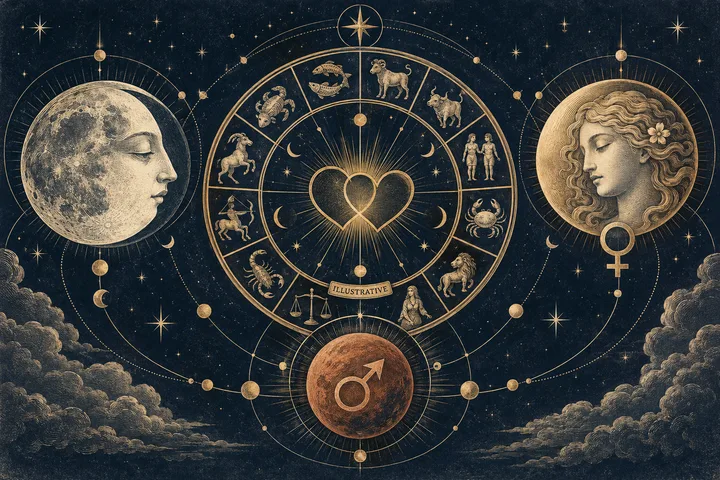
On November 27, 2026, the Moon moves through Cancer, Venus is in Libra, and Mars is in Virgo. The Moon is about 17° Cancer at 12:00 UTC; the verified Moon–Mercury trine occurs at 14:31 UTC. These positions describe the shared sky, not either partner’s birth chart. To connect them to known placements, first compare each transiting planet’s degree with natal Moon, Venus, or Mars and identify any close major aspect using a stated orb. A close degree contact gives a more specific focus than sign geometry alone; signs suggest possibilities when degrees are missing. Interpret the contact through the natal planet it reaches, then use the shared symbolism as context. The Moon–Mercury trine is transit-to-transit, not proof of a personal contact or relationship outcome. The report compares placements you supply and does not calculate a chart from birth details.
What November 27, 2026 actually brings to the love forecast
For the UTC day of November 27, 2026, the sky offers a Cancer Moon, Venus in Libra and Mars in Virgo. These placements set the shared astrological weather; they don't describe either partner's natal chart. The daily table in Daily planetary positions 27 November 2026 gives the Moon at 8° Cancer at 00:00 UTC, about 17° Cancer at noon, and 21° Cancer at 18:00. It identifies its positions as geocentric and tropical, sourced to NASA JPL Horizons, and rounds degrees to whole numbers. That fast movement matters. A noon position is a reference, not a description of the Moon for every hour. The independent November 2026 Ephemeris: Daily Planet Positions table places Venus at 25°58′ Libra and Mars at 0°24′ Virgo at 00:00 UT; Upstellar’s Ephemeris Tables agrees on those positions. Venus and Mars shift far less over this day than the Moon, so the lunar degree needs the clearest time label. There is one timed major aspect to carry into the reading: the Transits Report lists the Moon trine Mercury at 9:31 a.m. EST on November 27. EST is UTC−5, so that event falls at 14:31 UTC. Astrologically, a Cancer Moon trine Mercury in Scorpio offers a supportive backdrop for putting feelings into words. It is a transit-to-transit contact, however, not a personal synastry contact by itself. It becomes personal only if the moving sky also aspects a supplied natal placement. Keep that distinction in view: the general tone belongs to the date; a personal emphasis depends on the chart information you bring to it.
Sources: Daily planetary positions 27 November 2026 – Astrological Ephemeris (00:00 UTC); November 2026 Ephemeris: Daily Planet Positions; 2026 Astrological Weather (with the Moon); Skyscript: Beginners Astrology Course by Linda Reid, Lesson 2
How should the day's sky be compared with a natal placement?
A transit is a moving planet's contact with a point in a natal chart. A natal placement is where a planet stood at a person's birth. For this November 27 forecast, ask whether the day's Moon, Venus or Mars makes a close contact to a Moon, Venus or Mars placement you already know. That differs from synastry, which compares two people's natal charts. A daily transit describes the moving sky against one chart; it cannot supply either person's missing chart. Aspect names describe angular relationships. A conjunction places two points close together in the zodiac; a sextile is about 60 degrees apart, a square about 90, a trine about 120, and an opposition about 180. An orb is the distance from the exact angle that an astrologer allows when reading an aspect. The closer the degrees, the tighter the contact. Sign geometry can suggest which aspect family is possible, but it can't show how exact the contact is. Timing matters. An applying aspect moves toward exactness; a separating aspect has passed it. Those terms help distinguish a contact building from one that is waning, though a single reference position can't show every contact's precise timing. Deborah Houlding's “The Moon as the transmitter of influences” describes the Moon's swift motion as a changing focus that activates natal positions. That makes the Moon useful in a daily reading, but its position shouldn't be treated as fixed all day. Cafe Astrology's “Transits of Sun Moon Mercury Venus Mars” also frames inner-planet transits as brief. Read them as passing emphasis, not a complete account of a relationship. Keep the chart information in view. The Synastry Comparison Report compares Moon, Venus and Mars signs readers supply, with optional degrees, and checks selected major aspects within a six-degree orb. It doesn't calculate natal placements from birth dates or provide houses. With signs but no degrees, you can discuss broad possibilities. You can't call one an exact personal contact. Linda Reid's “The Symbolic Meaning of the Planets” offers a useful distinction: the Moon concerns emotional response and security, Venus pleasure and cooperation, and Mars assertion and action. First establish what the geometry supports. Then ask which part of relating the natal planet represents.
Sources: Skyscript: Beginners Astrology Course by Linda Reid, Lesson 2; The Moon as the transmitter of influences – by Deborah Houlding; Transits of Sun Moon Mercury Venus Mars
How does the Moon in Cancer contact your natal Moon, Venus and Mars?
On November 27, 2026, the transiting Moon stays in Cancer throughout the UTC day. Zodiac Astrology Horoscopes lists rounded positions of 8° Cancer at 00:00 UTC, 17° at noon and 21° at 18:00. AstroAk’s independent ephemeris gives 8°14′ Cancer at 00:00 UT. A natal placement near early Cancer may be contacted sooner than one farther along. The rounded positions show the sweep, not exact contact times.
Start with aspect geometry. The Cancer Moon can conjoin a natal placement in Cancer, oppose one in Capricorn, square one in Aries or Libra, trine one in Scorpio or Pisces, or sextile one in Taurus or Virgo. Sign relationships tell you where to look; degrees show whether an aspect is close. An orb sets how far from exactness a contact can count. With signs alone, call the pattern broad or possible, not exact.
Then read the natal planet being contacted. For a natal Moon, the transit brings emotional needs and habitual responses into focus. Linda Reid’s Beginners Astrology Course describes the Moon through instinctive reactions, emotional responses and the desire for safety in relationships. A close contact may make emotional availability worth noticing. These are interpretations, not claims about how either partner must behave.
When the Moon contacts natal Venus, the emphasis shifts to affection, pleasure and cooperation. Reid’s course associates Venus with enjoying relationships and seeking companionship. A close contact can make the fit between emotional comfort and relating preferences more noticeable. A harmonious aspect may support warmth; a square or opposition may surface a difference to discuss. Neither proves affection is present nor predicts the other person’s response. The chart describes a symbolic meeting; people supply the choices.
A contact to natal Mars brings initiative, desire and assertion into the picture. Reid describes Mars as action, effort and standing up for oneself, while noting its capacity for frustration. The Cancer Moon can draw feeling into how someone pursues closeness or protects a boundary. A supportive aspect may ease movement from feeling to action; a tense one can invite care around reactivity. Ask whether a person’s actions make room for the feeling involved, not what the transit guarantees.
Degree matters for timing. A natal point near the Moon’s early Cancer degrees may receive its closest contact sooner than one near the later degrees. The same applies through opposition or square geometry in Capricorn, Aries or Libra. Without exact chart degrees, stay with broad sign-level possibilities only.
Keep the Moon trine Mercury separate. The event table places this transit-to-transit aspect at 14:31 UTC. It gives shared sky context, but does not establish contact with either person’s natal Moon, Venus or Mars. Deborah Houlding’s technical discussion of lunar aspects in traditional chart judgment shows why method and orb should be stated. Identify the natal placement, compare its degree with the moving Moon, name the aspect and orb, then interpret through the natal planet. That shows whether the day raises a question about emotional response, affection or action, without turning a transit into a relationship verdict.
Sources: Daily planetary positions 27 November 2026 – Astrological Ephemeris (00:00 UTC); November 2026 Ephemeris: Daily Planet Positions; 2026 Astrological Weather (with the Moon); Skyscript: Beginners Astrology Course by Linda Reid, Lesson 2; The Moon as the transmitter of influences – by Deborah Houlding
What does Venus in Libra activate in a known placement?
At 00:00 UT on November 27, Venus is at 25°58′ Libra, according to AstroAk’s November 2026 Ephemeris. The placement gives the date a shared Venus-in-Libra tone: attention turns toward affection, pleasure, companionship and give-and-take. Linda Reid’s Skyscript lesson describes Venus through pleasure in relationships, loving and caring, companionship and cooperation. These ideas describe the moving planet’s symbolism. They set a theme; they don’t tell you what a partner feels or how they’ll respond.
To see whether that theme touches a natal placement, compare Venus’s degree with the natal Moon, Venus or Mars. In sign-based geometry, Libra placements can receive a conjunction; Aries, an opposition; Cancer or Capricorn, a square; and Gemini or Aquarius, a trine. These patterns show familiar angular relationships to Libra. But sign pairing only suggests an aspect. It doesn’t confirm that the planets are close enough by degree to count as a contact, or when it becomes exact.
Venus is near the end of Libra . A natal placement at an early degree of a sign on that list may be far from the exact angle, while one near 26° may be closer. AstroAk’s table gives daily positions at 00:00 UT, so its November 27 row anchors the comparison but doesn’t show Venus’s hourly position. Use exact degrees and a stated orb before calling a contact close. The Synastry Comparison Report compares supplied placements and optional degrees, checking selected major aspects within a six-degree orb. Without degrees, keep the reading at sign-level possibilities.
Then let the natal planet specify the subject. A Venus contact to natal Moon asks how affection meets emotional needs and security. To natal Venus, compare relating preferences and expressions of care. To natal Mars, consider pleasure meeting initiative, attraction or a difference in pace. These are distinct lenses, not three ways to announce the same outcome. Skyscript separates Venus’s wish for relatedness from Mars’s drive to assert and act, which helps keep the symbols clear.
Cafe Astrology’s guide to inner-planet transits treats Venus contacts to natal Moon, Venus and Mars separately, while describing inner-planet transits as brief. A daily contact can highlight a short-lived theme for reflection, but it cannot stand in for the full natal charts, the relationship’s history or what either person chooses. Even an exact contact doesn’t settle whether the experience feels easy; the aspect, natal planet, wider chart and people involved all shape the reading.
Use Venus in Libra as a question, not a promise. Check whether a supplied natal Moon, Venus or Mars makes a close contact to 25°58′ Libra. If it does, interpret the contact through that natal planet and ask what conversation it brings into focus. With signs only, note the possible aspect family and leave timing open. Libra may describe a wish for balance or cooperation; it cannot guarantee another person’s response.
Sources: November 2026 Ephemeris: Daily Planet Positions; Skyscript: Beginners Astrology Course by Linda Reid, Lesson 2; Transits of Sun Moon Mercury Venus Mars
What does Mars at the start of Virgo change?
Mars is at the beginning of Virgo on November 27, 2026. The monthly ephemeris from Astroak places it at 0°24′ Virgo at 00:00 UT; Upstellar gives the same position, and The Working Sky agrees to the same minute. This anchors the day’s Mars symbolism in Virgo, while leaving its personal meaning dependent on the natal placement it contacts. In this reading, Mars describes how desire, initiative and assertion move into action. Virgo gives that action a practical, exacting style: noticing what needs attention, making an adjustment, or putting effort into a useful task. A day with Mars in Virgo can be read as an invitation to make care tangible, by following through on a promise or discussing a detail in shared plans. It can turn sharp when improvement becomes fault-finding. Precision helps when both people can name what they need; it can feel like criticism when one person treats a preference as a flaw in the other. The useful question is not simply whether someone has a Virgo placement. It is whether the transiting Mars makes a close aspect to a known natal Moon, Venus or Mars. The monthly ephemerides place Mars just past 0° Virgo at the day’s opening, so early degrees matter most if using a modest orb. A natal placement in early Virgo could receive a conjunction; early Pisces, an opposition; early Gemini or Sagittarius, a square; and early Taurus or Capricorn, a trine. Early Cancer or Scorpio placements may form sextiles. These are sign-based possibilities, not confirmed personal contacts. Check the actual degrees before calling one exact, and remember Mars moves during the date. The natal planet changes the subject. A close Mars contact to the Moon can bring more force to emotional responses or the need to act. To Venus, Mars can sharpen attraction, initiative or disagreement in how affection is expressed. To natal Mars, it can energize a familiar way of pursuing a goal or asserting a preference. The Skyscript teaching reference describes Mars through assertion and action, alongside the Moon’s habitual response and Venus’s pleasure and cooperation. This framework keeps the interpretation specific: moving Mars supplies the push; the natal planet shows where it lands. It does not reveal what a partner intends. Nor does a harmonious aspect guarantee an easy day. A trine may make initiative feel more natural, but it can also make a habit easier to repeat without examining it. A square may expose irritation, yet give two people a clear issue to address. The strongest reading is therefore conditional: verify the contact, identify which natal function it touches, then ask how action is showing up between you. Are practical efforts being shared, or is one person correcting the other? That question makes the Mars layer useful without treating a transit as a forecast of conflict or success.
Sources: November 2026 Ephemeris: Daily Planet Positions; Skyscript: Beginners Astrology Course by Linda Reid, Lesson 2
What the three personal planets each contribute to a love reading
Moon, Venus and Mars describe different parts of relating. The Moon points to instinctive response and emotional security. Venus describes pleasure, affection and cooperation. Mars describes assertion, initiative and action. The Skyscript lesson “Beginning Astrology” sets out these distinctions and notes that a sign modifies how a planet expresses its principle. For November 27, ask what experience each contact brings into focus, not whether one placement tells the whole story.
| Natal planet contacted | The question it raises | What to notice | | --- | --- | --- | | Moon | What feels safe? | Emotional needs and response | | Venus | What do I enjoy? | Affection and cooperation | | Mars | What do I pursue? | Desire and action | Treat these as prompts, not scores. A Moon contact can put reassurance in view; Venus can highlight preferences; Mars can focus on pursuit or assertion. The same moving planet means something different when it touches a different natal planet. Venus contacting natal Moon, for instance, brings affection into conversation with emotional needs. Contacting natal Mars shifts attention toward desire and initiative. Signs and degrees refine each reading.
Read planet, aspect and sign together. The moving planet describes the function being stirred; the natal planet names the chart area receiving emphasis; the aspect shows how they meet; and the signs add their manner. A contact may feel easy, demanding or energizing depending on its aspect and chart context. For instance, a supportive contact and a square can both bring Venus and Mars into focus, but suggest different ways affection and initiative interact. “Beginning Astrology” supports the planetary distinctions; applying them to a couple is interpretation and must stay conditional on the placements supplied.
The Moon doesn't automatically outrank Venus and Mars because it concerns emotion. Any close contact may be the most useful if it answers the couple's question: Moon for reassurance, Venus for affection, Mars for initiative or desire. If both people are comparing placements, keep each person's contacts separate before looking for a shared theme. One person's Venus contact doesn't establish that the other person experiences the same emphasis. Check degrees and timing before choosing a focus. A sign-level link suggests a theme, but doesn't establish a close contact.
The natal chart as a whole and the lived relationship can change which layer matters most. Daily inner-planet transits are brief. Cafe Astrology's “Inner Planet Transits” also describes Moon, Venus and Mars transits as short-lived beside outer-planet transits. Read them as passing emphasis, not a judgment of the bond or a claim about what a partner feels.
Keep the reading specific: name the natal planet contacted, connect it to a relationship question, then check whether sign and aspect support the interpretation. If several contacts appear, examine the closest relevant degree first, while letting the couple's concern shape the emphasis. This keeps emotional security, affection and action distinct, with room for broader chart context and what the two people learn directly from each other.
Sources: Skyscript: Beginners Astrology Course by Linda Reid, Lesson 2; Transits of Sun Moon Mercury Venus Mars
How to rank a real personal contact against the general sky
Use three passes, from most personal to most general. First, check a close degree-based aspect between a transiting planet and a natal Moon, Venus or Mars whose placement you already know. Second, note sign-based aspect patterns as possibilities. They can help narrow your attention, though they don't confirm a close contact. Third, use the day's shared symbolism as context. This order is an interpretive method for this reading, not a universal measured hierarchy. For the first pass, compare the actual degrees and name the orb you are using. The Synastry Comparison Report checks selected major aspects with a six-degree orb when readers supply their placements and, optionally, degrees. It compares supplied placements and does not calculate unknown natal positions from birth details. A close contact can support a more specific personal reading because the moving planet reaches a known chart point within the chosen range. The annual astrological event table's Moon trine Mercury at 14:31 UTC is a transit-to-transit aspect. It is shared background, not a personal contact to your Moon, Venus or Mars. Next, use sign geometry only to frame what you might check. If a known natal placement is in a sign that forms a major-aspect pattern with the transiting planet's sign, mark it as a broad possibility. The Cancer Moon, Libra Venus and Virgo Mars give the date's sign-level frame. Signs cannot show whether an aspect is close, when it becomes exact, or whether it falls inside a chosen orb. Without degrees, avoid claims of exactness or timing. Cafe Astrology's overview of inner-planet transits also treats these contacts as brief. Finally, describe the general sky without personalizing it. The Cancer Moon, Libra Venus and Virgo Mars provide a shared symbolic backdrop for emotional response, relating and action. They offer themes, but rank below a transit-to-natal contact. This distinction also keeps the Moon trine Mercury in its proper place: it can inform the day's communication symbolism, but it cannot establish how either person will respond. If several contacts appear, rank them by closeness to exactness under the stated orb, then read each through the natal planet it touches. Closeness gives you a clear first comparison, not a guarantee that the contact will feel stronger in daily life. A Moon contact concerns emotional response; Venus concerns affection and cooperation; Mars concerns desire and action, as the Skyscript lesson on planetary meanings explains. Treat a second close contact as a supporting layer, not a reason to pile on unrelated predictions. If only signs are known, keep the reading at that level. Identify what is verified, label what is suggested, and choose one theme for reflection. More complete degrees may change which contact leads; they still don't turn a daily transit into a verdict about the relationship.
Sources: November 2026 Ephemeris: Daily Planet Positions; 2026 Astrological Weather (with the Moon); Skyscript: Beginners Astrology Course by Linda Reid, Lesson 2; Transits of Sun Moon Mercury Venus Mars
Why a local daily calendar can shift the forecast date
A horoscope assigned to the UTC day includes events whose converted timestamps fall from 00:00 through 23:59 UTC on November 27. The annual event table, 2026 Astrological Weather (with the Moon), labels its times EST. It places the Moon square Saturn at 6:48 p.m. EST on November 26. EST is five hours behind UTC, so the event falls at 23:48 UTC on November 26, twelve minutes before the UTC date changes. It therefore does not belong in this November 27 UTC forecast. The same conversion confirms the event that does belong. The table lists the Moon trine Mercury at 9:31 a.m. EST on November 27. Adding five hours gives 14:31 UTC that day. The event's moment is the same in either zone; the date label changes with the local clock. A calendar using a later time zone may place an event under November 27 even when it occurred on November 26 UTC. Daily event lists assign contacts to the civil dates used by their stated time zone. This forecast uses the UTC date, so convert a listed time before deciding which day's reading should discuss it. Here the accessible EST event table supplies both the named zone and times needed for conversion. The Moon trine Mercury is shared transit-to-transit context, not a personal natal contact. No unverified local-calendar display is needed to make that distinction.
An illustrative couple: turn a transit contact into a useful question
Imagine one partner already knows that their natal Venus is in Libra. The first step is not to decide what this means for the relationship; it is to check the placement and distance. AstroAk's daily ephemeris gives transiting Venus at 25°58′ Libra at 00:00 UT on November 27. That is a reference position, not the planet's position for every hour, and it does not supply the natal degree or prove an exact contact. If the natal chart provides a degree, compare the two positions and name the aspect; if it gives only Libra, describe a same-sign possibility and stop there. For this report's selected major aspects, the stated orb is six degrees. An orb is the distance from exactness that the reading accepts for an aspect. So a reader with degrees can ask whether the natal Venus falls within six degrees of the transiting Venus, rather than treating every Libra placement as equally activated. The report compares supplied placements; it does not calculate natal charts or fill missing degrees. Then interpret the contact through the planet it reaches. In “Beginners Astrology Course by Linda Reid, Lesson 2,” Venus is associated with pleasure, loving, companionship and cooperation. That symbolism makes a Venus-to-Venus contact a prompt to consider shared tastes, affection and ways of relating. It suggests a symbolic emphasis, not whether either partner is affectionate today. A useful question might be: “What kind of affection feels thoughtful to each of us, and what small gesture would make that clear today?” The answer may reveal different preferences, which gives them something real to discuss. The transit frames a topic; it cannot speak for either person. If the known natal placement were the Moon instead, the question would shift toward emotional response, comfort or security. If it were Mars, the focus would turn to initiative, desire or how someone acts on what they want. Lesson 2 distinguishes these planetary themes, while also explaining that signs modify how a planet expresses itself. So the same Venus transit raises a different question for each natal target. “Transits of Sun Moon Mercury Venus Mars” describes inner-planet transits to natal planets as brief. That supports a modest reading of a single day's Venus contact: use it as a timely lens, not a complete portrait of a couple or a lasting forecast. A transit cannot establish a partner’s intentions or whether affection is absent. Check through conversation and choice. This example is a method, not a hidden personal chart. It uses no invented birth details, degrees or history. Begin with a placement both people actually know, add a degree only when their chart provides one, identify the aspect within the stated orb, and translate the symbolism into a question neither partner has to answer in a predetermined way. The result is useful when it opens a conversation about affection, security or initiative. It stops being useful when a transit is treated as proof of someone else's feelings.
Sources: November 2026 Ephemeris: Daily Planet Positions; Skyscript: Beginners Astrology Course by Linda Reid, Lesson 2; Transits of Sun Moon Mercury Venus Mars
Compare the placements you know, then choose one next step
Note each person’s natal Moon, Venus and Mars signs, adding degrees when a chart source provides them. Compare these with November 27’s sky: the Moon moves through Cancer, Venus is in Libra and Mars in Virgo. The daily ephemeris places the Moon near 17° Cancer at 12:00 UTC; AstroAk’s November ephemeris lists Venus and Mars in Libra and Virgo. Close degree-based contacts support specific readings; sign-only aspects suggest broad possibilities.
Ask which natal planet a close contact reaches. The Moon describes emotional response, Venus affection and cooperation, and Mars desire and action, as the Skyscript beginners’ lesson explains. Which layer raises a useful question: what helps each person feel cared for, how affection is shown, or how initiative is shared? A transit offers a theme, not proof of another person’s feelings or a verdict on the relationship.
The Synastry Comparison Report compares Moon, Venus and Mars placements you supply, with optional degrees. It doesn’t calculate a natal chart from birth details. Chart data or a different time reference may change the strongest contact. Record the source and degree, choose one question, and bring it into conversation. Listen.
Sources: Daily planetary positions 27 November 2026 – Astrological Ephemeris (00:00 UTC); November 2026 Ephemeris: Daily Planet Positions; Skyscript: Beginners Astrology Course by Linda Reid, Lesson 2
A little more clarity
What are the main love transits on November 27, 2026?
The Moon moves through Cancer, Venus is in Libra, and Mars is in Virgo. The Moon trine Mercury occurs at 14:31 UTC.
How do I compare the day's transits with my chart?
Compare the transiting Moon, Venus and Mars with natal Moon, Venus and Mars placements you already know. Degrees help show whether a major aspect is close; signs alone suggest broad possibilities.
Is the Moon trine Mercury a personal synastry aspect?
No. It is a transit-to-transit aspect and shared sky context. It becomes a personal contact only if the moving sky also aspects a supplied natal placement.
Does the Synastry Comparison Report calculate my chart from birth details?
No. It compares supplied Moon, Venus and Mars signs and optional degrees. It does not calculate natal placements from birth details or provide houses.
Sources & further reading
- Daily planetary positions 27 November 2026 – Astrological Ephemeris (00:00 UTC)
Lists rounded geocentric tropical planetary positions at 00:00 UTC and the Moon at 08° Cancer at 00:00, 17° at 12:00 and 21° at 18:00 UTC on November 27. It supports the Moon's sign and approximate daily sweep, not exact contact times.
- November 2026 Ephemeris: Daily Planet Positions
The November 27 row gives 00:00 UT positions of Moon 8°14′ Cancer, Venus 25°58′ Libra and Mars 0°24′ Virgo. It anchors these positions at that reference time, not throughout the day.
- 2026 Astrological Weather (with the Moon)
The table is labeled EST; it lists the Moon trine Mercury at 9:31 a.m. on November 27 and the Moon square Saturn at 6:48 p.m. on November 26. These times convert to 14:31 UTC November 27 and 23:48 UTC November 26, respectively.
- Skyscript: Beginners Astrology Course by Linda Reid, Lesson 2
Describes Moon symbolism in terms of instinct, habitual and emotional response, and security; Venus in terms of pleasure, relationships and cooperation; and Mars in terms of assertion, initiative and action. These are the source's astrological interpretations.
- The Moon as the transmitter of influences – by Deborah Houlding
Discusses the Moon's swift motion as shifting focus and presents traditional aspect interpretation in relation to applying, separating and orb. It supports describing lunar methods as technique-dependent, not a universal rule for every chart.
- Transits of Sun Moon Mercury Venus Mars
Its overview characterizes the listed inner-planet transit interpretations as brief and the transits as brief in duration; it supports framing them as limited emphasis rather than a complete relationship account.
Synastry Comparison Report
Enter known placements for two people. Get an input-by-input comparison, selected aspect calculations and a clear record of what remains uncertain.
Compare our placements