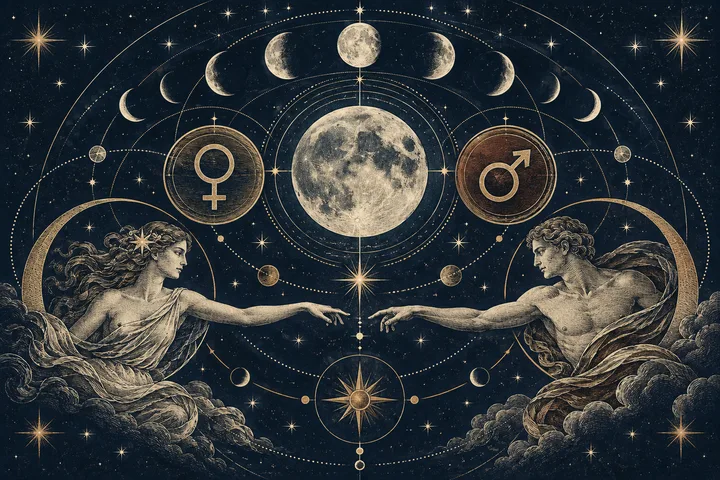
For November 23, 2026, the shared tropical sky has the Moon in Taurus, Venus in Libra and Mars in Leo at 00:00 UTC. Later, the Moon opposes Mercury in Scorpio at 05:27 UTC (00:27 in America/New_York), bringing a symbolic contrast between a need for steadiness and a wish to probe or name what is beneath the surface. Venus in Libra emphasizes reciprocity; Mars in Leo adds an expressive style to desire and action. These are shared transits, not personal birth-chart placements or predictions about what either partner will do. To see whether the day connects more directly with your relationship, compare each person's known Moon, Venus and Mars degrees with the transiting positions. Under the report's six-degree orb, only a close major aspect confirms a contact; sign resemblance alone does not. Read those temporary contacts separately from the natal synastry between you. Sign-only information can still offer reflection prompts, while exact aspects remain unconfirmed without degrees.
What is the shared sky at the UTC reference time?
For November 23, use the UTC day from 00:00 through 23:59, and keep the reference time attached to every position. The Ephemeris November 2026 table from AstroAk labels its daily rows 00:00 UT and identifies the positions as geocentric and tropical. At that reference, the Sun is at 0°41 Sagittarius, the Moon at 8°18 Taurus, Mercury at 11°22 Scorpio, Venus at 24°23 Libra and Mars at 28°47 Leo. These are moving planets in the shared sky, not placements in either person’s birth chart. A daily horoscope can describe a common astrological setting while each chart receives it differently. The Moon’s sign gives the day a Taurus tone: steadiness, comfort and tangible reassurance come to the foreground. Venus in Libra emphasizes balance and exchange, while Mars in Leo gives action a more expressive register. These are sign-level readings of the transits, not claims about how every couple will feel or behave. The exact event that sharpens this sky occurs later that day. November 2026 Daily Aspect List records the Moon opposing Mercury at 00:27 AM EST on November 23. Since the source uses Eastern Standard Time, that is 05:27 UTC. Its entry places the Moon in Taurus and Mercury in Scorpio. Read symbolically, the opposition brings a practical need for security into conversation with a wish to examine or name what lies beneath the surface. It supplies a shared question, not a verdict. AstroAk’s table gives the midnight snapshot; 1001 Horoscopes’ November 2026 Astrology Calendar explains its event-list basis and time zone. To know whether this sky closely contacts your Moon, Venus or Mars, compare the transit degrees with the degrees you already know.
Sources: November 2026 Ephemeris: Daily Planet Positions; November 2026 Astrology Calendar: Aspects & Moon Phases; November 2026 Major, Minor, and Lunar Aspect List
Which exact transit sets the day's relationship question?
The transiting Moon opposes Mercury at 00:27 Eastern Standard Time on November 23, or 05:27 UTC that same day. The Moon is in Taurus; Mercury is in Scorpio. Astrologically, this brings two ways of meeting a concern into view: Taurus seeks steadiness and tangible reassurance, while Scorpio Mercury probes beneath the surface for what has not been said. The question is not which planet wins. It is whether a need for security can be voiced clearly, and whether a searching question can be heard without turning the exchange into a contest. This is a transit-to-transit aspect in the shared sky, not a personal event assigned to every couple. The November 2026 Daily Aspect List records the opposition at 00:27 AM EST. The November 2026 Astrology Calendar says its event times are Eastern Time. Eastern Standard Time is UTC−5 on this date, so the event falls at 05:27 UTC, within November 23 in the UTC calendar.
That conversion matters because daily readings need a firm boundary. The November 2026 Astrology Calendar lists nearby events in Eastern Time, and an event shortly after midnight locally may fall on a different UTC date. For this reading, include only events from 00:00 through 23:59 UTC on November 23. The Moon–Mercury opposition qualifies. Later events displayed under a local November 23 heading may belong to November 24 UTC; they belong in that day's reading, not this one.
An opposition places two ends of a line across from each other. Here, the Moon brings feeling and the need for comfort into conversation with Mercury's way of thinking and speaking. Taurus gives the Moon a practical register: consistency and a reliable response may matter. Mercury in Scorpio asks for candor and depth; a vague answer may leave the real question untouched. One partner might ask for a plan or sign of dependability; the other might want to know what lies beneath that request. Either approach can help, but reassurance may sound like refusal to go deeper, while probing may sound like distrust. This is an interpretive reading of the signs and planets, not a claim that the transit causes an argument or guarantees a particular exchange.
The aspect itself is shared by everyone under the same sky. Its personal emphasis depends on chart contact. If the transiting Moon or Mercury makes a close major aspect to a supplied natal Moon, Venus or Mars degree, the day's symbolism has a more specific point of entry in that chart. Without a confirmed contact, keep the reading at the shared level. Sign resemblance may suggest a theme, but it does not establish an aspect. Use the transit as a prompt: what would help each of you feel secure enough to speak plainly, and what question would invite honesty without demanding a verdict? The sky names a tension to explore; it does not decide who is right or what either person intends.
Sources: November 2026 Astrology Calendar: Aspects & Moon Phases; November 2026 Major, Minor, and Lunar Aspect List
How does the Taurus Moon meet each person's natal Moon?
Compare the transiting Moon's exact degree with each natal Moon on its own. On November 23, the ephemeris places the transiting Moon at 8°18 Taurus at 00:00 UT. That's a snapshot, not its degree for every hour of the UTC day. Everyone shares the moving sky, but each chart receives it at a different point. One person's natal Moon may be close to a major aspect; the other's may be far from one. In astrological interpretation, the natal Moon speaks to emotional needs, habits of response and what helps someone feel settled. AstroAk's “Synastry Aspects Explained: How Two Charts Connect” describes Moon-Moon contacts as an encounter between emotional styles. Cafe Astrology's “Aspects Between Charts” advises reading each person's role in an interchart contact and considering both planets' signs. These principles help, but this section concerns a transit to each natal Moon, not the natal Moon-Moon contact between partners. Keep those comparisons separate. For each person, measure the angle between the transiting Moon and their natal Moon. A conjunction is near the same zodiac degree; an opposition is near 180 degrees; a square near 90; a trine near 120; and a sextile near 60. Under this publication's report method, a major contact counts within a six-degree orb, the distance allowed from the exact angle. AstroAk notes that astrologers use varying orb ranges and that closer aspects carry more weight. Use six degrees consistently, and don't call a contact exact unless the degrees support that word. If a natal Moon falls within that range, interpret the contact as a brief emphasis on the person's emotional pattern. The Taurus Moon can color the moment with a preference for steadiness, tangible comfort and a manageable pace. A conjunction may make that lunar tone more immediate. A trine or sextile may offer an easier channel for noticing a need. A square or opposition may make competing needs more visible. These are possibilities, not fixed reactions. The natal sign and aspect shape the reading together; neither alone tells you how someone will behave. Then compare the results. Imagine one person's natal Moon is within six degrees of a major aspect to the transiting Moon, while the other's isn't. The first chart has a confirmed personal contact for this date; the second shares the general Taurus Moon and Moon-Mercury background, but no close Moon-to-Moon contact is established. That doesn't mean one person cares more or carries the relationship. It identifies the clearer timed contact under this method. Cafe Astrology's advice to read each participant's role keeps the comparison reciprocal: ask what the contact may bring into focus for each person, rather than casting one as cause and the other as response. When you know only the natal Moon signs, compare their traditional styles with the Taurus Moon as a provisional reflection. Sign labels alone can't verify the angle or six-degree orb. AstroAk's November 2026 ephemeris gives a degree-specific position at 00:00 UT; it doesn't supply either reader's natal degrees. Use known placements for what they establish, and leave the aspect open when a number is missing. A daily Moon contact can focus attention briefly. It doesn't rewrite either birth chart or settle the couple's compatibility.
Sources: November 2026 Ephemeris: Daily Planet Positions; Synastry Aspects Explained: How Two Charts Connect; Aspects Between Charts
What can transiting Venus in Libra activate in natal Venus?
Transiting Venus in Libra brings affection, reciprocity, taste and the wish for a fair exchange into the day's relationship vocabulary. The November 2026 ephemeris places Venus at 24°23′ Libra at 00:00 UTC on November 23. That's a shared position in the moving sky. It doesn't tell you whether Venus aspects either natal Venus. Compare the transit's degree with each supplied natal degree, using the report's six-degree orb for major aspects: conjunction, sextile, square, trine and opposition. A sign label alone cannot establish the angular distance. Two Venus placements in Libra don't automatically form a conjunction. They may share a sign yet sit too far apart by degree to make a conjunction within this report's orb. Conversely, transiting Venus in Libra can aspect a natal Venus in another sign if their degrees are close to a relevant angle. The sign describes a placement's style; the measured angle determines whether the contact qualifies under this method. “Synastry Aspects: How Two Charts Connect” describes aspects by angular distance and notes that orb practice varies. The report's six-degree rule gives this comparison a consistent boundary, not a universal rule for every astrologer. Astrologers may read a close Venus trine or sextile to natal Venus as an easier opening for shared tastes or expressions of affection. A square or opposition may make different preferences more noticeable, while a conjunction can draw the themes together. These are possibilities, not promises that two people will agree or resolve a disagreement. “Interchart Aspects in Synastry” recommends reading planetary contacts with the signs and considering each person's role. So ask how the transit meets each natal Venus in turn; don't assign one partner the role of giver and the other receiver from the aspect alone. Consider an illustrative comparison: one person's natal Venus is near a degree that forms a close square to transiting Venus, while the other's natal Venus has no major aspect to it within six degrees. The first contact could make a preference or question of fairness more immediate for that person; the second chart doesn't confirm the same emphasis. This shows why one shared sky needn't land identically. It doesn't establish what either person wants. Ask: What would a fair exchange look like today? Is one person asking for time, affection or a practical gesture? What offer could the other genuinely accept? Those answers belong to the people and their circumstances. If you know only the natal Venus signs, use Libra's Venus themes as a reflection prompt: notice how each of you gives affection, what feels reciprocal and where taste differs. Keep it at possible resonance until degrees confirm an aspect. If degrees are available, record the transit degree, natal degree, aspect and orb for each person separately. Then compare that time-specific contact with natal Venus-to-Venus synastry, a separate chart relationship. The transit can highlight a moment for discussing preferences; it doesn't change the underlying synastry or decide whether the relationship works.
Sources: November 2026 Ephemeris: Daily Planet Positions; Synastry Aspects Explained: How Two Charts Connect; Aspects Between Charts
How can transiting Mars in Leo change the day's tone?
On November 23, the tropical geocentric ephemeris places Mars at 28°47′ Leo at 00:00 UTC. In astrological interpretation, Mars describes how desire becomes action: how you pursue, initiate, assert, and meet resistance. In Leo, that drive can take a visible, wholehearted, or pride-conscious form. Someone may want appreciation for their effort; another may prefer to act boldly and make interest unmistakable. These are symbolic possibilities for the shared day, not claims about what either partner will do. A sign gives the planet's style. It doesn’t tell you whether this Mars touches your chart. To make the reading personal, compare 28°47′ Leo with each person’s supplied natal Moon, Venus, and Mars degrees. Check the report’s major aspects and six-degree orb. A conjunction, square, trine, sextile, or opposition within that range gives you a specific transit-to-natal contact to interpret. Sign resemblance alone doesn’t confirm one. A natal Venus in Leo, for instance, isn’t automatically conjunct transiting Mars; the degrees still need to be close enough. The November 2026 Ephemeris: Daily Planet Positions supplies the date’s degree; the relationship to a natal planet depends on the degree you bring to the comparison. The planet contacted changes the question. If transiting Mars closely aspects a natal Venus, consider how initiative and affection meet: does one person’s way of showing desire feel welcome, or does the other need a clearer invitation? Synastry Aspects Explained: How Two Charts Connect describes Venus–Mars contacts as linking affection and desire, with flowing aspects tending to feel easier and hard aspects bringing charged friction. That gives a symbolic lens, not a script. Notice what each person actually offers. A close contact to the natal Moon shifts attention toward emotional response. Does a direct approach feel energizing, too forceful, or easier to understand today? A contact to natal Mars makes initiative itself the focus: do your ways of acting support one another, compete for the lead, or call for coordination? The same transit can meet two charts differently. Aspects Between Charts advises reading both sides of a contact and considering the signs involved. Keep that reciprocity in view; don’t turn a chart symbol into a claim about someone’s motives. Mars moves more slowly than the Moon, so a Mars-to-natal-planet contact may extend beyond this UTC date. The ephemeris shows Mars at 28°47′ Leo on November 23 and its entry into Virgo on November 25 at 23:38 UTC. This horoscope stays fixed to November 23. The date alone can’t establish whether an aspect is applying or separating. For that, you’d need positions over time. Use the sign-level reading as a prompt about how desire and initiative are expressed. Then check degrees before calling it a personal activation. If you find a close contact, name the planet, aspect, orb, and whose placement it touches; read it from both sides. Finally, connect it to something observable: what attention feels welcome, what action feels too forceful, or what shared plan needs a clear lead? A Mars contact can sharpen that conversation. It can’t decide it for you, and one aspect can’t stand in for the relationship.
Sources: November 2026 Ephemeris: Daily Planet Positions; Synastry Aspects Explained: How Two Charts Connect; Aspects Between Charts
How is a transit different from the chart comparison between you?
Natal synastry compares the planets in two birth charts; a transit compares a moving planet with a natal position on a particular date. The November 23 Moon, Venus and Mars describe a shared sky. A close contact to one supplied chart can give that person a more specific point of entry, while the other person may have no corresponding contact. Neither changes the couple's natal pattern.
Cafe Astrology's “Aspects Between Charts” recommends reading each participant's role and the signs involved. Apply that guidance in two passes: first consider the partners' supplied Moon, Venus and Mars contacts, then check whether November 23's transits closely aspect either person's placements. A repeated theme across both layers can be useful to explore; it does not prove an outcome. A theme present only in the daily sky remains part of the day's shared astrological context.
Use supplied signs for sign-level interpretation and optional degrees to check selected major aspects within the report's six-degree orb. The Synastry Comparison Report does not derive natal placements from birth details or calculate houses. Keep the transit as a temporary emphasis and the chart comparison as the relationship pattern you are examining.
Sources: Synastry Aspects Explained: How Two Charts Connect; Aspects Between Charts
Which chart contacts deserve attention first?
Start with the contacts you can actually confirm. For this comparison, check whether a transiting planet makes a conjunction, sextile, square, trine or opposition to a supplied natal Moon, Venus or Mars, using the report's six-degree orb. A sign resemblance can point to a shared style, but it does not establish one of these angles. The Synastry Aspects guide defines the major aspects by their angular distances and notes that astrologers vary in how widely they set an orb. Here, the six-degree limit is the report's stated rule. It gives both people the same clear threshold, so a contact just outside it doesn't quietly become a confirmed aspect because its symbolism feels appealing.
Once you have a list of confirmed contacts, sort tighter orbs ahead of wider ones. The Astroak guide to synastry aspects also gives closer contacts greater weight, while warning against reading one contact as the whole relationship. That is a useful ranking principle for a daily transit too: a close square may deserve attention before a wide trine when the question is what the day's sky is activating. The square's geometry describes tension or friction in traditional aspect reading; the trine describes flow or ease. Neither word tells you whether the actual exchange will be constructive. Exactness helps rank the contact's emphasis, not declare its outcome.
Next, look for repetition. Note whether one transiting planet closely contacts more than one of the supplied placements, or whether its contact echoes a major natal synastry contact already present between you. Repetition makes a theme more relevant to investigate because two chart layers point toward similar material: the established inter-chart pattern and today's moving sky. Treat that as an editorial reading method, not a guarantee that the theme will appear. A transit might touch one person's Venus while leaving the other's listed placements untouched. In that case, describe an individual emphasis within the shared day; don't turn it into a mutual experience or a claim about what the other person feels. If two contacts have similar orbs, compare their planetary roles and whether both charts repeat the theme; do not force a winner from geometry alone. This keeps the ranking useful when several contacts cluster together.
Keep a compact record for each contact: transiting planet, natal planet and whose chart it belongs to, aspect, orb, and whether it repeats a natal synastry theme. Then interpret each side in turn. Cafe Astrology's guide to inter-chart aspects recommends considering the planetary roles in both directions, rather than treating one person's planet as the only active part of a contact. Applied here, ask what the contacted placement may bring forward for each person, and compare that with what you can observe or discuss. If you have only signs, keep the reading at sign level and leave aspects unconfirmed. If degrees are available, the ranked list can focus a conversation without becoming a relationship verdict.
Sources: Synastry Aspects Explained: How Two Charts Connect; Aspects Between Charts
What can signs tell you when birth information is incomplete?
Known signs can still give you a useful reading when birth information is incomplete. They describe a placement's style: how someone may seek comfort, show affection or pursue desire in astrology's language. But a sign alone can't confirm that November 23's transiting Moon, Venus or Mars makes a close aspect to someone's natal Moon, Venus or Mars. For that, you need degrees. Without birth time and place, houses and the Ascendant remain outside this comparison. Keep the chart layers distinct. A sign names a planet's zodiac sign; a degree gives its position within that sign. An aspect describes the angle between two planetary positions. The Ephemeris for November 2026 gives daily positions in the tropical zodiac. Its November 23 row represents a specific time, so treat it as a snapshot, not the whole UTC day. How to Use an Ephemeris at 1001 Horoscopes explains why: the Moon moves about six to seven degrees in half a day. That can change its orb to a natal placement or, near a sign boundary, its sign. If your natal Moon is in Taurus, the day's Taurus Moon may feel familiar in sign language. Both suggest steadiness and tangible comfort. Yet that resemblance doesn't establish a conjunction. The transiting Moon could be early or late in Taurus, while your natal Moon sits elsewhere. Their angular distance decides whether an aspect is present. Sign language suggests resonance; degrees settle the geometry. You may know your Moon, Venus and Mars signs but have only a partner's Venus sign. Describe each known placement and compare only supplied themes. Don't guess a partner's Moon or treat a similar sign as a verified contact. Say what the placements suggest, name what's unknown, and stop there. Venus signs can frame affection and exchange; Mars signs, desire or initiative; Moon signs, familiar needs for comfort. These are starting points, not a full account of either person. Supplied signs support discussion of those placements and their traditional meanings. Degrees let you test selected major aspects using the report's six-degree orb. Without degrees, mark a possible aspect unconfirmed. Without birth time or place, leave houses and angles out. AstroAk's ephemeris introduction notes that houses and the Ascendant depend on exact birth time and place. The Synastry Comparison Report uses Moon, Venus and Mars placements supplied by the reader, with optional degrees. It doesn't calculate natal positions from birth details. Compare signs you know, then add degrees to check whether the day's transits form close major aspects to either chart. A sign-only reading is useful but incomplete. It offers shared language for reflection. Degrees show whether the date makes a close contact; birth details support the separate house and angle layer. Use known signs to explore comfort, affection and desire on November 23. Leave exact contacts open until you have the relevant degrees.
Sources: November 2026 Ephemeris: Daily Planet Positions; Ephemeris for November 2026 – Daily Planetary Positions; Synastry Aspects Explained: How Two Charts Connect
What should you compare next?
Start with the shared sky, then make the comparison personal only where known placements support it. On November 23, the Taurus Moon opposes Mercury in Scorpio, inviting attention to steadiness, feeling and the words used to express a need. The November 2026 ephemeris gives positions at 00:00 UT; the dated aspect list records the opposition at 00:27 Eastern Standard Time, or 05:27 UTC. Keep that event within its UTC day. Its symbolism offers a reflection prompt, not a verdict about either person.
Next, compare the day's Moon, Venus and Mars with each person's supplied Moon, Venus and Mars degrees. Record major aspects within the report's six-degree orb, noting whose placement receives each contact. Sign resemblance can suggest a shared style, but it doesn't confirm an angular aspect. With signs alone, leave degree-based contacts open. Then set these temporary transit contacts beside the natal synastry between you. Cafe Astrology's “Synastry: Interchart Aspects” treats contacts between two charts as a distinct layer; a passing transit doesn't replace that comparison.
Use this order: name the shared event, check the degrees, separate transits from natal synastry, then ask what conversation the symbolism helps you have. The chart can focus that exchange; it can't choose the response. The Synastry Comparison Report uses placements you provide and optional degrees. It doesn't calculate natal positions from birth details. Compare carefully, talk plainly, and decide together what the day calls for.
Sources: November 2026 Ephemeris: Daily Planet Positions; November 2026 Major, Minor, and Lunar Aspect List; Aspects Between Charts
Sources & further reading
- November 2026 Ephemeris: Daily Planet Positions
Labels its daily table as positions at 00:00 UT and identifies the positions as tropical and geocentric; the November 23 row gives Sun 0°41 Sagittarius, Moon 8°18 Taurus, Mercury 11°22 Scorpio, Venus 24°23 Libra, and Mars 28°47 Leo. Its sign-change listing gives Mars entering Virgo on November 25 at 23:38 UTC.
- November 2026 Astrology Calendar: Aspects & Moon Phases
Labels the displayed monthly planet-position tables and event times as Eastern Time. This supports identifying the calendar's time basis; the UTC conversion of a listed EST event is arithmetic.
- November 2026 Major, Minor, and Lunar Aspect List
Lists the Moon in Taurus opposing Mercury in Scorpio at 00:27 AM EST on November 23, 2026.
- Ephemeris for November 2026 – Daily Planetary Positions
Provides daily planetary positions in the tropical zodiac and offers table display options for midnight Eastern Time and 00:00 UTC, establishing that the displayed reference time depends on the selected table option.
- Synastry Aspects Explained: How Two Charts Connect
Describes major aspect angles (opposition 180°, trine 120°, square 90°, sextile 60°, conjunction 0°), says orb practices vary (roughly 1–8°) and tighter contacts carry more weight, describes Moon–Moon and Venus–Mars contacts, and says synastry is read from both sides and is not a fixed outcome.
- Aspects Between Charts
Advises considering each person's role in an inter-chart aspect and considering the sign and house placements of the planets involved.
Synastry Comparison Report
Enter known placements for two people. Get an input-by-input comparison, selected aspect calculations and a clear record of what remains uncertain.
Compare our placements