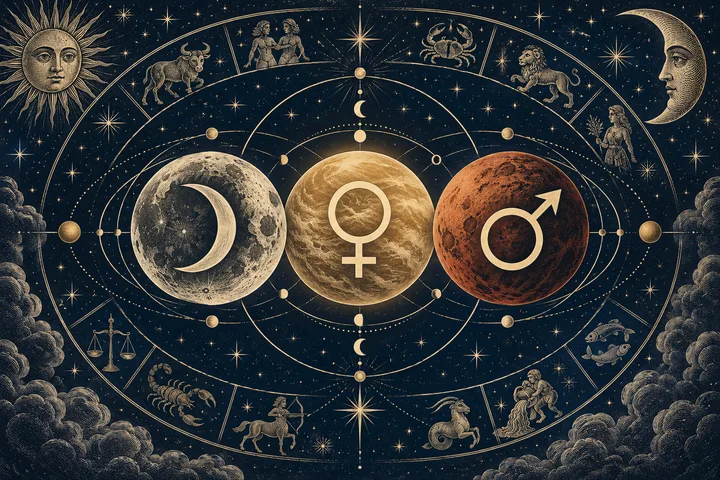
What is actually in the sky during November 21 UTC?
At 12:00 UTC on November 21, 2026, the tropical zodiac places the Moon at 17° Aries, Venus at 23° Libra, and Mars at 28° Leo. The Sun and Mercury are in late Scorpio. Together, these positions set the day's shared love-weather: feelings may ask for direct expression, while affection and desire call for fairness and warmth. This is a sign-level reading, not a personal chart. The UTC-noon table in “21 November 2026 — name days, holidays and the day's sky” gives these positions. Zodiac Astrology Horoscopes' daily ephemeris shows the Moon in Aries at 00:00, 06:00, 12:00 and 18:00 UTC. Astrolog-App's ephemeris, sampled at 09:58 UTC, also places the Moon in Aries, with Venus in Libra and Mars in Leo. The Moon degrees differ because the samples fall at different times and use different rounding. The sign remains the same. Keep the reference time in view: the Moon moves quickly, so a degree without a timestamp can mislead. The Moon-Venus opposition perfects just after this UTC date ends, at 00:10 UTC on November 22. For November 21, read the Aries Moon alongside Libra Venus and Leo Mars as the day's background. This shared sign pattern is a starting point for comparing it with known natal placements.
Sources: 21 November 2026 — name days, holidays and the day's sky; Daily Ephemeris: November 21, 2026; Ephemeris — November 21, 2026
Why do some calendars put the Moon-Venus opposition on November 21?
The calendars are using different clocks. Cafe Astrology’s 2026 Astrological Weather table labels its event times EST and places the Moon opposite Venus at 7:10 p.m. on November 21. EST is UTC−5, so add five hours: the exact opposition falls at 00:10 UTC on November 22. Dr. Standley’s November 2026 Major, Minor, and Lunar Aspect List gives the same EST time. A forecast built for the EST evening can reasonably include the aspect on its November 21 page. This forecast uses the UTC civil day, so its exact perfection belongs to November 22.
That distinction matters whenever an event sits near midnight. A date without a timezone cannot tell you which civil day contains an exact contact. Both event tables state EST, while 21 November 2026 lists the Moon-Venus opposition under November 22 and gives its event times in UTC. The two listings agree once you compare their clocks. By contrast, the 0800-Horoscope November calendar labels the opposition under November 21 without showing a time beside that entry. Its date label alone cannot establish whether it means an EST evening, another local date, or the UTC day. It may reflect a local-calendar convention, but the opened entry does not identify one, so don’t treat that label as a timestamp.
An exact aspect and its surrounding sign relationship are related, but they aren’t the same thing. Before perfection, the Moon is already moving through Aries toward Libra Venus; after the opposition, that immediate contact begins to separate. Astrologers can read the developing polarity as a prompt to balance emotional candor with consideration. But calling the opposition exact throughout November 21 UTC would blur the event boundary. Use the Aries–Libra symbolism as the broader tone, then reserve the exact-contact language for 00:10 UTC on November 22. If you follow a local forecast, check its stated timezone first. If it names no clock, read its date as a calendar convention, not proof of when the aspect perfects.
Sources: 2026 Astrological Weather (with the Moon); November 2026 Major, Minor, and Lunar Aspect List; 21 November 2026 — name days, holidays and the day's sky; November 2026 Astrology Calendar — Moon Phases, Retrogrades, Eclipses
Which exact lunar contacts fall inside the UTC day?
The “2026 Astrological Weather (with the Moon)” event table uses EST. It lists the Moon’s sesquiquadrate to Mars at 12:05 a.m. on November 21 and its sesquiquadrate to the Sun at 1:43 a.m. EST. Adding five hours places them at 05:05 and 06:43 UTC on November 21. A sesquiquadrate is a 135-degree minor aspect. These contacts fall inside the assigned UTC day, though neither should carry the same interpretive weight as a conjunction, opposition, square, trine or sextile. In this reading, they add a brief note of friction, not a forecast of conflict. That distinction also explains why the event list and a UTC calendar can appear to disagree. The “21 November 2026 — name days, holidays and the day’s sky” page says no exact angle or sign boundary occurs on November 21, then lists the Moon-Venus opposition and Moon-Jupiter trine under November 22. Read alongside the EST header in the event PDF, the difference is aspect class and clock: the calendar’s statement fits its selected major events, while the PDF also records minor contacts. Its Moon-Venus opposition at 7:10 p.m. EST converts to 00:10 UTC on November 22; the Moon-Jupiter trine at 10:58 p.m. EST converts to 03:58 UTC that day. Neither perfects within November 21 UTC. This timing matters when assigning an event to a daily forecast. Astrologically, the early Moon-Mars contact can be read as a short prompt to notice when a quick response needs a pause. The Moon-Sun contact can suggest a brief pull between immediate feeling and the direction you want to take. Those are symbolic readings of minor aspects, not guaranteed experiences. The Moon remains in Aries across the day, so its sign tone lasts beyond these exact minutes. Meanwhile, the Moon-Venus opposition arrives shortly after the UTC date turns, making it a nearby handoff toward the next day’s relationship theme. Keep the order clear: minor exact contacts first, the longer sign pattern around them, then the major opposition after midnight.
Sources: 2026 Astrological Weather (with the Moon); 21 November 2026 — name days, holidays and the day's sky
What does the Aries Moon ask of a relationship conversation?
An Aries Moon favors saying what you need plainly and moving toward a small, honest beginning. It can also make patience thin. In love, the useful form is directness with room for the other person's answer: name the feeling, make a clear request, then listen before deciding what the response means. The Moon describes the day’s emotional tempo, not either partner’s whole nature.
Cafe Astrology’s “The Moon’s Transits through the Signs” links Aries with initiative, spontaneity and enthusiasm, while naming impulsiveness and tactlessness as possible expressions. The same reference says the Moon-in-Aries tone favors quick actions and self-assertion, though staying power may be short. Read together, those qualities support a useful relationship choice: begin the conversation, but don’t rush the other person toward your preferred answer. Clear speech can open a door. Pressure can close it.
The traditional rulership adds another layer. Mars rules Aries, and on this date Mars is in Leo. That sign position can color action with warmth, pride and visible care. This is a symbolic link through rulership, not a claim that the Aries Moon forms a major aspect to Mars all day. It offers a style to consider: make the first move generous, then leave room for a different response.
Imagine you’d like more time together this week. You might say, “I miss having an evening that’s just ours. Could we choose one night now?” That names a feeling and makes a request the other person can answer. It doesn’t assume why they’ve been busy or treat the first reaction as a verdict. If irritation rises, pause and return to the request in simpler words. The early Moon sesquiquadrates to Mars and the Sun in Cafe Astrology’s “2026 Astrological Weather (with the Moon)” support a brief caution about friction in the chart’s symbolism. Their EST timestamps convert to early Nov 21 UTC; they don’t predict an argument.
So use the Aries Moon to start, not to force an ending. Ask one concrete question, listen to the answer, and decide together on a next step. The reading is a prompt for a more honest exchange; the people in the conversation still choose what happens next.
At 12:00 UTC on November 21, 2026, the tropical Moon is in Aries, Venus in Libra and Mars in Leo. Read the shared sky symbolically: the Moon can foreground direct emotional expression, Venus reciprocity and Mars warm, visible action. These are sign-level themes, not predictions about either person. The Moon-Venus opposition perfects at 00:10 UTC on November 22, so it is not an exact November 21 UTC event, even though EST calendars date it November 21. Compare this broad backdrop with known natal Moon, Venus and Mars placements; degrees and a stated orb are needed to identify precise contacts. Use it to frame a conversation, not settle a relationship decision.
Sources: The Moon's Transits through the Signs; Moon in Aries; 2026 Astrological Weather (with the Moon)
How do Libra Venus and Leo Mars shape the day's love tone?
At 12:00 UTC on November 21, Venus stands at 23°56′ Libra and Mars at 28°10′ Leo, according to the noon positions in ‘21 November 2026 — name days, holidays and the day's sky.’ For the love reading, the signs give the useful shared backdrop: Libra Venus emphasizes reciprocity and the pleasure of meeting one another, while Leo Mars favors warm, visible initiative. These are two distinct functions. Venus describes what draws us and how we exchange affection; Mars describes how desire moves into action. Neither placement tells us what either partner privately feels.
The combination can support a generous gesture, provided it leaves room for a genuine response. Libra seeks balance and consideration; Leo wants enthusiasm to be felt and seen. They can also pull in different directions. One person may want to discuss what feels fair before acting, while the other would rather make a clear, heartfelt move now. That tension is an interpretive possibility, not a forecast of disagreement. ‘Transits in Astrology: Predictions’ describes moving planets as forming relationships to natal placements, and advises reading faster inner-planet cycles within a wider context. Here, the broad sign pattern is shared by everyone on the date; it is not a personalized synastry result.
Nor should the two signs be turned into a precise Venus-Mars aspect. At the noon positions, Libra Venus and Leo Mars are about 55 degrees apart, not at the standard 60-degree sextile. Without a declared orb, calling them a sextile would overstate the geometry. A considerate check-in paired with one specific, generous action is a practical way to explore it: ask whether the gesture feels welcome, and adjust if the answer is different from what you expected. Treat this as an invitation, not a script. The day can invite affection with balance and confidence. It cannot promise an easy or dramatic romantic event.
Sources: 21 November 2026 — name days, holidays and the day's sky; Ephemeris — November 21, 2026; Transits in Astrology: Predictions
What does a Moon transit mean for the natal Moon?
A transit is a moving planet’s relationship to a position in a birth chart. On November 21, the moving Moon travels through Aries, so the useful question is whether its passage forms a close contact to either partner’s natal Moon. Astro.com’s “What are transits?” explains that transit labels put the moving planet first and the natal planet second: “Moon Square Moon,” for example, means the sky’s Moon is square the chart’s Moon. The exact moment depends on the time zone named by the calendar. For this forecast, the civil day is UTC, and noon UTC is the reference for the day’s positions. That order keeps two different questions clear. The Aries Moon describes the day’s shared emotional weather. A transit to your natal Moon asks how that moving weather meets the emotional patterns represented in your own chart. If you know only your Moon sign, compare signs and call the result a broad resonance. If you know its degree too, you can check whether the moving Moon reaches a particular angle to it. An exact major aspect needs the two longitudes and a stated orb; sign labels alone can suggest an opposition or trine by sign, but cannot prove the contact is exact. An Aries natal Moon shares the transiting Moon’s sign, so its direct, initiating tone may feel familiar. A Libra natal Moon offers a contrast between acting on an immediate need and preserving balance. These are possibilities, not fixed reactions. A fire-sign Moon may find an element-level affinity with Aries, while another cardinal Moon may share its emphasis on beginning or change. Neither resemblance tells you what either partner will choose. The timing sets the scale. Cafe Astrology’s “Transits of the Moon” describes lunar transits as brief; its sign reference gives the Moon roughly two and a half days in each sign. A sign passage is a short chapter of the month, while a close Moon-to-Moon contact is a narrower moment within it. You may notice the Aries tone without a close natal contact. Distinguish that broad reading from a precise contact instead of turning every shared sign into an exact transit. Use the comparison as a prompt, not a verdict. Notice whether directness helps you name a need or makes you rush past your partner’s response. When degrees are available, compare them at the same UTC reference with a stated orb; otherwise, stay with sign-level themes. Cafe Astrology’s “Transits of the Moon” offers symbolic interpretations for brief contacts, while Astro.com explains how to name them. The transit describes a temporary emphasis; the natal Moon is the chart point it may touch. Neither predicts a partner’s intentions.
Sources: What are transits?; Transits of the Moon; The Moon's Transits through the Signs
How might the daily sky meet natal Venus?
Compare the transiting Moon in Aries and Venus in Libra with each person's natal Venus to ask what kind of affection feels direct, mutual, or out of step today. A natal Venus near the opposition degrees can receive the sharper lunar contact. If you know Venus only by sign, use the symbolism as a broad reflection, not an exact timed claim. The distinction matters because a sign describes a stretch of sky, while an aspect names the angular relationship between two measured positions.
Keep moving Moon, moving Venus, and natal Venus distinct. On November 21, transiting Venus in Libra sets a shared background for affection and exchange. The Aries Moon moves faster and can briefly contact an individual's natal Venus; closeness depends on that natal degree. Natal Venus describes a person's own style of affection and values. It doesn't move with the daily sky.
The exact Moon-Venus opposition sits on a date boundary. Cafe Astrology's 2026 event table lists it at 7:10 PM EST on November 21; DrStandley's November 2026 aspect calendar confirms that timestamp and labels the source clock EST. EST is five hours behind UTC here, so the contact perfects at 00:10 UTC on November 22. It belongs to the following UTC day, even though it falls in the evening for a person following EST. The timestamp is useful; the calendar label alone is not enough.
The Aries-Libra symbolism still frames November 21, but timing changes what you can say precisely. As the opposition approaches, immediate feeling meets the question of mutual response. Don't call it exact all UTC day or assume every natal Venus receives it closely. Check the natal degree against the Moon at contact and state the orb. Without those inputs, stay with sign-level language.
Cafe Astrology's “Moon-Venus Aspects in the Natal Chart” treats the Moon as connected with inner needs and Venus with companionship, harmony, and partnership. That page discusses lasting natal patterns, not a one-day transit, so its descriptions shouldn't be transferred wholesale to this forecast. The useful bridge is narrower: a passing Moon contact can bring a need into sharper awareness, while Venus symbolism asks how affection is offered and exchanged. That's an interpretive application, not a claim that the natal reading predicts this day's events.
Notice whether a direct request leaves room for the other person's preference. Imagine you ask plainly for reassurance; care may arrive in a different form than expected. Ask what gesture would feel mutual before reading a pause as rejection. Without a close natal contact, this may be ordinary relationship weather, and the sign symbolism may fit some people better than others. Name a need and invite an answer. Don't use the date to decide what your partner feels.
Sources: Moon-Venus Aspects in the Natal Chart; Transits of the Moon; 2026 Astrological Weather (with the Moon); November 2026 Major, Minor, and Lunar Aspect List
How might the daily sky meet natal Mars?
On November 21, the transiting Moon moves through Aries while transiting Mars is in Leo. The Moon is quick emotional weather; Mars describes the shared sky's style of drive. Your natal Mars is a third, personal layer. Keep them separate. A transit reading asks how a moving planet relates to a natal position, as Cafe Astrology's “Transits in Astrology: Predictions” explains. Its “Transits of the Moon” reference describes lunar contacts as brief. The day's Moon can stir natal Mars briefly, but it doesn't describe a lasting relationship pattern by itself.
Start with the sign relationship, then ask whether the degrees support an exact contact. Aries and Leo form a trine by sign, both fire signs. If one partner's natal Mars is in Leo, the Aries Moon and that Mars share an element-level ease: initiative may come readily, and action can feel energizing. That's symbolic, not proof of a close trine on November 21. A major aspect is an angular relationship between actual longitudes. Signs alone don't tell you how close it is; you need both degrees and a stated orb.
Other Mars signs compare differently. Aries and Libra oppose one another, suggesting a contrast between acting directly and weighing another person's response. Aries and Scorpio form a quincunx by sign, which can suggest that instinct and strategy need adjustment. Neither pairing guarantees tension or ease. A loose contact may deserve little attention; other placements or lived circumstances may matter more. Cafe Astrology's “Transits in Astrology: Predictions” recommends reading shorter inner-planet transits within broader context. Let a fleeting Moon contact refine the picture, not take it over.
Consider an example. One partner knows their Mars is in Leo and the other knows theirs is in Libra, but neither has degrees. They might discuss whether to start a plan quickly or first agree on pace and details. Leo can prompt a question about making the activity lively; Libra, whether both have a say. These are conversation prompts, not claims about motives. Without degrees, don't label either Mars as receiving an exact transit. And don't turn an elemental affinity into a prediction about desire, conflict, or success.
On this date, the Moon is in Aries and Mars in Leo. The UTC-noon table at “21 November 2026 — name days, holidays and the day's sky” and the sampled “Ephemeris — November 21, 2026” give different Moon degrees because they use different moments, but both give the same signs. If known degrees show a close Moon-to-natal-Mars aspect, consider how to use a brief burst of initiative with care. If you know signs only, use the fire tone as a nudge to propose something together, or contrasting signs as a reason to coordinate pace. If neither fits, let the transit stay in the background.
Sources: Transits of the Moon; Transits in Astrology: Predictions; 21 November 2026 — name days, holidays and the day's sky; Ephemeris — November 21, 2026
How should the Moon, Venus and Mars readings be ranked together?
Rank the reading by how specific the evidence is. Start with the shared sky as context; give a brief transit priority only when its timing and geometry are known; then ask whether a natal placement makes that contact personally relevant. A sign resemblance can suggest a theme, but it cannot show that an aspect is exact. The hierarchy keeps a vivid daily symbol from being mistaken for a description of either partner or a forecast of the relationship.
| Reading layer | What makes it useful | What would make it more specific | |---|---|---| | Shared sky | A common symbolic prompt for the day | Nothing personal follows from the signs alone | | Transit contact | A short-lived theme worth noticing | Exact time, natal degree and stated orb | | Relationship meaning | A question to discuss or observe | Both people’s words, choices and context |
Astro.com’s transit explainer supports the distinction between moving-planet contacts and natal positions. Applying that distinction here, a close contact can refine which known placement to consider, but it does not establish how someone feels or how a couple will fare. If degrees are unavailable, stop at a sign-level reflection; if no close contact appears, let the transit remain background. The comparison should clarify a question, not manufacture certainty.
A practical reading therefore ends with a check rather than a conclusion: which specific need, affectionate gesture or way of initiating plans is worth asking about? The answer comes from the people involved. A chart comparison can organize placements they already know, with precision limited by the supplied information and the chosen orb.
Sources: What are transits?
What can a placement comparison responsibly settle?
A placement comparison can organize what you know about each person’s Moon, Venus and Mars. Signs give a broad picture of emotional needs, affection and action; supplied degrees can make a contact more specific. For November 21, use the forecast to choose one question for a real conversation: Does directness feel welcome? What gesture would feel mutual? How do we each prefer to begin a plan? The answer comes from the people talking, not a sign label.
Astro.com’s “What are transits?” explains that a transit compares a moving planet with a birth-chart position, and that its exact moment uses the horoscope’s stated timezone. The daily forecast describes the shared sky; a personal transit comparison needs a known natal position. The Synastry Comparison Report compares Moon, Venus and Mars placements you provide, with optional degrees and selected major aspects using a six-degree orb. It doesn’t calculate missing positions from birth details, include houses, or decide whether a relationship will succeed. Without degrees, keep the reading at sign level. With them, a lunar contact may become clearer, though it still describes a moment, not a verdict. Choose one low-pressure action, then let the conversation tell you what the chart cannot.
Sources: What are transits?
Sources & further reading
- 21 November 2026 — name days, holidays and the day's sky
Provides tropical planetary positions for 12:00 UTC and lists the Moon-Venus opposition under November 22.
- Daily Ephemeris: November 21, 2026
Shows the Moon in Aries at UTC checkpoints through November 21.
- Ephemeris — November 21, 2026
Cross-checks the Moon, Venus and Mars signs at its stated 09:58 UTC sample.
- 2026 Astrological Weather (with the Moon)
Lists EST timestamps for the lunar aspects, including the opposition at 7:10 PM on November 21.
- November 2026 Major, Minor, and Lunar Aspect List
Corroborates the EST timing of the Moon-Venus opposition and Moon-Jupiter trine.
- November 2026 Astrology Calendar — Moon Phases, Retrogrades, Eclipses
Labels the Moon-Venus opposition under November 21 without showing an event time beside the entry.
- What are transits?
Defines transits as moving-planet contacts to natal positions and explains the relevance of the stated timezone.
- The Moon's Transits through the Signs
Describes Aries Moon themes including initiative and spontaneity, with impulsiveness as a counterweight.
- Moon in Aries
Provides interpretive context for the Aries Moon's direct, initiating emotional tone.
- Transits of the Moon
Explains brief Moon transits and offers symbolic interpretations of contacts to natal placements.
- The Moon
States that the Moon spends approximately two and a half days in each zodiac sign.
- Moon-Venus Aspects in the Natal Chart
Distinguishes Moon-related needs from Venus themes in natal interpretation and notes chart context matters.
- Transits in Astrology: Predictions
Provides interpretive context for transits and advises reading shorter cycles within broader context.
Synastry Comparison Report
Enter known placements for two people. Get an input-by-input comparison, selected aspect calculations and a clear record of what remains uncertain.
Compare our placements