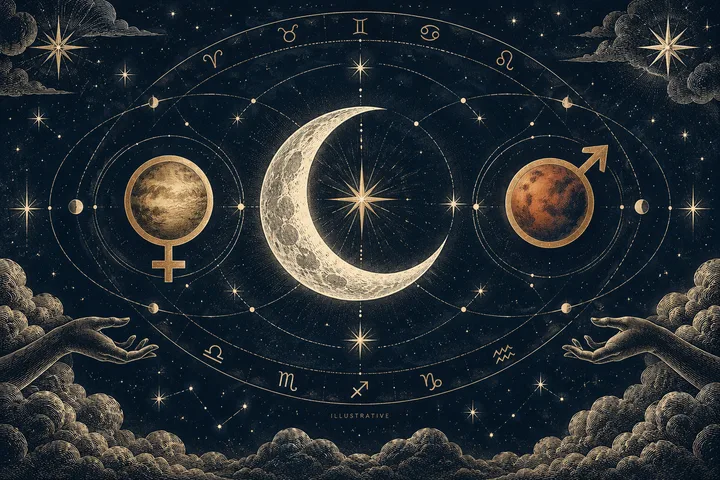
What kind of love reading does November 20 support?
November 20 supports a reading of the day’s shared astrological weather, not a blanket verdict about a relationship. The distinction matters when you ask whether a transit is personal: a moving planet must contact a known natal placement. Astrodienst’s help reference defines transits through that meeting between a moving planet and a birth-chart position. The sky’s aspects to itself describe the day; comparison with each person’s natal Moon, Venus, or Mars shows whether that day touches a particular relationship theme in their chart.
For this horoscope, the day runs from 00:00 to 23:59 UTC, and planetary positions use the tropical zodiac and geocentric frame. The noon snapshot is a reference point, not a claim that the sky stands still all day. The verified Moon sequence begins with its move from Pisces into Aries at 05:52 UTC, followed by conjunctions with Neptune and Saturn and sextiles with Pluto and Uranus at their own times. The Witchcraft Daily Sky Calendar lists these as dated sky events. They give the day a changing lunar rhythm; they do not show that either partner has a natal contact.
That answer is useful even before you know whether the day is personal. First ask what the shared sky describes, then check the same moving positions against each person’s known natal placements. Exact degrees distinguish a close contact from a broad sign resemblance. If you have signs but not degrees, keep the reading at that wider level. Venus and Mars can also be moving planets in the comparison, but their meaning depends on the natal target and aspect. Use the day to notice a theme or choose a conversation, without treating a general horoscope as a promise about what someone will do.
For November 20, 2026, this love horoscope uses the UTC civil day, from 00:00 to 23:59 UTC. At the 12:00 UTC reference snapshot, the Moon is at 3°24′ Aries, Venus at 23°41′ Libra, and Mars at 27°44′ Leo. The day’s verified lunar sequence begins with the Aries ingress at 05:52 UTC, followed by exact contacts with Neptune, Pluto, Uranus, and Saturn at their listed UTC times. These describe the shared sky, not automatic personal transits or a relationship verdict. Compare the moving planets with each person’s known natal Moon, Venus, and Mars separately. Exact degrees can show whether an aspect is close under a stated orb; signs alone support a broader reading. Use the symbolism to choose what to notice or discuss, while keeping the date and all event times on the UTC calendar.
Sources: What are transits?; November 2026 Sky Calendar
How does a shared transit become personal?
A personal transit has four parts: a moving planet, a natal target, an aspect, and an orb. The November 20 sky is shared at a given moment. It becomes personal when a moving planet forms a measured relationship to a placement in one person's birth chart. Astrodienst's “What are transits?” defines transit as a moving planet meeting a birth-chart position; its example names the moving Moon first and natal Moon second. That order matters. The Moon's conjunction with Neptune in the sky is not a transit to your Moon or your partner's Venus. Use the same sequence for each person. Note the transiting planet's sign and degree at the time you want to examine. Select one known natal placement, such as your Moon, Venus, or Mars, and compare its zodiac longitude with the moving planet's. Their angular distance tells you whether they form a major aspect. The five commonly used aspects are conjunction at 0 degrees, sextile at 60, square at 90, trine at 120, and opposition at 180. “Transits Right Now: How to Read Them Against Your Chart” explains this comparison with a longitude example; “How to Read Daily Transits: Astrological Timing” also identifies the moving planet, natal target, aspect, and orb. The orb is the distance between the measured angle and the exact angle. If a moving planet sits at 92 degrees from a natal placement, for example, it is two degrees from an exact square. Whether that counts as close depends on the orb convention. Sources do not share one universal limit: the NatalChart.AI guide gives its own transit orbs, while Kerykeion describes a general 1-to-3-degree range as tighter. Treat these as their conventions, not rules to combine. Record the aspect, distance from exact, and chosen orb so readers can see why a contact is included. Call a transit applying or separating only when movement shows whether the distance is closing or opening; one snapshot cannot establish direction. Then interpret the moving planet and natal target together. The moving planet describes current symbolism; the natal placement identifies the part of the chart being engaged. A moving Moon aspect to natal Venus and a moving Venus aspect to natal Moon share two symbols, but they are different contacts. Describe them separately. Kerykeion's guide recommends combining planetary meanings after identifying the contact. Tie the reflection to a real question: what needs attention, affection, or a clear expression of desire today? The symbolism can shape that question. It cannot supply another person's intentions. A transit to your natal placement differs from synastry between two birth charts. In the first comparison, today's moving sky meets one person's natal chart. In synastry, one person's natal planets are compared with the other's. For November 20, overlay the same sky separately on each person's known Moon, Venus, and Mars; don't treat the shared Moon-Neptune or Moon-Saturn contact as proof that both charts receive it personally. If only signs are known, discuss broad sign relationships, but not close degree aspects. Degrees make the contact testable under a stated orb.
Sources: What are transits?; Transits Right Now: How to Read Them Against Your Chart; How to Read Daily Transits: Astrological Timing
What is in the sky at the November 20 reference time?
For November 20, read the sky in two layers: a noon reference snapshot and a sequence of timed lunar events. The date here runs from 00:00 through 23:59 UTC. At 12:00 UTC, the Moon is at 3°24′ Aries, Venus at 23°41′ Libra, and Mars at 27°44′ Leo, according to the date-specific table in 20 November 2026 — name days, holidays and the day’s sky. The same table gives the Sun at 28°11′ Scorpio, Mercury at 8°42′ Scorpio, Saturn retrograde at 8°18′ Aries, Uranus retrograde at 3°54′ Gemini, Neptune retrograde at 1°45′ Aries, and Pluto at 3°22′ Aquarius. These positions use the tropical zodiac and a geocentric frame. The reference time matters: a planetary position is a coordinate at a moment, not a label for every hour of the day. A second table helps check the date without pretending it reports the same instant. Upstellar Astrology’s Ephemeris Tables explicitly list daily geocentric positions at 00:00 UT. Its November 20 row places the Moon at 26°46′ Pisces, Venus at 23°33′ Libra, Mars at 27°31′ Leo, Saturn at 8°19′ Aries, Uranus at 3°55′ Gemini, Neptune at 1°45′ Aries, and Pluto at 3°22′ Aquarius. The slower bodies and Venus and Mars remain in the same signs in both tables, while the Moon has moved from late Pisces to early Aries by noon. That is a useful cross-check of the day's broad sky, not a reason to blend two snapshots into one imaginary chart. Upstellar identifies its entries as 00:00 UT; the other table identifies noon Universal Time. The Moon’s change has a clear timestamp. The November 2026 Sky Calendar records its entrance into Aries at 05:52 UTC, after its earlier passage through Pisces. It then lists four exact lunar aspects: conjunction Neptune at 09:03 UTC, at 1°46′ Aries; sextile Pluto at 11:56, at 3°22′ Aries; sextile Uranus at 12:54, at 3°54′ Aries; and conjunction Saturn at 20:44, at 8°17′ Aries. Those are moments in the shared sky. They help order the day’s astrological rhythm, but none proves that the Moon contacted a particular reader’s natal planet. The event calendar reports apparent geocentric tropical longitudes, rounds times to the nearest minute, and defines its major aspects as conjunctions, sextiles, squares, trines, and oppositions between moving bodies. Its calculation method is specific to that calendar, so retain its UTC timestamps as published. The noon table gives positions; the event calendar supplies the timed sequence. Read together, they show why “the Moon is in Aries today” is too blunt for a day with an early sign ingress and contacts spread from morning to evening. UTC also sets the article’s day boundary, not every reader’s local clock. Depending on where you live, an event near midnight UTC can fall on a different local date. Keep the listed times in UTC when comparing sources, then translate them for your own day only if needed. A noon position can orient a reader to the sky, while the separate event times show when the Moon reaches its listed aspects. Neither tells us what any couple experienced. For that, the next step is to compare these moving positions with each person’s known natal placements, separately, and only as precisely as the available signs and degrees allow.
Sources: 20 November 2026 — name days, holidays and the day’s sky; Ephemeris Tables; November 2026 Sky Calendar
Which of the day's verified contacts shape its love-reading tone?
The sequence is more nuanced than one ‘good for love’ or ‘bad for love’ label. The Moon enters Aries early, meets Neptune, sextiles Pluto and Uranus around noon, then joins Saturn later. These exact aspects describe relationships among moving bodies in the shared sky. Their symbolism can shape the day’s astrological tone, but none is automatically a hit to either person’s birth chart. This is shared sky tone, not a private chart contact. The November 2026 Sky Calendar places the Moon’s Aries ingress at 05:52 UTC. The Moon moves from Pisces into Aries, shifting the lunar tone from a receptive, impressionable register toward a direct, initiating one. Book of Horoscopes’ November 20 calendar describes the Aries Moon as quick, brave, and ready to move. This is an astrological portrait, not a report that everyone will act quickly. In a love context, the change frames a useful question: does the moment call for listening and sensing, or for naming a wish plainly? The Moon meets Neptune at 09:03 UTC, at 1°46′ Aries, according to the November 2026 Sky Calendar. Astrologically, a lunar-Neptune meeting can bring imagination, sensitivity, and emotional impressions to the foreground. This can suit tenderness or intuitive attention, but it can also make an assumption feel vivid before it has been checked. In conversation, distinguish what you sense from what the other person has said. This works with the symbolism without predicting confusion or romance. It becomes personal only if it contacts a known natal placement. Around midday the Moon makes two sextiles: Pluto at 11:56 UTC, then Uranus at 12:54 UTC. The November 2026 Sky Calendar gives the positions as 3°22′ Aries/Aquarius for Pluto and 3°54′ Aries/Gemini for Uranus. A sextile is traditionally read as an opening that can be used; it doesn’t compel an outcome. Pluto can invite emotional depth and a look beneath the first answer. Uranus can bring a fresh angle or room to depart from a stale pattern. Together, they suggest meeting a feeling honestly, then allowing a flexible response. Ask a curious question and leave room for an unexpected answer. Neither sextile proves agreement or affects both charts equally. The Moon’s conjunction with Saturn is exact at 20:44 UTC, at 8°17′ Aries, according to the November 2026 Sky Calendar. The tone turns toward restraint, responsibility, and steadiness. Saturn symbolism can help give a feeling a boundary: what can be promised, what needs time, and what practical care would make an intention real? This can steady a mature conversation or sober someone expecting an immediate answer. The aspect doesn’t decide which experience applies; context and any natal contact matter. Date-checking matters. The calendar places the Moon opposition Venus at 00:10 UTC on November 22, not November 20. It lists the exact Sun square Mars at 17:49 UTC on November 19; that is not newly exact on November 20. An in-orb window belongs to the source’s stated convention. The verified November 20 sequence is the Aries ingress, Neptune conjunction, Pluto and Uranus sextiles, and Saturn conjunction. The day’s love-reading tone is quick and layered, not universally romantic or difficult. Follow the changing Moon for the shared rhythm, then ask whether one of these moving-body contacts reaches a person’s known Moon, Venus, or Mars. Without that natal comparison, use the sequence as a prompt for attention and conversation, not a claim about compatibility or what a partner will do.
Sources: November 2026 Sky Calendar; 20 November 2026 — name days, holidays and the day’s sky
How should Moon, Venus, and Mars contacts be ranked?
Rank a contact by asking four questions: which natal planet is touched, which planet is moving, how close is the aspect, and how long does it hold? A Moon contact asks about emotional needs and response; Venus turns attention to affection, attraction, pleasure, and values; Mars brings initiative, desire, assertion, and friction into view. These are distinct themes, not interchangeable measures of chemistry. The natal planet names the part of the person under attention. The moving planet describes the current symbolic pressure or invitation. In “How to Read Daily Transits: Astrological Timing,” Kerykeion advises combining the transiting planet’s theme with the natal planet it aspects, then considering the aspect and orb. “Transits Right Now: How to Read Them Against Your Chart” makes the sequence plain: the moving body supplies the theme, the natal placement is the part addressed, the aspect shows the manner, and the phase shows whether the contact is building or easing. For a relationship question, begin with the natal Moon. Ask what a close transit might bring into awareness about comfort, emotional rhythm, or reassurance. Then consider Venus: does the contact focus attention on affection, pleasure, or values in closeness? Mars comes next when the question concerns making a move, stating a desire, protecting a boundary, or handling irritation. “Synastry: Love and Relationship Astrology” at Cafe Astrology distinguishes Venus as a symbol of attraction and pleasure from Mars as desire and assertion, while describing the Moon through familiarity, tenderness, and care. Use those meanings as prompts, not fixed descriptions of either partner. The moving planet changes the question. If the Moon touches natal Venus, the symbolism joins a short-lived emotional tone to affection or pleasure. If Venus touches natal Moon, the emphasis runs from current relating style toward emotional receptivity. If Mars touches natal Moon, the contact may call attention to how feeling and action meet. Name both planets before interpreting the aspect. Next rank the geometry. A conjunction brings two functions together; a sextile or trine often offers easier cooperation; a square or opposition can make their meeting more demanding or visible. Cafe Astrology’s “Synastry” overview describes these broad distinctions while noting that a challenging contact can create energy as well as tension. Don’t label a hard aspect bad or a flowing one decisive. Say what the contact asks the person to notice, then leave room for chart context. Orb and timing decide how sharply to apply that symbolism. An aspect is exact at its named angle; the orb is the distance from exact. Tighter contacts usually take priority, but astrologers use different conventions. NatalChart.AI’s guide uses a two-degree orb for transiting Moon, Venus, and Mars, and three degrees for other transiting bodies. Those are that publisher’s settings, not a universal rule. The Synastry Comparison Report uses its own stated six-degree convention for selected major aspects. Name the convention before calling a contact close. Finally, ask how long the moving body takes to cross the contact. The Moon can describe a brief mood or conversation window; Venus and Mars move more slowly and can color several days around a contact, while Saturn, Uranus, Neptune, and Pluto can form a longer background when they reach a natal relationship placement. NatalChart.AI’s speed table illustrates this contrast, and Kerykeion separates fast daily or weekly shifts from slower cycles. For November 20, rank a degree-confirmed contact above a sign-only resemblance, then give the Moon’s brief timing less weight than a sustained contact. Compare each partner’s placements separately. A contact to one person’s Venus is not automatically the other person’s experience.
Sources: How to Read Daily Transits: Astrological Timing; Synastry: Love and Relationship Astrology; Transits Right Now: How to Read Them Against Your Chart
When do signs suffice, and when do degrees matter?
Signs can show a broad pattern; degrees show whether a particular aspect is close on this date. If you know only that your Venus is in Libra, you can explore the Aries–Libra opposition by sign. But you can’t tell whether the Moon at 3°24′ Aries opposes your Venus closely without its degree. The sign gives you a useful first comparison. The degree tells you whether the November 20 sky makes a close contact at the reference time.
The five major aspects describe angular relationships: conjunction at 0°, sextile at 60°, square at 90°, trine at 120°, and opposition at 180°. In “Transits Right Now: How to Read Them Against Your Chart,” the reader compares the moving planet’s longitude with a natal placement, finds the nearest major aspect, then measures how far the angle is from exact. That distance is the orb. An exact aspect has no distance from its named angle; an allowed orb is the range an astrologer chooses to read around it. The guide uses its own transit limits, while the Synastry Comparison Report uses a six-degree orb for its selected major-aspect calculations.
At 12:00 UTC on November 20, the Moon is at 3°24′ Aries. A natal placement near 3° Aries could meet it by conjunction; near 3° Libra by opposition; near 3° Cancer or Capricorn by square; near 3° Gemini or Aquarius by sextile; or near 3° Leo or Sagittarius by trine. These are possible degree zones, not claims about anyone’s chart. “Ephemeris Tables” lists the Moon at 26°46′ Pisces at 00:00 UT, while the date-specific noon calendar places it at 3°24′ Aries. The Moon’s changing degree is why the UTC reference matters. A match near noon does not establish an exact contact at every hour.
The same comparison works for moving Venus at 23°41′ Libra or Mars at 27°44′ Leo: note the moving body’s degree, then compare it with a known natal Moon, Venus, or Mars degree. The angle between those positions tells you whether a major aspect is close under the chosen orb. The broad sign pattern can still be meaningful when degrees are unknown, but it cannot confirm that a specific contact is exact, applying, or separating. As “Transits Right Now: How to Read Them Against Your Chart” explains, phase depends on whether the moving body is approaching or moving away from the exact angle; that requires movement information, not just sign labels.
If you have signs but no degrees, stay with the sign-level reading and call it broad. If you have reliable degrees, you can check whether the date brings a close contact and name the aspect and orb you are using. The Synastry Comparison Report accepts supplied Moon, Venus, and Mars signs, with optional degrees; it does not calculate natal positions from birth details. For a missing degree, leave the question open. That keeps the reading useful without making the sky more personal than the available chart information allows.
Sources: Transits Right Now: How to Read Them Against Your Chart; Ephemeris Tables
What is the strongest alternative reading of this day?
A general horoscope can be meaningful before you compare anyone’s birth chart. The Aries Moon and its exact contacts describe the shared rhythm of November 20, and a reader may use that rhythm to notice how the day feels, whether or not the Moon touches a personal placement. That is the strongest alternative to making a natal overlay the sole test of relevance. It answers a different question from “Which of my relationship placements does this transit contact?” The November 2026 Sky Calendar gives the Moon’s sign change and its conjunctions and sextiles as events among moving planets. In mundane astrology, that sequence can stand on its own as a description of the day’s common atmosphere. The Moon enters Aries, meets Neptune, then makes sextiles to Pluto and Uranus before joining Saturn later. Read together, those contacts suggest a shift from sensitivity toward initiative, then moments for depth, flexibility, and steadiness. These are astrological meanings, not reports of what everyone will experience. A daily reading can offer a useful lens without naming each reader’s chart response. The distinction matters because a transit has a natal target. The Astrodienst Help reference defines transits through moving planets passing over positions in a birth chart; its example separates the moving Moon from the natal Moon. So the Moon’s conjunction with Neptune in the shared sky is not automatically a conjunction to your Moon, Venus, or Mars. It may still describe the day’s general tone. To call it a personal contact, you need the known natal position and a degree comparison under a stated orb. Exactness should not carry the whole interpretation. Sign, planetary symbolism, wider chart context, and the question you bring to the day all shape a reading. Exact degrees distinguish a close contact from a sign-level resemblance; they do not turn one transit into a complete account of two people. The Sky Calendar places the Moon opposite Venus at 00:10 UTC on November 22, not November 20. That contact belongs to a nearby day. Keep both levels. Read the Aries Moon sequence as shared weather, then personalize only the contacts your chart information supports. You need not dismiss a daily horoscope because it is collective, or mistake collective symbolism for a verdict about a couple. One transiting aspect can suggest what to notice or discuss. It cannot, by itself, say how two charts fit together.
Sources: November 2026 Sky Calendar; What are transits?; 20 November 2026 — name days, holidays and the day’s sky
What should you compare before using the reading?
Write down each person’s natal Moon, Venus, and Mars signs, adding degrees where known. Keep the lists separate. The November 20 sky is shared, but a transit becomes personal through contact with a natal placement. Astrodienst’s “What are transits?” defines the moving planet as forming an aspect to a birth-chart position. Compare moving planets with each person’s placements. Keep time labels intact: this reading uses the UTC civil day, with 12:00 UTC as its reference snapshot and lunar events at UTC times. Name the aspect and orb convention. Degrees show how close a conjunction, sextile, square, trine, or opposition is; signs alone support a broader reading. “Transits Right Now: How to Read Them Against Your Chart” explains longitude comparisons and orb checks. Its limits belong to that guide, not every approach. Then ask what a supported contact might help you notice: an emotional need, affection, or an impulse to act. If a degree is missing, leave exactness undecided. The Synastry Comparison Report compares supplied Moon, Venus, and Mars signs, plus optional degrees, using its six-degree convention for selected major aspects. It doesn’t calculate natal positions from birth details. Use it to choose a conversation, not a verdict.
Sources: What are transits?; Transits Right Now: How to Read Them Against Your Chart
A little more clarity
What time zone does this horoscope use?
It covers the UTC civil day, from 00:00 through 23:59 UTC. Planetary positions use the tropical zodiac and geocentric frame. The reference snapshot is 12:00 UTC; lunar events are listed at their specific UTC times.
Does the Aries Moon affect both partners’ charts?
The Aries Moon is part of the shared sky. A personal transit requires a comparison with a known natal placement. Check each person’s Moon, Venus, and Mars separately, using degrees to assess whether an aspect is close.
Can I use this reading if I know only the signs?
Yes. Signs support a broad comparison, but without degrees you can’t confirm whether a particular aspect is close or exact. The Synastry Comparison Report uses supplied placements and optional degrees; it doesn’t calculate natal positions from birth details.
Sources & further reading
- What are transits?
Defines transits as moving planets forming aspects to birth-chart positions and distinguishes moving from natal planets.
- November 2026 Sky Calendar
Lists the November 20 UTC Moon ingress and exact lunar aspects, with its calculation scope and aspect set.
- 20 November 2026 — name days, holidays and the day’s sky
Gives tropical geocentric planetary positions calculated for 12:00 Universal Time and separately lists dated events.
- Ephemeris Tables
Provides an independent daily table of geocentric planetary positions at 00:00 UT for comparison with the noon snapshot.
- Transits Right Now: How to Read Them Against Your Chart
Explains longitude comparisons, major aspects, orbs, and how transiting planets are read against natal placements.
- How to Read Daily Transits: Astrological Timing
Sets out an interpretive sequence combining the moving planet, natal target, aspect, orb, and transit duration.
- Synastry: Love and Relationship Astrology
Distinguishes relationship symbolism associated with the Moon, Venus, and Mars and places those factors within a broader chart reading.
Synastry Comparison Report
Enter known placements for two people. Get an input-by-input comparison, selected aspect calculations and a clear record of what remains uncertain.
Compare our placements