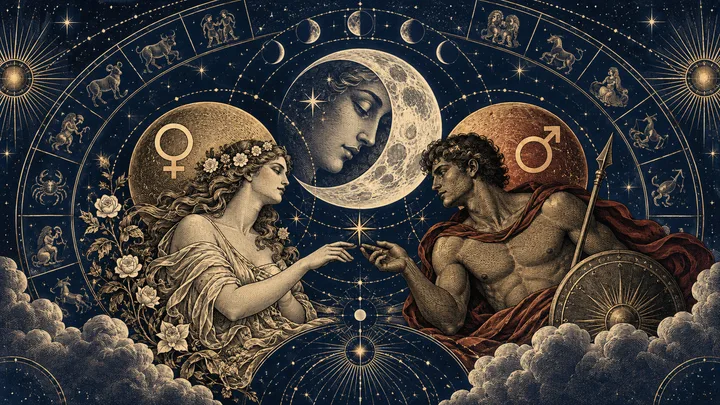
For November 19, 2026 (the UTC day), the verified sky combines a Pisces Moon with a Sun–Mars square and Moon quincunxes to Venus and Jupiter. In astrological terms, that makes a mixed reading: sensitivity may be present, while assertion, affection and expectations call for adjustment. These shared transits do not reveal either partner’s feelings or automatically describe a personal chart. To see whether they relate to your known Moon, Venus or Mars, compare the day’s transiting degrees with each person’s supplied natal degrees and check the aspect and orb; this article uses a 3° working limit. A close contact can frame a conversation, while sign-only matches stay tentative. Treat the forecast as a reflection prompt, then judge the relationship by what each person says and does.
What was actually in the sky during the UTC day?
The November 19 UTC day keeps the Moon in Pisces. At the ephemeris reference time of 05:00 UTC (00:00 America/New_York), the Moon is at 16°31′ Pisces, Venus at 23°23′ Libra, Mars at 27°10′ Leo and the Sun at 26°52′ Scorpio. These are shared transits, not anyone's natal placements. Setting the reference moment and date boundary first keeps a local calendar from quietly shifting an aspect into the wrong day. The Ephemeris for November 2026 – daily planetary positions identifies its longitudes as tropical and explains that the displayed table defaults to midnight Eastern Time; another control switches it to 00:00 UTC. The November 19 row gives the listed degrees at that Eastern midnight. On this date Eastern Time is five hours behind UTC, so that table moment is 05:00 UTC. The source says its calculation follows NASA JPL DE440 and describes the table as planetary positions, not interpretation. This distinction matters: the figures establish where the moving bodies stand at one stated instant. They do not describe either partner's birth chart, houses or Ascendant. An ephemeris row is a reference point, not a claim that every planet stays at that exact degree throughout the day. The Moon moves especially quickly; the source notes it covers about six to seven degrees in half a day. Its November 19 and 20 rows both place it in Pisces, supporting the reading that it remains in that sign over the UTC date while its degree changes. The sign gives the shared backdrop. The exact degree gives a starting point for checking whether the moving Moon or another planet contacts a known natal placement. Without that natal degree, this section can establish the sky, but not a personal aspect. The date boundary matters just as much as the sign. This forecast covers 00:00 through 23:59 UTC on November 19. An event printed under November 19 in a calendar set to another time zone may fall after midnight UTC and belong to November 20 here. Later sections use UTC event times for that reason. If you are following the forecast from another time zone, convert the event time to UTC before deciding which day's reading includes it. That keeps the shared sky clear; your own chart comparison begins only when you set it beside known natal positions.
Sources: Ephemeris for november 2026 – daily planetary positions
Which exact contacts shape the day's relationship tone?
Inside November 19 UTC, the source-checked sequence includes Mars trine Chiron at 10:41, the Sun square Mars at 17:49, the Moon quincunx Venus at 17:59 and the Moon quincunx Jupiter at 22:54. The later Moon–Mars quincunx, Moon–Sun trine and Mercury–Saturn quincunx shown on November 19 in the Eastern calendar perfect after midnight UTC; they belong to November 20 for this article. The times matter because the calendar’s default clock is America/New_York. On this date that zone is Eastern Standard Time, five hours behind UTC, so its 5:41 a.m. Mars–Chiron trine becomes 10:41 UTC; 12:49 p.m. for the Sun–Mars square becomes 17:49 UTC; 12:59 p.m. for the Moon–Venus quincunx becomes 17:59 UTC; and 5:53 p.m. for the Moon–Jupiter quincunx becomes 22:53 UTC. The assigned plan rounds that final time to 22:54; the calendar itself displays 5:53 p.m. The November 2026 Astrology Calendar: Aspects & Moon Phases labels these as exact contacts. The UTC conversion keeps all four within the assigned day. Astrotexts Monthly Planetary Calendar offers a useful boundary check. It explicitly presents times in GMT, and its Thursday, November 19 list places the Sun–Mars square at 17:50, Moon–Venus quincunx at 18:00 and Moon–Jupiter quincunx at 22:54. Those minute-level differences from the Eastern calendar are small, but the dates agree. Astrotexts then lists Moon quincunx Mars at 01:25 and Moon trine Sun at 01:47 under Friday, November 20. The Mercury–Saturn quincunx at 02:17 also appears under Friday. These occur after midnight UTC. Although the Eastern calendar groups them with its November 19 evening events, the UTC day boundary puts them in tomorrow’s forecast. Keeping the assignment’s clock avoids borrowing a later lunar mood and calling it part of November 19. The aspect words describe different kinds of motion. A square brings two principles into friction, so the Sun–Mars contact can be read as a push between intention and action. It may call for measured assertion rather than force; it does not promise an argument. A trine describes an easier flow. Mars trine Chiron can suggest that action finds a constructive route around a tender point, but it remains background here, not a guarantee of repair. A quincunx asks for adjustment between things that do not quite fit. The Moon’s contacts to Venus and Jupiter therefore add a passing note of recalibration around affection and expectation. That sequence makes this a mixed day, not a single verdict. The Sun–Mars square may sharpen urgency, while the two late Moon quincunxes ask for flexibility in feeling and in the scale of expectations. Those are interpretations of the listed aspects, not events the calendar can promise. Nor does a transit-to-transit contact automatically touch either partner’s natal chart. To make the day personal, compare the exact transiting degrees with the known natal Moon, Venus and Mars of each person; the coming sections explain that matching step. For now, use UTC to place a conversation or choice in the right window. If tension rises, pause and name the need before pressing for agreement. If affection feels out of sync, ask what would feel welcome rather than guessing. The day has more than one tone, and no single contact describes every hour or every chart.
Sources: November 2026 Astrology Calendar: Aspects & Moon Phases; Astrotexts monthly planetary calendar
How can a shared transit become personal to your chart?
A transit becomes personal when a moving planet forms an aspect to a fixed degree in a natal chart. That distinction matters on November 19. The day's Sun–Mars square is a relationship between two moving bodies in the shared sky. It doesn't mean either person's natal Mars is being squared. To see whether the date touches your chart, compare its transiting positions with your known Moon, Venus and Mars, then repeat the check for your partner's placements. Keep the two charts separate. This is the difference between a transit-to-transit aspect and a transit-to-natal contact. The first describes geometry between planets moving through the sky together. The second describes a moving planet contacting a placement fixed in one person's birth chart. “How to Read Daily Transits: Astrological Timing” lays out a useful sequence: identify the moving planet and degree, find the natal factor it aspects, note the aspect and orb, then blend the meanings of both planets. This keeps a general forecast from becoming a claim about a particular person. First confirm the zodiac system and each sign and degree at the stated reference time. Convert the transiting position and one natal placement, such as your Venus, to the 360-degree zodiac. Measure their shortest angular distance. Each sign spans 30 degrees. Compare the distance with major angles: conjunction 0°, sextile 60°, square 90°, trine 120°, opposition 180°. Its difference from an exact angle is the orb: 92° is a square with a 2° orb. “How to Read Daily Transits: Astrological Timing” says tighter orbs are generally felt more intensely. This article uses a 3° working limit, a declared filter rather than a universal rule. The ephemeris “Ephemeris for november 2026 – daily planetary positions” gives a shared starting point, not personal results. At 00:00 Eastern Time (05:00 UTC), the Sun is at 26°52′ Scorpio and Mars at 27°10′ Leo. Their square is transit-to-transit. Compare moving degrees with your natal Moon, Venus or Mars to check for personal contact. Sign resemblance alone can't confirm an aspect; degrees within one sign produce different distances. Read each partner's results as separate personal layers. If the moving Moon contacts your Venus, that is a transit to your Venus. It isn't automatically an aspect to your partner's Venus, and it doesn't create a new aspect between your natal charts. The sky is shared; the natal points it touches differ. List each person's Moon, Venus and Mars, mark confirmed contacts, and leave unconfirmed ones blank. With signs but no degrees, you can discuss broad symbolism, but the exact aspect and orb remain unknown. The ephemeris records positions at a chosen moment; it doesn't provide anyone's birth chart. Before taking a daily reading personally, ask whether a moving planet contacts a known placement. If so, use that planet pair as a prompt for reflection. If not, treat it as shared astrological weather. Let it suggest a conversation, not declare your partner's intentions.
Sources: How to Read Daily Transits: Astrological Timing; Ephemeris for november 2026 – daily planetary positions
How do you match today's sky to known Moon, Venus and Mars degrees?
Start with the degree, then interpret the sign. For this reading, a contact is “confirmed” only when a November 19 transiting position falls within 3° of a major aspect to a supplied natal Moon, Venus or Mars. That 3° limit is the article’s working orb, not a rule shared by every astrological school. Kerykeion’s “How to Read Daily Transits: Astrological Timing” describes an orb as the distance from an exact aspect and says tighter orbs, around 1°–3°, are generally read more intensely. The useful habit is to state your chosen limit and apply it the same way to both charts. Use this sequence for each placement. First, record the moving planet’s sign and degree at a named time. The “Ephemeris for november 2026 – daily planetary positions” gives the November 19 tropical positions at 00:00 Eastern Time, which is 05:00 UTC: the Sun is at 26°52′ Scorpio and Mars at 27°10′ Leo. Second, record the natal placement’s exact sign and degree from the chart information you already have. Third, compare their angular distance with a major aspect: conjunction at about 0°, sextile 60°, square 90°, trine 120° or opposition 180°. Finally, measure how far the actual separation sits from that exact angle. Within this article’s 3° orb counts as a close contact; outside it does not. Consider an example using a hypothetical natal Venus at 27°00′ Scorpio. It is illustrative, not a real person’s chart. The transiting Sun at 26°52′ Scorpio is only 0°08′ away, so it forms a close conjunction under the stated method. You could read that as a brief focus on affection, values or being seen in a relationship. The contact describes a theme to notice, not a promised event or a claim about what a partner privately feels. Now change the hypothetical Venus to 27°00′ Taurus. Scorpio and Taurus can suggest an opposition by sign, but the degrees decide how close it is: 26°52′ Scorpio and 27°00′ Taurus sit almost exactly opposite, so the opposition is close. A Venus at 10° Taurus would share the sign pattern but sit far from an exact opposition to this Sun. The sign resemblance alone would not qualify under the 3° rule. This distinction matters with Mars, too. The day’s Mars is at 27°10′ Leo; compare that degree with each natal placement rather than treating every Leo, Aquarius, Taurus or Scorpio placement as contacted. A sign can show which aspect is possible. It cannot tell you whether the aspect is tight. Keep three labels in your notes: confirmed, possible by sign only, and no close contact. “Confirmed” means the supplied degree passes the chosen orb for a named aspect. “Possible by sign only” means the signs suggest an aspect, but the degrees are missing or do not verify it. “No close contact” means the available positions fall outside the working orb. This prevents a broad daily forecast from turning into a personal claim by assumption. If one partner’s degrees are known and the other’s are not, keep the first person’s contact specific and the second person’s reading broad. Don’t fill a missing degree with a guess. Kerykeion’s transit guide also recommends identifying the moving planet, natal factor, aspect and orb before combining their meanings. That order gives you a fair comparison: exactness first, interpretation second.
Sources: How to Read Daily Transits: Astrological Timing; Ephemeris for november 2026 – daily planetary positions; November 2026 Astrology Calendar: Aspects & Moon Phases
What can the Pisces Moon add—and what can it not settle?
The Moon supplies the quickest emotional coloring in this reading, and Pisces can be read through sensitivity, imagination and receptivity. On November 19, though, the Moon’s exact quincunxes to Venus and Jupiter complicate an easy “romantic flow” headline. In astrology, the Pisces tone may invite empathy and openness; the quincunx adds a need to adjust between a feeling, an expression of affection and an expectation. That is a useful prompt, not proof of what someone feels. The timing matters. The November 2026 Astrology Calendar: Aspects & Moon Phases lists the Moon quincunx Venus at 12:59 p.m. Eastern on November 19, which is 17:59 UTC, and its Moon quincunx Jupiter at 5:54 p.m. Eastern, or 22:54 UTC. Both fall within this forecast’s UTC day. The same calendar places the Moon in Pisces from November 17 until November 20 Eastern time. This supports a Pisces Moon backdrop across November 19 UTC, but the sign alone doesn’t describe the whole day. A sign gives the Moon’s broad style; an exact aspect shows another relationship in the sky that can color how that style is expressed. A quincunx is commonly read as a mismatch that calls for adjustment. Applied to the Moon and Venus, the symbolism can point to a moment when what feels comforting and what feels affectionate don’t line up neatly. One person might want quiet reassurance while the other offers practical help or playful attention. The useful question is whether the gesture is landing as intended, then what small change would help. The calendar’s labels describe this contact as a minor strain. It makes adjustment the more fitting image than effortless agreement. The Moon–Jupiter quincunx adds a parallel question about scale. A feeling or hope may be larger than the immediate moment can hold, or a generous offer may overshoot what the other person asked for. This is astrological interpretation of the listed aspect, not a forecast that anyone will overpromise. The Moon’s passage through Pisces can still support compassion and imagination. The aspects simply argue against treating sensitivity as automatic harmony. For your own chart, check whether the transiting Moon makes a close contact to a known natal Moon, Venus or Mars. A Moon contact to your natal Moon can bring your emotional rhythms into sharper awareness for a short time. To natal Venus, it can turn attention toward affection, pleasure and what feels valued. To natal Mars, it can briefly stir initiative or a quicker response. How to Read Daily Transits: Astrological Timing describes the Moon as a fast-moving inner planet and says its sign changes about every two and a half days; Cafe Astrology’s Transits of Sun Moon Mercury Venus Mars likewise calls inner-planet transits brief. Neither source treats one passing contact as a fixed relationship outcome. So compare the exact degrees before applying the day personally. With no close contact to your placements, read Pisces as shared background, not an instruction borrowed from someone else’s chart. With a close lunar contact, use it to name a need: “I’d like reassurance,” or “Can we check what each of us meant?” Then listen to the answer. The Moon can help you notice what wants care today. It can’t settle what a partner feels, decide whether you fit, or replace the pattern you’ve built together.
Sources: November 2026 Astrology Calendar: Aspects & Moon Phases; Astrotexts monthly planetary calendar; Transits of Sun Moon Mercury Venus Mars; How to Read Daily Transits: Astrological Timing
How should Venus and Mars contacts change the reading?
Venus points the reading toward attraction, affection and what feels valued; Mars brings desire, initiative and friction into view. The day's Venus is in Libra and Mars in Leo, but their signs alone don't personalize the forecast. Look for an exact contact from the day's moving planets to each natal Venus or Mars, then read the day's Sun–Mars square as a possible prompt to balance self-expression with considerate timing.
The November 2026 Astrology Calendar: Aspects & Moon Phases links Venus with affection and pleasure, Mars with action and drive. A transit to natal Venus asks how someone experiences affection or value in the moment. A transit to natal Mars brings initiative, desire and response into focus. Someone may want closeness and still need a different approach. The chart can help name the question; it can't answer for the other person.
The calendar gives this day a shared pressure point: the Sun squares Mars at 17:49 UTC. The Sun can describe will; Mars, the urge to act. Their square suggests assertion may meet resistance, or impatience may outrun good timing. It could bring a sharp disagreement, or useful courage: someone states a need and leaves room for a reply. Actual exchanges and close natal contacts help distinguish them. This is an aspect between transiting bodies, not proof that either partner's natal Mars is squared.
For a personal reading, compare the transiting Sun and Mars degrees with each person's natal Venus and Mars, using the declared 3-degree working orb and aspect angle. Transiting Mars close to natal Venus may stir desire or initiative in seeking affection, lively or too forceful. Transiting Venus close to natal Mars may give attraction and action an easier channel, though ease doesn't guarantee agreement. How to Read Daily Transits: Astrological Timing recommends identifying the moving degree, finding its natal aspect, considering orb, then combining the planets' meanings. It cautions that an exact transit describes a theme, not a fixed event. Without degrees, a sign resemblance remains possible, not confirmed.
The Moon's quincunx to Venus, exact at 17:59 UTC according to the November 2026 Astrology Calendar: Aspects & Moon Phases, adds an adjustment cue. A feeling may not match the way affection is offered or received. One might expect reassurance while the other shows care by solving a problem. The aspect doesn't prove a misunderstanding; ask what happened. “What kind of support would feel good tonight?” tests the reading better than assuming a hidden motive. If no close contact reaches natal Venus or Mars, keep these themes in the shared sky. Don't assign them personally.
These are quick-moving influences. Transits of Sun Moon Mercury Venus Mars describes inner-planet contacts as brief, while How to Read Daily Transits: Astrological Timing calls inner planets markers of daily or weekly shifts. Its interpretations allow more than one expression: a Mars contact can energize initiative, yet impatience may accompany it. Give the Sun–Mars square enough weight to mind your tone, not enough to predict an argument. If Venus is contacted, ask what affection is landing well. If Mars is contacted, agree on pace before pushing a plan. Let actions guide the next step.
Sources: November 2026 Astrology Calendar: Aspects & Moon Phases; Transits of Sun Moon Mercury Venus Mars; How to Read Daily Transits: Astrological Timing
How long should a daily contact carry weight?
A Moon contact is a brief passing emphasis; faster personal-planet contacts also move on, while slower transits describe a longer background. Give today's contact enough weight to notice a mood or choose timing, not enough to overrule the relationship's history, a sustained pattern or what either partner says and does. Planetary pace gives this distinction a basis. “How to Read Daily Transits: Astrological Timing” describes the Sun, Moon, Mercury, Venus and Mars as fast-moving inner planets that mark daily or weekly shifts. It says the Moon changes signs about every two and a half days, so lunar contacts color a day without carrying the weight of major developmental themes. The guide places slower planets in a longer frame. Cafe Astrology’s “Transits of Sun Moon Mercury Venus Mars” also calls inner-planet transits brief and less significant than outer-planet transits. These are interpretive timing conventions, but they offer a useful scale: a lunar contact is passing weather, not the climate of a relationship. Rank each contact by duration, exactness and relevance. Duration asks how long it can hold the emphasis. Exactness asks how close it is to the natal aspect; Kerykeion says tighter orbs, around one to three degrees, tend to feel more intensely, while wider ones suggest a background theme or buildup and resolution. Relevance asks whether the natal planet fits the question. For emotional responsiveness, the Moon may be the closest fit; for affection or desire, Venus or Mars may speak more directly. None guarantees an event. The date’s Moon–Venus quincunx can invite a brief check on whether an affectionate gesture and an emotional need are meeting. A close aspect to a known natal placement can sharpen that focus. But the Moon moves on. A disagreement that repeats over months deserves more attention than one tense exchange; direct conversation matters more than a dramatic reading of a moment. The transit may help you choose when to ask or listen. It can’t tell you what your partner privately feels. There’s a fair counterpoint: exact fast contacts can feel vivid. Kerykeion says inner planets can trigger a longer transit, bringing an underlying theme into daily awareness. That makes the day useful as a prompt when the wider chart carries a slower background, but not a stand-alone explanation. The guide warns against expecting a specific event from an exact transit, while Cafe Astrology gives alternate interpretations for some contacts. Let the exact aspect raise a question; let the broader chart and lived pattern test it. Use November 19 as a moment to notice, not a deadline. Name the feeling, check whether a close natal contact supports giving it extra attention, and revisit the conversation after the day has passed. If the same issue remains, respond to the pattern you can observe. If it fades, let the passing weather pass.
Sources: How to Read Daily Transits: Astrological Timing; Transits of Sun Moon Mercury Venus Mars
What is the fairest love reading of this mixed sky?
For November 19 UTC, read the sky as receptive but not uniformly easy. Pisces Moon symbolism meets adjustment contacts to Venus and Jupiter, while the Sun squares Mars. The November 2026 Astrology Calendar: Aspects & Moon Phases lists these contacts. Together, they suggest slowing down and checking whether affection and expectations are landing as intended. This is an astrological interpretation, not an observed outcome. A blanket reading might call a Pisces Moon soft, romantic weather. That captures receptivity, but leaves out the Moon’s quincunxes and the Sun–Mars square. Openness is available, yet expressing it may take adjustment. Imagine two people who want closeness but show it differently. One asks for reassurance; the other asks what support would help. A close transit to a known natal Moon, Venus or Mars can make the symbolism more personal; without one, treat the day as shared background. Kerykeion’s How to Read Daily Transits: Astrological Timing treats a transit as a prompt, not a guaranteed event. Start with exact contacts, name one need, listen, then choose a next step. The Synastry Comparison Report compares supplied Moon, Venus and Mars placements and optional degrees. It doesn’t calculate natal charts from birth details or this day’s transits.
Sources: November 2026 Astrology Calendar: Aspects & Moon Phases; Astrotexts monthly planetary calendar; How to Read Daily Transits: Astrological Timing
A little more clarity
Can I tell whether November 19’s transits affect my chart if I know only my planet signs?
Signs can suggest which aspects are possible, but exact degrees are needed to confirm an aspect and its orb. Without degrees, keep the reading broad and leave the personal contact unresolved.
Sources & further reading
- Ephemeris for november 2026 – daily planetary positions
Provides tropical planetary positions, the table's Eastern Time reference, and its stated NASA JPL DE440 calculation basis.
- November 2026 Astrology Calendar: Aspects & Moon Phases
Lists the November 19 aspect events and times in its stated America/New_York time zone.
- Astrotexts monthly planetary calendar
Lists monthly planetary contacts in GMT and helps check which events fall after midnight UTC.
- How to Read Daily Transits: Astrological Timing
Explains how to compare moving planets with natal factors using aspects and orbs.
- Transits of Sun Moon Mercury Venus Mars
Describes inner-planet transits as brief and offers interpretive context for their varied expressions.
Synastry Comparison Report
Enter known placements for two people. Get an input-by-input comparison, selected aspect calculations and a clear record of what remains uncertain.
Compare our placements