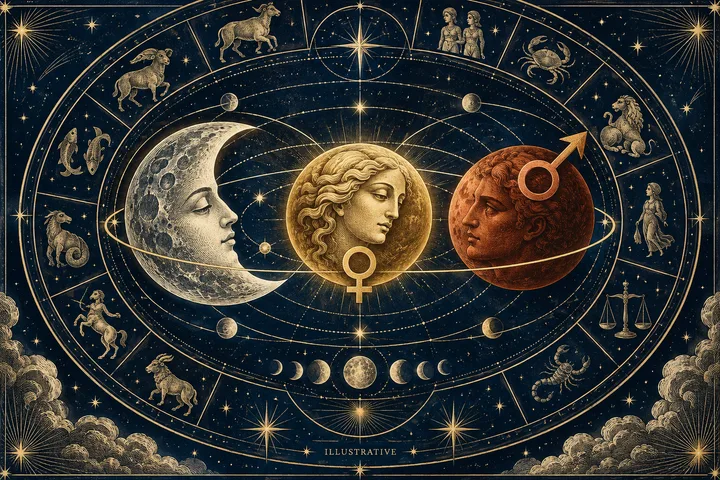
What does November 18 ask you to notice in love?
On November 18, notice the first feeling without letting it write the whole story. The Pisces Moon squares Uranus early, then trines Mercury in Scorpio; the Scorpio Sun also squares Jupiter in Leo. The date-specific table, 18 November 2026 — name days, holidays and the day's sky, lists a sequence: an emotional jolt, a chance to put it into words, and a reminder that hopes or gestures can swell beyond the moment. The Daze's November calendar lists the same aspect order, though its opened page doesn't state a time zone, so its times aren't used here. Read that sequence as a prompt, not a script. A changed plan might stir disappointment; it doesn't, by itself, reveal why the other person changed it. Pause, name what you feel, and ask one plain question. Then listen to the answer. That step gives tenderness room without turning a guess into a verdict. Your known Moon, Venus, and Mars placements can make parts of the day's symbolism more familiar. Exact degrees matter when you want to identify a close contact; sign alone gives a broader comparison. The shared sky describes the day's tone, while your own placements add a personal point of reference. Neither tells you what your partner intends. Let the exchange show what needs care, clarification, or a change of plan.
Sources: 18 November 2026 — name days, holidays and the day's sky; The Daze's November calendar
What is actually in the sky at noon UTC?
At 12:00 UTC on November 18, the tropical, geocentric sky places the Moon in Pisces, the Sun and Mercury in Scorpio, Venus in Libra, and Mars and Jupiter in Leo. In degrees, the positions are Sun 26°09 Scorpio, Moon 7°35 Pisces, Mercury 6°59 Scorpio, Venus 23°15 Libra, Mars 26°52 Leo, and Jupiter 26°04 Leo. The date-specific table in Book of Horoscopes labels its snapshot noon Universal Time, which gives this reading one clear reference point. These are the shared transiting positions for the stated time, not a chart calculated from anyone’s birth details. The Moon moves quickly enough that its position needs a timestamp. At midnight UT, the November 18 row in Upstellar’s Ephemeris Tables places it at 1°22 Pisces; The Working Sky’s November 2026 ephemeris independently lists the same midnight position. By noon, Book of Horoscopes shows it at 7°35 Pisces. The comparison makes the Moon’s movement through the sign visible across those twelve hours. The other five listed bodies also agree closely by sign and degree: the two midnight tables put the Sun at 25°39 Scorpio, Mercury at 6°37 Scorpio, Venus at 23°10 Libra, Mars at 26°39 Leo, and Jupiter at 26°01 Leo. Their noon degrees have advanced, while the signs remain the same. That distinction matters when you compare today’s sky with placements you already know. Sign-level comparison can show a broad symbolic resonance: for instance, note whether one of the day’s planets shares a sign with your natal Moon, Venus, or Mars. To judge a degree-based aspect, you need the natal degree as well as the transit’s degree; matching signs alone doesn’t establish an exact contact. Use the noon snapshot to identify the day’s reference positions, then consult the timed event sequence separately for aspects that peak earlier or later in UTC. This keeps a moving Moon from becoming an all-day frozen picture, and keeps a shared transit reading distinct from a personal chart. It also gives you a practical starting point: compare only placements you have, and let the level of detail stop where your information stops.
For November 18, 2026, the love reading centers on a brief emotional shift followed by a chance to name what you feel. The Pisces Moon squares Uranus at 05:05 UTC, then trines Mercury at 10:46 UTC; between those contacts, the Scorpio Sun squares Jupiter in Leo at 09:38 UTC. Read this sequence as a prompt to pause before interpreting a surprise, speak plainly, and keep hopes or gestures proportionate to what both people can offer. At 12:00 UTC, the Moon is in Pisces, Venus in Libra, and Mars in Leo. Compare those shared-sky signs with Moon, Venus, and Mars placements you already know; reliable degrees are needed to assess a close major aspect. Use the day as a conversation guide, not a verdict about your partner’s intentions or your relationship’s future.
Sources: 18 November 2026 — name days, holidays and the day's sky; Ephemeris Tables; The Working Sky: November 2026 Ephemeris
How does the Pisces Moon color a love conversation?
A Pisces Moon colors the emotional weather with receptivity, imagination, and compassion. In a love conversation, that can help you notice tenderness, longing, or a change in tone. It can also make an unfinished story feel complete before you hear the other person's side. Let the feeling matter. Then give it a question.
The noon UTC sky table in Book of Horoscopes places the Moon at 7°35 Pisces on November 18, 2026. This is the transiting Moon, the day's moving emotional symbol. It isn't a description of every reader's natal Moon, and it doesn't mean everyone will feel the same thing. Pisces brings attention to what is felt, imagined, and sensed between people.
Astrology.com's “The Moon in Pisces” describes a Pisces Moon period as one when connecting with one's own feelings and those of others may feel more natural. It links the sign with compassion and intuition, while warning that romanticizing emotions can blur reality. The page often describes people born with a Pisces Moon; those natal traits shouldn't be assigned to everyone under a Pisces transit. The useful idea is narrower: listen generously, while checking impressions against what is said and done.
Imagine someone whose partner changes a dinner plan at short notice. They feel disappointed and wonder if the change means the partner would rather be elsewhere. They recognize the hurt without dismissing it. An imaginative reading might supply a motive the partner hasn't given. They can keep both possibilities open: “I felt disappointed when the plan changed. What came up?” The question respects the feeling and leaves room for an answer.
That's the balance in the Pisces Moon's love symbolism. Empathy can help you hear a hesitation or make space for a vulnerable admission. But empathy isn't mind-reading. A tender mood doesn't prove that someone shares your hopes, just as uncertainty doesn't prove that they don't. Say what you sense, then ask whether you've understood.
Keep the request clear. “Could we choose another time?” asks for a practical next step. “Do you still care about me?” may be the deeper concern, but the day's symbolism can't answer it for the other person. Ask what you need to know, then notice how the person responds.
The Pisces Moon supports a gentle check-in more than a silent conclusion. Name the feeling as yours, describe the moment that stirred it, and invite the other person to explain. If the reply settles the uncertainty, let it. If it raises another concern, address that in turn. The day's receptive tone is most useful when it makes room for compassion and clarity.
Sources: 18 November 2026 — name days, holidays and the day's sky; The Moon in Pisces
What can the Moon-Uranus square stir up?
The Moon-Uranus square is the day's brief disruptive signal. It can describe a sudden emotional shift, unexpected news, or a changed plan. In a relationship, flexibility is more useful than treating surprise as proof of disinterest. The aspect marks tension; it doesn't promise a fight, breakup, or message.
Book of Horoscopes places the exact square at 05:05 UTC on November 18, with the Moon in Pisces and Uranus in Gemini. Its noon-UTC table confirms those signs. The Daze lists the same aspect in sequence, but its opened page doesn't state a time zone. Use its page as a sequence check, not a clock.
Astrologically, a square brings friction between two kinds of movement. The Pisces Moon seeks emotional receptivity, while Uranus in Gemini can symbolize a quick change of thought, plan, or need for space. Together, they describe a feeling that shifts before the situation catches up. This interpretation doesn't reveal another person's motive.
Imagine you and your partner planned to meet after work, then they ask to move the time. You might feel disappointed. The Moon-Uranus symbolism can give that jolt a name, but it can't explain the change. A work delay or a wish for more room are different possibilities. Ask what changed. The feeling deserves attention; it isn't evidence of a motive.
This distinction matters when a change touches an old worry. A delayed reply may feel like rejection, but the transit can't confirm that reading. Stay open to an ordinary explanation and to the possibility that a pattern needs a conversation. One revised plan doesn't establish a relationship pattern; repeated behavior gives you more to discuss.
Timing adds another layer. The square peaks at 05:05 UTC, while Book of Horoscopes lists a Moon-Mercury trine at 10:46 UTC. Read as a sequence, the early jolt gives way to a more receptive opening for words. The later aspect doesn't guarantee agreement. The useful contrast is between reacting at the first spark and returning with clearer language.
The Moon moves quickly, so this contact belongs to the day's shorter emotional weather. It shouldn't carry the same weight as slower planetary patterns that remain in orb for days or weeks. A sharp mood matters, but it doesn't define the whole day or settle how two people relate.
If plans shift or your reaction spikes, pause before assigning meaning. Ask what changed and whether you can reschedule. If it still bothers you, say so plainly and invite an explanation. The other person's words and actions give you a basis for deciding what the moment means. The transit is a prompt for flexibility, not a verdict.
Sources: 18 November 2026 — name days, holidays and the day's sky; The Daze's November calendar
What can the Moon-Mercury trine help you say?
The Moon-Mercury trine supports putting a feeling into words. At 10:46 UTC on November 18, the Pisces Moon forms a trine to Mercury in Scorpio. In astrological reading, this water-sign connection offers a passage from a feeling still taking shape to language that can reach its depth. You don't need a grand declaration. Start with what you noticed, say how it landed, and ask what you want to understand. This brief lunar contact doesn't promise every conversation will flow. The date-specific sky table in “18 November 2026 — name days, holidays and the day's sky” places the Moon at 7°35 Pisces and Mercury at 6°59 Scorpio at noon UTC, and lists their trine as exact earlier, at 10:46 UTC. That pairing gives the day's symbolism a useful shape: listen for the feeling beneath the first reaction, then give it a clear, honest sentence. The Daze's November calendar independently lists Moon trine Mercury in the same aspect sequence. Its opened page doesn't state a time zone, so it confirms the sequence, not the UTC time. Mercury in Scorpio can sharpen a conversation. Astrology.com's “Mercury in Scorpio” reference associates the sign with penetrating communication and deep discussion. Applied to a transit, that symbolism can help a reader move past vague hints and name the issue that matters. But the source also describes natal traits, so its portrait shouldn't become a forecast of anyone's personality today. The transit offers a moment for directness; it doesn't tell you what your partner is thinking. That distinction is where the trine can be used well or badly. A question can invite an answer, or disguise an accusation. “I felt unsettled when our plan changed. What happened?” gives the other person room to explain. “You changed the plan because you don't care” treats a fear as fact. The first is direct and specific. The second claims to know a motive, which no aspect can establish. Imagine someone sees a tender conversation opening after plans change. They might ask every question at once, searching for reassurance. Instead, they can say what they observed, name the feeling without blame, and ask one question. Then pause. The reply is the evidence the conversation provides. The trine offers a favorable symbolic opening for candor, but neither chart nor timing controls how two people speak or listen. Try this pattern: “When [specific thing] happened, I felt [feeling]. Can you help me understand [one question]?” Fill in your own details. If you don't yet know what you feel, say that. A pause may be more honest than a quick interpretation. Let the answer shape your next question, or your next step.
Sources: 18 November 2026 — name days, holidays and the day's sky; Mercury in Scorpio; The Daze's November calendar
How does the Sun-Jupiter square change the scale?
The Sun-Jupiter square asks how large to make a feeling, a promise, or a gesture. On November 18, its exact contact falls at 09:38 UTC, with the Sun in Scorpio and Jupiter in Leo. The date-specific sky table, “18 November 2026 — name days, holidays and the day’s sky,” records that time and places both planets in fixed signs at noon UTC. Scorpio seeks depth while Leo wants affection expressed with warmth. Their square can press those wishes together: one person may want private reassurance, while the other reaches for a visible declaration. That is a symbolic possibility, not a script every couple will follow. The useful question is whether a gesture’s scale fits what both people have agreed to. An invitation or offer of support may be sincere and welcome. But enthusiasm can run ahead of capacity. A promise made in hope may sound reassuring now and become difficult to keep later. Proportion protects warmth. It lets affection stay generous without asking a gesture to prove more than it can. The fixed-sign tension adds persistence. The Sun in Scorpio can focus attention on what feels essential; Jupiter in Leo can enlarge the urge to express pride or make the moment memorable. Read together, that can bring conviction and courage. It can also tempt someone to mistake intensity for certainty. A strong feeling deserves attention, but it doesn't establish what the other person wants. Ask before turning a hope into a shared plan. Astrology.com’s “Jupiter Square Sun” gives a counterweight to a purely cautionary reading. Its transit interpretation connects the aspect with ambitious plans and warns that expecting too much progress too quickly can bring disappointment. It also says confidence can help when a person has made a realistic appraisal and prepared for the goal. Applied to a relationship, boldness isn't automatically overreach. Telling someone you care can be a sound expression of affection when it leaves room for their answer. The warning concerns assuming a hope is mutual. The Daze’s astrological calendar lists the square on November 18, though its opened page doesn't state the event-time zone, so it supports the event’s presence rather than the published UTC time. It also shows Mars conjoining Jupiter on November 16, not November 18. That conjunction can be background momentum, but shouldn't be recast as a fresh exact transit today. Let warmth be visible, then check its size. Before making a sweeping promise, ask what each of you can offer now. “Would this feel good to you?” makes space for enthusiasm and consent. If the answer changes the plan, that needn't diminish the feeling.
Sources: 18 November 2026 — name days, holidays and the day's sky; The Daze's November calendar; Jupiter Square Sun
What does Venus in Libra add to the relationship tone?
Venus in Libra brings fairness, cooperation, and mutual consideration into the day's relationship symbolism. It favors asking whether care is being exchanged, not simply whether an interaction looks romantic or peaceful. At 12:00 UTC on November 18, the date-specific table in 18 November 2026 — name days, holidays and the day's sky places Venus at 23°15 Libra. Read that as an ongoing backdrop for affection, preference, and the ways people make room for one another. It is not a new exact Venus event on this date, and it does not promise that every couple will feel at ease. Astrology.com's Venus in Libra describes this sign's love language through fairness, cooperation, compromise, and consideration. It also names a tension: the wish to keep things pleasant can sometimes conceal dissatisfaction or practical needs. That contrast is useful here. Harmony has value when both people can speak honestly within it. A quiet agreement that leaves one person resentful is not the same as mutual care.
The same daily table lists Venus sextile Mars as in orb from November 4 through November 20, with the aspect exact on November 10 at 06:47 UTC. So on November 18 it is separating, a continuing background influence rather than the day's peak. In astrological interpretation, Venus describes attraction and relating, while Mars describes desire and initiative; their sextile can suggest an easier opening between affection and action. But an easy opening is still an invitation, not proof of shared wishes. The date-specific calendar supplies the aspect dates and time; Astrology.com's Venus in Libra supplies the broader symbolism of reciprocity and graceful compromise. Neither source establishes what a particular partner feels or how a conversation will end.
Imagine you want to spend the evening together, while your partner needs a quiet night alone. One reading of Venus in Libra might urge you to preserve the pleasant mood and say, “Anything is fine.” A more balanced reading asks what would feel fair to both of you. You might name your wish, hear the other person's need, and settle on a specific plan, perhaps time together tomorrow and rest tonight. That is compromise with two voices in it. If you hide your preference to avoid discomfort, the surface may stay smooth while the real exchange becomes less honest. If you insist that your preferred plan proves whether your partner cares, fairness has turned into a test. The stronger use of this transit is smaller and kinder: make a clear request, leave room for a real answer, and notice whether consideration moves both ways. Venus in Libra can frame the question; the exchange itself shows how each person responds.
Sources: 18 November 2026 — name days, holidays and the day's sky; Venus in Libra
How do the Leo Mars and Jupiter background themes interact?
Mars and Jupiter are both in Leo at the November 18 noon-UTC snapshot: Mars is at 26°52 and Jupiter at 26°04. Their conjunction was exact on November 16 at 06:23 UTC, according to “18 November 2026 — name days, holidays and the day's sky.” The Daze calendar independently places the conjunction on November 16 at 26° Leo. So the pairing still colors the day, but it is a recent background contact, not a fresh exact event on November 18. In astrological interpretation, Mars describes the push to act, while Jupiter enlarges the reach of what it touches. In Leo, that combination can make initiative visible: someone may want to express affection boldly, take the lead, or make a generous gesture with a little ceremony. The lively version is constructive courage. A person who has been holding back may find it easier to say, “I’d like to see you,” or suggest a plan with warmth and confidence. The same symbolism can also enlarge pride or appetite. A gesture can become a performance, or a confident invitation can start to feel like an expectation. Neither reading is automatic. The strongest alternative to a caution about excess is that open enthusiasm may be exactly what a connection needs. A clear invitation, freely offered, can make affection easier to recognize. The useful test is not whether the gesture is grand enough for the sky. It is whether both people have room to respond honestly. Can the other person welcome it, decline, or suggest a different plan without being made to feel ungrateful? That answer tells you more about the exchange than the size of the gesture. The conjunction also sits beside the day's exact Sun-Jupiter square, which the date calendar lists for 09:38 UTC. The two contacts shouldn't be collapsed into one event: Mars-Jupiter was exact two days earlier, while the Sun-Jupiter square is exact on the 18th. Together, they support a reading of enthusiasm that needs proportion. Let generosity be generous, but don't make a promise for two people before you know what each can offer. In practice, make the invitation clear and leave space around it. “Would you like to spend the evening together?” invites an answer. “I planned our future tonight” assumes one. For November 18, read the Leo pairing as encouragement to act with heart, not as a forecast of passion, conflict, or a particular relationship outcome. Confidence helps when it gives affection a voice; it becomes pressure when it treats another person's agreement as settled. Keep the initiative sincere, mutual, and easy to answer.
Sources: 18 November 2026 — name days, holidays and the day's sky; The Daze's November calendar
When does a transit touch your known Moon, Venus, or Mars?
A sign match offers a broad symbolic comparison; an exact degree is needed to judge whether a close major aspect is present. The November 18 sky has a Pisces Moon, Libra Venus, and Leo Mars at noon UTC, as listed in “18 November 2026 — name days, holidays and the day's sky.” Compare those signs with the Moon, Venus, and Mars placements you know. This shows which themes may resonate. It doesn't show that a transit forms an exact aspect to your natal chart. For example, if your known Moon is in Pisces, the day's Pisces Moon shares its sign. In astrology, that can make the day's emotional symbolism feel familiar: both point toward receptivity, imagination, and sensitivity. But a shared sign alone doesn't establish a conjunction. Your natal Moon might sit near the beginning or end of Pisces while the transiting Moon is elsewhere in the sign. Without reliable degrees, the reading stays at the sign level. The same distinction applies to Venus and Mars. If your known Venus is in Libra, compare it with transiting Venus in Libra as a broad echo around affection, harmony, and give-and-take. If your Mars is in Leo, compare it with transiting Mars in Leo as an echo around initiative, expression, and desire. These are symbolic prompts, not descriptions of what you or a partner must do. A sign match can suggest where to reflect; it can't reveal another person's intentions or guarantee an exchange. Degrees let you ask a narrower question. With reliable degrees for both placements, compare their angular distance. A conjunction is near the same zodiacal degree; other major aspects depend on their familiar angular relationships. The Synastry Comparison Report uses a six-degree orb for its selected major-aspect calculations. Sign-level resemblance and degree-based aspect are different kinds of information, so don't turn the first into proof of the second. Keep this comparison separate from synastry between two natal charts. Synastry describes contacts between one person's birth placements and another person's. A transit describes current planetary motion in relation to a natal placement. The November 18 Moon doesn't alter either person's natal Moon, Venus, or Mars; it supplies the moving sky against which a known placement can be read. A practical check takes three steps. Write down each person's supplied Moon, Venus, and Mars signs. Add degrees only when the source is reliable. Label each comparison as sign resonance or a major aspect within the report's six-degree orb. If degrees are missing, stop at sign-level interpretation. The report uses placements and optional degrees you provide; it doesn't calculate natal charts or houses from birth details.
Sources: 18 November 2026 — name days, holidays and the day's sky
What should you do with the reading today?
Treat November 18 as a day for a gentle check-in, not a verdict about your relationship. If a feeling arrives suddenly, pause. The calendar, ‘18 November 2026 — name days, holidays and the day’s sky,’ places the Moon-Uranus square before the Moon-Mercury trine. Notice the jolt, then find words for it. You might say, ‘I felt unsettled when our plan changed. Can you tell me what happened?’ That names your experience without deciding what the other person meant. Then listen. Their answer, and what they do next, matter more than a forecast can tell you. Keep the next step proportionate to the exchange. You might clarify the plan or return to the subject later. If you know your Moon, Venus, and Mars placements, a close contact by reliable degrees can make one theme more personally emphasized. Without those degrees, stay with the broader sign-level reading. Even a close transit describes a symbolic emphasis; it doesn’t settle what a partner intends or what the relationship will become. Context matters. If you want to compare placements, the Synastry Comparison Report uses the signs you supply and optional degrees. It doesn’t calculate natal charts from birth details. Explore a contact, then bring the question back to the conversation in front of you. Notice what you feel. Ask plainly. Decide together what comes next.
Sources: 18 November 2026 — name days, holidays and the day's sky
A little more clarity
What time are the November 18 positions based on?
The reference positions are tropical, geocentric positions at 12:00 UTC on November 18, 2026. The Moon moves during the day, so its position needs a stated time.
Does a sign match mean a transit is conjunct my placement?
No. A shared sign gives a broad symbolic comparison. You need reliable degrees to assess whether a close major aspect is present.
Does the horoscope predict what my partner will do?
No. The transits offer a symbolic prompt for reflection and conversation; they do not establish another person’s intentions or decide a relationship’s outcome.
Can the report calculate our natal charts from birth details?
No. The Synastry Comparison Report uses supplied placements and optional degrees. It does not calculate natal charts or houses from birth details.
Sources & further reading
- 18 November 2026 — name days, holidays and the day's sky
Provides the November 18 noon-UTC planetary positions and UTC times for the Moon-Uranus square, Sun-Jupiter square, and Moon-Mercury trine.
- Ephemeris Tables
Lists the November 18 planetary positions at 00:00 UT, independently corroborating the signs and approximate degrees.
- The Working Sky: November 2026 Ephemeris
Lists November 18 positions at 00:00 UT, including the Pisces Moon and Libra Venus, as an independent ephemeris cross-check.
- The Daze's November calendar
Lists the November 18 aspect sequence and earlier Mars-Jupiter conjunction; its opened page does not state the event-time zone.
- The Moon in Pisces
Offers broad Pisces Moon symbolism, including receptivity and compassion, and cautions against idealizing feelings.
- Mercury in Scorpio
Associates Mercury in Scorpio symbolism with penetrating communication and deep discussion.
- Venus in Libra
Describes Venus in Libra themes of fairness, cooperation, and harmony, including the risk of hiding practical needs.
- Jupiter Square Sun
Complicates a caution-only interpretation by pairing possible overambition with confidence grounded in realistic appraisal and preparation.
Synastry Comparison Report
Enter known placements for two people. Get an input-by-input comparison, selected aspect calculations and a clear record of what remains uncertain.
Compare our placements