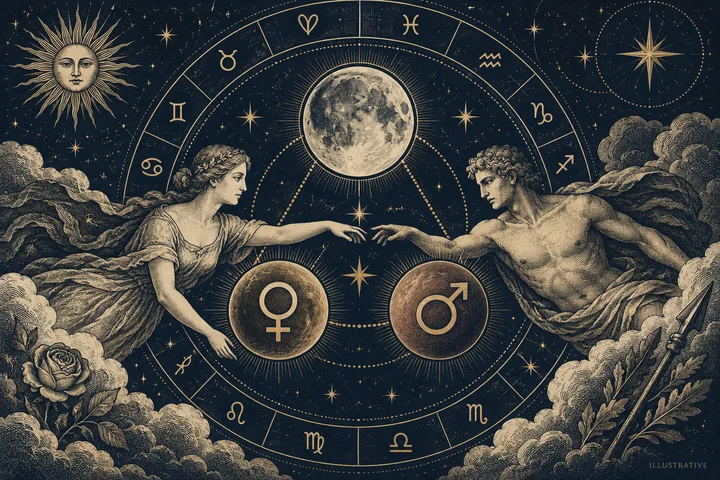
What is actually in the sky at noon UTC?
For November 16, 2026, the useful starting point is a stated moment, not a claim about the whole day. In the tropical zodiac at 12:00 UTC, the Moon is at 13°10 Aquarius, Venus at 22°59 Libra, and Mars at 25°00 Leo. The same table places Jupiter at 25°54 Leo. These are shared positions in the sky; they do not tell us where either partner's natal planets fall. The date-specific table in “16 November 2026 — name days, holidays and the day's sky” explicitly labels its positions as computed for noon Universal Time and gives these degrees. That makes it a clear reference snapshot for the comparison that follows. A daily position row is a photograph at one chosen hour. It isn't a list of unchanging placements from midnight to midnight. The Moon makes that distinction easy to see: at noon it has reached 13°10 Aquarius, while the separate daily ephemeris “Daily planetary positions 16 November 2026 – Astrological Ephemeris (00:00 UTC)” gives 9° Aquarius at 00:00 UTC and rounds its progression to 12°, 15°, and 18° Aquarius at 06:00, 12:00, and 18:00 UTC. The noon figure from the first table is more precise for the requested reference; the second page corroborates the sign and shows why the clock time belongs beside any degree. “November 2026 Ephemeris: Daily Planet Positions” makes the same convention explicit for its monthly table: every row is set at 00:00 UT. Its November 16 row again puts the Moon in Aquarius, Venus in Libra, and Mars and Jupiter in Leo, but it isn't a noon reading. Mixing those snapshots would blur a distinction that matters when comparing degrees. The day also has two timed contacts, which should be kept separate from the noon positions. The calendar lists the Moon sextile Saturn as peaking at 02:33 UTC and Mars conjunct Jupiter at 06:23 UTC. Those are intraday event times, not extra noon placements. In plain terms, the positions answer, “Where are these bodies at our chosen reference?” The event list answers, “When does a current-sky contact reach its listed peak?” Together, the positions and event times describe the shared sky; personal contacts require each partner’s natal degrees. With signs only, keep the reading broad.
On November 16, 2026, the tropical Moon is at 13°10 Aquarius, Venus at 22°59 Libra, and Mars at 25°00 Leo at 12:00 UTC. The Moon sextiles Saturn at 02:33 UTC; Mars conjuncts Jupiter at 06:23 UTC. Read these moving-planet contacts as shared symbolic weather: a chance to pair steadiness with generous initiative. The signs can prompt separate questions about emotional comfort, affection, and action, but they cannot tell you what either partner feels. For a personal transit, compare each moving planet’s degree with each person’s supplied natal Moon, Venus, or Mars, using a named aspect and orb. The report uses a six-degree orb for selected major aspects. Without reliable degrees, keep the reading broad and ask each other what kind of support or invitation feels welcome today.
Sources: 16 November 2026 — name days, holidays and the day's sky; November 2026 Ephemeris: Daily Planet Positions; Daily planetary positions 16 November 2026 – Astrological Ephemeris (00:00 UTC)
Which verified events shape the relationship weather?
Two timed contacts give this day its clearest relationship-weather cues. The date-specific calendar in Book of Horoscopes lists the Moon sextile Saturn peaking at 02:33 UTC, then Mars conjunct Jupiter at 06:23 UTC on November 16. These are aspects among moving planets in the shared sky. They describe the day’s symbolic backdrop; they do not, on their own, establish a transit to either partner’s natal Moon, Venus, or Mars. That distinction keeps a useful forecast from turning into a claim about what one person must feel or do.
In the modern Western interpretive frame used here, a sextile is a cooperative opening between planetary principles. It can make a response easier to reach, though it still calls for participation. The Astrology University guide to transits makes that point about supportive aspects: an available opening becomes meaningful through what a person does with it. With the Moon and Saturn, the relationship reading is a brief chance to give feeling a steadier form. A calm check-in, a kept promise, or a boundary stated without withdrawal can carry more weight than a grand emotional display. The Moon moves quickly, so this is a short-lived tone, not a forecast for the whole relationship.
A conjunction brings two planetary principles together more directly. The same date calendar places Mars and Jupiter together in Leo at 06:23 UTC. AstroTexts’ November calendar independently lists both the Moon-Saturn sextile and Mars-Jupiter conjunction, with times one minute later; the excerpt does not state its time zone, so it corroborates the sequence and timing closely, while Book of Horoscopes supplies the explicitly labeled UTC times. Read Mars with Jupiter as drive meeting amplification: initiative can feel generous, bold, and ready to take up space. In a love context, that can support a warm invitation or an open show of appreciation. It can also make a plan swell beyond what either person can comfortably give. The chart points to enthusiasm; proportion is the choice that makes it kind.
Together, these contacts suggest a useful balance: make the gesture, then give it a dependable shape. A specific time to talk is more useful than a vague invitation. These are symbolic examples, not predictions; a personal transit still requires a separate degree-based natal comparison. Pair an open gesture with one realistic commitment, and notice when enthusiasm starts to overpromise.
Sources: 16 November 2026 — name days, holidays and the day's sky; AstroTexts November 2026 Calendar; What Do Transits Mean in Your Birth Chart?
Why is a shared transit different from your personal transit?
The Moon-Saturn sextile and Mars-Jupiter conjunction describe moving bodies meeting in the sky. A personal transit asks a different question: does a moving planet form a chosen aspect to a known natal placement? Everyone shares the event time, but only a degree-based comparison can show whether either event also contacts one person's Moon, Venus, or Mars. In Astrology Transits Explained: How Planets Trigger Your Chart, a current-to-current aspect is described as shared sky geometry. A natal transit compares one moving planet with a fixed point in a particular birth chart. So the Moon-Saturn sextile is part of November 16's common astrological weather; it is not automatically a Moon-Saturn contact in your chart. The same goes for Mars conjunct Jupiter. The event names two moving planets. To call it personal, you must compare a moving planet's position with a natal placement and identify the aspect between them. That gives a clean two-layer reading. First, consider the shared configuration as a symbolic backdrop for the day. Then ask whether the moving Moon, Saturn, Mars, or Jupiter forms a selected major aspect to a supplied natal Moon, Venus, or Mars. The first layer belongs to the date. The second belongs to an individual chart. Astrology University’s What Do Transits Mean in Your Birth Chart? similarly defines a transit through the current position, natal target, and aspect, while stressing that natal context affects how the symbolism is interpreted. The useful sequence is therefore sky first, personal comparison second. For a couple, that second step happens twice. You and your partner share the same moving sky, yet your natal placements differ. Imagine one person's natal Moon degree sits close enough to a moving planet's degree to form a major aspect within the stated orb. That contact may deserve attention in that person's reading. Another person could have the Moon in the same sign but at a degree too far away to meet that orb. The sign label alone cannot settle the question. Nor does one person's contact transfer to the other partner. Name the moving body, natal target, aspect, and permitted orb so a shared event is not confused with a personal contact. This reading uses the report's six-degree orb for selected major aspects; signs alone cannot confirm a degree-specific hit. Check each person's supplied placements separately.
Sources: Astrology Transits Explained: How Planets Trigger Your Chart; What Do Transits Mean in Your Birth Chart?
How should Moon, Venus, and Mars each enter the reading?
Keep three questions separate. The Moon asks what helps someone feel emotionally settled and met. Venus asks what they value in affection, pleasure, and exchange. Mars asks how they pursue what they want, take initiative, and handle friction. On November 16, 2026, the moving Moon is in Aquarius, Venus in Libra, and Mars in Leo. Those are the day’s placements. They are not either partner’s natal placements, and they don’t combine into one verdict about the relationship. Astrology University’s “What Do Transits Mean in Your Birth Chart?” describes a transit as a moving planet forming an aspect to a natal planet or another chart point. It also stresses that the moving planet, natal target, and aspect each contribute a different part of the interpretation. The Great Almanac’s “Astrology Transits Explained: How Planets Trigger Your Chart” makes the related distinction between a current-to-current aspect in the sky and a transit to a particular person’s chart. Apply that distinction here: read the Aquarius Moon, Libra Venus, and Leo Mars first as shared symbols of the date. Compare each one with a person’s known natal placements only when the relevant signs are supplied; a specific personal contact calls for degrees and a defined aspect. The Moon’s sign can frame a question about comfort: does a little room to think help, or would a direct check-in feel more reassuring? Aquarius supplies the day’s lunar symbolism, but it doesn’t prove that either partner wants distance. Ask what kind of response actually feels supportive. Venus in Libra shifts attention to exchange and relating. You might ask whether appreciation feels mutual, or whether a plan gives both people a say. That is a way to use the symbol, not a claim that a partner will automatically act in a Libra manner. Mars in Leo brings the day’s action symbol into view: how does each person show enthusiasm, make an invitation, or express irritation? Ask whether a bold gesture sounds welcome and what pace feels comfortable to both. Keep the planets’ meanings distinct: talk separately about emotional reassurance, affection, and initiative. A transit-to-natal reading requires a measured contact to a supplied placement. The comparison report accepts Moon, Venus, and Mars placements, with optional degrees; it does not calculate houses or natal positions from birth details.
Sources: What Do Transits Mean in Your Birth Chart?; Astrology Transits Explained: How Planets Trigger Your Chart
What can sign-only placements tell you about November 16?
Sign-only placements show a broad symbolic relationship between the day’s sky and placements you already know. They can’t establish an exact aspect to anyone’s natal chart. At noon UTC on November 16, the tropical Moon is in Aquarius, Venus in Libra, and Mars in Leo, according to “16 November 2026 — name days, holidays and the day’s sky.” Aquarius and Libra are air signs; Leo is fire. This air-and-fire emphasis offers themes to explore through conversation, relating, and initiative. It’s a starting description, not a personal forecast.
Keep the planets’ questions separate. Compare the transiting Aquarius Moon with each person’s natal Moon sign as a broad prompt about emotional needs and comfort. Compare Libra Venus with natal Venus signs when considering affection, values, or reciprocity. Then compare Leo Mars with natal Mars signs as a prompt about action and desire. These comparisons don’t tell you how someone will feel or behave. They offer distinct symbolic themes to test against what both people want to discuss.
The shared air element of Aquarius and Libra lends an interpretive emphasis to ideas, exchange, and social connection. Leo’s fire adds a different note: visible, expressive initiative. Read together, the signs might suggest a day to talk through an idea, consider what feels fair, and decide whether to make an enthusiastic plan. That’s an astrological reading, not a measured account of how people with those signs act. No sign pairing guarantees ease, attraction, or agreement.
Modality and planetary role add nuance. Aquarius is fixed air, Libra cardinal air, and Leo fixed fire. In traditional sign language, fixed signs sustain or hold a course, while cardinal signs begin or direct movement. Libra Venus can therefore suggest initiating exchange, while the Aquarius Moon and Leo Mars carry fixed-sign themes. These are interpretive qualities, not personality measurements. And Venus describes a different part of relationship life than Mars, even when their signs seem to resonate.
The key limit is that signs alone can’t confirm a degree-based transit. “What Do Transits Mean in Your Birth Chart?” describes transits as moving positions forming aspects to natal chart factors. An aspect depends on the angle between two positions. Two natal Moons may both be in Aquarius but have different degrees; a moving planet might form a close major aspect to one and fall outside the chosen orb for the other. Without degrees, there’s no sound basis to say a specific contact is active. A close degree contact could also shift the emphasis suggested by sign resemblance.
Use the sign layer to ask: does today’s air-and-fire symbolism help you talk about space, consideration, or initiative? Keep the conversation grounded in each person’s answer. If you know only the signs, describe broad themes. Don’t call that an exact personal transit or turn a sign match into a compatibility verdict. Degrees are needed to check whether a major aspect is present.
Sources: 16 November 2026 — name days, holidays and the day's sky; What Do Transits Mean in Your Birth Chart?
When do degrees change a sign-only reading?
Degrees matter when you want to know whether a moving planet aspects a natal Moon, Venus, or Mars. Shared signs describe symbolic resonance, but they don't establish a precise contact. Compare zodiac degrees, measure angular distance, and name the allowed orb. The Synastry Comparison Report uses a six-degree orb for selected major aspects. That's its working rule, not a universal rule. An aspect is a measured relationship between two zodiac positions. The five major aspects used here are conjunction (0°), sextile (60°), square (90°), trine (120°), and opposition (180°). An orb is the distance between the separation and the aspect's exact angle. If two planets are 64° apart, they're 4° from an exact sextile. Under a six-degree rule, that falls within orb. The degree tells you how close the contact is; the chosen orb tells you whether this reading includes it. The glossary “Orb” explains that astrologers use different thresholds and that tighter orbs sit closer to exact. “Astrology Transits Explained: How Planets Trigger Your Chart” also defines orb as distance from an exact aspect and recommends stating the threshold. Its examples use narrower timing orbs; this report uses six degrees. State the rule instead of borrowing one from another method. Consider this example, without assigning either person a chart: suppose a transiting planet sits 4° from an exact trine to a natal Venus. That geometry could qualify under the report's six-degree rule. If you only know that two placements occupy signs often described as compatible, you can discuss sign-level symbolism, but you can't confirm a trine. Even two Moons in the same sign may be many degrees apart. Sign labels narrow the field; degrees show the geometry. Check each person's supplied degrees against the moving planet. The Great Almanac's transit guide describes this as comparing a moving position with a fixed natal point, not an aspect between two moving planets. The day's Mars-Jupiter conjunction doesn't automatically contact either partner's Venus or Mars. It becomes a personal transit only if its relationship to that person's natal degree meets the stated aspect and orb. Apply the same check to the Moon and Saturn. Astrologers describe an aspect as applying when it moves toward exactness and separating after it passes exact. That can add timing detail, but one daily position can't show which way the contact is moving. “Astrology Transits Explained: How Planets Trigger Your Chart” says an ephemeris or time series is needed to determine motion. Use the separately verified event times for this date's Moon-Saturn sextile and Mars-Jupiter conjunction; don't infer applying or separating status from the noon snapshot alone. If you have only signs, stay with sign-level interpretation. With reliable degrees, compare the angles and apply the report's six-degree rule to its selected major aspects. The report works from placements you supply; it doesn't calculate natal charts from birth details. Ask each other which theme feels present.
Sources: Orb; Astrology Transits Explained: How Planets Trigger Your Chart; What Do Transits Mean in Your Birth Chart?
What does the Aquarius Moon add to known Moon placements?
The Aquarius Moon gives November 16’s emotional tone a more observant, spacious, and socially aware cast in this interpretive tradition. Its sextile to Saturn can suggest a short opening for steadiness: a clear boundary, a kept promise, or a calm check-in may help a feeling find its shape. To make it personal, compare the moving Moon’s degree with each natal Moon separately. The sign alone cannot establish an exact contact. The date calendar “16 November 2026 — name days, holidays and the day’s sky” places the Moon at 13°10 Aquarius at noon Universal Time and lists the Moon-Saturn sextile’s peak at 02:33 UTC. These are two different moments. The Moon was earlier in Aquarius at the event, so its noon degree should not be used as the aspect’s exact degree. A second ephemeris, “Daily planetary positions 16 November 2026,” shows the Moon progressing from 9° Aquarius at 00:00 UTC to 12°, 15°, and 18° at six-hour intervals. A timestamp matters when degrees matter. First separate the sky’s event from a birth-chart contact. The sextile describes the moving Moon and Saturn in relation to each other. A transit-to-natal reading asks whether a moving body also forms a chosen aspect to one person’s fixed natal placement. “What Do Transits Mean in Your Birth Chart?” describes transits through this moving-to-natal comparison and notes the Moon’s quick pace. So the day’s Moon-Saturn contact is a shared symbolic backdrop; it doesn’t prove that either person’s natal Moon is receiving that contact. In a couple, check each chart independently. Their Moon signs may match while their degrees differ enough to change whether a contact falls within the chosen orb. Moon-to-Moon synastry asks how two people’s emotional rhythms meet; today’s transit can prompt that conversation but cannot answer it. Aquarius does not assign fixed behavior. Ask whether room, perspective, or practical care would help, then let each person say what fits. A useful check-in is simple: “What would feel reassuring today: a little space, a practical follow-through, or a direct conversation?” Then listen. One partner may want time to think; the other may prefer a specific plan. The chart can name possibilities without deciding the answer. If you have only sign placements, keep the interpretation broad. If reliable degrees are available, compare them under the report’s stated major-aspect method. Either way, ask before assuming. Steadiness is something the two of you can make together.
Sources: 16 November 2026 — name days, holidays and the day's sky; AstroTexts November 2026 Calendar; Daily planetary positions 16 November 2026 – Astrological Ephemeris (00:00 UTC); What Do Transits Mean in Your Birth Chart?
How do Libra Venus and Leo Mars color affection and action?
On November 16, Venus in Libra gives affection a reciprocal tone, while Mars in Leo brings action forward with warmth and visible enthusiasm. At noon UTC, Venus stands at 22°59 Libra and Mars at 25°00 Leo, according to “16 November 2026 — name days, holidays and the day's sky.” The independent “November 2026 Ephemeris: Daily Planet Positions” lists both in the same signs at 00:00 UT, with Venus at 22°56 Libra and Mars at 25°46 Leo. The reference times explain the degree differences; the sign pattern agrees. This is the shared sky for the date, not either partner’s natal chart. In traditional symbolism, Venus describes attraction, pleasure, values, and the way we seek accord. Libra is Venus’s domicile, emphasizing balance, consideration, and meeting another person halfway. Mars describes desire, initiative, and how energy moves toward a goal. In Leo, Mars favors a wholehearted gesture or a show of interest. Together, these placements suggest a pairing: make the invitation warmly, then leave room for the other person’s answer. Reciprocity needs both voices. A grand gesture alone doesn’t show whether it’s welcome. That distinction keeps the reading practical. Libra’s wish for harmony can become over-accommodation if one person keeps smoothing every difference; Leo’s expressive drive can overwhelm if enthusiasm outruns the other person’s pace. These are interpretive cautions, not predictions about anyone born under these signs. The day’s Mars-Jupiter conjunction, timed for 06:23 UTC in the calendar, gives action a stronger note of scale and generosity. “What Do Transits Mean in Your Birth Chart?” describes conjunctions as concentrating planetary principles and notes that Jupiter’s expansive spirit can overextend. Here, confidence helps when it stays responsive to real limits. This conjunction is between moving Mars and Jupiter, not automatically a contact to your natal planets. Translate the symbolism into one direct choice. You might say, “I’d love to spend time together tonight. Would dinner or a walk suit you?” The invitation carries Leo’s initiative; offering a choice gives Libra’s reciprocity room to work. Then listen. If your partner prefers another plan, treat that answer as information about today’s shared pace, not a hidden chart message. If both people are enthusiastic, agree on a plan that fits your time and energy. For a personal Venus or Mars transit, compare supplied natal degrees under a stated aspect rule. The Synastry Comparison Report accepts Moon, Venus, and Mars placements, optional degrees, and uses a six-degree orb for selected major aspects; it does not calculate natal charts from birth details. Without degrees, stay at sign level: offer affection warmly, make room for a reply, and choose the pace together.
Sources: 16 November 2026 — name days, holidays and the day's sky; November 2026 Ephemeris: Daily Planet Positions; What Do Transits Mean in Your Birth Chart?
Which interpretation is strongest, and what could change it?
The strongest reading is a shared invitation to pair social openness with dependable, generous action. The verified Moon-Saturn sextile at 02:33 UTC and Mars-Jupiter conjunction at 06:23 UTC frame that contrast. They describe the sky's common symbolism on November 16, not a promise that every couple will feel or act alike. The date calendar, “16 November 2026 — name days, holidays and the day's sky,” gives the event times and noon-UTC positions. First comes event geometry and time. A Moon-Saturn sextile can be read as an opening to give feeling a steadier form: a clear boundary, practical offer, or promise kept. Mars joining Jupiter concentrates initiative and confidence. In love, this can support a generous invitation, with proportion keeping the gesture welcome. This is symbolic interpretation, not a claim that an event must happen. Astrology University's “What Do Transits Mean in Your Birth Chart?” describes conjunctions as concentrating planetary principles and sextiles as making movement more available, while stressing participation and context. That supports a reading of opportunity and response, rather than automatic outcome. Second comes the sign pattern: the Moon in Aquarius, Venus in Libra, and Mars in Leo at noon UTC. In this interpretive frame, air signs favor exchange and perspective, while fire brings expressive momentum. Together, those signs suggest room to talk, mutual regard, and a more visible gesture. This is a broad reading of the shared sky, not a window into private wishes. Ordinary plans and circumstances may shape the day more strongly. Third, check each person's supplied natal degrees before making the reading personal. A moving planet forms a personal transit only when it makes a defined aspect to a natal point. The Great Almanac's “Astrology Transits Explained: How Planets Trigger Your Chart” distinguishes contacts among moving planets from contacts between a moving planet and a natal chart. So the shared Mars-Jupiter conjunction does not automatically touch either partner's natal Moon, Venus, or Mars. Under the report's six-degree orb, reliable degrees can establish whether a selected major aspect falls within range. Sign labels alone cannot. A close major aspect to a supplied natal degree could change the emphasis. Without one, keep the reading collective; no placement settles a relationship verdict. Ask, “What kind of support or invitation would feel good to you today?” Then listen.
Sources: 16 November 2026 — name days, holidays and the day's sky; What Do Transits Mean in Your Birth Chart?; Astrology Transits Explained: How Planets Trigger Your Chart
What conversation can you start with this reading?
Ask your partner: “What would feel like a good balance of space and closeness today, and what’s one thing we’d genuinely enjoy doing together?” It turns the day’s symbolism into a choice you can make together.
The Aquarius Moon offers a prompt about breathing room. Libra Venus brings reciprocity into the picture: are both people’s preferences part of the plan? Leo Mars adds a nudge toward clear, warm initiative. These are astrological themes, not instructions to perform a role. If one of you wants quiet and the other wants an outing, say so plainly. Then look for a plan that respects both answers. Choose an activity together instead of treating the chart as a script.
A placement comparison can help name which themes matter to each of you. The Synastry Comparison Report uses Moon, Venus, and Mars signs you supply, with optional degrees for selected major-aspect comparisons. It doesn’t calculate natal positions from birth details. If you know those placements, you can [compare them here](/compatibility-test) to prepare for a more specific conversation. The comparison can give you language, but it can’t make the choice for you.
Ask and listen. What each person says matters more than a guess about their feelings. Let the reading open the conversation; let your shared answer decide what comes next.
A little more clarity
Can I compare these transits with my placements if I know only the signs?
Yes. Sign-only information supports a broad symbolic comparison with the day's Aquarius Moon, Libra Venus, and Leo Mars. It cannot confirm an exact transit or major aspect to a natal placement; that requires reliable degrees and a stated orb.
Does the Mars-Jupiter conjunction mean it contacts my natal Mars or Jupiter?
No. The conjunction is between moving planets and describes shared sky geometry. It becomes a personal transit only if a moving planet forms a selected aspect to a known natal placement within the stated orb.
Sources & further reading
- 16 November 2026 — name days, holidays and the day's sky
Provides the noon-UTC tropical positions and explicitly timed Moon-Saturn and Mars-Jupiter events for November 16, 2026.
- November 2026 Ephemeris: Daily Planet Positions
Provides November 16 planetary positions at its stated 00:00 UT reference, corroborating the daily sign pattern.
- Daily planetary positions 16 November 2026 – Astrological Ephemeris (00:00 UTC)
Shows the Moon's Aquarius degree progression through the UTC day and supports the need to state a reference time.
- Astrology Transits Explained: How Planets Trigger Your Chart
Distinguishes aspects among moving planets from transits that compare a moving planet with a natal chart point.
- What Do Transits Mean in Your Birth Chart?
Explains transit-to-natal interpretation through the moving planet, natal target, aspect, and chart context.
- AstroTexts November 2026 Calendar
Independently lists the Moon-Saturn sextile and Mars-Jupiter conjunction on November 16 within one-minute time differences.
- Orb
Defines orb as the allowable distance from an exact aspect and notes that orb conventions vary.
Synastry Comparison Report
Enter known placements for two people. Get an input-by-input comparison, selected aspect calculations and a clear record of what remains uncertain.
Compare our placements