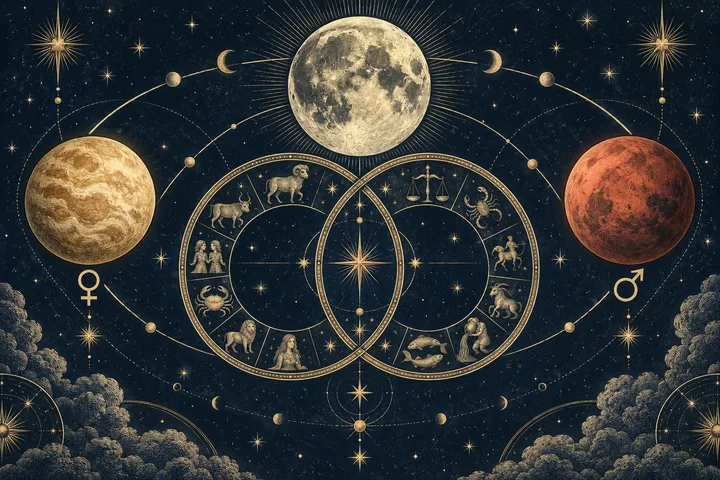
What the November 12 sky means for a love reading
A daily love horoscope is a description of the shared sky, not a report on how every couple will experience it. On November 12, the Moon’s changing contacts give the day a short emotional rhythm, while Venus and Mars describe a broader backdrop. Those layers can offer language for noticing affection, initiative and changing needs, but they cannot tell you what a partner feels or will choose. The date calendar supplies the UTC positions and event times; a separate midnight ephemeris confirms the slower sign and retrograde picture. Together they support a bounded reading of the day, rather than a personal forecast.
The useful distinction is between common symbolism and individual experience. Two people share the same transiting sky, yet their known placements and current circumstances differ. Treat the date’s themes as questions to bring into a conversation; reserve claims about personal timing for a comparison supported by the relevant chart information. This keeps the horoscope useful without turning a shared calendar into a verdict about a relationship.
On November 12, 2026, the tropical Moon sextiles Venus at 06:11 UTC and trines Mars at 08:34 UTC, then enters Capricorn at 20:27 UTC. At the 12:00 UTC reference point, the Moon is at 25°49 Sagittarius, retrograde Venus at 22°55 Libra, and Mars at 24°11 Leo; Venus and Mars are in a longer sextile pattern exact on November 10, not an exact event today. Read these as shared relationship symbolism: the Moon can frame immediate needs, Venus relating and values, and Mars initiative. They do not describe every couple identically. Compare each moving planet with each person’s known natal Moon, Venus and Mars separately. A close degree-based contact supports a more specific personal reading; a sign resemblance alone suggests a broad reflection. Use today’s pattern to ask what care, fairness or follow-through would feel mutual, not to predict a partner’s feelings or an outcome.
Sources: 12 November 2026 — name days, holidays and the day's sky; November 2026 daily ephemeris table
Which transits are actually active during the UTC day?
For November 12, use the tropical zodiac and keep the clock consistent: the daily calendar gives its planetary snapshot for 12:00 Universal Time (UTC), while its listed events have their own UTC times. At noon, the Moon is at 25°49 Sagittarius, Venus is retrograde at 22°55 Libra, and Mars is at 24°11 Leo. Those are positions at one reference moment, not labels to apply unchanged through every hour of the day. The calendar lists the Moon sextile Venus at 06:11 UTC and the Moon trine Mars at 08:34 UTC. It places the Moon's entry into Capricorn at 20:27 UTC. So the Moon moves through Sagittarius for most of this UTC date, then changes sign late in the day. A reader using another local clock may describe the same instant under a different calendar date; this guide follows UTC throughout. A second table helps check the broad picture. The November 2026 daily ephemeris table gives the Moon at 19°51 Sagittarius at 00:00 UTC on the 12th, with Venus retrograde in Libra and Mars in Leo. Its midnight sample is earlier than noon, so the Moon's different degree is expected; the useful cross-check is the signs and retrograde status, not a claim that both rows show the same instant. The table says its positions are calculated with Swiss Ephemeris using NASA JPL DE441 data. Astrodienst's Swiss Ephemeris Test Page independently describes Swiss Ephemeris as based on DE441 and identifies the page as a test interface for that calculation utility. These sources establish the stated calculation basis, while the date calendar supplies the noon positions and timed events used here. The event clock and the position snapshot answer different questions. The 06:11 and 08:34 times are listed as the peaks of the Moon's aspects to Venus and Mars; 20:27 marks the sign ingress. The date calendar also lists a Venus sextile Mars that began in orb on November 4, became exact on November 10 at 06:47 UTC, and remains in orb through November 20. That makes it a longer background pattern on November 12, not an exact aspect occurring that day. The calendar does not state the orb threshold behind its interval, so treat those dates as its own timing notation rather than a universal rule. This sequence gives the reader a reliable map before interpretation begins: two brief lunar peaks early in the UTC day, a Moon that changes sign at 20:27, and a Venus-Mars sextile whose exact moment has passed but whose listed period continues. Keep the noon degrees attached to noon, and the event times attached to their events. That simple distinction prevents a shared sky description from being mistaken for one unchanging, all-day configuration.
Sources: 12 November 2026 — name days, holidays and the day's sky; November 2026 daily ephemeris table; Swiss Ephemeris Test Page
What does the Sagittarius Moon change as the day unfolds?
The Sagittarius Moon gives November 12 a searching tone. In the tropical zodiac, it sextiles Venus at 06:11 UTC and trines Mars at 08:34 UTC, then enters Capricorn at 20:27 UTC. These shared events describe the day’s symbolic weather. A personal transit depends on whether the moving Moon contacts a point in someone’s natal chart. A harmonious aspect can suggest an opening; it cannot promise closeness.
Astrology.ac’s “Moon in Astrology: Meaning & Chart Role” describes the Moon through instinctive needs, emotional memory, attachment, and comfort. Its sign gives those needs a style, not a complete personality. Sagittarius can frame feelings through candor, meaning, movement, and room to explore. Ask: can we say what we need plainly, then give each other space to consider it? That is an interpretive prompt, not a character claim.
The date calendar lists the Moon sextile Venus at 06:11 UTC. Astrologically, a sextile can make exchange easier to use. With the Moon symbolizing immediate feeling and Venus affection, this brief contact can support a graceful opening: naming what felt kind or asking for reassurance. The Moon trine Mars follows at 08:34 UTC. Astrology.ac notes that Moon-Mars contacts can connect feeling with action; here, the trine suggests making care visible rather than leaving it implied.
These sky contacts are not automatically personal transits. Astrology University’s “What Do Transits Mean in Your Birth Chart?” defines a transit through an aspect between a moving planet and a natal planet or point. The natal chart supplies context, and supportive aspects still call for participation. To identify a personal Moon transit, compare its degree at the relevant time with a known natal Moon, Venus, or Mars degree, then state the aspect and orb convention. Without that comparison, the contacts remain shared sky patterns.
The timing keeps the lunar reading in proportion. The date calendar places both exact aspects in the early UTC morning and the Capricorn ingress at 20:27 UTC. The November 2026 daily ephemeris independently lists the Moon at 19°51 Sagittarius at 00:00 UTC, consistent with its later passage into Capricorn. This fast-moving layer should not be stretched unchanged across the whole day. Readers elsewhere can convert the times to local clocks; the article follows the UTC date.
At the Capricorn ingress, the emphasis shifts from seeking perspective toward follow-through. Sagittarius may ask for honesty and latitude; Capricorn can ask what care is workable and dependable. The signs need not compete. An open conversation can begin the process, and a practical agreement can sustain it. After naming a need, partners might ask what action would meet it. This contrast is not a forecast.
Imagine one partner wants to talk about feeling overlooked, while the other needs time to consider a response. As a hypothetical illustration, Moon-Venus symbolism can frame a warm invitation, and Moon-Mars can suggest a concrete gesture, such as setting aside time to listen. Later, Capricorn raises a question about reliable follow-through. No birth placements are assumed. A close contact to either person’s natal Moon, Venus, or Mars would add a personal timing layer; without degrees, this remains a shared prompt.
Use the sequence for a check-in, not a verdict. Ask what would make an honest exchange welcoming, how care can become visible in action, and what practical commitment would help it last. Compare the Moon separately with each partner’s known natal Moon, Venus, and Mars; contacts may differ. Astrology University advises identifying the exact natal aspect before interpreting a transit and using tighter timing for faster planets. The Moon suggests a timely conversation; the degree check shows whether it is personal.
Sources: 12 November 2026 — name days, holidays and the day's sky; November 2026 daily ephemeris table; Moon in Astrology: Meaning & Chart Role; What Do Transits Mean in Your Birth Chart?
How does retrograde Venus in Libra relate to natal Moon and Venus placements?
At 12:00 UTC on November 12, 2026, Venus is retrograde at 22°55 Libra. That position gives the day a longer relationship theme than the Moon’s brief morning contacts: consider how affection, pleasure, appreciation and values are being exchanged. In “Transits: Venus Retrograde,” Cafe Astrology describes this cycle as a time to reassess what and whom we value. Read that as an invitation to review, not as a forecast of a breakup, reunion or decision. Libra adds a question of balance: does each person feel heard, appreciated and met halfway? This is an astrological interpretation of the placement, not a claim that every couple will face the same situation.
A transit becomes personal through contact with a natal placement. “What Do Transits Mean in Your Birth Chart?” from Astrology University explains that astrologers read a moving planet in relation to natal planets and the wider birth chart. So compare transiting Venus with each person’s known natal Moon, Venus and Mars, one chart at a time. A close contact to natal Venus can bring that person’s values, preferences or way of relating into focus. A contact to the Moon joins the Venus themes of affection and appreciation with the Moon’s emotional needs. A contact to Mars asks how attraction or desire is expressed through action. These are symbolic possibilities to explore. They don’t establish what another person feels or what either partner will choose.
The natal placement and the transit also answer different questions. A natal Venus sign describes a continuing part of a person’s birth-chart pattern; transiting Venus describes a temporary sky movement that may contact that pattern. If someone knows only that their natal Venus is in Libra, they can use that shared sign symbolism to reflect on fairness, compromise or mutual regard. But the sign label alone can’t show whether today’s Venus is conjunct, square, opposite, trine or sextile that natal Venus. Those are degree-based relationships. To verify one, you need the natal degree, the transiting degree at the relevant time, and a stated orb convention. The date calendar lists Venus at 22°55 Libra at noon UTC; that is a reference snapshot, not a calculation of either partner’s chart.
The same distinction matters when comparing partners. One person may have a close Venus-to-Moon contact while the other has no close contact to the day’s Venus. That difference gives each person a distinct symbolic emphasis; it doesn’t mean one cares more, or that the couple is incompatible. Begin with the person whose natal point is actually contacted, then ask how the theme meets the relationship they share. Name the transiting planet, the natal planet and the aspect before interpreting it. That small sequence keeps the reading clear: first identify whose chart is involved, then describe the symbolism, then compare it with what both partners say they need. If more than one contact appears, don’t flatten them into a single couple-wide message; note which person and which natal function each one touches. If neither chart’s degrees are available, keep the reading at the broader sign level and don’t present it as a confirmed personal transit. The question to carry into the day is simple: where does affection feel mutual, and what would make that exchange fairer now? Retrograde Venus invites a second look at the answer, not a negative verdict about the bond.
Sources: 12 November 2026 — name days, holidays and the day's sky; Transits: Venus Retrograde; Venus: The Planet of Love and Money; What Do Transits Mean in Your Birth Chart?
What does Leo Mars add to the day's love reading?
At noon UTC on November 12, Mars stands at 24°11 Leo. Mars signifies action, desire and assertion; Leo gives that action an expressive, wholehearted style. This colors the day's love symbolism, but it doesn't tell you that a partner will make a grand gesture or feel a certain way. The useful question is simpler: how might care become visible through a chosen action?
Keep two Mars patterns separate. First, “12 November 2026 — name days, holidays and the day's sky” lists the Moon trine Mars, exact at 08:34 UTC. This is a transiting-to-transiting aspect. Because the Moon moves quickly, it describes a brief stretch, not a lasting relationship phase. A trine symbolically links feeling with initiative in a flowing way. Use it as a prompt: can an honest feeling find direct expression through asking, offering help or suggesting time together? That's reflection, not prediction.
The second pattern lasts longer. The date calendar lists Venus sextile Mars in orb from November 4 through November 20, exact on November 10 at 06:47 UTC. On the 12th, it is background, not an exact event. “Venus: The Planet of Love and Money” associates Venus with relating, affection and values; “Mars, God of War, in Astrology/Zodiac” connects Mars with action, desire and assertion. Reading their sextile as cooperation between affection and initiative is an astrological synthesis. It can raise a question about whether warmth meets action. It can't promise attraction, reconciliation or a partner's initiative.
A supportive aspect describes ease available in the symbolism. People still choose what to do, and their situation matters. Partners may feel affection but want different forms of care: one values a clear plan, while the other shows devotion by making room or sharing a task. Neither response proves more love. Ask what kind of action feels meaningful to each person, then listen.
For a personal transit reading, compare Mars at the relevant time and degree with each person's known natal Moon, Venus and Mars, one person at a time. A close contact to natal Venus brings desire and relating into focus; a Moon contact links action with emotional needs; a Mars contact highlights assertion or drive. “What Do Transits Mean in Your Birth Chart?” describes transits as moving planets contacting natal planets or points, interpreted in the chart's context. This method doesn't supply either partner's degree or calculate contacts from birth details.
Without natal degrees, keep the Venus-Mars sextile as shared sky symbolism; don't claim a partner's natal Mars is activated. The noon position alone can't verify a close personal aspect. If a contact is confirmed, name whose chart it touches and which natal planet is involved before comparing the pair. The two partners may experience different patterns: one person's Venus might receive a transit while the other's chart shows no close contact.
This distinction keeps a harmonious label from becoming a guarantee. The sky symbolizes feeling meeting initiative in the brief Moon-Mars trine, and relating meeting desire in the wider Venus-Mars pattern. A natal contact can make a theme more personal, but neither pattern settles what happens between you. Ask: is warmth becoming a freely chosen action, and does it feel welcome to both of us?
Sources: 12 November 2026 — name days, holidays and the day's sky; Mars, God of War, in Astrology/Zodiac; Venus: The Planet of Love and Money; What Do Transits Mean in Your Birth Chart?
How do you compare the same transit across two people's charts?
Compare each transit with each chart separately. A transit forms when a moving planet aspects a natal planet or point. “What Do Transits Mean in Your Birth Chart?” explains that the moving planet, natal point and aspect all shape the reading. For November 12, check the Moon, Venus and Mars against Person A's natal Moon, Venus and Mars, then repeat for Person B.
Use a worksheet with three rows for transiting Moon, Venus and Mars, and three columns for natal Moon, Venus and Mars. Make one grid for each person. In every cell, record the natal sign and degree if known, the transiting sign and degree at the relevant time, and the aspect only when the information establishes one. Add a short theme for confirmed contacts. Leave unsupported cells blank. An empty cell means no contact has been established from the supplied data, not that a hidden influence should be guessed.
For this date, “12 November 2026 — name days, holidays and the day's sky” lists the noon-UTC positions as Moon 25°49 Sagittarius, retrograde Venus 22°55 Libra and Mars 24°11 Leo. Use the Moon's position at the hour in question because it moves quickly; noon is a reference snapshot, not the whole day. For all three planets, a personal contact still requires comparing the moving degree with a natal degree.
Read each person's contacts before comparing the couple. If transiting Venus closely contacts Person A's natal Moon, the symbolic focus falls on A's emotional needs and relating themes. If no contact is established for Person B, don't assign B the same personal transit just because both share the date. The pattern could instead differ in another way: Mars might contact one person's natal Venus while leaving the other's listed placements untouched. These are method examples, not claims about actual charts; no natal degrees were supplied.
Then ask how the individual themes meet in the relationship. One person may be reflecting on affection while the other considers how to express desire or initiative. That difference can frame a useful conversation. It doesn't show who cares more or determine what happens next.
Keep transits distinct from natal synastry. “Aspects Between Charts” describes interchart aspects as contacts between two birth charts and notes that each person may take the role of the planet they contribute; sign and house context also matter. A transit to A's natal Moon is a moving-to-natal contact. A transit to B's natal Venus is another. Neither is automatically an aspect between A's and B's charts. You can read natal synastry separately and then consider today's timing beside it, without blending the methods.
State results with the person, transiting planet, natal point and aspect: “Venus closely contacts Person A's natal Moon,” if the degrees support that. Report Person B's result just as plainly, including when no close contact is found. Without degrees, keep the reading at sign symbolism rather than calling it a degree-confirmed transit.
Sources: What Do Transits Mean in Your Birth Chart?; Aspects Between Charts; 12 November 2026 — name days, holidays and the day's sky
When is a sign match enough, and when do degrees change the reading?
Use sign contacts to name a broad symbolic family. Use natal degrees and a stated orb when you want to describe a close, timed transit. Some traditional astrologers read planets in signs with an aspectual relationship as connected even when the degrees are far apart. The sign-based view offers a general reading; degrees show how closely planets meet and whether that pattern holds at their actual positions.
Take the November 12 sky as a practical example. At noon UTC, the date calendar places the Moon at 25°49 Sagittarius, Venus retrograde at 22°55 Libra, and Mars at 24°11 Leo. A natal Moon in Sagittarius shares a sign with the transiting Moon, but its degree is needed to tell whether they are near conjunction. The Moon moves quickly, so its noon position cannot describe every hour. The date calendar lists the Moon entering Capricorn at 20:27 UTC. Astrology University’s “What Do Transits Mean in Your Birth Chart?” describes a transit through the aspect between a moving planet and a natal point.
The difference between sign and degree methods has a real history. In “The Classical Origin and Traditional Use of Aspects,” Deborah Houlding explains that classical practice often treated planets in aspecting signs as connected regardless of their exact degrees. She also shows why astrologers refined that broad relationship by measuring degrees: two placements can share a sign-based trine pattern while their actual positions form a different, closer angle. Her example compares 28° Leo with 2° Sagittarius. By sign, they trine; measured by degree, they lie close to a square. The methods answer different questions: signs describe a broad link; degrees reveal the geometry between placements.
For this article’s personal timing, the useful rule is to name a degree-based contact only after comparing the transiting degree with the natal degree and stating the orb convention. Astrologers do not use one universal cutoff; Deborah Houlding’s history traces changing orb practices across periods and authors. Choose a convention before judging a contact and apply it consistently. Astrology University advises keeping faster-planet transits tighter. State that choice plainly before interpreting. A sign alone can support reflection, but it cannot verify a close timed contact. If birth time is unknown, a natal Moon near a sign boundary may need checking; without full chart data, house-specific claims are outside this reading.
Keep the report’s six-degree convention in its proper place. The Synastry Comparison Report uses supplied placements and optional degrees for selected major aspects between two natal charts. Nor does a missing close contact make the day’s symbolism useless. You can still use a declared sign-based method or reflect on the Sagittarius-to-Capricorn lunar shift, while keeping the conclusion broad. The precision choice is simple: signs can suggest the theme; verified degrees support the specific timing claim.
Sources: What Do Transits Mean in Your Birth Chart?; Swiss Ephemeris Test Page; Aspects Between Charts; 12 November 2026 — name days, holidays and the day's sky; The Classical Origin and Traditional Use of Aspects
What conversation can you have with this reading?
Choose one verified contact that best describes a live theme for either of you. If neither chart has degrees, use the day’s Moon sequence as a shared reflection prompt. Ask about care, fairness, or follow-through in your present experience. A transit offers a symbol for conversation; it cannot answer for your partner. Start with the planet involved. The Moon points toward an immediate emotional need, Venus toward what feels mutual and worthwhile, and Mars toward how desire becomes action. Try asking, “What kind of care or initiative would feel mutual to each of us today?” The Astrology University guide “What Do Transits Mean in Your Birth Chart?” describes transits through contacts with natal planets. For a degree-confirmed contact, name whose chart and placement it touches. Without degrees, call this a general reflection on the November 12 sky, not a specific personal transit. The Synastry Comparison Report lets you compare supplied Moon, Venus and Mars signs, with optional degrees. It doesn’t calculate natal placements from birth details or this date’s transits. Bring the known placements to the comparison, then bring one question to each other: what would care, fairness, or initiative look like today?
Sources: What Do Transits Mean in Your Birth Chart?; Transits: Venus Retrograde
Sources & further reading
- 12 November 2026 — name days, holidays and the day's sky
Provides the November 12 noon-UTC planetary positions and UTC times for the lunar aspects and Capricorn ingress.
- November 2026 daily ephemeris table
Cross-checks the November 12 midnight-UTC Moon position and the signs and retrograde status of the planets.
- Swiss Ephemeris Test Page
Describes Swiss Ephemeris as based on NASA JPL DE441 and identifies its test calculation interface.
- What Do Transits Mean in Your Birth Chart?
Explains transits as moving-planet contacts to natal planets or points, interpreted in natal chart context.
- Aspects Between Charts
Distinguishes contacts between two natal charts and discusses the roles and sign context of the planets.
- Transits: Venus Retrograde
Describes Venus retrograde as a period for reviewing values and discusses its contacts to natal planets.
- Moon in Astrology: Meaning & Chart Role
Provides interpretive meanings for the Moon and distinguishes Moon-Venus and Moon-Mars contact themes.
- Venus: The Planet of Love and Money
Provides astrological symbolism for Venus, including affection, relating, pleasure and values.
- Mars, God of War, in Astrology/Zodiac
Provides astrological symbolism for Mars, including action, desire and assertion.
- The Classical Origin and Traditional Use of Aspects
Describes traditional sign-based aspects and how degree-based reckoning refines or changes the relationship.
Synastry Comparison Report
Enter known placements for two people. Get an input-by-input comparison, selected aspect calculations and a clear record of what remains uncertain.
Compare our placements