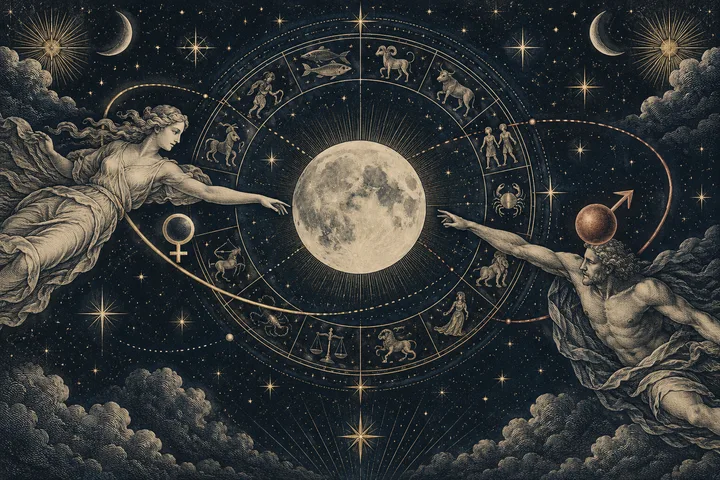
On November 3, the Moon moves from Leo into Virgo at 08:28 UTC, while retrograde Venus in Libra is close to a sextile with Jupiter in Leo. The sequence gives this love horoscope two shared themes: expressive warmth early in the UTC day, then more practical attention to care and details. Venus and Jupiter add a symbolic prompt to review what feels pleasurable and fair between you. Use your known Moon, Venus and Mars signs for broad reflection, not as proof of how a partner feels or what will happen. A personal transit comparison needs each relevant natal placement; to call an aspect exact or close, compare degrees and state the orb. The transits describe the shared sky, while your choices and conversation determine what the day means for your relationship.
What do the November 3 love transits suggest?
November 3 is not one uniform Moon-sign day. The Moon moves from Leo into Virgo at 08:28 UTC, while Venus retrograde in Libra sits close to a sextile with Jupiter in Leo. AstroAk’s November 2026 Ephemeris gives tropical, geocentric positions at 00:00 Universal Time and lists the Moon’s Virgo ingress at 08:28 UTC. That shift gives the day two distinct tones: early hours favor Leo’s warmth and open expression; later hours invite Virgo’s practical attention. The close Venus–Jupiter contact adds a prompt to revisit what feels fair, pleasurable and generous. These are shared-sky themes, not a verdict about a relationship. Astrology University’s “What Do Transits Mean in Your Birth Chart?” explains that transits gain personal meaning through their contacts with natal planets and chart factors. Known Moon, Venus and Mars signs can offer a broad first comparison, but exact personal contacts require natal degrees and a stated orb. Use the day’s symbolism as a question, then look to the charts and lived connection for context.
Sources: Ephemeris November 2026; What Do Transits Mean in Your Birth Chart?
What was in the sky on November 3, and when did it change?
Read November 3 in a clear frame: tropical zodiac, geocentric positions, and the UTC day. AstroAk's November 2026 Ephemeris gives the planetary positions at 00:00 UT, so its row is a midnight snapshot, not a description of every hour. At that reference, the Moon stands at 25°12′ Leo. The Sun is at 10°34′ Scorpio; Venus is retrograde at 25°18′ Libra; Mars is at 19°37′ Leo; Jupiter is at 24°33′ Leo; and Mercury is retrograde at 14°15′ Scorpio. Those degrees identify the listed positions. They do not, by themselves, tell us what a particular couple will experience.
The Moon changes signs during the date. AstroAk places its Virgo ingress at 08:28 UTC. By the requested noon reference, the Moon has already entered Virgo; the calendar's next midnight row shows 8°42′ Virgo at 00:00 UT on November 4. A second check, Daily Planetary Positions 3 November 2026 from Zodiac Astrology Horoscopes, shows the same passage: its rounded six-hour positions put the Moon near 0° Virgo at 06:00 UTC and 3° Virgo at noon. That page rounds to whole degrees, so use it to confirm the sign change, not to replace AstroAk's more precise ingress time. A horoscope that calls the Moon Leo all day would miss half the story. One that calls it Virgo from midnight would miss the opening hours.
An ephemeris records positions at stated times and within a stated reference frame. The Swiss Ephemeris documentation distinguishes geocentric positions from topocentric and heliocentric ones, while the JPL Horizons System manual explains how an ephemeris request depends on its selected center, time, and coordinate settings. These are practical choices: when readers compare two tables, they need to know whether they are looking at the same kind of position and the same moment. Here, the day uses the geocentric tropical frame specified above; the lunar sign change gets its own UTC time because a single noon snapshot cannot stand for the entire day.
Aspect geometry is another step. Using AstroAk's midnight longitudes, Venus at 25°18′ Libra and Jupiter at 24°33′ Leo are separated by about 60°45′, close to a sextile's 60°. That is a comparison derived from the listed positions, not a separate personal-chart result. In astrological interpretation, a Venus–Jupiter sextile can frame questions about affection, pleasure, generosity, and fairness. The positions establish where the planets are; the aspect names their angular relationship; interpretation gives that relationship meaning. Keeping those steps distinct lets you read the date with confidence and still reserve personal claims for a comparison with known natal placements.
Sources: Ephemeris November 2026; Daily Planetary Positions 3 November 2026; Swiss Ephemeris documentation; JPL Horizons System manual
How do today's transits meet your known natal placements?
A transit becomes personal when a moving planet forms an aspect to a point in a natal chart. So the useful question is not only “Where is the Moon today?” but “How does it relate to a planet in my chart?” Astrology University's “What Do Transits Mean in Your Birth Chart?” describes a transit through three parts: the moving planet, the natal factor it contacts, and the aspect between them. Houses and the wider natal chart add context. That gives us a clear distinction: a daily ephemeris describes the shared sky, while a transit-to-natal reading asks how that sky meets one person's chart. The second depends on the chart being compared. For November 3, AstroAk's “Ephemeris November 2026” lists the Moon at 25°12′ Leo at 00:00 UT, with Venus retrograde at 25°18′ Libra, Mars at 19°37′ Leo, and Jupiter at 24°33′ Leo. These are time-stamped positions in the tropical, geocentric frame used here. The Moon enters Virgo later that day, so its sign description changes with the UTC clock. None of these shared positions alone shows that a planet is contacting your natal Moon, Venus, or Mars. Even the close Venus–Jupiter sextile is a transit-to-transit relationship. It describes the angle between two moving planets; it becomes personal only if a moving planet also contacts a natal point. Start with the placements you know. Compare the transiting Moon with each person's natal Moon, Venus, and Mars. Then check whether transiting Venus or Mars makes a major aspect to one of those natal points. Signs offer a broad first layer: a shared sign, element, or mode can suggest related themes. But sign resemblance does not establish an aspect. A conjunction, square, trine, or sextile depends on the angular distance between two positions. You need degrees as well as signs. The ephemeris gives the moving planet's degree at a stated time; the natal chart gives the other. Without both, describe the sign-level symbolism and leave the aspect unclaimed. An orb is the allowed distance from an exact aspect. Name your orb convention before calling a contact active: a wider orb includes looser contacts, while a tighter one focuses on closer alignments. Astrology University notes that astrologers often use tighter orbs for faster-moving planets. That matters for the Moon, which moves quickly. Its Leo-to-Virgo ingress makes this comparison time-sensitive: a natal point may have a different sign relationship to the Moon before and after 08:28 UTC. Record the time you are comparing. Then you can read the day's changing shared atmosphere without presenting it as one exact personal contact. Keep the steps in order. Identify the moving planet and natal point, measure their angle, state the orb, then interpret the natal planet's sign and, where known, its house and other chart connections. Astrology University's method brings these factors together because an aspect alone doesn't tell the whole story. No individual birth charts, houses, or natal degrees are supplied here, so those details remain open. Known signs support a useful first comparison; degrees support a narrower claim about direct contact. Use signs to ask which themes may feel familiar, and degrees only when the positions justify that precision.
Sources: What Do Transits Mean in Your Birth Chart?; Ephemeris November 2026
Why does the Moon's sign change matter for a love reading?
The Moon’s sign changes the tone of this date because November 3 does not carry one lunar emphasis from midnight to midnight. AstroAk’s November 2026 ephemeris places the Moon at 25°12′ Leo at 00:00 UTC and records its move into Virgo at 08:28 UTC. A separate daily ephemeris, with rounded positions through the day, also shows the Moon moving from Leo into Virgo. So a 12:00 UTC snapshot belongs to Virgo, but that label does not describe the whole UTC day. The timing matters when you compare the day’s symbolism with a conversation, plan or known placement. In the first part of the day, read the Leo Moon as an invitation to make affection visible. Leo’s fixed fire carries warmth, play and the wish to be met with an open response. In a love reading, that can point toward saying what you appreciate, making room for shared enjoyment or offering a gesture with some heart behind it. The useful question is simple: have you let the other person know what you value about the connection? The Moon’s sign gives a symbolic lens for that choice. It doesn’t establish that anyone will feel confident, seek attention or respond in a particular way. After 08:28 UTC, Virgo brings a different emphasis. Its mutable earth symbolism turns attention toward details, timing and practical care. Appreciation can become easier to receive when it takes a form the other person can use: keeping an agreed time, remembering a preference, or helping with a small task. That doesn’t make Virgo more loving than Leo. The signs describe different modes of expression. Leo highlights the warmth of the offer; Virgo asks whether the offer attends to the real circumstances in front of you. The transition offers a sequence, not a script. You might express affection directly, then listen for what would make a shared plan work better. Or you may choose only one part of the sequence. Someone whose day is already full may welcome quiet, practical support more than a grand display; another person may need to hear the appreciation plainly before any offer of help feels meaningful. Those are differences in preference, not outcomes that the transit can decide. Let the response guide the next step. This is a shared-sky reading. The same Moon ingress applies to the UTC date; it doesn’t mark a synchronized emotional shift in every couple. A person’s natal Moon sign and degree, house placement and aspects add context to a personal lunar reading. The ephemerides verify the sign transition; the interpretation of Leo as expressive and Virgo as attentive is astrological synthesis. The ingress supplies timing, and its symbolism suggests choices to consider. If you’re comparing the day with a known natal placement, note which sign the transiting Moon occupies at the relevant time, then treat that correspondence as a prompt for reflection rather than a prediction. For November 3, make care both felt and useful, in whatever order suits the people involved.
Sources: Ephemeris November 2026; Daily Planetary Positions 3 November 2026
What does retrograde Venus in Libra add to the day's relationship symbolism?
Venus retrograde in Libra turns the day's relationship symbolism toward a review of how affection and fairness meet. In the November 2026 ephemeris, AstroAk lists Venus at 25°18′ Libra at 00:00 UT on November 3 and marks it retrograde. In astrological interpretation, Venus speaks to attraction, pleasure, taste and the ways we value one another; Libra brings those matters into the space of exchange, agreement and balance. Retrogradation makes the reading reflective. What feels beautiful or agreeable deserves a second look: does it still feel mutual, and does the arrangement leave room for both people’s preferences? It can apply to a shared routine, a social plan or the small choices through which a couple makes space for each other. The symbolism asks for attention to the terms of enjoyment, not suspicion about the relationship. The day's close Venus–Jupiter sextile adds warmth to that review. AstroAk's 00:00 UT positions place Venus at 25°18′ Libra and Jupiter at 24°33′ Leo. Their zodiacal longitudes differ by about 60°45′, roughly 45 arcminutes from an exact 60-degree sextile. AstroSofa's November 3 calendar also lists Venus sextile Jupiter, a useful cross-check on the aspect. The ephemeris supplies positions; the angular comparison is arithmetic from those positions, and the relationship meaning is astrological interpretation. A sextile is commonly read as an opening that can be used when the people involved respond to it. Here, Libra's concern with mutual regard meets Leo's generous, expressive style. That can suggest a day for appreciating what each person brings, making room for shared pleasure, or reopening a conversation about what feels equitable. It doesn't promise a reconciliation, a romantic gesture, or a financial gain. A favorable symbol is an invitation, not an outcome. Keep the shared transit separate from a personal contact. These positions describe the sky for the stated reference time; they don't show that either person's natal Venus is being contacted. If someone knows only that their Venus is in Libra, the sign offers a broad point of reflection. It doesn't establish a conjunction with transiting Venus. AstroAk's listed degree gives a more exact comparison point: a natal Venus near 25°18′ Libra may be close to the transit, but calling that a conjunction requires the natal degree and a declared orb. The same rule applies to Jupiter's side of the sextile. Without those details, don't turn a sign match into a claim about a particular couple. Compare the symbolism with what both people actually value and say. A useful question for November 3 is simple: what do we enjoy together, and what would make that exchange feel fair to both of us?
Sources: Ephemeris November 2026; 3 Nov 2026 - Astrology Calendar
How do Mars and Jupiter in Leo color the day's shared tone?
Mars and Jupiter are both in Leo at 00:00 UTC on November 3, but their shared sign tells us more securely than their closeness does. AstroAk’s November 2026 Ephemeris lists Mars at 19°37′ Leo and Jupiter at 24°33′ Leo, a separation of 4°56′. Whether to call it a conjunction depends on the orb chosen and interpretive convention behind it. A sign describes the broad territory two planets occupy; an aspect describes their angular relationship. Leo gives both planets a common style in this reading: expressive, wholehearted, proud of what it values, and drawn to visible gestures. Mars speaks to initiative and pursuit. Jupiter enlarges and encourages. By sign, they suggest a day when affection may be shown boldly: making the invitation, saying the praise out loud, or proposing something worth looking forward to. But boldness is a tone, not proof of compatibility. Astrology University’s “What Do Transits Mean in Your Birth Chart?” explains that a transit becomes personal through its contact with a natal planet or chart point, and interpretation depends on natal context. Here, Mars and Jupiter describe the shared sky. Without either person’s natal degrees, we can’t say that this pair activates their Moon, Venus, or Mars, or forms a particular contact to either chart. If you know only your signs, take the Leo emphasis as a theme to consider, not a personal forecast. There’s a reason not to let the showier half of the day carry the whole reading. The Moon enters Virgo at 08:28 UTC, according to AstroAk. In this symbolic sequence, expressive Leo energy sits beside a later invitation to notice details and offer useful care. A declaration can be lovely; remembering the practical thing your partner asked for may make it felt. This is an interpretive bridge between the day’s placements, not a claim that every couple will experience a mood change at the ingress. Read Mars and Jupiter in Leo as encouragement to lead with warmth and enthusiasm, then let the other person’s response guide what comes next. Ask what they’d enjoy. Listen to the answer. Follow through in a way that suits both of you. Leo’s generous display gets room to breathe, while Virgo’s later precision keeps attention on the person receiving it. The chart offers a symbolic prompt; it doesn’t tell you how someone feels or promise that a grand gesture will land well. The shortcut is to see two planets in Leo, notice they sit fewer than five degrees apart, and announce a conjunction with a fixed meaning. A closer reading names its orb rule, then checks whether relevant natal placements are contacted. For this shared horoscope, the broader claim is enough: Mars and Jupiter share Leo, and the Moon moves into Virgo later that morning. Pair expressive initiative with attentive follow-through.
Sources: Ephemeris November 2026; What Do Transits Mean in Your Birth Chart?
What changes when you compare signs with exact degrees?
Sign comparison gives you the broad shape of a transit. Degree comparison tests whether that planet reaches a particular point in a natal chart. Knowing your natal Venus is in Libra lets you consider Libra themes such as balance and shared taste as transiting Venus moves through that sign. It doesn't establish a conjunction. For that claim, you need both positions in degrees and a stated orb, the allowed distance from exactness. Without those inputs, keep the reading at sign level.
The November 3 ephemeris gives a useful, date-specific example. AstroAk's November 2026 table lists transiting Venus at 25°18′ Libra at 00:00 UTC, retrograde. That is a position in the shared sky. Imagine a reader who knows only that their natal Venus is in Libra. They can compare the sign symbolism and consider whether questions of fairness, affection or pleasure feel relevant, but they cannot tell from the sign alone whether Venus is close to their natal Venus by degree. A natal Venus at 25° Libra would be near the listed transit; one elsewhere in Libra could be much farther away. No personal placement should be assumed from the example.
An aspect is an angular relationship between two chart positions. A conjunction brings them close by longitude; a sextile describes a separation near 60 degrees. Sign names suggest the relationship between placements, but degrees establish their actual separation. Compare the shortest angular distance with the exact angle and chosen orb. A label such as “conjunct” should follow that check. State the orb: tighter allowances identify closer contacts.
This also separates a transit-to-transit aspect from a transit-to-natal contact. The November 3 table places Venus near 25° Libra and Jupiter near 24° Leo. Their close sextile describes two moving planets in the day's sky; it doesn't show either contacting a reader's natal Venus, Moon or Mars. Astrology University's “What Do Transits Mean?” describes transits as moving planets interacting with natal chart factors. That comparison requires the natal factor's position. Ask first what the shared sky is doing, then whether its moving planets contact either person's chart by degree.
The Moon makes the same point across time. AstroAk lists it at 25°12′ Leo at 00:00 UTC, then gives its Virgo ingress at 08:28 UTC. The sign-level reading shifts after that boundary. To say the Moon forms a specific aspect to a natal placement, you need its degree and a reference time. The changing Moon doesn't supply missing natal data.
Use the comparison your information supports. Known signs are enough for a reflective overview; exact degrees let you test a contact under a declared orb. Natal context shapes an aspect’s meaning. The Synastry Comparison Report compares supplied Moon, Venus and Mars signs, with optional degrees and selected major aspects using its stated six-degree orb. It doesn't calculate natal positions from birth details. Without degrees, keep the reading broad; with them, name the orb before interpreting the contact.
Sources: Ephemeris November 2026; What Do Transits Mean in Your Birth Chart?
What is the strongest limit on this day's reading?
The strongest limit is simple: November 3's sky is shared, but the way it meets a natal chart is personal. A general horoscope can describe the day's changing symbolism. It cannot show, by itself, whether either partner has a close contact to the transiting Moon, Venus, Mars or Jupiter. That distinction keeps a useful reading from becoming a claim about the couple. The ephemeris gives a time-specific sky, not two natal charts. AstroAk's November 2026 ephemeris places the Moon in Leo at 00:00 UTC and records its Virgo ingress at 08:28 UTC; it also lists Venus retrograde in Libra and Mars and Jupiter in Leo. Those positions support a shared reading of expression, review and practical attention as the day unfolds. They don't identify which person, if either, feels a transit as especially personal. A transit-to-natal comparison needs a moving planet's position set against an actual natal placement. As the Astrology University article “What Do Transits Mean?” explains, interpretation also draws on the natal chart's other factors and the way the transit fits its wider pattern. That missing context can change the emphasis. A Virgo Moon transit might be read through practical care at the sign level, yet a person's natal Moon, its degree and its chart context shape how that symbolism belongs in their own reading. The same is true of the Venus-Jupiter contact: the day's aspect is part of the shared sky, but it is not proof that either person's Venus receives that contact. If one partner knows only a sign, the comparison can stay at the level of themes. If both know degrees, an astrologer can check the angular distance and state the orb used before calling a contact close. No degrees or complete natal charts are supplied here, so naming a personal conjunction, square, trine or sextile would go beyond the evidence. Even a close contact would sharpen an interpretation, not settle what two people should do. The daily symbolism can suggest a conversation about appreciation, fairness or helpful gestures. Each person's words, choices and circumstances still give that conversation its meaning. A chart factor may draw attention to a theme; it doesn't speak for someone or establish a relationship outcome. So read this date as a shared invitation: lead with warmth, revisit what feels reciprocal, and let care become concrete. Treat it as a personal transit only when the relevant natal placements and degrees are known and compared. That is the line between a useful daily reflection and a couple-specific chart reading.
Sources: What Do Transits Mean in Your Birth Chart?; Ephemeris November 2026
What can you do with the reading today?
Put the symbolism to work in a mutual conversation. Name one thing you enjoy sharing, then ask what would make that exchange feel fair and helpful to both of you. The first part gives the day's expressive Leo emphasis a place to land; the second brings in Venus retrograde in Libra's invitation to review balance and pleasure. AstroAk's November 2026 Ephemeris places Venus at 25°18′ Libra and Jupiter at 24°33′ Leo at 00:00 UT on November 3, a close sextile by longitude. In astrological interpretation, that pairing can frame a generous question: how can you make room for enjoyment without assuming you both value the same thing? Let the answer come from the conversation. If you know both charts' Moon, Venus and Mars signs, compare the themes as prompts, not conclusions. The Moon can suggest emotional rhythms, Venus affection and shared values, and Mars initiative and desire. Then notice whether the actual exchange fits. Astrology University's “What Do Transits Mean in Your Birth Chart?” explains that a transit becomes personal through its aspect to a natal point and the wider chart context. A sign resemblance alone doesn't establish that November 3's transiting Venus contacts either person's Venus. Degrees show the angle, and an orb must be chosen before calling the contact active. Keep the action simple: offer appreciation, ask what would feel reciprocal, and listen. If you want a placement comparison, the Synastry Comparison Report uses Moon, Venus and Mars placements you supply, with optional degrees. It doesn't calculate natal charts from birth details. Compare your placements, then bring the reading back to what you each choose to share.
Sources: What Do Transits Mean in Your Birth Chart?; Ephemeris November 2026
A little more clarity
What sign is the Moon in on November 3, 2026?
The Moon is in Leo early in the UTC day and enters Virgo at 08:28 UTC. A noon snapshot falls in Virgo, but that sign does not describe the whole day.
Does Venus sextile Jupiter mean a romantic event will happen?
No. The close sextile is a shared transit and an astrological prompt about pleasure, generosity and fairness. It does not promise a particular event or relationship outcome.
Can I compare these transits with my placements if I know only the signs?
Yes, for a broad thematic comparison. To identify a personal aspect such as a conjunction or sextile, you need the relevant natal degrees and a stated orb.
Sources & further reading
- Ephemeris November 2026
Supports the November 3 tropical geocentric positions, the Moon's 08:28 UTC Virgo ingress, and the listed Venus, Mars, Jupiter and Mercury placements.
- 3 Nov 2026 - Astrology Calendar
Cross-checks the listed November 3 Moon sign change and Venus-Jupiter aspect; its unresolved timezone is not used for event times.
- Daily Planetary Positions 3 November 2026
Independently shows the Moon changing from Leo to Virgo in rounded positions through November 3.
- Swiss Ephemeris documentation
Documents the available position frameworks, including geocentric, heliocentric and topocentric calculations.
- JPL Horizons System manual
Explains how ephemeris outputs depend on the selected coordinate center, time and coordinate settings.
- What Do Transits Mean in Your Birth Chart?
Explains transit-to-natal interpretation and the role of natal planets, houses and wider chart context.
Synastry Comparison Report
Enter known placements for two people. Get an input-by-input comparison, selected aspect calculations and a clear record of what remains uncertain.
Compare our placements