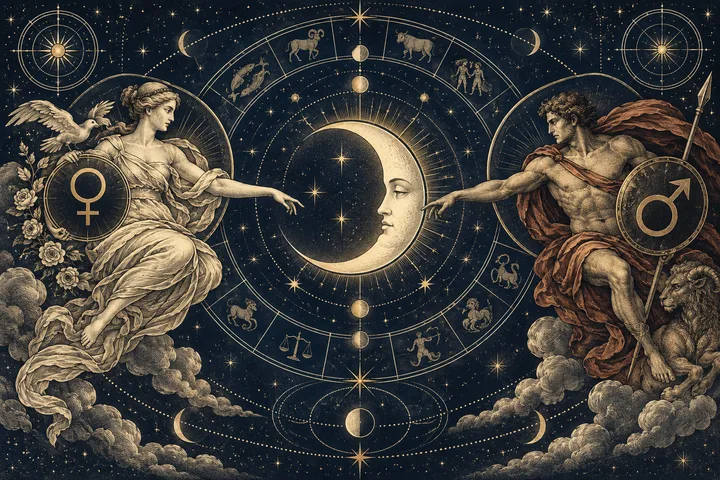
What is November 1's love-transit answer in brief?
On November 1, 2026, the tropical sky carries a clear change of tone. The Moon begins the UTC day at 27°28′ Cancer and enters Leo at 04:18 UTC. By noon the Moon is in Leo. At 00:00 UTC, AstroAk places the Sun at 8°34′ Scorpio, Venus retrograde at 26°14′ Libra, and Mars at 18°37′ Leo. AstroAk’s ephemeris gives the midnight planetary positions; the November 2026 Sky Calendar gives the ingress time and confirms the later lunar phase. Together, they describe the sky for everyone, not a private forecast calculated from a birth chart. Astrologically, the sequence suggests a movement from emotional ease and reassurance toward warmer, more visible expression. Cancer’s lunar symbolism turns attention to care, safety and what helps people feel at home with each other. After the Moon enters Leo, affection can be considered through generosity, play, appreciation and the wish to be seen. Venus retrograde in Libra adds a review of balance: what feels fair, what each person values, and whether affection is being exchanged in a way both can recognize. These are interpretive themes, not promises about what either person will do. Keep shared sky and personal contact distinct. A sign can suggest the kind of conversation a placement invites, but signs alone don’t show whether a moving planet makes a close aspect to your natal Moon, Venus or Mars. That requires degrees and a stated orb. If you know only that your Venus is in Libra, Libra’s themes of reciprocity and preference may offer a useful lens; the sign label by itself doesn’t establish a precise Venus-to-Venus transit. A close contact, when checked, gives the reading a more specific chart basis. Without degrees, keep the interpretation broad. Start with the UTC hour that matters, since the Moon is in Cancer only during the opening hours and in Leo for most of the date. Then choose the known placement that best fits your question. Are you looking for emotional reassurance, a clearer sense of what you value, or a more direct way to express desire? Let the symbolism help you name that concern. Use it to open a conversation about care, appreciation or fairness, not to decide in advance what your partner feels. November 1’s reading is vivid but bounded: the sky offers a shared theme, while a verified degree contact lets you relate it more closely to a known chart.
Sources: November 2026 Ephemeris: Daily Planet Positions · AstroAk; November 2026 Sky Calendar
What is actually in the sky on November 1 UTC?
This reading uses the tropical zodiac and the UTC civil day of November 1, 2026. At 00:00 UTC, AstroAk’s November 2026 ephemeris lists the Sun at 8°34′ Scorpio, the Moon at 27°28′ Cancer, Mercury at 16°39′ Scorpio retrograde, Venus at 26°14′ Libra retrograde, and Mars at 18°37′ Leo. AstroAk states that its positions are geocentric and tropical, and its table gives degrees and minutes. Treat these as the midnight reference positions, not as a snapshot that holds through the full day or either reader’s birth chart. The slow-moving placements can be anchored to midnight; the Moon needs its own intraday timestamps because it crosses a sign boundary before noon. The Moon moves quickly enough that one midnight snapshot can't stand for the whole day. The midnight table places the Moon at 27°28′ Cancer; the UTC Sky Calendar gives its sign ingress at 04:18. By noon it is in Leo, but the midnight table should not be read as an intraday degree table. So the Cancer placement belongs to the opening hours; by midday, the Moon is well into Leo. The Last Quarter occurs at 20:29 UTC in Leo. That phase marks the date without adding a sign change. | UTC reference | What the calendar shows | | --- | --- | | 00:00 | Sun 8°34′ Scorpio; Moon 27°28′ Cancer; Venus 26°14′ Libra retrograde; Mars 18°37′ Leo | | 04:18 | Moon enters Leo | | 12:00 | Moon in Leo | | 20:29 | Last Quarter in Leo | The November 2026 Astrology Calendar: Aspects & Moon Phases is a secondary monthly comparison and is not the reference for exact 00:00 UTC degrees in this reading. The date-specific midnight values above come from AstroAk’s explicitly timed table; the Moon’s ingress time comes from the UTC Sky Calendar. Keeping those distinct avoids treating a monthly display or a different reference time as a precise UTC position. The November 2026 Sky Calendar places Venus's direct station on November 14 at 00:21 UTC, confirming it remains retrograde on November 1. The shared pattern is clear: Venus in Libra retrograde, Mars in Leo, and a Moon that shifts from Cancer to Leo. Match the Moon's sign to the hour you mean, then compare these moving positions with known natal placements separately. The sky table sets the date; it doesn't establish a personal contact.
Sources: November 2026 Ephemeris: Daily Planet Positions · AstroAk; November 2026 Sky Calendar; November 2026 Astrology Calendar: Aspects & Moon Phases
Why does the Moon's Cancer-to-Leo shift matter for the day's tone?
In a traditional symbolic reading, the Cancer Moon foregrounds comfort, protection and emotional attunement. After its ingress, the Leo Moon favors warmth, play, generosity and visible affection. The Moon enters Leo at 04:18 UTC on November 1, according to the November 2026 Sky Calendar, so Leo governs most of this UTC date. Early-hour moments still belong to Cancer. That timing gives the day a change of tone, not a sudden change in anyone’s feelings or relationship.
Think of the shift as a movement from private reassurance toward expressed affection. Cancer symbolism asks what helps you feel safe enough to open up: a familiar ritual, a gentle check-in, room to settle. Leo symbolism asks how care can be made visible: a sincere compliment, shared laughter, an invitation to enjoy one another’s company. These are interpretive prompts, not instructions for how either person must act. A person may want quiet closeness under a Leo Moon, or direct praise while the Moon is in Cancer. The signs offer a language for reflection; the conversation tells you what matters to the people involved.
That distinction matters because a daily horoscope that names only Leo can flatten the day. Someone reading in the first hours of November 1 UTC would miss the Cancer phase if the forecast treated Leo as present from midnight. Conversely, a reader focused on afternoon or evening would miss most of the date by carrying Cancer’s tone forward after the ingress. The November 2026 Sky Calendar gives the UTC boundary explicitly and notes that a local civil date may differ because the Moon moves quickly. So anchor the interpretation to the hour you mean. A local calendar may show a different clock time or even a neighboring date without describing a different sky.
The day’s lunar sequence also has a natural limit. The Moon moves through signs quickly, so its symbolism describes a brief emotional rhythm rather than a fixed relationship pattern. Transits to the natal chart: how to read them describes Moon transits as short-lived emotional weather, a passing layer that rarely decides matters on its own. That makes the Cancer-to-Leo progression useful for choosing a question, not forecasting an outcome. Are you asking for reassurance, or would a more open display of affection feel welcome now? The answer need not match the symbolism neatly.
Astrosofa’s 1 Nov 2026 Astrology Calendar also places the Moon in Cancer before it moves into Leo, and lists lunar aspects during the date. Its page displays a timezone control but does not make the selected zone clear in the opened view, so its clock labels should not be treated as UTC. The UTC calendar is the firmer guide to when the sign boundary falls. The sequence itself is the useful comparison: Cancer’s inward care gives way to Leo’s more demonstrative style. Notice which kind of care fits the moment, and ask rather than assume.
Sources: November 2026 Sky Calendar; Transits to the natal chart: how to read them
What does retrograde Venus in Libra add to the reading?
Venus retrograde in Libra gives November 1 a review-and-rebalance theme. Ask how attention, compromise, pleasure and fairness are being shared. AstroAk’s November ephemeris places Venus at 26°14′ Libra at 00:00 UTC and marks it retrograde. The November 2026 Sky Calendar independently lists Venus stationing direct on November 14 at 00:21 UTC. The review is still underway on this date. These are sky positions and timing, not instructions for what a couple must experience.
In astrological interpretation, Venus speaks to affection, attraction, pleasure and the values that shape relating. Libra brings those matters into the space between people: how they listen, negotiate, make room for one another and restore balance after a difference. With Venus retrograde, the emphasis turns toward reconsidering those habits. A preference that once felt settled may need to be named again. An old compromise may deserve a second look. This is a symbolic reading, not a claim that the ephemeris proves a conversation or event.
The useful question is not “Will an ex return?” It is “What are we learning about what feels fair and welcome?” The first asks the sky to promise an outcome; the second gives two people something observable to discuss. Each person might name one gesture that helps them feel appreciated, then compare whether the effort feels mutual. Neither answer has to match. The point is to make preferences clear enough to respond to them.
This approach fits an astrological reading of retrograde motion as a time for a planet’s themes to receive another look. The November calendar describes Venus retrograde as drawing attention back to prior relationships, purchases or tastes. A weekly forecast for October 26 through November 1 likewise says the review continues, while noting that Venus is in Libra. These are astrologers’ interpretations, not dated promises. They support reflection, but do not establish that a past partner will reappear or that a current bond is in trouble.
There is a sharper version: Venus retrograde means relationships break, or the past returns. It gives a definite answer, but the date-specific sources do not support that certainty. The November calendar records Venus’s sign and station; it does not report relationship outcomes. The weekly forecast offers sign-based interpretations and distinguishes its general framework from examining an individual natal chart. Review might mean a calm renegotiation, renewed appreciation, or clearer knowledge of what matters. It need not mean separation or reunion.
For November 1, keep the lens practical. Where does generosity feel easy, and where does compromise feel one-sided? Which preference has gone unspoken? These questions make Libra’s balance theme concrete without assuming anyone’s intention. They work whether or not Venus makes a close aspect to either person’s natal placements. A sign match can suggest a topic; degrees are needed to test a specific contact.
On November 1, 2026, the Moon moves from Cancer into Leo at 04:18 UTC, so the lunar tone depends on the hour you mean. At 00:00 UTC, Venus is retrograde at 26°14′ Libra and Mars is at 18°37′ Leo. In astrological interpretation, these placements can frame reflection on reassurance, visible affection, fairness and initiative; they do not establish what a partner feels or will do. To connect the shared sky to a known natal Moon, Venus or Mars, compare the actual degrees, identify the aspect and state the orb. A sign match alone cannot show whether a contact is close. Use the symbolism as a prompt for a specific conversation, not a verdict. The Synastry Comparison Report compares placements you supply, with optional degrees; it does not calculate natal positions from birth details.
Sources: November 2026 Ephemeris: Daily Planet Positions · AstroAk; November 2026 Sky Calendar; Weekly Horoscope: October 26 – November 1, 2026, All 12 Signs
When does shared sky weather become a personal transit?
Shared sky weather becomes a personal transit when a moving planet forms a recognizable angle to a planet in your natal chart. The moving body is the transiting planet; the natal planet is the target. For this November 1 reading, the relevant targets are the Moon, Venus and Mars you already know from your chart. Cafe Astrology’s transit guide describes comparing current positions with natal planets or chart angles. The Transits to the Natal Chart guide at Le Grand Grimoire also defines transits through moving planets and fixed natal positions. First identify the angle, then measure how close the positions are by degree.
The major aspects are geometric relationships around the zodiac. A conjunction is about 0° apart, a sextile 60°, a square 90°, a trine 120°, and an opposition 180°. These angles describe geometry; interpretation depends on planets, signs and chart context.
Aspect | Approximate angle Conjunction | 0° Sextile | 60° Square | 90° Trine | 120° Opposition | 180°
An orb is the distance from an exact aspect that an astrologer still treats as active. If two planets are 88° apart, for example, they are 2° from an exact square. Orbs vary by astrologer, aspect and planets involved. Neither Cafe Astrology nor the Le Grand Grimoire guide makes one orb a universal rule. This article uses a working convention: prioritize major aspects within a six-degree orb and show the measured distance. It is a clear house rule for this reading, not a decree for every tradition.
A sign match alone doesn't establish contact. If the transiting Moon and a natal planet are both in Leo, they share a symbolic field, but could sit far apart within the sign. Compare degrees to test a conjunction; compare angular separation with 90° to test a square. Signs that traditionally form a trine or square suggest an aspect family, while degrees show whether the contact falls within the stated orb. The day’s Leo Moon or Mars describes general weather; personal transit language needs this comparison.
Applying and separating describe whether two planets are moving toward or away from exactitude. They require precise positions and the transiting body's direction and speed. Rounded degrees may not settle a close call. With only a natal sign, you can explore broad symbolism, but can't reliably measure distance, judge whether an aspect is applying, or rank close contacts. Compare degrees before treating a sign-based story as personal.
Birth information can affect the natal target. If a person's Moon lies near a sign boundary, an uncertain birth time may leave its sign or degree unresolved. Don't force a precise contact from an uncertain placement; keep the reading broad or confirm the supplied position first. The Synastry Comparison Report works from placements and optional degrees readers provide. It doesn't calculate natal positions from birth details. Signs offer a broad symbolic conversation; a measured aspect supports more tailored transit language.
Sources: Transits in Astrology: Predictions; Transits to the natal chart: how to read them
Which natal placement should you compare first: Moon, Venus or Mars?
Start with the placement that matches your question. A moving planet describes the current emphasis; the natal planet shows which part of your chart receives it. “Transits to the Natal Chart: How to Read Them” describes this as comparing current positions with fixed birth-chart positions. For a love reading, that gives you three lenses: the Moon for emotional rhythm, Venus for affection and preference, and Mars for desire, initiative and friction. Choose one first. Begin with your natal Moon if you’re asking, “What helps me feel emotionally met today?” The transit Moon moves quickly, so astrologers often read its contact as a brief mood or response pattern. Le Grand Grimoire’s transit guide calls lunar transits short-lived emotional weather that rarely decides a matter alone. On November 1, the Moon moves from Cancer into Leo during the UTC day. As astrological interpretation, the earlier Cancer hours can invite attention to comfort and reassurance; later Leo hours can bring warmth and visible expression forward. These are broad sign themes. The Moon in Leo doesn’t show by itself that it contacts your natal Moon. For questions about affection, look at natal Venus. In traditional symbolism, Venus describes attraction, pleasure, values and welcome forms of care. At 00:00 UTC, transiting Venus is at 26°14′ Libra and retrograde. If you know only that your Venus is in Libra, use the shared sign as a broad prompt about fairness, compromise or preferences under review. But the sign label alone doesn’t establish a close aspect. You need degrees to measure the angular relationship. Café Astrology’s transit guide also describes a transit as a moving planet making a relationship to a point in an individual natal chart. Choose Mars for questions about action, desire or impatience. Mars is at 18°37′ Leo at 00:00 UTC that day. At the sign level, confident pursuit, playful courage or wanting to be seen can be useful themes to reflect on. “Mars in Leo” doesn’t mean a transit to every natal Mars in Leo. Same sign is a starting comparison, not proof of a close conjunction. Check degrees and state the orb before calling it a contact. Imagine you know your natal Venus is in Libra, but not its degree. You can use the day’s Venus-in-Libra symbolism to reflect on mutuality and taste. You can’t say transiting Venus is exactly conjunct your natal Venus or tell how close the positions are. If you later find the degree, compare the positions and measure their angular distance. That makes the interpretation more specific. Keep the placements distinct. The Moon asks what feels tender or immediate. Venus asks what feels valued and reciprocal. Mars asks what you want to pursue and how you act on that desire. Transit guides compare moving planets with natal targets; the November 1 ephemeris supplies the moving positions at its stated reference time. Match the placement to your question, note the transit’s sign, then check degrees before making a personal-contact claim.
Sources: November 2026 Ephemeris: Daily Planet Positions · AstroAk; Transits in Astrology: Predictions; Transits to the natal chart: how to read them
What does a sign-only reading tell you, and what does it leave open?
A sign-only reading can give you a useful theme for the day. It can’t tell you that a transit is making a close contact to your natal Moon, Venus or Mars. Those are different kinds of statements. The first describes broad symbolic weather; the second depends on comparing moving and natal positions, including their degrees. A clear example is the weekly forecast “Weekly Horoscope: October 26 – November 1, 2026, All 12 Signs.” It says its interpretations are prepared according to the reader’s Sun sign using the solar whole sign system, then distinguishes that general framework from a more personal analysis of the natal chart. That boundary helps you read the forecast on its own terms. Its sign sections offer a way to consider the week through a solar chart; they don’t claim to have compared your natal Moon, Venus or Mars with each moving planet. For November 1, that difference matters because the shared sky changes during the UTC day. AstroAk’s November 2026 ephemeris lists the Moon at 27°28′ Cancer at 00:00 UTC; the UTC Sky Calendar places its ingress into Leo at 04:18. The midnight table gives Venus at 26°14′ Libra and Mars at 18°37′ Leo. Those are date-specific positions. They tell you what is moving through the sky, not which of your natal placements receives a close contact. A sign can still be meaningful without that extra comparison. If a general reading gives you a language for affection, reassurance or fairness, you can use the theme to notice what feels important and choose a conversation. The limit is narrower: a shared sign label doesn’t establish the exact angle between two planets, and it doesn’t show how close a contact is. For that, you need the relevant natal degree and a stated orb, the allowed distance from an exact aspect. A sign-only comparison leaves those details open. It also leaves the exact house context unresolved when the reading has not examined the individual natal chart. So keep the two layers together without blending them. Start with the verified daily positions for the hour you care about. Then ask whether you know a natal Moon, Venus or Mars placement that fits the question. If you know only its sign, stay with a broad symbolic reading. If you also know its degree, compare the angular distance before calling the transit close or exact. This gives a general horoscope room to guide reflection while keeping a personal transit claim tied to the information that can support it.
Sources: November 2026 Ephemeris: Daily Planet Positions · AstroAk; November 2026 Sky Calendar; Weekly Horoscope: October 26 – November 1, 2026, All 12 Signs
How can you turn the November 1 reading into a useful conversation?
Use the chart symbolism to frame a question, then let the answer come from the people involved. On November 1, the Moon’s Cancer-to-Leo shift makes the UTC time part of the reading. Ask whether the moment calls for comfort and reassurance, or for open warmth and appreciation. It offers language, not certainty about what your partner feels or will choose. Next, choose the natal placement that fits the concern. The Moon can help you reflect on emotional needs; Venus can frame affection and shared preferences; Mars can bring attention to initiative or desire. Cafe Astrology’s “Transits in Astrology: Predictions” describes a transit as a moving planet forming a relationship to a natal planet or point. “Transits to the natal chart: how to read them” likewise centers the comparison on the angle between the moving planet and its natal target. So before calling November 1 a personal transit, compare degrees and state the orb you’re using. A shared sign can suggest a theme, but it doesn’t establish a close contact by itself. Imagine a couple knows one person has natal Venus in Libra, but they don’t have its degree. They might use the day’s Venus-in-Libra symbolism to ask what feels fair or pleasurable to each of them. They shouldn’t call it an exact Venus transit. If the degree is available, they can check whether a recognized aspect is close, then use that symbolism as a prompt, not a verdict. Keep the conversation observable: “What helps you feel appreciated?” or “What would make this feel more mutual?” The Synastry Comparison Report can compare supplied Moon, Venus and Mars placements, with optional degrees. It doesn’t turn birth details into natal positions. Bring the placements you already know, and let the conversation tell you what matters now.
Sources: November 2026 Sky Calendar; Transits in Astrology: Predictions; Transits to the natal chart: how to read them
What should you compare next?
For November 1, start with the hour you mean. The Moon begins the UTC day at 27°28′ Cancer, enters Leo at 04:18 UTC, and reaches its Last Quarter at 20:29 UTC, according to the Witchcraft Daily Sky Calendar. AstroAk’s 00:00 UTC ephemeris places Venus at 26°14′ Libra retrograde and Mars at 18°37′ Leo. These positions describe the shared sky; they don’t tell you what either person will do. Choose one natal placement that fits your question. For emotional ease, begin with the Moon. For affection and preference, look to Venus; for initiative or desire, consider Mars. A matching sign offers a broad theme. To call it a personal transit, compare degrees, name the aspect, and state your orb. For exact contact judgments, compare the transit and natal degrees at a matching time. Then use the symbolism in a real conversation: what kind of reassurance or appreciation feels welcome today? A different UTC hour, exact natal degrees, or a Moon placement uncertain near a sign boundary could change the reading. The Synastry Comparison Report compares placements you supply, with optional degrees; it doesn’t calculate natal charts from birth details. Compare your placements when you’re ready.
Sources: November 2026 Ephemeris: Daily Planet Positions · AstroAk; November 2026 Sky Calendar
A little more clarity
What time does the Moon enter Leo on November 1, 2026?
The Moon enters Leo at 04:18 UTC. It begins the UTC day in Cancer.
Is Venus retrograde on November 1, 2026?
Yes. Venus is retrograde in Libra on November 1 and stations direct later in November.
Does having Venus in Libra mean Venus is transiting my natal Venus?
No. A shared sign can suggest a broad theme, but degrees are needed to measure whether the planets form a close aspect.
Can the Synastry Comparison Report calculate placements from birth details?
No. It compares supplied Moon, Venus and Mars placements, with optional degrees; it does not calculate natal positions from birth details.
Sources & further reading
- November 2026 Ephemeris: Daily Planet Positions · AstroAk
The page states its table gives tropical planetary positions at 00:00 UT. Its November 1 row lists Sun 8°34′ Scorpio, Moon 27°28′ Cancer, Mercury 16°39′ Scorpio retrograde, Venus 26°14′ Libra retrograde, and Mars 18°37′ Leo.
- November 2026 Sky Calendar
The page states event timestamps are in UTC; it lists the Moon entering Leo on November 1 at 04:18 UTC, Last Quarter at 20:29 UTC, and Venus stationing direct November 14 at 00:21 UTC.
- November 2026 Astrology Calendar: Aspects & Moon Phases
Provides a separate November astrology-calendar comparison with planetary positions described as midnight Eastern Time; useful as a differently timed monthly reference, not as evidence for exact 00:00 UTC positions.
- Transits in Astrology: Predictions
Describes transits as moving planets or points forming relationships to planets or points in an individual natal chart, with degree examples and natal aspects.
- Transits to the natal chart: how to read them
Defines natal transits as current planetary positions compared with fixed birth-chart positions, with the angle between them called an aspect; also discusses Moon transits as short-lived emotional weather.
- Weekly Horoscope: October 26 – November 1, 2026, All 12 Signs
The author says the weekly interpretations are prepared according to Sun sign using the solar whole sign system and says a more personal analysis requires examining the natal chart; it also describes Venus retrograde in Libra as a period of continuing review.
Synastry Comparison Report
Enter known placements for two people. Get an input-by-input comparison, selected aspect calculations and a clear record of what remains uncertain.
Compare our placements