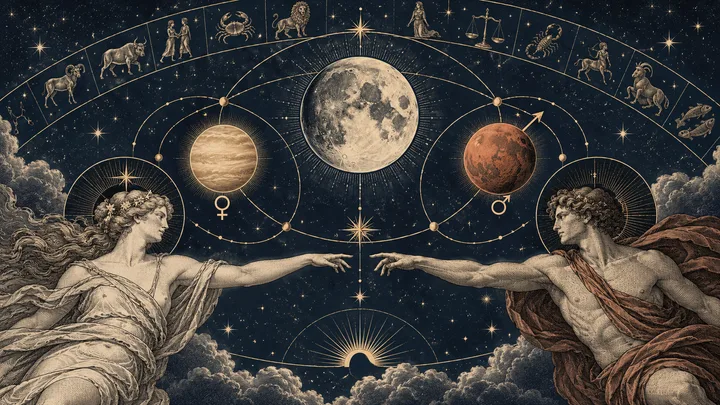
What does October 31, 2026 suggest for love?
At noon UTC on October 31, the tropical Moon is in Cancer, Mercury in Scorpio, Venus in Libra, and Mars in Leo. Vivida’s “October 31, 2026 Astrology: Planetary Positions & Aspects” gives that noon reference and lists a 3.2-degree Moon–Mercury trine, a 1.2-degree Mercury–Mars square, and a wider 6.1-degree Moon–Venus square. It also notes that the fast-moving Moon may enter another sign later in the day. The shared sky therefore offers more than one tone: emotional expression may feel easier, while forceful words or a difference between comfort and affection may call for care. The square is wider than six degrees, so a reading that uses the report’s six-degree orb should treat it as a secondary influence, not a selected major contact. These transits describe the day’s common astrological weather. They don’t say what you or your partner will do. 1001 Horoscopes’ “October 2026 Astrology Calendar” independently lists the same broad sign placements for October 31, including retrograde Mercury in Scorpio and Venus in Libra. Its monthly table is rounded and uses Eastern Time, so it corroborates the sign picture rather than replacing the noon UTC reference. Your known Moon, Venus, and Mars placements add a personal layer only when a transit makes a relevant contact to them. Sign resemblance can suggest a theme; degrees are needed to judge whether an aspect is close. Without them, keep the interpretation broad. Use the day’s symbolism as a prompt for one caring, direct conversation, then let the words and choices you share tell you what the moment means.
At 12:00 UTC on October 31, 2026, the tropical Moon is in Cancer, Mercury in Scorpio, Venus in Libra, and Mars in Leo. In traditional astrology, that combination puts care and emotional expression beside a sharper potential in speech and action: the Moon–Mercury trine symbolizes easier expression, while the close Mercury–Mars square suggests pausing before pressing a point. Venus in Libra with a Venus–Jupiter sextile adds a theme of generosity and reciprocity. These are interpretations of shared transits, not predictions about any couple; the Moon’s sign may change later in the UTC day. Compare the transits with known natal Moon, Venus, and Mars placements. Signs support broad reflection, while degrees are needed to identify close contacts. Let the symbolism guide one caring, direct conversation, and judge the exchange by what you both actually say and do.
Sources: October 31, 2026 Astrology: Planetary Positions & Aspects; October 2026 Astrology Calendar: Aspects & Moon Phases
What is actually in the October 31 sky at noon UTC?
For October 31, 2026, use noon UTC as the reference, not as a label for every hour. The date-specific page “October 31, 2026 Astrology: Planetary Positions & Aspects” lists the tropical Sun and Mercury in Scorpio, Moon in Cancer, Venus in Libra, and Mars in Leo at 12:00 UTC. For a love reading, focus on the Moon, Venus, and Mars, with Mercury included for communication. The Moon moves quickly; the page cautions that it may enter another sign later that day. “Cancer Moon” describes the shared sky at this stated moment. It does not establish the Moon’s sign at every local hour or either person’s natal chart. Two other calendars support the broad pattern. “October 2026 Astrology Calendar: Aspects & Moon Phases” gives October’s Moon sign changes and month-end positions, and notes Mercury turned retrograde on October 24 while Venus turned retrograde on October 3. “Ephemeris — October 2026” also marks October 31 with the Moon in Cancer, Mercury retrograde in Scorpio, Venus retrograde in Libra, and Mars in Leo. These sources show daily or rounded positions, not the same explicitly stated noon-UTC snapshot. Their agreement helps check signs and retrograde status; it does not make them identical calculations at one instant. The hour matters most for the Moon, while the slower planets set a broader backdrop. | Body | Tropical sign at 12:00 UTC | Love-reading focus | | --- | --- | --- | | Moon | Cancer | Emotional response and care | | Mercury | Scorpio, retrograde | Private thoughts and review | | Venus | Libra, retrograde | Affection and reciprocity | | Mars | Leo | Initiative and assertion | Retrograde is a motion label, not a promise that an old relationship will return or a conversation must be repeated. Here it can invite reflection on what has already been said, valued, or agreed. That is an astrological interpretation, not an event forecast. Before interpreting a daily position, confirm the date and zodiac framework, then record its reference time and zone. Here, the framework is tropical and the reference is 12:00 UTC. Keep that snapshot distinct from an aspect’s exact time: an aspect calendar may list a contact becoming exact at another hour. If a calendar uses rounded positions or a different time convention, retain its stated convention instead of silently blending entries. This prevents a noon Moon sign from being stretched across the whole day. These placements describe the collective transit sky. They become personal through comparison with reliable natal placements, and degrees are needed to establish close contacts. Knowing someone has a Cancer Moon or Libra Venus offers a broad point of reflection; it cannot prove that October 31’s transits contact that placement exactly. Start with the shared sky, then check the person’s known Moon, Venus, or Mars and the degree if available. If natal information is incomplete, stay with sign-level interpretation.
Sources: October 31, 2026 Astrology: Planetary Positions & Aspects; October 2026 Astrology Calendar: Aspects & Moon Phases; Ephemeris — October 2026
Which timed contacts change the emotional tone of the day?
The day has a sequence, not one aspect repeated from morning to night. Prokerala’s October 2026 Planet Aspects lists the Moon trine Mercury at 03:01 and Moon square Venus at 17:59, using its stated EST (UTC−5) display. Under that fixed offset, those moments correspond to 08:01 UTC and 22:59 UTC. The calendar names EST, not an IANA local zone, so keep its convention attached whenever you quote the times. The order matters for interpretation: the earlier contact joins feeling and speech; the later one sets emotional comfort beside Venusian preference. These are symbolic periods for reflection, not scheduled relationship events. The Moon–Mercury trine offers the clearest opening. Cafe Astrology’s October 2026 calendar describes this contact as a time when feelings may be expressed with clarity and thoughts with sensitivity. In astrological language, a trine links two placements through easier flow. Here, the Moon signifies immediate feeling and Mercury signifies words and thought. That symbolism can support naming a feeling while hearing what the other person says. It doesn’t promise agreement or remove the need to listen. Prokerala lists the same trine at 03:01 in its fixed UTC−5 display, while Cafe Astrology lists it at 03:01 without a time zone beside the entry. Since Cafe Astrology’s opened text does not state the zone, use it for interpretation rather than converting its clock time to UTC. At noon UTC, Vivida’s October 31 Astrology page places Mercury square Mars among the closer contacts, with a displayed 1.2-degree orb. That is separate from the Moon’s changing aspects. In the article’s interpretive frame, Mercury square Mars adds a sharper edge to speech and action: it can describe urgency, forceful words, or the wish to press a point. Prokerala’s timed list does not show this square as an exact October 31 event; it records exact aspect moments, while Vivida reports a noon position snapshot and aspect orbs. Keep those claims distinct. The square can help explain why a day that also carries an easier Moon–Mercury symbol still calls for care with tone. Neither aspect says a disagreement must happen. The Moon square Venus arrives later in Prokerala’s UTC−5 list, at 17:59, or 22:59 UTC under that offset. Cafe Astrology also lists a Moon–Venus square on October 31 and interprets it as a brief period when romantic matters may feel unsettled or sensitivity may rise. The calendars differ in what they show and how they state times; Cafe Astrology’s event time cannot be converted responsibly from the opened page alone. Use its wording as interpretation, not independent timing verification. This square can symbolize a gap between the comfort someone wants and the way affection or fairness is expressed. Minor contacts also appear in Prokerala’s day list, including a Moon semi-sextile Mars and a Moon semi-square Uranus. They add detail for readers who work with minor aspects, but should not outrank the trine and square here. The practical sequence is simple: use the Moon–Mercury symbolism to speak plainly, then meet any mismatch in comfort or preference with curiosity. Aspect times mark the calendar’s exact angular contact under its stated convention; their meaning remains interpretive, and no clock entry guarantees a conversation or outcome.
Sources: October 2026 Planet Aspects; October 2026 Calendar; October 31, 2026 Astrology: Planetary Positions & Aspects
What does the Cancer Moon add to a love reading?
A Cancer Moon turns attention toward what helps feeling settle: care, familiarity, memory, and belonging. Cafe Astrology’s October 2026 calendar describes the Moon in Cancer as a time for nurturing emotional connections, sharing feelings, and attending to home and family. In a love reading, that symbolism points to a useful question: what helps each person feel safe enough to be present? It doesn’t say every couple will feel tender, or that anyone must disclose more than they want.
The Moon–Mercury trine gives that emphasis a channel. Cafe Astrology says the trine supports expressing feelings clearly and thoughts sensitively. Prokerala’s October 2026 Planet Aspects calendar lists it at 03:01 under its displayed EST (UTC-5) convention, with the Moon at 17° Cancer and Mercury at 17° Scorpio. Cancer brings feeling and memory into view; Scorpio Mercury can seek meaning beneath a first answer. A trine is traditionally read as an easier flow between planets. Easier doesn’t mean automatic. Someone may still need time, privacy, or a gentler question before speaking plainly.
Cancer symbolism can describe attentiveness or protectiveness, not softness alone. Care may become guardedness when a person doesn’t yet feel secure. Candid speech can clarify a need, but probing too hard can close a conversation. Imagine one partner says, “I’d like more time together,” and the other asks what kind of time would feel good. This illustration shows how a feeling can become a specific request without assuming the other person already knows what’s needed.
The later Moon–Venus square adds a countercurrent. Prokerala lists it for October 31 at 05:59 pm in its stated UTC-5 convention. Cafe Astrology describes romantic matters as potentially unsettled under this contact, with insecurity possible. In traditional terms, the Moon’s wish for comfort and Venus’s way of relating may not line up neatly. That doesn’t erase the trine or cancel affection. It asks for care around different preferences: one person may want reassurance while the other reaches for balance, space, or a practical agreement. Notice the difference before naming it rejection.
If you know your natal Moon’s sign, use this transit as a broad prompt about emotional response. With its degree too, you can check whether a close contact is present; without it, don’t claim an exact aspect. Test the interpretation against the conversation in front of you. Ask, “What would help you feel cared for today, and what kind of response would feel fair to both of us?” Listen. The Cancer Moon offers a language for care and belonging; the trine symbolizes sensitive expression, while the later square reminds you that needs can differ. The exchange itself shows what care looks like between you.
Sources: October 2026 Calendar; October 31, 2026 Astrology: Planetary Positions & Aspects; October 2026 Planet Aspects
How might the day's Venus pattern meet your natal Venus?
Venus in Libra gives this love reading a clear question: what would make affection feel mutual, and how can each person show it in a way the other can receive? In traditional astrology, Venus describes attraction, pleasure, values, and the ways we seek harmony. Libra emphasizes exchange, tact, and balance. It can invite appreciation or a fair check-in, without promising agreement. The date-specific picture holds both ease and friction. “October 31, 2026 Astrology: Planetary Positions & Aspects” lists Venus in Libra at noon UTC and a Venus–Jupiter sextile with a 2.2-degree orb. A sextile is traditionally read as an opening between two planetary functions: here, relating and enjoyment meet Jupiter’s themes of growth and generosity. The aspect can support a warm gesture or generous view of what the other person offers. An opening still asks for participation. The same calendar lists a Moon–Venus square at 6.1 degrees. That is a separate, faster-moving contact, and the source’s listed orb is just beyond the six-degree convention used for selected major aspects in the publication’s report. It can still be discussed as part of the day’s broad symbolic weather, but don’t quietly treat it as a close personal contact. In astrological terms, the Moon speaks to immediate feeling and comfort; Venus speaks to relating and preference. Their square can describe a moment when someone wants reassurance while the other reaches for a different expression of affection. Treat that as a prompt, not a prediction. “October 2026 Astrology Calendar: Aspects & Moon Phases” describes Venus as retrograde and places it in Libra by October 31. It also frames Venus retrograde as a review of relationship, taste, and pleasure themes. Read that as an invitation to reconsider what feels fair or valuable now. It doesn’t establish that a former partner will return, that a current relationship will end, or that old issues must resurface. “Ephemeris October 2026 — celestial body positions” independently lists Venus retrograde in Libra for the date, while its rounded daily positions serve as a broad cross-check rather than a precise personal chart. Consider two hypothetical readers who know only that their natal Venus is in Libra. Both might use the day’s Venus symbolism to reflect on reciprocity, but the shared sign label alone doesn’t show that transiting Venus makes a close aspect to either natal Venus. If one reader has verified degrees that place the transit in a close contact, the symbolism can be read more personally under the chosen orb. For the other, with no degrees available, the honest reading stays at the sign level. These are illustrative possibilities, not calculated charts. Ask what would help more: a clear expression of appreciation or a fairness check? A close contact to known natal Venus can sharpen that reflection. Without degrees, let Libra’s themes guide a small act of mutual care, then pay attention to what each of you actually says and does.
Sources: October 31, 2026 Astrology: Planetary Positions & Aspects; October 2026 Astrology Calendar: Aspects & Moon Phases; Ephemeris — October 2026
What does Mercury square Mars ask you to handle carefully?
Mercury square Mars puts speech, decisions, and disagreement in sharper focus. In the noon tropical positions for October 31, Mercury is in Scorpio and Mars is in Leo: one placement presses toward what lies beneath the surface, while the other favors bold, visible action. Vivida’s October 31 Astrology: Planetary Positions & Aspects lists this square at a 1.2-degree orb, its closest listed aspect. That makes it a strong feature of this day’s collective chart, not a forecast that every couple will argue. A square describes tension between two planetary functions. In practice, it asks for adjustment and conscious handling; it does not mean that either person must lose, or that a conversation is doomed.
Mercury signifies how we think, speak, ask, and negotiate. Mars describes drive, assertion, and action. Together in a square, they can symbolize a quick answer, a forceful demand, or the urge to push a point . Scorpio Mercury may want candor about the real issue; Leo Mars may want a clear response . These are interpretive possibilities, not labels for everyone under the transit. The same pattern can help someone stop hinting and name what needs to change.
The sources don’t present timing in exactly the same way. Vivida gives the noon positions and a 1.2-degree Mercury–Mars orb. 1001 Horoscopes’ October 2026 Astrology Calendar, which says its times are Eastern Time, lists the exact square on October 30. Prokerala’s October 2026 Planet Aspects uses a displayed default of EST (UTC-5), a fixed offset. Keep those conventions visible; don’t turn them into one precise local clock time. Vivida supports reading a close square in the October 31 noon chart, while the exact peak and clock time depend on each calendar’s stated convention.
For a love conversation, use four steps: pause before answering, name the issue , make a request, then listen. “I want us to decide how we’ll share Sunday’s plans” gives the other person something clear to answer. It’s more useful than accusing them of never caring, which folds old grievances into one charge. If the transit closely contacts your natal Mars, use it as a prompt to notice where you’re ready to act or defend a boundary. A close contact to natal Mercury puts more focus on words and choices. These personal refinements require known natal degrees; the shared transit alone doesn’t establish either contact.
The strongest exception matters: a square can mobilize honest action. If you’ve been avoiding a needed request, Mars can lend nerve while Mercury gives it language. Deliberate speech changes the expression of the aspect. Bring up one concrete need, leave room for your partner’s answer, and decide together what happens next. The chart frames a moment; conversation shows what is possible.
Sources: October 31, 2026 Astrology: Planetary Positions & Aspects; October 2026 Astrology Calendar: Aspects & Moon Phases; October 2026 Planet Aspects
How do you compare the transits with known Moon, Venus, and Mars placements?
Use three passes: identify the shared sky, compare it with known natal placements, then check the symbolism against real choices. This order keeps a daily horoscope useful without turning it into a personal prediction. At 12:00 UTC on October 31, the tropical Moon is in Cancer, Mercury in Scorpio, Venus in Libra, and Mars in Leo. Vivida’s date-specific calendar gives those positions and lists a Mercury–Mars square at a 1.2-degree orb and a Moon–Mercury trine at 3.2 degrees. Book of Horoscopes’ October 2026 ephemeris independently shows the day’s Moon in Cancer, Mercury retrograde in Scorpio, Venus retrograde in Libra, and Mars in Leo, with rounded whole-degree positions. They establish the shared sky, not its contact with your natal chart. In the second pass, compare each known natal placement with the day’s transiting planets and their contacts. The Moon describes emotional responses and needs; Venus points to affection, values, and relating; Mars describes desire, initiative, and ways of pursuing or handling conflict. Use these as interpretive roles, not labels for a whole person. Cancer Moon themes may speak more directly to a natal Moon than to Venus or Mars, while the Mercury–Mars square may be more relevant if it closely contacts someone’s natal Mars. A contact to natal Venus raises a different reflection from one to natal Moon. A sign match suggests a theme, not a close contact. When degrees are available, compare them before drawing a stronger conclusion. An aspect describes an angular relationship between two chart positions, and its orb is the distance from the exact angle. A smaller orb makes the contact more exact. The day’s Mercury–Mars square, for example, is listed by Vivida at 1.2 degrees; that describes the transit-to-transit aspect, not a contact to your natal chart. Test contacts to your chart only against its actual degrees. The Synastry Comparison Report uses a six-degree orb for selected major aspects when supplied degrees permit that comparison. Treat this as the report’s working convention. Other traditions may use different orbs; six degrees is not a universal boundary. | What you know | Safe reading | What remains unknown | |---|---|---| | A natal sign only | Describe broad sign symbolism beside the verified daily positions. | Whether an aspect is close or exact. | | Natal signs and degrees | Check sign relationship and measure possible angular contacts. | Any placement that was not supplied or calculated. | | A report using supplied placements | Read the selected comparisons within its stated six-degree orb. | Houses, missing birth-chart factors, and a relationship outcome. | The third pass is observation. Ask whether the symbolism helps name something present, such as a need for reassurance or tension around how to act. Compare the prompt with what each person says and does. If the theme does not fit the day’s conversation, don’t force it. Use the chart as a lens, not a substitute for listening. Keep the kind of comparison clear, too. A daily transit overlay compares the current sky with one person’s natal placements. Synastry compares two natal charts with each other. They use similar planets but answer different questions. The report offered here compares Moon, Venus, and Mars signs supplied by the reader, with optional degrees for selected major aspects. It doesn’t calculate natal placements from birth details. With signs alone, stay broad; without degrees, don’t claim an exact contact.
Sources: October 31, 2026 Astrology: Planetary Positions & Aspects; Ephemeris — October 2026
How should a reader weigh mixed signals instead of choosing one headline?
A mixed day needs a ranked reading, not a single mood label. The Moon–Mercury trine and Venus–Jupiter sextile make room for warmth, emotional candor, and generous gestures. Mercury–Mars and Moon–Venus add friction around tone, speed, comfort, and fairness. Both currents belong in the picture. The useful question is which one speaks most clearly to the chart placements you know and the conversation in front of you.
The calendar “October 31, 2026 Astrology: Planetary Positions & Aspects” lists all four contacts from its tropical noon positions: Moon trine Mercury, Venus sextile Jupiter, Mercury square Mars, and Moon square Venus. Its orbs offer one way to compare their closeness, but the page's label for the day's strongest tone is an editorial choice. A closer contact can draw attention, yet no single ranking settles how a person will experience it. Read the geometry first, then ask which natal point, if any, it touches.
There’s a good case for giving the supportive signatures more weight. A trine between the Cancer Moon and Scorpio Mercury can symbolize a flow between feeling and expression; a Venus–Jupiter sextile can suggest ease in extending goodwill or appreciation. Cafe Astrology's October 2026 calendar describes the Moon–Mercury trine as helpful for expressing feelings, while its Cancer Moon notes favor nurturing emotional connection. These meanings support a warm reading. They don't require the reader to ignore the sharper contacts, or promise that a conversation will go smoothly.
The timing sources need to be read on their own terms. 1001 Horoscopes explains that its October calendar uses Eastern Time and rounds its daily table, while Prokerala labels its default event times EST (UTC−5). That fixed offset should not be silently renamed as New York local time. Prokerala’s list includes the Moon–Mercury trine and later Moon–Venus square, but its timed entries cannot be compared as if every calendar used the same clock setting. Vivida’s noon UTC positions offer a reference snapshot; they don’t erase the Moon’s movement through the day.
So weigh the signals in this order: confirm the date and time basis, notice the aspect’s closeness, then compare it with known natal Moon, Venus, or Mars degrees. A close contact to a natal placement may make one theme more personally resonant than a general sign resemblance. Without degrees, stay with broad symbolism. The lived situation matters too. If care and clear speech are already present, the supportive side may describe the day well; if a preference is being pushed or a reply feels sharp, the friction side offers a useful prompt for slowing down. Either observation can revise the emphasis. The chart frames attention; it doesn’t decide the relationship.
Sources: October 31, 2026 Astrology: Planetary Positions & Aspects; October 2026 Astrology Calendar: Aspects & Moon Phases; October 2026 Planet Aspects; October 2026 Calendar
What conversation should you choose for October 31?
Choose one conversation that asks for care and makes room for an honest answer. You might say, ‘I’d like us to feel more connected today. What would help you feel cared for, and can I tell you what would help me?’ Then name one specific need and agree on a next step you can both accept, together and plainly.
That approach fits the day’s mixed symbolism: the Cancer Moon and Moon–Mercury trine invite attention to feeling and expression, while the sharper contacts favor care with tone. Cafe Astrology’s October 2026 Calendar describes the Cancer Moon through nurturing and emotional connection; treat that as an interpretive prompt, not a promise about another person’s response. A transit can focus attention without deciding what the exchange means.
If you know only your Moon, Venus, or Mars signs, keep the reading broad. A close contact needs known natal degrees and a stated orb; the shared transit chart alone can’t establish that it touches your chart. The Synastry Comparison Report compares supplied Moon, Venus, and Mars signs and optionally degrees. It doesn’t calculate natal placements from birth details. Use the sky to choose what to discuss, then let the conversation itself guide your next step.
A little more clarity
Do October 31’s transits affect every couple in the same way?
The transiting sky is shared, but its contacts to natal placements depend on each chart’s known signs and degrees. Without degrees, keep the comparison broad.
Can this horoscope calculate my natal placements?
No. The Synastry Comparison Report compares supplied Moon, Venus, and Mars signs and optionally degrees; it does not calculate natal placements from birth details.
Sources & further reading
- October 31, 2026 Astrology: Planetary Positions & Aspects
Provides tropical positions at 12:00 UTC and listed aspect orbs for October 31.
- October 2026 Astrology Calendar: Aspects & Moon Phases
Corroborates broad October 31 placements and states its calendar time convention and calculation basis.
- October 2026 Planet Aspects
Lists October 31 aspect moments and identifies its displayed default as EST (UTC-5).
- October 2026 Calendar
Provides traditional interpretations of the Cancer Moon, Moon–Mercury trine, and Moon–Venus square.
- Ephemeris — October 2026
Independently lists the October 31 signs and retrograde status with rounded daily positions.
Synastry Comparison Report
Enter known placements for two people. Get an input-by-input comparison, selected aspect calculations and a clear record of what remains uncertain.
Compare our placements