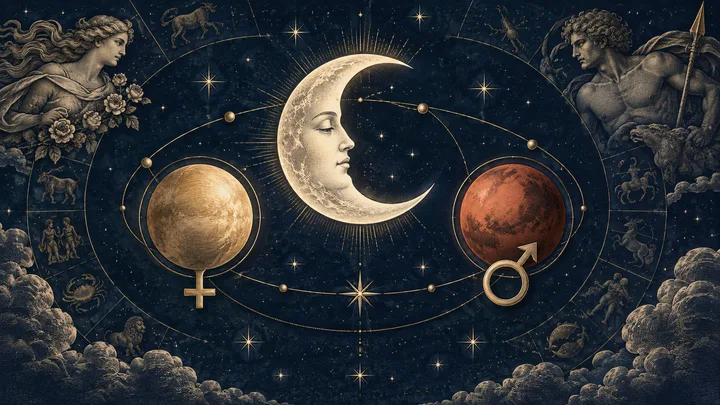
What sky are we reading on October 28 UTC?
To read October 28 as a UTC day, start with its boundary. This is a tropical, geocentric reading: the positions are measured from Earth’s center against the tropical zodiac. The noon snapshot gives a consistent reference for the slower planets and the day’s broad pattern, but the Moon moves quickly enough that one sign label cannot describe every hour. Here, the date begins with the Moon still in Taurus, then shifts into Gemini early in the UTC morning. That small boundary matters. Upstellar’s October 2026 Ephemeris Tables list the Moon at 29°22′ Taurus at 00:00 UT on October 28, then at 14°04′ Gemini at 00:00 UT on October 29. For that, the October Astrology Transit Calendar from Astrolis lists the Moon entering Gemini at 9:01 PM on October 27 in Eastern Time (US & Canada), marked EDT. EDT is four hours behind UTC on that date, so 9:01 PM on October 27 converts to 01:01 UTC on October 28. The UTC day therefore opens for about an hour with the Moon in Taurus, then spends the rest of the date with the Moon in Gemini. Astrolis also lists the next ingress, into Cancer, at 10:05 PM EDT on October 29, or 02:05 UTC on October 30. The noon reference adds the other planetary positions, each useful as a snapshot rather than a claim about a full day. Vivid Astro’s October 28, 2026 Astrology page explicitly labels its positions tropical and sampled at 12:00 UTC: the Sun is in Scorpio, Mercury retrograde in Scorpio, Venus retrograde in Libra, and Mars in Leo. Its page also lists the Moon in Gemini at noon. Upstellar’s midnight rows bracket that placement, and Astrolis’s ingress times fit the same sequence. One opened daily ephemeris does not agree on the Moon’s starting degree. The October 28 page from Zodiac Astrology Horoscopes says its table is for 00:00 UTC and gives the Moon as 25° Taurus, while Upstellar gives 29°22′ Taurus for 00:00 UT. The daily page also shows 29° Taurus at 06:00 and 3° Gemini at noon, which does not fit Astrolis’s listed 01:01 UTC ingress. Because these lunar figures conflict, they are not used to set the day’s Moon timing here. The chosen boundary comes from Upstellar’s monthly positions and Astrolis’s explicitly time-zoned ingress. Keep the distinction in view: the date opens briefly under Taurus, but the verified noon reference and most of the UTC day carry the Gemini Moon.
Sources: October 2026 Ephemeris Tables; October 2026 Astrology Transit Calendar; October 28, 2026 Astrology: Planetary Positions & Aspects; October 28, 2026 Ephemeris
How does a collective transit become personal?
A transit becomes personal when a moving planet forms an aspect to a point in a natal chart. The Moon–Uranus conjunction and Moon–Saturn sextile listed for October 28 describe relationships among planets moving through the sky together. They set a collective tone. To ask what either contact means for you, compare the moving planets with your natal Moon, Venus, or Mars. If neither mover contacts one of those placements, the daily configuration remains general background rather than a direct personal hit.
The terms are simple. A transiting planet is at its current position; a natal placement is where a planet stood in your birth chart. An aspect is the angular relationship between two positions. A conjunction brings them together, while a sextile links them at a supportive angle. The orb is the distance from the exact angle, measured in degrees. Exactness is when the positions reach that angle. A closer contact is usually clearest to examine, but interpretation still depends on the planets and the rest of the chart.
Astrology University’s “What Do Transits Mean in Your Birth Chart?” explains a transit through the moving planet, natal factor, aspect, and house context. Its step-by-step approach offers a useful order: identify the transit, find the natal point it aspects, then consider that point’s sign and chart setting. Here, the comparison is limited to known Moon, Venus, and Mars placements. Houses and the wider natal chart can add context, but they are outside the supplied inputs.
Verify the date and reference time, then compare the moving planet’s zodiac position with the natal degree. Classify the angle only when the positions support it, and consider the natal planet’s symbolism after that. For October 28, Vivid Astro’s date page lists the Moon’s conjunction with Uranus and sextile with Saturn at noon UTC, with its own reported orbs. Those figures describe its collective aspect list; they do not establish an orb for contact with your natal chart. The brief supplies no universal personal orb, so don’t treat a particular cutoff as settled here.
Cafe Astrology’s “Transits of the Moon” describes lunar transits as brief because the Moon moves quickly, and discusses Moon contacts to natal planets separately from contacts among current transits. Sharing a Gemini Moon does not mean everyone has the same natal contact. Sign can provide broad symbolic context. Degrees show whether an aspect is close enough to interpret as a specific contact.
Read the day in two layers. First, take the Moon’s contacts to Uranus and Saturn as the moving sky’s short-lived pattern. Then check whether those transiting positions aspect your natal Moon, Venus, or Mars. Astrology University stresses that the natal chart shapes a transit’s expression; a planet’s symbolism alone cannot supply a personal story. Without degrees, houses, and the rest of the chart, keep the reading at sign level. It can suggest a theme, but it cannot establish an exact natal aspect or tell you what another person feels.
Sources: What Do Transits Mean in Your Birth Chart?; Transits of the Moon; October 28, 2026 Astrology: Planetary Positions & Aspects
Which lunar contacts set the relationship tone?
At 12:00 UTC on October 28, the Moon is in Gemini and forms two close contacts that carry the day’s relationship tone: a conjunction with Uranus, reported at a 1.9-degree orb, and a sextile with Saturn, reported at 2.8 degrees. Those figures come from “October 28, 2026 Astrology: Planetary Positions & Aspects,” which states that positions are tropical and sampled at noon UTC. They describe the listed sky at that reference time. They are not aspects to either partner’s natal chart, and the page’s separate index score does not add evidence to the reading. The Moon moves quickly, so its contact is a passing emphasis rather than a lasting background condition. “Transits of the Moon” describes lunar transits as brief and interprets them through the natal factors they touch. Here, the conjunction and sextile are among the moving planets themselves. They give a collective picture, not a personalized statement about what someone will feel. The Moon’s sign also changes during the UTC date: “October 2026 Astrology Transit Calendar” lists its Gemini ingress at 9:01 PM EDT on October 27, which converts to 01:01 UTC on October 28. The UTC day begins before that listed ingress; by noon, the Moon is in Gemini. Astrologically, Gemini brings questions, conversation, and a willingness to consider another angle. Uranus adds the possibility of a break in routine or a sudden change of mind. Together, the Moon and Uranus can describe a day when a fresh idea or altered plan catches attention. In a relationship, that symbolism can support curiosity and flexibility: ask what has changed before deciding what the change means. It can also describe restlessness. Novelty is useful when both people can respond freely; it becomes harder when a surprise leaves no room for the other person’s needs. The chart supports holding both possibilities, rather than declaring the disruption exciting or harmful in advance. Saturn’s sextile gives the picture a second movement. In astrological interpretation, Saturn speaks to limits, responsibility, patience, and structures that let effort endure. A sextile is read as an opening for cooperation that still asks for participation. With the Moon in a close sextile to Saturn at noon, the day’s symbolism offers a way to give an unexpected idea a workable shape: name the practical limit, keep the useful part of the change, and agree on what happens next. The aspect does not promise agreement. It describes a pattern to engage. Read the pair together. Uranus invites a different response; Saturn asks what can be sustained. If a couple is weighing a spontaneous plan, the useful question is what can change while the important commitment remains clear. A flexible time, a direct check-in, or a smaller trial can hold both principles. That is the day’s most useful relationship reading: welcome new information, then make one concrete agreement. The emphasis shifts if either person’s natal chart receives a close contact, but this collective pattern alone cannot establish that personal link or determine anyone’s intentions.
Sources: October 28, 2026 Astrology: Planetary Positions & Aspects; Transits of the Moon; October 2026 Astrology Transit Calendar
What can your natal Moon, Venus, and Mars add?
Your natal Moon, Venus, and Mars describe different parts of how you meet a relationship. The Moon speaks to emotional response and the habits that help you feel settled. Venus describes what you value, enjoy, and seek in affection. Mars shows how you pursue what you want, express desire, and act when something matters. Read them as distinct layers. A transit can bring one of those themes forward when the moving planet makes an aspect to that natal placement; the sign by itself does not prove that contact has occurred. The verified daily pattern centers on the transiting Gemini Moon's conjunction with Uranus and later sextile with Saturn. Those are contacts among moving bodies, so they describe the day's shared astrological weather. To make the reading personal, compare the Moon's path and the listed contact degrees with the natal degrees you already know. Astrology University’s “What Do Transits Mean?” explains the basic sequence: identify the moving planet, the natal factor, the aspect, and the chart context. Cafe Astrology’s “Transits of the Moon” treats lunar transits as brief and interprets them in relation to natal factors. Imagine two people who both have Venus in the same sign. Their sign gives them a broad symbolic language in common, perhaps a similar style of showing affection or weighing what feels worthwhile. But suppose the transiting Moon–Uranus conjunction is close to one person's Venus degree and far from the other's. The first chart may receive a more direct, short-lived Venus emphasis in this reading; the second shares the sign's broad symbolism, but no exact contact is established. This is an illustrative comparison, not a claim about actual charts or a prediction of either person's behavior. Degrees let you test whether the moving planet forms a conjunction, square, trine, sextile, or opposition to a natal placement, and how close that contact is. An orb is the distance from the exact angle; a smaller orb is closer. Vivid Astro reports orbs for the collective Moon aspects at noon UTC, but those figures do not set a universal orb for natal comparisons. Use a stated method consistently rather than treating a sign match as an exact aspect. If you know only signs, you can still compare elemental or same-sign resonance as broad context. You cannot tell from that alone whether the Moon conjoins, squares, trines, sextiles, or opposes a particular natal Venus, Moon, or Mars. Nor does an aspect settle what it means in a whole chart. Astrology University notes that a transit's interpretation depends on the moving planet, natal factor, aspect, and house. Houses and wider natal patterns remain outside this comparison. A contact to natal Moon may feel especially immediate in the symbolism because the transiting body is also the Moon, whose daily movement makes this emphasis brief. A contact to natal Venus shifts attention toward relating, attraction, or values; a contact to natal Mars brings desire, initiative, or assertion into the picture. Cafe Astrology’s “Inner Planet Transits” offers brief interpretations of Moon contacts to natal planets, including Venus and Mars, while cautioning through its scope that these are short readings drawn from different interpretive sources. Treat them as symbolic prompts, not fixed outcomes. Start with the placement actually contacted, then ask what that function means in the situation you are living.
On October 28, 2026, the Moon enters Gemini at 01:01 UTC, so the UTC day opens briefly with Taurus and carries Gemini through most of the date. At the 12:00 UTC reference, the Moon is in a close conjunction with Uranus and a sextile with Saturn. In astrological terms, the pairing brings curiosity and room for a change of plan together with an opening to give a new idea practical shape. Venus is in Libra and Mars in Leo at that noon snapshot; these are transiting positions, not either partner’s natal placements. To personalize the reading, compare the moving Moon with each known natal Moon, Venus, and Mars by degree. Sign resemblance alone suggests broad symbolism, not an exact aspect. Use the day as a prompt for one flexible, clear conversation, not a prediction of anyone’s feelings or the relationship’s future.
Sources: What Do Transits Mean in Your Birth Chart?; Transits of the Moon; Transits of Sun Moon Mercury Venus Mars
What might the Gemini Moon contact bring to a natal Moon?
A close contact from the transiting Gemini Moon to a natal Moon can make the day's themes feel personally immediate. The aspect describes how the moving Moon meets the Moon in a birth chart. Without a natal degree, you can compare signs and symbolism, but you cannot name an exact contact. That distinction matters on October 28 because the Moon does not stay at one degree all day.
At 12:00 UTC, October 28, 2026 Astrology: Planetary Positions & Aspects lists the Moon in Gemini, conjunct Uranus with a reported 1.9° orb and sextile Saturn with a 2.8° orb. Those figures describe aspects among moving planets. They are not automatically aspects to your natal Moon. The page gives a noon snapshot, so don't treat its position as fixed across the whole UTC date.
To check your own Moon, find its sign and degree in the chart information you have. Then compare that longitude with the Moon's position at the time of the transit. A conjunction is close alignment; a sextile and a square describe different angular relationships. A sign match alone cannot show that the transiting Moon conjoined your natal Moon. It suggests broad resonance, not a degree-based contact.
Timing matters because the Moon moves quickly. Transits of the Moon from Cafe Astrology describes lunar transits as brief, so a natal Moon contact may mark a passing emphasis rather than a theme that defines the relationship or the entire day. The October 28 page lists the Uranus conjunction and Saturn sextile at noon. Read those as features of the collective sky, then check a timed ephemeris against your natal degree before calling either a personal contact.
If the Uranus conjunction is close to your natal Moon, one possible astrological reading is a need for more emotional room, a fresh response, or a change in routine. The Saturn sextile offers a contrasting possibility: steadier support, clearer boundaries, or a practical way to care for what matters. These are interpretive possibilities, not claims about what you or a partner must feel. Cafe Astrology's Moon transit reference treats contacts to natal factors individually. What Do Transits Mean in Your Birth Chart? from Astrology University adds that a transit's meaning depends on the moving planet, natal point, aspect, and wider chart context. Houses and natal aspects can refine that reading, but a sign-only comparison does not supply them.
If you know only that your natal Moon is in Gemini, use the day's Gemini symbolism as a broad prompt for curiosity, conversation, or flexibility. You still cannot conclude that the transiting Moon conjoins it: matching signs do not establish an exact aspect. If you have the degree, compare it with the Moon's position at the relevant time and state the orb you use. With degrees, you can check whether the brief lunar emphasis directly touches a natal Moon. With signs alone, use a broad prompt: make room for a fresh exchange, then notice whether steadier support helps it land.
Sources: October 28, 2026 Astrology: Planetary Positions & Aspects; Transits of the Moon; What Do Transits Mean in Your Birth Chart?
How do Venus and Mars change the comparison?
Venus and Mars give you two different questions to bring to the October 28 sky. Venus describes what you value, enjoy, and welcome in relationship; Mars describes desire, initiative, and how you move toward what you want. On this date, the tropical noon-UTC positions place Venus in Libra and Mars in Leo, according to “October 28, 2026 Astrology: Planetary Positions & Aspects.” Those are the sky’s placements, not your natal Venus and Mars. Keep the two layers separate before drawing a personal comparison.
Start with the transiting Moon, then check each known natal placement by degree if you have it. A transit is read through the moving planet’s aspect to a natal point, so a close Moon contact to your Venus can bring themes of affection, appreciation, or shared values into the day’s brief emotional weather. A contact to natal Mars may put initiative, desire, or a difference in pace in focus. “Transits of Sun Moon Mercury Venus Mars” describes inner-planet transits as brief and offers multiple readings for the same contact; that range is a useful reminder to read symbolism as a prompt, not a guaranteed event. The Moon’s fast movement matters here: a contact may be active for only part of the day, and a noon snapshot cannot establish the exact time it reaches a particular natal degree. Check a timed ephemeris against the actual degree before calling it a hit.
Sign alone gives a wider, softer comparison. You can notice broad elemental or sign-based resonance between a Gemini Moon and a natal Venus or Mars, but that does not prove an aspect. Degrees tell you whether the Moon reaches a conjunction, square, trine, sextile, or opposition, and how close that contact is. Without degrees, say “this sign may echo that placement,” not “the Moon is activating your Venus.” “What Do Transits Mean in Your Birth Chart?” likewise frames transit interpretation through the moving planet, natal factor, aspect, and chart context; the sign label is only one piece of the reading.
Here’s the important exception: a sign pairing that looks easy by element may miss a close degree contact altogether, while a more tense-looking pairing can be handled constructively through the rest of the chart and the choices two people make. A Venus contact doesn’t promise closeness, and a Mars contact doesn’t require conflict. If you have the degrees, compare each partner’s Venus and Mars separately with the Moon’s path; if you have signs only, keep the reading broad. Then use the symbolism to ask a grounded question: what would help us feel appreciated, or how should we handle a change of plan? That gives Venus and Mars their proper place without turning either into a score or a verdict.
Sources: October 28, 2026 Astrology: Planetary Positions & Aspects; Transits of Sun Moon Mercury Venus Mars; What Do Transits Mean in Your Birth Chart?
Which reading is most useful for a real conversation?
A useful reading of October 28 holds three layers apart before bringing them together. First comes the collective pattern: the Gemini Moon's conjunction with Uranus and later sextile with Saturn. Next come each person's known natal Moon, Venus, and Mars signs. Finally, if birth degrees are available, check whether the moving Moon actually aspects any of those placements. The opened “October 28, 2026 Astrology: Planetary Positions & Aspects” page lists the Moon–Uranus conjunction at 1.9° orb and the Moon–Saturn sextile at 2.8° at 12:00 UTC. They describe relationships among moving planets, not automatically a contact to either partner's natal chart. Begin with this shared weather, then ask whether either person's placements receive a specific contact. In astrological interpretation, Uranus brings themes of surprise, independence, and a break from the familiar. A Gemini Moon lends the day's emotional symbolism a curious, conversational cast: questions, new information, a change of plan. Saturn brings limits, steadiness, and the work of giving a choice structure. A sextile is traditionally read as a supportive opening that still needs participation. Together, they suggest: stay curious when something shifts, then decide what should remain settled. Imagine two partners have planned a quiet evening at home. One proposes going out instead, after a friend extends an invitation. That suggestion can fit the Uranian side of the symbolism: try something different and see what the new possibility offers. The other asks whether they can still be home by ten, since an early morning matters. That question fits Saturn's concern with time and commitment. Neither person has to stand for a planet. This example shows how the day's themes might help a couple name what is changing and what still matters. They could make one clear agreement: “Let's go, and leave by ten.” That lets the plan move while making its boundary plain. Or they might decline and choose another evening. The useful outcome isn't novelty for its own sake, nor strictness as proof of care. It's a choice both people understand. Let flexibility open a conversation, then use Saturn's symbolism to shape a workable next step. There is a counter-reading. Uranian themes can describe disruption, or a change that leaves one person unsettled. Saturn can bring steadiness, but it can also symbolize over-control or refusal to consider a new option. A Moon–Saturn sextile doesn't guarantee an easy conversation, and a Moon–Uranus conjunction doesn't make a surprise welcome. The exchange itself matters. “What would make this change workable for both of us?” is more useful than deciding in advance that one partner is spontaneous and the other rigid. A natal contact can make the symbolism more personal, but only if the chart information supports one. “What Do Transits Mean?” explains that interpretation depends on a moving planet's aspect to a natal factor and wider chart context. That comparison differs from the conjunction and sextile between moving planets. If a reader knows a natal placement and degree, they can compare it with the Moon's position at the relevant time. The date-specific page gives a noon snapshot; the Moon moves during the UTC day, so that listing isn't its position at every hour. Without degrees, a shared sign or elemental affinity remains broad symbolism, not evidence of an exact aspect. Houses can't be inferred from these placements alone. The scale is brief. “Transits of the Moon” describes lunar transits as short-lived and interprets them in relation to natal factors. Use this reading as a prompt for one conversation or plan, not a verdict about a relationship's future. If an invitation changes the evening, ask what each person wants to keep, what can flex, and what practical limit matters. Curiosity doesn't require a dramatic event; clarity doesn't turn an ordinary agreement into a test. So the useful reading is neither “say yes to every surprise” nor “hold the plan at all costs.” Be open to a new idea, then make its terms clear. A precise natal contact, checked from known degrees, may focus that theme for one person's Moon, Venus, or Mars. The collective aspects alone cannot establish it. The conversation shows what each person means and needs.
Sources: October 28, 2026 Astrology: Planetary Positions & Aspects; What Do Transits Mean in Your Birth Chart?; Transits of the Moon
What should you compare next?
Begin with the clock. October 28 is a UTC day, and its first hour differs from the rest: the Moon enters Gemini at 01:01 UTC, according to the October 2026 Astrology Transit Calendar. The October 28 Astrology Calendar: Planetary Positions & Aspects lists the Moon in Gemini at 12:00 UTC and reports its conjunction with Uranus and later sextile with Saturn. Read those contacts as brief symbolic weather: make room for a fresh idea, then decide what would give it a steady shape.
Write down each person's known natal Moon, Venus, and Mars signs, adding degrees where available. Compare those degrees with the Moon's movement and mark a contact only when the positions support it. Sign resemblance can suggest a broad theme, but it doesn't establish an exact aspect. If you know signs without degrees, keep the reading broad. Leave houses and unprovided chart factors out; don't fill gaps with guesses.
Then carry one question into the relationship: where could you welcome a change while agreeing on what happens next? Choose a plan that can flex, and name one practical detail that matters to each of you. Treat the chart as a prompt for that conversation, not a verdict about either person's feelings or future.
The Synastry Comparison Report compares supplied Moon, Venus, and Mars placements, with optional degrees. It doesn't calculate natal positions from birth details or provide an October 28 transit calculation. Use it to compare known placements. The day's useful answer is simple: read the UTC sky first, personalize it only where your data allow, and let the conversation show what flexibility and follow-through mean for you both.
Sources: October 28, 2026 Astrology: Planetary Positions & Aspects; October 2026 Astrology Transit Calendar
A little more clarity
What sign is the Moon in on October 28, 2026?
The Moon enters Gemini at 01:01 UTC on October 28, according to the EDT-stamped ingress converted to UTC. It is in Gemini at 12:00 UTC. The UTC date begins with about an hour of Taurus Moon.
What are the main love transits on October 28, 2026?
At 12:00 UTC, the Gemini Moon is listed in a close conjunction with Uranus and a sextile with Saturn. Astrologically, this can frame the day around curiosity and flexibility, balanced by the chance to make a clear, workable agreement.
Can I tell whether these transits affect my natal Venus or Mars?
A specific transit-to-natal contact requires comparing the moving Moon’s position with your natal placement by degree. Signs alone can suggest broad symbolic resonance, but they don’t establish an exact aspect.
Does the Synastry Comparison Report calculate my birth chart or daily transits?
No. The report compares supplied Moon, Venus, and Mars placements, with optional degrees. It doesn’t calculate natal positions from birth details or provide an October 28 daily transit calculation.
Sources & further reading
- October 2026 Ephemeris Tables
Lists the Moon at 29°22′ Taurus at 00:00 UT October 28 and 14°04′ Gemini at 00:00 UT October 29.
- October 2026 Astrology Transit Calendar
Lists the Moon’s Gemini ingress at 9:01 PM EDT October 27, which converts to 01:01 UTC October 28.
- October 28, 2026 Astrology: Planetary Positions & Aspects
Lists tropical positions and lunar aspects at 12:00 UTC, including Moon conjunct Uranus and sextile Saturn.
- October 28, 2026 Ephemeris
Its lunar samples conflict with other opened sources, so the article excludes this page as evidence for Moon timing.
- What Do Transits Mean in Your Birth Chart?
Explains transit interpretation through the moving planet, natal factor, aspect, and chart context.
- Transits of the Moon
Describes lunar transits as brief and offers interpretations of Moon contacts to natal factors.
- Transits of Sun Moon Mercury Venus Mars
Provides brief interpretive examples of inner-planet transits, including Moon contacts to natal Venus and Mars.
Synastry Comparison Report
Enter known placements for two people. Get an input-by-input comparison, selected aspect calculations and a clear record of what remains uncertain.
Compare our placements