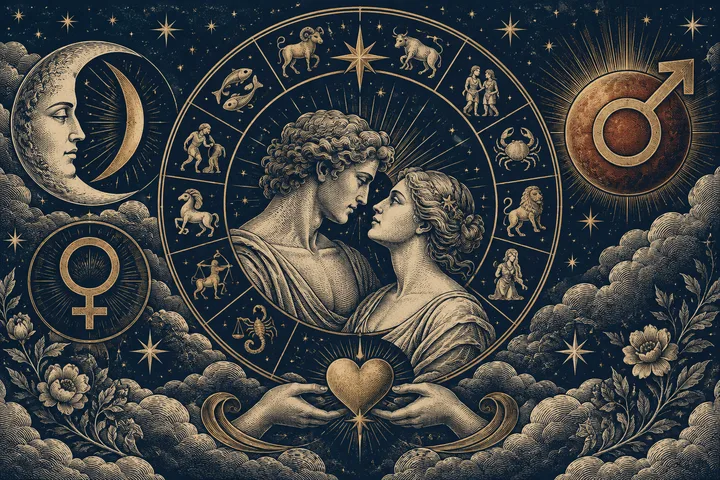
October 26, 2026 is anchored by a Taurus Full Moon at 04:12 UTC, opposite the Scorpio Sun and interpreted in the event chart as square Pluto in Aquarius. The Moon is already in Taurus at 00:00 UTC: AstroAk’s October table gives 0°15 Taurus then and places the ingress at 23:35 UTC on October 25. Its phase listing is 04:11 UTC, one minute earlier than Cafe Astrology and Space.com; those sources agree at 04:12 UTC, an immaterial difference for this reading. The fixed-sign pattern brings comfort, shared values, intimacy, and change into focus as collective symbolism, not a guaranteed event between partners. To see whether it is personal, compare the verified transiting degrees with known natal Moon, Venus, and Mars placements. Sign matches alone are not close aspects.
What is actually happening in the sky on October 26?
October 26 opens under a Taurus Full Moon, exact at 04:12 UTC. The moment matters: a Full Moon is not simply a label for the whole calendar day, but the instant when the Moon stands opposite the Sun. This timestamp anchors the day’s comparison. Cafe Astrology’s “Full Moon on October 26, 2026” places the lunation at 2°46′ Taurus, opposite the Scorpio Sun. Space.com’s “Full moon calendar 2026” independently lists the peak at 12:12 a.m. Eastern Daylight Time, or 04:12 GMT. Use tropical, geocentric positions: signs refer to the tropical zodiac, viewed from Earth’s center. AstroAk’s October 2026 ephemeris, based on Swiss Ephemeris, places the Moon at 0°15 Taurus at 00:00 UTC on October 26 and records its Taurus ingress at 23:35 UTC on October 25. The Moon is therefore in Taurus throughout this UTC date. The monthly table also lists Venus retrograde in Libra and Mars in Leo at the opening reference time; those signs give context, while a personal reading still requires degree-based contact to a natal placement. The Full Moon time differs by one minute across the accessible listings. AstroAk gives 04:11 UTC; Cafe Astrology places the lunation at 2°46′ Taurus and Space.com lists 04:12 GMT. The latter two agree, so this article uses 04:12 UTC; a one-minute difference does not alter the sign or the reading. The Moon had entered Taurus before the UTC date began, so there is no Aries-to-Taurus sign change to resolve on October 26. The opposition gives the day its central relationship image. Taurus speaks to steadiness, comfort, tangible care, and the values that make affection feel secure. Scorpio turns attention toward intimacy, trust, shared resources, and the truths beneath the surface. Cafe Astrology describes this polarity as tangible simplicity meeting complexity and transformation, linking the lunation with comfort, values, and sexuality. Together, the signs ask what feels safe to keep, what deserves honesty, and where individual needs meet the bond. This is a symbolic reading, not a report about a particular couple. Cafe Astrology also interprets the Full Moon as square Pluto and gives the lunation’s degree as 2°46′ Taurus. Its event chart supplies this aspect; the interpretation does not depend on the conflicting daily positions page. A square adds friction: a stable arrangement may need examination as deeper change gathers force. In love, that can invite a candid look at security, closeness, or control. It doesn’t promise a crisis or breakup. A Full Moon can bring awareness or culmination; its personal expression depends on lived circumstances and exact natal contacts. The wider backdrop includes retrograde Venus in Libra and Mars in Leo. AstroAk’s date table verifies those signs at 00:00 UTC. Venus in Libra brings questions of balance, reciprocity, and affection; retrograde motion turns that symbolism toward review. Mars in Leo colors action with warmth, pride, and visible desire. These placements add context, but don’t automatically activate either person’s Venus or Mars or establish an event between partners. The strongest signature remains the Taurus Full Moon opposite the Scorpio Sun, with Pluto intensifying its themes. The collective layer is clear: Taurus and Scorpio bring comfort, values, intimacy, and change into focus, with Venus and Mars as background context. Personal emphasis depends on degree-based contacts to a known natal Moon, Venus, or Mars. Begin with the verified UTC lunation and remember that Taurus is the Moon’s sign throughout October 26 UTC.
Sources: Full Moon on October 26, 2026; Full moon calendar 2026: When to see the next full moon; October 2026 Ephemeris: Daily Planet Positions
How does a daily transit become personal?
A daily transit becomes personal when a moving planet forms a close aspect to a planet or point in your birth chart. For October 26, compare the transiting Sun and Moon with your known natal Moon, Venus, and Mars. A transit is a planet’s current movement in relation to a natal placement. Cafe Astrology’s “Transits in Astrology: Predictions” explains this comparison through a moving Saturn approaching the degree of a natal Sun, then identifies the square by the degrees and signs involved. An aspect is the angle between two chart positions. Conjunction joins planets near one degree; opposition places them across the zodiac. Square describes tension, while trine suggests ease and sextile a supportive opening that asks for participation. The planets shape the meaning; the angle describes how their themes meet. Degree distance matters because aspects aren’t simply sign pairings. An orb measures the distance from an exact aspect. If natal Venus is at 3° Taurus and a transiting planet is at 4° Taurus, they are close to conjunction. A same-sign placement many degrees away is a wider contact. Sign symbolism can help, but it isn’t precise personal activation. For a careful reading, start with the transiting body and natal target. Identify the angle, then report the approximate orb when both degrees are known. Only then describe the relationship theme. A close contact from the October 26 lunation to natal Moon brings emotional rhythms and security into the interpretation; a contact to natal Venus shifts attention toward affection and values; a contact to natal Mars brings desire, initiative, or friction forward. Keep the general forecast separate from a personal transit. Everyone can read the Taurus Full Moon as a shared sky event, but not everyone has natal planets at the same degrees. A daily transit also differs from synastry. A transit compares the current sky with one person’s birth chart. Synastry compares placements in two birth charts. Cafe Astrology’s “Aspects Between Charts” makes that distinction by organizing interchart links such as Moon-to-Venus and Venus-to-Mars. They describe two natal patterns interacting, not today’s transits contacting either person. When comparing two people, check each chart independently. The Full Moon may closely contact one person’s natal Venus and sit far from the other person’s Moon, Venus, or Mars. That chart has a more direct link to the day’s symbolism, but this doesn’t measure who cares more or rank the relationship. Describe each close contact by planet and aspect. If neither chart has one, keep the reading collective. A chart suggests a topic; conversation reveals what each person values. Orb practice varies, so don’t present one range as universal. This report uses a six-degree orb for selected major-aspect calculations. That is its stated scope, not a law of astrology. Closer contacts support more emphasis; wider ones call for lighter language. With exact natal degrees, state the distance. With signs alone, call the comparison sign-based and leave the exact aspect open. A personal reading therefore needs a known natal placement, a verified moving position, and a named aspect close enough for the method being used. Without those inputs, stay with shared symbolism. With them, identify which Moon, Venus, or Mars theme is highlighted, while leaving room for lived experience.
Sources: Transits in Astrology: Predictions; Aspects Between Charts
Which of your Moon, Venus, or Mars placements gets activated?
Check each natal placement by degree against the moving sky. The Full Moon reaches 2°46′ Taurus at 04:12 UTC, opposite the Scorpio Sun. Cafe Astrology’s “Full Moon on October 26, 2026” says personal planets and points from 0° to 6° of the fixed signs—Taurus, Leo, Scorpio, and Aquarius—are affected most significantly. Treat that as this lunation’s interpretive range, not a rule for every transit. A sign match alone names a shared symbolic theme; it doesn’t prove a close contact to your chart. Start with the known degree of your natal Moon, Venus, and Mars. Compare each separately with the exact Taurus Moon and Scorpio Sun at the Full Moon, then note whether transiting Pluto makes a close contact to that same natal point. Pluto’s square can add a third layer for placements near the relevant fixed-sign degrees. Cafe Astrology identifies the event-chart square; without verified exact transiting and natal degrees, describe the pattern without assigning a more specific orb. First, write down the natal planet’s sign and degree from a chart you already know. Second, identify the angle between it and the transiting point: a conjunction is near the same zodiac degree, an opposition near 180°, and a square near 90°. Third, record the distance from exactness as the orb. Cafe Astrology’s “Transits in Astrology: Predictions” explains the basic degree comparison: a moving planet forms a transit aspect when it reaches the relevant angular relationship to a natal placement. Use close degree contacts to decide whether the day is personally emphasized. Don’t turn a planet’s sign alone into an exact aspect. Then read the natal planet that receives the contact. A natal Moon brings emotional rhythms, comfort, and security into focus. A contact to Venus points toward affection, values, and ways of relating. Mars brings desire, initiative, and the handling of tension or conflict. For example, imagine a reader with a natal Venus at 3° Taurus. That degree pattern sits close to the Full Moon, so an astrologer could read the lunation as highlighting affection or values for that chart-holder. This is an illustration, not a supplied chart. A natal Venus farther into Taurus may share the sign but sit outside Cafe Astrology’s stated 0°–6° range; it would be misleading to call it an exact Full Moon contact on sign alone. Finally, check Venus retrograde in Libra and Mars in Leo as separate moving planets. AstroAk’s ephemeris places Venus in Libra and Mars in Leo at 00:00 UTC on October 26. Either can add a personal transit only if its own degree makes a close aspect to a known natal Moon, Venus, or Mars. Keep the hierarchy simple: the exact Full Moon axis is the day’s anchor; a close degree contact makes it personal; sign symbolism supplies context. If you don’t have the natal degrees, stay with the collective reading rather than guessing. A natal point near 2°–3° Taurus may sit beside the Taurus Moon, while a point near the same degrees in Scorpio faces it across the zodiac. Leo and Aquarius placements near those degrees form the square relationship to the lunation axis. Those are geometric descriptions of the chart, not a ranking of easy and difficult outcomes. Cafe Astrology’s event interpretation names the fixed-sign range and the lunation’s Pluto square; use the degree comparison to identify which piece of that pattern actually reaches a natal planet.
Sources: Full Moon on October 26, 2026; October 2026 Ephemeris: Daily Planet Positions; Transits in Astrology: Predictions
Why the UTC hour changes the Moon reading
The Moon is in Taurus for all of October 26 UTC. AstroAk’s Swiss Ephemeris based October table places it at 0°15 Taurus at 00:00 UTC and records the ingress at 23:35 UTC on October 25. That resolves the day’s sign timeline: the Moon had already left Aries before this UTC date began. The daily tone is Taurus throughout, even as the Moon continues moving through the sign. The Full Moon's exact time is a separate marker. AstroAk lists the phase at 04:11 UTC; Cafe Astrology and Space.com give 04:12 UTC. This article follows the matching Cafe Astrology and Space.com time. The one-minute difference does not change the interpretation: the Full Moon occurs early in the UTC day, with the Moon in Taurus. The ingress marks the crossing into Taurus; the Full Moon marks the opposition of Sun and Moon. That distinction changes how a daily love reading should sound. Taurus symbolism gives the lunar mood a steadying emphasis on comfort, tangible care, and what feels secure. The Full Moon brings those themes into culmination opposite the Scorpio Sun, whose symbolism turns toward intimacy, trust, and shared matters. These traditional sign meanings describe the collective sky, not a particular person's feelings or a couple's behavior. UTC is the reference frame here. Convert the time of a conversation or reflection into UTC when comparing it with the exact phase or another timed transit. Local calendars can place 04:12 UTC on different clock times, and some locations may still show the previous civil date. Space.com also separates the exact phase from local moonrise and moonset, which vary with viewing location. For a personal comparison, the clock is only the first check. The Moon's sign at a chosen hour offers broad symbolism; a close contact to a known natal Moon, Venus, or Mars supports a more specific transit reading. If you have the natal degree, compare it with the moving Moon at the relevant time and name the aspect and closeness. If you know only the sign, keep the interpretation at the sign level. Don't turn “both in Taurus” into a claim of an exact conjunction. The Moon moves quickly, so its degree and contacts change during October 26 even though its sign does not. The verified 00:00 UTC position confirms Taurus at the start of the date, and the previous evening’s ingress establishes that Taurus continues across the day. No hourly degree sequence is needed to make the sign-level reading reliable. Keep the stable fact (Moon in Taurus all day UTC) distinct from more precise transit contacts that require checking the Moon’s degree at a chosen hour. Use the timing in sequence: identify the relevant moment, convert it to UTC, confirm that the Moon is in Taurus throughout this date, then compare any known natal degree with a verified position for that hour. The Full Moon is exact at 04:12 UTC according to Cafe Astrology and Space.com, while AstroAk lists 04:11. Let that one-minute source difference and the lunar symbolism refine the reading, not dictate a decision.
Sources: Full Moon on October 26, 2026; Full moon calendar 2026: When to see the next full moon; October 2026 Ephemeris: Daily Planet Positions
What does the Full Moon–Pluto pattern add to love themes?
The Full Moon–Pluto pattern adds a question of depth to October 26: what feels secure, and what must be shared, named, or changed for that security to hold? At 2°46′ Taurus, the Moon opposes the Scorpio Sun and squares Pluto, according to “Full Moon on October 26, 2026.” The source places the exact lunation at 12:12 a.m. EDT, which is 04:12 UTC. A Full Moon brings the Sun and Moon to opposite sides of the zodiac. In traditional reading, that opposition makes a matter visible: something begun or building reaches a point of recognition, choice, or release. The Taurus Moon seeks steadiness through what can be held, valued, and relied on. The Scorpio Sun turns attention toward what lies beneath the surface, including intimacy, trust, and shared resources. “Full Moon on October 26, 2026” describes this as a contrast between form and transformation, collecting and sharing. For a relationship, ask whether comfort can include honest depth, and whether closeness can respect each person’s need for stability. Pluto’s square sharpens that tension. A square joins signs through friction. Pluto is associated in this reading with intensification, power, and transformation. The pattern can bring attention to a charged habit, bargain, or fear. That is an interpretation of the event chart, not a promise of a crisis. Pressure may mean a difficult conversation or a quiet imbalance that needs a new response. The chart points toward attention, not an outcome. The distinction between a collective signature and a personal transit matters here. The Full Moon describes the shared sky and gives the date its broad symbolism. It becomes more personally prominent when its degrees make a close major aspect to a known natal Moon, Venus, or Mars. The event page gives 0°–6° of Taurus, Leo, Scorpio, and Aquarius as the most affected range for personal planets and points. This is the source’s range for this lunation, not a universal orb rule. If a reader’s natal Venus falls within that range and makes the relevant contact, the themes of affection, values, or relating may feel nearer to the surface. A close contact to the natal Moon can center emotional needs and security; one to Mars can color desire, initiative, or conflict. The planet specifies the question; the aspect and its closeness rank its weight. If none of those three natal placements makes a close contact, keep the reading at the level of atmosphere. The polarity can still prompt reflection on comfort, trust, and what each person protects. But it cannot establish that a particular couple is facing a turning point. Sign labels alone show no exact activation or another person’s intentions. There is also a quieter reading of the same lunation. A Full Moon can mark awareness or completion without rupture, drama, or a public event. The square adds tension to interpret, but tension need not become conflict. Ask: what would make closeness feel safer, and what truth would make that safety more durable? Listen to each answer. The strongest reading joins the sky’s fixed-sign emphasis to a real chart contact, if one exists, and to choices the people involved can make. If no close contact appears, let the symbolism remain an invitation to consider the balance between personal comfort and shared depth, not a verdict about what must happen. That distinction keeps interpretation specific without making it fatalistic.
Sources: Full Moon on October 26, 2026; Transits in Astrology: Predictions
How do Venus retrograde and Mars in Leo modify the day?
Venus retrograde in Libra and Mars in Leo add a relationship backdrop to October 26, but neither placement speaks personally to everyone. AstroAk’s October 2026 ephemeris places Venus retrograde in Libra and Mars in Leo at 00:00 UTC. Those sign placements provide context, not whether either planet contacts your natal chart. In traditional astrology, Venus signifies affection, pleasure, and the values shaping what we give and receive. Libra brings Venus into its own sign, where balance and reciprocity come into focus. Retrograde motion turns that attention inward or back toward a matter under review. Symbolically, the day asks whether an exchange feels fair and whether an agreement still fits. Mars describes assertion, pursuit, and how desire moves into action. In Leo, it can express itself warmly, visibly, and proudly, with a wish to be appreciated. In a love reading, this may suggest a more open display of interest or a stronger need to feel seen. It also raises a useful question: does each person's expression leave room for the other? Read Venus and Mars as context, not as a special Venus–Mars event. The ephemeris places them in different signs. Without relying on rounded positions to calculate an orb, this article makes no claim about an exact Venus–Mars aspect. Their signs offer separate lenses: Venus considers balance and exchange; Mars considers how desire gets expressed. The Taurus–Scorpio Full Moon remains the day's defining pattern. Venus and Mars can color its relationship themes, but they don't replace the lunation or establish what anyone feels or will do. A personal reading needs a degree-based contact to a known natal placement. If transiting Venus or Mars closely aspects your natal Venus or Mars, that contact can make the relevant planet part of your personal reading. A contact to natal Venus brings affection, preference, and mutual value nearer the foreground; one to natal Mars highlights initiative, desire, and how friction is handled. Sharing a sign isn't enough to call a transit exact. If no close contact appears, keep Venus and Mars in the background. You can still use their symbolism to ask: Where would a fairer exchange help? What expression of affection or initiative would feel welcome to both people? Those questions turn the sky's language toward conversation without assuming an outcome. Cafe Astrology's Transits of Sun Moon Mercury Venus Mars describes inner-planet transits to natal planets as brief. An exact personal activation therefore has a different scale from an all-day sign theme. The distinction keeps October 26 specific. AstroAk verifies Venus retrograde in Libra and Mars in Leo at 00:00 UTC. Their relationship meanings are interpretive: review and fairness on one side, expressive desire on the other. Whether either becomes your personal story depends on natal degrees and actual contacts. Check those first. Then decide whether these wider themes add anything useful to the conversation raised by the Full Moon.
Sources: October 2026 Ephemeris: Daily Planet Positions; Transits of Sun Moon Mercury Venus Mars
What changes when the transit touches one partner's chart but not the other's?
If the October 26 Full Moon or its Pluto square closely contacts one person's Moon, Venus, or Mars and misses the other's, describe a stronger personal emphasis for the chart-holder. That doesn't establish unequal affection, effort, or commitment. If both charts receive contacts, compare each placement separately. If neither does, the day still has a shared Taurus–Scorpio Full Moon theme, but the reading remains collective rather than a personalized compatibility forecast. Start with two separate records. For each person, write the known natal Moon, Venus, and Mars sign and degree, then list the October 26 transiting body, its degree at the chosen UTC time, the aspect, and the distance from exact. Cafe Astrology's “Transits in Astrology: Predictions” describes a transit as a moving planet forming a relationship to a natal planet or point; its example identifies a square by comparing degrees. Name the moving body, natal target, and angular contact before interpreting it. A sign resemblance alone doesn't establish a close aspect. If the birth degree isn't known, leave the contact unconfirmed. Keep the two kinds of chart comparison distinct. In a transit-to-natal reading, the October sky contacts one person's birth chart. In synastry, one person's natal planets form aspects to the other person's natal planets. Cafe Astrology's “Aspects Between Charts” lists pairings such as Moon–Venus and Venus–Mars as interchart aspects, and says the signs and houses shape how those contacts are expressed. That is a different question from whether the Full Moon contacts either chart. Don't describe a transit to one partner as a synastry aspect between them. Then read the contacted planet, not a ranking of the partners. A lunar contact can bring emotional needs, habits, or the search for security into sharper focus. A Venus contact turns attention toward affection, values, pleasure, and ways of relating. A Mars contact can color initiative, desire, assertion, or how disagreement gets expressed. If one person's Venus is closely contacted and the other's Mars is not, that supports saying Venus themes are more directly highlighted in the first chart. It doesn't support saying that person loves more, wants more, or carries more responsibility. A useful comparison therefore has three columns for each partner: the natal placement and degree; the exact transit contact, if any; and the question that placement raises. A Moon contact can prompt a question about emotional security; Venus, about affection or fairness; Mars, about how to raise a difficult subject. Without a close contact, don't force a personal reading. The Full Moon can still offer a shared topic, such as balancing comfort with honesty, while each person's response remains their own. Timing changes the weight of the comparison. The Moon moves quickly, so a lunar contact belongs to a brief window around its passage over the relevant degree. Cafe Astrology's “Transits of Sun Moon Mercury Venus Mars” treats inner-planet transits as brief, while its transits overview recommends reading slower-moving outer-planet context before using inner planets to refine a picture. In this date's plan, the lunation is the quick focal point; Venus retrograde and Pluto provide a broader backdrop. Treat a feeling near the contact as a prompt to reflect, not proof of cause. There is also a fair alternative to a narrow Moon–Venus–Mars comparison. The day may also involve another natal planet, a house emphasis when birth time is reliable, or circumstances beyond this reading. Cafe Astrology's transit overview includes other natal planets and chart points among possible transit targets. No close contact to these three placements doesn't mean no astrological factor is active; it means this comparison found no direct contact among its chosen targets. Missing information isn't a negative result. Use the comparison to open a mutual conversation, not to assign unequal importance. Each partner can name a theme and a shared choice: clarify an expense, make time for affection, or agree how to revisit a tense subject. These are prompts, not predicted events. With one contact, ask what the chart-holder wants to discuss and what support would help. With two, let each person speak for their own placement. With none, keep the reading at the day level. The useful verdict is modest and clear: compare the two charts separately, give degree-based contacts more weight than sign labels, and let the people involved decide what the symbolism helps them see.
Sources: Transits in Astrology: Predictions; Aspects Between Charts; Transits of Sun Moon Mercury Venus Mars
What should you do with this day's reading?
Start with the sky's timing, then bring in the chart. The Full Moon was exact at 04:12 UTC on October 26, according to “Full Moon on October 26, 2026” and Space.com's full Moon calendar. Convert local time to UTC before comparing placements; the civil date can differ by location. Use a natal chart you have and confirm the degrees of each known Moon, Venus, and Mars. Compare them with the Full Moon axis, then note the aspect and orb. The event source gives a 0–6° fixed-sign range for this lunation; treat it as that source's interpretive range, not a rule for every transit. “Transits” explains how moving planets compare with natal placements. If birth time or location is uncertain, leave houses out. Keep the charts distinct. A transit to one person's natal planet describes its contact with the day's sky; synastry compares one person's placements with the other's. The Synastry Comparison Report compares supplied Moon, Venus, and Mars signs, optional degrees, and selected major aspects within its six-degree orb. It doesn't calculate natal positions from birth details, houses, or relationship outcomes. Ask one another what comfort, shared values, intimacy, or change means in a choice you face now. Keep the theme you both recognize. Let that conversation guide the next step.
Sources: Full Moon on October 26, 2026; Full moon calendar 2026: When to see the next full moon; October 2026 Ephemeris: Daily Planet Positions; Transits in Astrology: Predictions; Aspects Between Charts
A little more clarity
Does the October 26 Full Moon affect everyone with a fixed-sign placement?
The event interpretation gives 0°–6° of Taurus, Leo, Scorpio, and Aquarius as a range of emphasis for this lunation. A personal reading still depends on the actual degree and aspect to a known natal placement; sharing a sign alone doesn’t establish a close contact.
Sources & further reading
- Full Moon on October 26, 2026
Lists the Full Moon at 2°46′ Taurus at 12:12 a.m. EDT (04:12 UTC), opposite the Scorpio Sun, square Pluto, and identifies 0°–6° of the fixed signs as the range most significantly affected. Describes the Taurus–Scorpio themes of tangible simplicity, transformation, comfort, values, and sexuality.
- Full moon calendar 2026: When to see the next full moon
Lists the October 26, 2026 Full Moon at 12:12 a.m. EDT (04:12 GMT) and states that local moonrise and moonset times vary by viewing location.
- October 2026 Ephemeris: Daily Planet Positions
Its daily table gives positions at 00:00 UT: on October 26 the Moon is at 0°15 Taurus, Venus at 29°37 Libra retrograde, and Mars at 15°32 Leo. The monthly listings place the Moon's Taurus ingress at 23:35 UTC on October 25 and the Full Moon at 04:11 UTC on October 26.
- Transits in Astrology: Predictions
Explains that moving planets form relationships to natal planets and illustrates a transit square by comparing planetary degrees and signs. It also recommends considering slower outer-planet transits before inner-planet transits.
- Aspects Between Charts
Identifies interchart aspects as aspects between two charts in synastry and lists examples including Moon–Venus and Venus–Mars; notes that signs and houses shape expression.
- Transits of Sun Moon Mercury Venus Mars
Describes transits of the Sun, Moon, Mercury, Venus, and Mars to natal planets as brief in duration.
Synastry Comparison Report
Enter known placements for two people. Get an input-by-input comparison, selected aspect calculations and a clear record of what remains uncertain.
Compare our placements