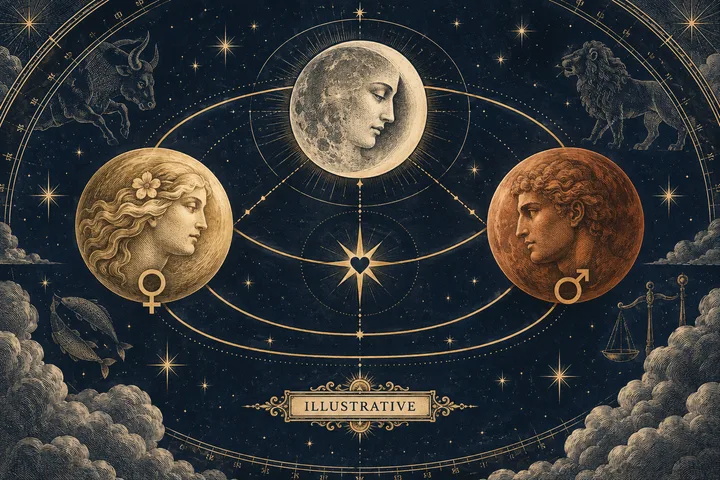
What is actually happening in the sky on November 17?
Use 12:00 UTC as the reference for the Moon’s daily position: the date-specific table rounds it to 27° Aquarius then. AstroAk’s November 2026 ephemeris gives Venus at 23°02 Libra, Mars at 26°12 Leo, and Jupiter at 25°56 Leo in its 00:00 UT row; those exact degrees are a midnight snapshot, not noon positions. AstroAk and the separate Daily Planetary Positions 17 November 2026 page keep the Moon in Aquarius through their listed daytime snapshots, though the latter rounds positions to whole degrees and gives a different midnight Moon degree. The agreement supports the sign and broad movement, not an exact personal contact.
Astrotexts’ Tuesday 17 November entry lists the Moon trine Venus at 07:44, opposite Jupiter at 13:29 and Mars at 14:26, then entering Pisces at 21:21. These timed contacts describe a changing shared sky: an early Venus aspect followed by two afternoon contacts with planets in Leo. Astrotexts reports GMT; on this date, Europe/London is at UTC+0, so its times match UTC. AstroAk independently lists the Mars opposition at 14:26 and Pisces ingress at 21:20 UTC. Report the ingress as approximately 21:20–21:21, not as a meaningful one-minute divide. The event times locate each contact; compare a natal placement only with the moving position at that time.
The ephemerides describe the shared sky, not anyone’s natal chart. To make the reading personal, compare the timed positions with known natal degrees; without them, stay with broad sign symbolism.
Sources: Daily planetary positions 17 November 2026 – Astrological Ephemeris (00:00 UTC); November 2026 Ephemeris: Daily Planet Positions · AstroAk; Tuesday 17th November 2026 · The Daze Astrological Commentary; Horizons System
What does the morning Moon–Venus trine offer in love?
At 07:44 UTC, the Aquarius Moon trines Venus in Libra. Read this as a brief opening for friendly warmth, graceful affection, and an easier exchange of preferences, not as a promise that every couple will agree or feel romantic. The date-specific event calendar in Astrotexts places both bodies at 23 degrees when the trine perfects. In a modern relationship reading, the Moon describes the immediate emotional tempo: what feels close, familiar, or responsive in the moment. Venus describes attraction, affection, taste, and the ways we offer or receive pleasure. A trine is commonly read as a flowing connection between two parts of the chart. It can make a response easier to give, but ease is an opening, not an outcome. Astrodienst’s “What are transits?” makes this point directly: supportive aspects still need participation to become meaningful. The signs add texture. Aquarius and Libra are both air signs in the tropical zodiac, so this article reads their connection through conversation, perspective, fairness, and social ease. The Aquarius Moon can invite a little room to think and an exchange between equals; Libra Venus can favor courtesy, mutual regard, and the pleasure of meeting halfway. Together, that symbolism suits a friendly check-in, a thoughtful message, or a simple invitation that leaves space for an honest answer. In practice, that can mean asking a clear question, hearing the answer without rushing to correct it, and making a plan both people actually want. These are interpretive themes for the shared sky, not a script assigned to either partner. The distinction between a sky aspect and a personal transit matters here. At 07:44, the Moon and Venus form an exact transit-to-transit trine: two moving bodies relate to each other in the day’s sky. A transit-to-natal reading asks a different question. It compares a moving body with a specific known point in someone’s birth chart. If the morning Moon or Venus also makes a close aspect to your natal Moon or Venus, that can give the day’s symbolism a more personal focus. You need the actual natal sign and degree to establish that contact; knowing only that someone is an Aquarius Moon or Libra Venus does not show whether the dated aspect is close to their placement. Astrodienst describes the transiting planet as the active symbol, the natal point as the chart factor engaged, and the aspect as the relationship between them. That method keeps the broad atmosphere separate from an individual reading. There is a real exception to the easy-reading interpretation. A trine may smooth the first exchange, yet it cannot settle a disagreement that has been avoided, make an absent partner available, or substitute for listening. Someone may want a warm message while the other needs quiet. Someone may offer a plan that feels generous to them but too quick for the other person. The chart does not erase those differences. It can, however, help you notice where an invitation might land gently and where you should leave room for the answer to be no, not yet, or something else. Try one small, direct move in the morning: say what kind of attention would feel good, then ask what would feel good to the other person. “Would you like to talk over breakfast, or would a little quiet time suit you better?” keeps the choice mutual. The value is in the exchange, not in staging a perfect Venus moment. If the conversation reveals different preferences, take that as useful information. The trine’s promise is modest but worthwhile: a little more grace around the ask. Whether that becomes closeness depends on both people taking part.
Sources: Tuesday 17th November 2026 · The Daze Astrological Commentary; What are transits? · Astrodienst FAQ
Why do the afternoon oppositions change the tone?
The Moon opposes Jupiter at 13:29 UTC and Mars at 14:26 UTC, both in Leo. Astrologically, this sequence asks for room to express enthusiasm without mistaking intensity for agreement. Astrotexts lists the contacts in this order. AstroAk’s November ephemeris places Jupiter at 25°56 Leo and Mars at 26°12 Leo at 00:00 UT, supporting a close pair of Leo placements behind the afternoon sequence. In a modern relationship reading, the Moon describes the immediate emotional weather: what feels pressing or worth responding to now. Jupiter enlarges the field. It can signify confidence, appetite, generosity, or the wish to make more room for a hope. In Leo, that growth may take a visible form: a grand invitation, a warm declaration, or a desire to celebrate. A larger gesture may feel generous to one person and overwhelming to another. The opposition asks how emotion meets that expansive impulse. The next contact turns the emphasis toward Mars. Mars signifies assertion, pursuit, desire, and the energy used to act; in Leo, that action may seek a clear response or a chance to take the lead. As the Moon opposes Mars, a feeling can move quickly toward expression. Someone may state a want or react strongly to a different answer. That is a symbolic possibility, not a forecast of an argument. The same contact can support direct affection, lively play, or the courage to propose something both people want. An opposition places two modes of response across from each other. Aquarius symbolism often values perspective, independence, and room to consider the larger pattern. Leo symbolism wants heartfelt expression, recognition, and creative presence. Neither side is wrong. One person might want an enthusiastic display while the other needs time or a quieter form of closeness. Ask whether the expression leaves room for the other person to answer freely. Astrodienst’s transit guide describes transits as moving contacts to natal chart factors and urges context. Here, the Moon’s oppositions to Jupiter and Mars describe the shared sky. They do not establish a close natal contact for either partner. That requires comparing moving positions with verified natal degrees and naming the aspect and orb. Someone with a late fixed-sign Moon, Venus, or Mars might connect more closely with this sequence, but the sign label alone cannot confirm it. There is a strong alternative reading. Jupiter can bring generosity and optimism, while Mars can give a couple the nerve to be candid. If both welcome the same plan, the afternoon may feel animated rather than tense. The actual exchange and close natal contacts can change the reading. Before escalating a disagreement or making a large romantic gesture, ask whether you both want the same pace and scale. Enthusiasm helps when it invites an answer; it becomes pressure when a strong feeling gets mistaken for proof of agreement.
Sources: November 2026 Ephemeris: Daily Planet Positions · AstroAk; Tuesday 17th November 2026 · The Daze Astrological Commentary; What are transits? · Astrodienst FAQ
What information do you need before applying the day to your chart?
For a personal comparison, start with verified tropical sign and degree for each person's natal Moon, Venus, and Mars, plus the moving planet, aspect, and chosen orb. Signs offer broad symbolism; they can't confirm a close dated contact. Without a natal degree, you can explore themes but can't confirm whether it makes a close contact to either chart.
Astrodienst’s “What are transits?” defines a transit as a current planetary position forming an aspect to a natal chart point. The transit is the moving sky factor; the natal placement is the birth-chart factor it meets. An aspect describes their angular relationship. A daily forecast describes the shared sky, while a personal transit reading asks how it meets a particular chart.
A sign tells you the zodiac area a placement occupies and gives broad symbolic language. A degree locates it more precisely. Knowing your natal Venus is in Leo doesn't tell you whether the November Moon in Aquarius reaches it by opposition that afternoon. Compare degrees and identify their angular distance. The aspect names the relationship; the orb is how far positions may be from the exact angle and still be read together. Sign information starts an interpretation, but cannot establish whether this date's Moon forms a close contact.
The Moon shifts over a day. A placement listed at midnight UTC describes that moment, not the whole date. This forecast uses 12:00 UTC as its daily reference and records lunar events across the UTC day. Compare a natal point with the morning Moon using its morning position, or with afternoon contacts using those positions. A degree read at one time shouldn't be carried through every hour as if the Moon stood still.
Gather each person's known natal Moon, Venus, and Mars sign and degree. The Moon speaks to emotional response, Venus to affection, and Mars to desire or assertion. These meanings guide interpretation; they don't prove what someone will feel or do. Astrodienst advises reading a transit in natal context, not relying on keywords. Ask which point is contacted. A contact to Venus raises a different symbolic topic from one to Mars.
Houses and angles require a chart calculated for relevant birth details, so this reading doesn't add them. None are supplied. Keep the comparison to verified planetary placements. If a natal degree is unknown, leave the exact-contact question open rather than guessing. Discuss sign symbolism as resonance, not a confirmed dated aspect. Don't fill gaps with an assumed birth time or invented placement.
The supplied-placement Synastry Comparison Report compares known Moon, Venus, and Mars signs and optional degrees. Its selected major-aspect comparisons use a stated six-degree orb. That allowance belongs to the report's method, not every astrologer's rule. The report doesn't calculate natal placements from birth details. Decide whether signs answer your question or degrees support closer comparison. If information is missing, name that limit and stay within what the supplied placements support. Record the known sign, degree, transit time, and missing input. This shows what remains open.
At 12:00 UTC, the rounded daily ephemeris places the Moon at 27° Aquarius. The timed sequence is a Moon–Venus trine at 07:44, oppositions to Jupiter at 13:29 and Mars at 14:26, then the Moon’s Pisces ingress around 21:20–21:21 UTC. In this love reading, the morning can ease an exchange of affection; the afternoon may bring enthusiasm, desire, or different preferred paces into view; late evening changes the tone. These are shared-sky themes, not predictions. To relate them to your charts, compare the Moon’s positions at the relevant times with each person’s known natal Moon, Venus, and Mars degrees, then state the aspect and orb. Signs alone cannot confirm a close contact. Use the sequence to ask what attention feels welcome and where each person wants room, then let their answers guide the next step.
Sources: What are transits? · Astrodienst FAQ
How can you compare the sky with known Moon, Venus, and Mars placements?
To compare the day with known placements, keep two layers separate. First read the sky as a shared pattern: on November 17, the Moon moves through its contacts with Venus, Jupiter, and Mars. Then ask whether those moving positions form close aspects to either person's natal Moon, Venus, or Mars. In the transit method described in “What are transits?”, the moving planet describes the active theme, the natal point shows what part of the chart is engaged, and the aspect describes how they meet. That sequence gives you a way to read the date without turning it into a forecast of anyone's behavior. Begin with the shared sky. The Moon's trine to Venus offers a brief opening for affection and ease; its later oppositions to Jupiter and Mars bring a more visible exchange of enthusiasm, desire, and personal space. These transit-to-transit contacts belong to the date itself. Note the event and its time before moving to the natal charts. A morning aspect and an afternoon aspect don't have to mean the same thing, even though the Moon carries the thread between them. Next, compare each moving position with each person's known natal placements. The Moon speaks to emotional response and felt security; Venus points to affection, attraction, and what a person values; Mars describes pursuit, desire, and assertion. The same transiting Moon can contact one person's Venus and the other's Mars. In the first chart, you might explore how the day's mood meets that person's style of showing affection. In the second, you might ask how initiative or desire is being stirred. The planets don't reveal hidden motives. They give you different questions to bring to the conversation. Imagine someone whose natal Moon is in late Aquarius. The day's Aquarius Moon may echo that placement by sign, and if the natal degree is close to the moving Moon at the relevant time, an exact or near-exact contact may add emphasis in a degree-based reading. Now imagine another person with an Aquarius Moon far from the active degrees. The shared sign symbolism still offers a broad point of comparison, but it doesn't establish a close aspect. Without the natal degrees, don't turn “same sign” into “exact contact.” Last, rank what you find. Start with the closest verified aspect, then ask whether its natal planet matters to the question you're exploring, and note whether another contact repeats or changes the theme. “What are transits?” advises readers to identify the exact aspect and synthesize it with natal context rather than match isolated keywords. Applied here, that means a close contact to one partner's Venus deserves more weight for a question about affection than a loose sign resemblance elsewhere. It tells you where to look first. A simple comparison record can keep the reading clear: write down the moving planet and event time, the natal planet it contacts, the aspect, and the degree separation. Then describe the theme as a question, not a conclusion. For example: “The day's Moon is close to your Venus; what kind of attention would feel welcome?” If the contact is to Mars, ask what pace of initiative feels good. If it touches the natal Moon, ask what helps each person feel heard. These prompts leave room for the actual relationship, which a transit cannot speak for on its own. Keep the evidence in proportion. Signs can suggest a broad resonance; degrees establish whether a dated aspect is close. A couple can compare where attention may be drawn, then decide together whether the theme fits their day. The comparison stays symbolic and specific to the placements you actually know.
Sources: What are transits? · Astrodienst FAQ
What changes when you compare degrees instead of signs?
Degrees show whether a broad sign connection is also a close aspect on this date. At midday UTC, the Moon is in late Aquarius while Mars and Jupiter are in late Leo. The opposition is clear, but a personal contact depends on the degree of the natal planet. Late-degree placements may sit closer to the active positions than placements elsewhere in those signs. Start with signs, then check degrees before calling a transit personal. A sign describes a 30-degree stretch of the zodiac. An aspect measures the angular distance between two positions. Aquarius and Leo are opposite signs, across the zodiac from one another. But “Aquarius opposes Leo” only gives a broad relationship. It doesn't tell you whether today's Moon sits close to opposition with your natal Venus or falls outside the range you use. That distinction matters when asking how the shared sky meets a known placement in one person's chart. AstroAk's “November 2026 Ephemeris: Daily Planet Positions” gives the Moon at 19°10 Aquarius at 00:00 UT on November 17, with Mars at 26°12 Leo and Jupiter at 25°56 Leo. These are midnight positions, not an all-day snapshot. The Moon moves quickly through Aquarius, so its midday degree differs. A personal comparison needs a date and reference time. Late Aquarius and late Leo describe the broad pattern; degree comparison shows how close a specific contact is. Astrodienst’s “What are transits?” defines a transit as a moving planet forming an aspect to a natal point. The moving body marks the symbolic prompt, the natal planet shows which chart function is engaged, and the aspect describes how they meet. Here, compare the Moon with a person's natal Moon, Venus, or Mars. Degree distance distinguishes a close opposition from sign-level resonance. The sky's transit-to-transit opposition is shared; it becomes transit-to-natal only when someone's placement is near the relevant degree. For example, imagine two people with natal Venus in Leo, one near the degrees contacted by the day's Moon and the other much earlier in the sign. Both share a broad Leo-Venus theme, but the first may have a closer lunar contact during this window. This is an illustration, not a claim about anyone's chart. The same distinction applies to natal Moon or Mars. A close contact to one partner's Venus and a loose sign resemblance in the other's chart are not equal evidence, and neither reveals what either person intends. Use an orb as a stated working range around an exact aspect, not a guarantee. The Synastry Comparison Report includes selected major aspects within its six-degree orb; that is the report’s method, not a universal rule. A tighter contact is a more specific degree match than one near the edge, but neither predicts an outcome. Astrodienst’s transit guide emphasizes the moving planet and natal chart context, so consider the planet, aspect, and actual placement together. To check the geometry, measure the smaller angular separation between the positions. An opposition is exact at 180 degrees; the difference from exactness is its orb. You need the actual natal degree and transit time, whether you calculate the distance or consult a verified aspect table. Signs alone cannot establish an exact aspect. Because the Moon moves quickly, a contact can move toward exactness and then separate during the day. Check precise positions at the relevant times; don't guess direction from rounded signs or a midnight row. The practical ranking is simple: give most weight to a verified close degree contact, read the planet and aspect together, then use sign symbolism to color the interpretation. Sign-only similarity is context, not proof that a transit touches both charts in the same way. With signs alone, reflect on the broad Aquarius-Leo contrast. With verified degrees, compare them to the date-specific positions and state the orb. That turns a general forecast into a precise chart question, not a relationship verdict.
Sources: Daily planetary positions 17 November 2026 – Astrological Ephemeris (00:00 UTC); November 2026 Ephemeris: Daily Planet Positions · AstroAk; What are transits? · Astrodienst FAQ
What does the evening move into Pisces add—and what can the forecast conclude?
The Moon enters Pisces at about 21:20–21:21 UTC, after its final listed opposition to Mars. That shift matters because the day has not held one emotional weather pattern from morning through night. Astrotexts’ “Tuesday 17th November 2026” entry places the Moon’s trine to Venus at 07:44, its oppositions to Jupiter and Mars at 13:29 and 14:26, then its Pisces ingress at 21:21. AstroAk’s “November 2026 Ephemeris” gives the Mars opposition at 14:26 and the ingress at 21:20 UTC. The one-minute difference is small, but it is a good reason to say “around 21:20” rather than pretend the sources agree to a single exact minute. Both records show a clear sequence: an easier opening for affection, a more charged middle, then a change of tone late in the UTC day.
In a modern astrological reading, Pisces brings a softer, more receptive quality to the Moon’s expression. It can make room for tenderness, imagination, quiet care, or a wish to let a sharp exchange settle. That does not erase what came before. AstroAk lists the Moon’s opposition to Mars as the last exact lunar contact before Pisces begins, and its table defines the intervening void-of-course period by the Moon’s final aspect to a planet from the Sun through Saturn, ending at the sign change. This is a timing convention, not a prediction that nothing can happen or that a relationship pauses. The useful reading is simpler: the day’s evening atmosphere changes, while the conversations and choices already made remain part of the day.
The supported verdict is therefore a day with distinct phases, not a single verdict about love. The morning Moon–Venus trine can lend ease to expressing what feels pleasant. The afternoon oppositions to Jupiter and Mars can make enthusiasm, desire, or irritation more visible and call for a little moderation. By late evening, the Moon’s move into Pisces favors a gentler register for reflection or reconnection. These are symbolic invitations, not guaranteed scenes. An opposition can describe lively mutual engagement as readily as tension, especially when both people welcome directness and share the same pace. And a trine can pass quietly, offering ease without becoming the day’s main story. The strongest alternative is that the couple’s own plans and circumstances matter more to their experience than a general transit description. That is fair: the shared sky gives context, not a script.
A close transit-to-natal contact could make the shared theme more personally specific: a contact to Venus may focus attention on affection, while one to Mars may foreground assertion or desire. These are conditional examples; no individual charts, houses, locations, or relationship histories are supplied. Exact natal degrees are needed to identify a contact, and a transit cannot tell you what a partner intends or whether a relationship is right. Notice the day’s changing tone, then let each person’s words and choices guide what happens next.
The UTC frame also keeps the forecast’s ending in proportion. “Evening” here means the final hours of November 17 in the stated UTC day; a reader elsewhere may experience the ingress at a different local clock time, even though the event is the same. Astrotexts labels its calendar times as UK time, and its page states that its times are GMT. AstroAk independently lists the ingress in UTC and explains that its daily positions are tropical and geocentric, with rows set at 00:00 Universal Time. A midnight row cannot stand in for the Moon’s position at night, so the timed ingress is more useful for this final turn than the day’s opening degree. This distinction also explains why the article can describe a shared symbolic change without claiming a personalized forecast for every location or chart. The sign change supports the interpretive transition; it does not establish that every couple will feel softer, that a disagreement will resolve, or that a particular message should be sent. If the evening has been warm, enjoy that warmth. If a conversation still feels unsettled, let the real words exchanged guide what happens next. Astrology offers a meaningful lens for the moment, while the conclusion stays modest: the daily pattern closes in Pisces after a more outward, forceful stretch.
Sources: November 2026 Ephemeris: Daily Planet Positions · AstroAk; Tuesday 17th November 2026 · The Daze Astrological Commentary; What are transits? · Astrodienst FAQ; Horizons System
What conversation can you start with this reading?
Ask: “What kind of affection or attention would feel good today, and where do we each want a little more room?” The morning Moon–Venus trine in Astrotexts’ event calendar offers a prompt to name what feels warm or welcome. Later, the Moon’s oppositions to Jupiter and Mars invite care around enthusiasm, desire, and pace. Neither transit speaks for your partner. Listen for the difference between a gesture one of you enjoys and one you both want, then choose a pace that leaves room for both.
If you know each person’s tropical Moon, Venus, and Mars degrees, compare them with the day’s positions and note any close aspects. Keep the question modest: which themes might each person notice, and what would be useful to ask? The interpretation becomes personal only when the degrees support that contact. If you know signs but not degrees, stay with broader symbolism. You don’t need to guess at a birth time or turn a sign into a promise.
The Synastry Comparison Report uses supplied Moon, Venus, and Mars placements, with optional degrees. It doesn’t calculate natal charts from birth details. Use it if comparing placements would help frame this conversation. Otherwise, the question itself is enough. Let what each of you says shape the next step.
Sources: Tuesday 17th November 2026 · The Daze Astrological Commentary; What are transits? · Astrodienst FAQ
A little more clarity
Can signs alone show whether November 17’s transits contact my natal Moon, Venus, or Mars?
No. Signs offer broad symbolism, but confirming a close dated contact requires the natal degree, the transit position at the relevant time, and a stated orb.
Sources & further reading
- Daily planetary positions 17 November 2026 – Astrological Ephemeris (00:00 UTC)
The opened page labels its snapshot 17 November 2026 at 00:00 UTC and gives rounded tropical/geocentric positions; its hourly Moon table lists Aquarius at 21° at 00:00, 24° at 06:00, 27° at 12:00, and 29° at 18:00. It supports the rounded noon Moon position and that the Moon remains in Aquarius at those listed snapshots, not exact aspect times.
- November 2026 Ephemeris: Daily Planet Positions · AstroAk
The opened tropical, geocentric table specifies daily rows at 00:00 Universal Time and lists 17 November positions including Moon 19°10 Aquarius, Venus 23°02 Libra, Mars 26°12 Leo, and Jupiter 25°56 Leo. Its timed events list the Moon–Mars opposition at 14:26 UTC and Pisces ingress at 21:20 UTC; these are source-specific values, not noon positions.
- Tuesday 17th November 2026 · The Daze Astrological Commentary
The opened date entry lists the Moon trine Venus at 07:44, opposition to Jupiter at 13:29, opposition to Mars at 14:26, and Pisces ingress at 21:21. The page identifies its times as GMT.
- What are transits? · Astrodienst FAQ
The opened FAQ describes a transiting Moon forming an aspect to a position in a natal horoscope and explicitly distinguishes the moving/transiting planet from the natal planet. It supports the article’s transit-to-natal terminology, not the dated 2026 event calculations or interpretive outcomes.
- Horizons System
The opened JPL manual says Horizons users should check settings such as timescale, coordinate system, and output quantities, and documents available time scales. This supports caution that ephemeris output depends on specified settings; it does not verify the article’s astrology tables or aspects.
Synastry Comparison Report
Enter known placements for two people. Get an input-by-input comparison, selected aspect calculations and a clear record of what remains uncertain.
Compare our placements