What is actually in the sky on November 4 UTC?
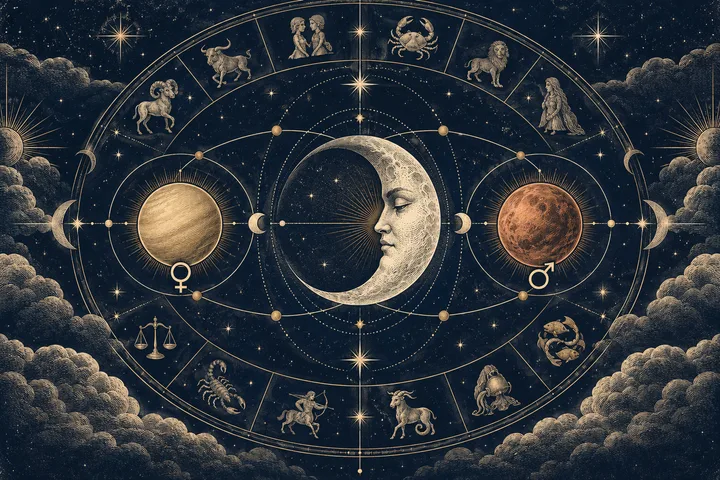
Start with the clock. This reading uses the tropical, geocentric zodiac and the UTC civil date, with positions sampled at 12:00 UTC. In the opened daily calendar, the Moon is at 15°23′ Virgo, Venus is retrograde at 24°42′ Libra, and Mars is at 20°22′ Leo. Jupiter is also in Leo, at 24°44′; the Sun and retrograde Mercury are in Scorpio at 12°05′ and 12°19′. These are the day's shared placements, not a map of either partner's birth chart. The reference time matters because planets move, and the Moon moves. The November 2026 Ephemeris from AstroAk lists positions at 00:00 UT: its Moon is at 8°42′ Virgo, while Venus, Mars, Jupiter, the Sun, and Mercury are still in the same signs as at noon. The Daily Planetary Positions ephemeris likewise shows the Moon at Virgo 09° at 00:00 and Virgo 15° at 12:00, with its values rounded to whole degrees. These tables support the sign picture and show why an exact degree needs a stated hour. They also confirm that the Moon remains in Virgo through this UTC date. So the day's baseline is a Virgo Moon, Libra Venus, and Leo Mars, set against Scorpio Sun and Mercury. Read those placements as the sky for November 4. They establish signs and positions at a stated time; they don't supply natal houses, personal Moon, Venus, or Mars placements, or a synastry comparison. To call a transit personal, compare it with a verified degree someone has supplied. Until then, this is the shared weather of the day, ready for interpretation but not a verdict about a couple.
On November 4, 2026, the Moon stays in Virgo throughout the UTC day, while Venus retrograde in Libra forms a sextile with Jupiter in Leo at about 10:20 UTC. In astrological symbolism, the Moon points to passing emotional needs, so Virgo favors practical, attentive care; Venus–Jupiter can frame shared pleasure and generosity, with fairness as a useful check. The Sun meets Mercury in Scorpio later, around 14:25 UTC, a symbolic prompt for focused conversation. Mars remains in Leo, adding a separate lens on initiative and expression. These are shared transits, not personal predictions or relationship verdicts. Compare them with known Moon, Venus, or Mars placements for broad themes; a personal contact requires verified natal degrees, a defined aspect, and a stated orb. For today, choose one welcome, practical gesture or fair conversation and let the other person’s response—not the horoscope—guide what follows.
Sources: 4 November 2026 — name days, holidays and the day's sky; November 2026 Ephemeris; Daily Planetary Positions
Which events carry the clearest relationship symbolism?
Four exact aspects shape November 4, but they do different work. The clearest relationship-centered one is Venus sextile Jupiter at 10:20 UTC. The Moon's sextiles to the Sun at 05:34 and Mercury at 06:58 set an earlier tone, while the Sun's conjunction with Mercury at 14:25 brings focused words later. These are moments when moving bodies form exact angular relationships, not promises that a particular event will happen. The November 2026 Sky Calendar lists the four times in UTC and gives positions at each exact aspect. It defines major aspects as exact conjunctions, sextiles, squares, trines, and oppositions between moving bodies; its displayed times are rounded to the nearest minute. The November 4 calendar from Book of Horoscopes independently places the Sun–Moon sextile at 05:33, the Moon–Mercury sextile at 06:57, and the Sun–Mercury conjunction at 14:24 UTC. Their times differ by about a minute. In astrological interpretation, Venus–Jupiter in sextile suggests ease, generosity, and room for pleasure in relating. Yet the Virgo Moon gives the day a practical register: affection may land best as useful care, a thoughtful check-in, or a plan both people can enjoy. The symbolism doesn't require a grand gesture. Generosity works better when it respects what each person wants. The Moon's contacts with the Sun and Mercury occur early in the UTC day. Read together, they connect feeling with attention and speech: notice what needs care, then find clear words for it. Later, the Sun–Mercury conjunction in Scorpio favors a concentrated conversation. Candor can help when it stays focused on the matter at hand rather than turning into pressure to disclose everything. Venus–Jupiter is the strongest love theme because Venus speaks directly to attraction, pleasure, and exchange. But the Moon's Virgo tone qualifies that expansive symbolism. A generous offer isn't automatically a fair one, and enthusiasm isn't the same as mutual agreement. Does the gesture feel welcome to both people? Can each say what would make the exchange comfortable? Treat exact aspect times as a map of the shared sky. The Moon contacts are brief, while Venus–Jupiter develops more slowly; its exact time marks a peak, not the only hour when its symbolism can be considered. These transits describe a collective backdrop. A personal reading would require checking whether their degrees contact a supplied natal placement. For November 4, choose proportionately: offer practical care, enjoy something together if it suits you both, and use the day's focused tone for one fair conversation.
Sources: November 2026 Sky Calendar; 4 November 2026 — name days, holidays and the day's sky
Why does the Moon set the day's emotional tempo?
The transiting Moon describes the emotional weather moving through the day; your natal Moon describes a more enduring pattern in how you seek comfort, respond by instinct, and recognize what feels familiar. Keep those layers distinct. On November 4, the Moon travels through Virgo throughout the UTC day, according to the AstroAk November 2026 Ephemeris. That gives the shared emotional tone a practical, observant quality. It can draw attention to small acts of care and useful adjustments. It doesn't tell us what either partner is like all the time. Astrology.com’s “Moon Planet Meaning in Astrology” connects the Moon with mood, instinct, feeling, memory, and the way emotions shape daily life. The Moon moves quickly through the zodiac, so its sign offers a short-lived lens. A natal Moon belongs to the birth chart and remains a reference point. The transiting Moon describes what is emphasized now; it doesn't replace the natal placement. Put Virgo's symbolism beside those lunar themes and the emphasis becomes specific: care may be easier to recognize when it is attentive and practical. A partner might ask what would make the evening run more smoothly, remember a small preference, or follow through on a task. These are illustrations, not predictions. Virgo's discerning quality can also turn into over-editing if every detail becomes a fault to correct. The useful expression is thoughtful attention. The strained expression is treating a person as a problem to fix. That distinction keeps a general horoscope humane. If one of you has a natal Moon in Virgo, the shared transit may feel symbolically familiar, but the sign match alone doesn't establish a precise personal contact. A natal Moon's house, degree, and aspects would add chart context; this daily reading hasn't calculated them. If your Moon is in another sign, the Virgo transit still describes the same passing sky. It doesn't assign you a new emotional style. For a couple, the practical question is simple: what small, observable act would help today feel easier for both of you? Ask, listen, and let the answer guide the gesture. It can't tell you what the other person feels without their words, and it shouldn't be used to label their character. Let the transiting Virgo Moon set a temporary tempo; let each person's known natal Moon remain a separate part of the comparison.
Sources: Moon Planet Meaning in Astrology; November 2026 Ephemeris
How should readers handle the Virgo Moon and its timing?
For the UTC day of November 4, the Moon stays in Virgo. It does not enter Libra until November 5, at about 14:39 UTC in AstroAk’s November 2026 Ephemeris. A sign ingress is the moment a moving body crosses from one zodiac sign into the next. The day’s Moon therefore carries Virgo symbolism from 00:00 through 23:59 UTC, even though its degree changes throughout those hours. Read the date in that frame before applying the interpretation: this is a Virgo Moon day, not a Libra Moon day. AstroAk places the Moon’s final qualifying aspect before that ingress at a sextile to Mercury, with the void beginning near 06:57 UTC. WitchcraftDaily’s November 2026 Sky Calendar lists the Moon–Mercury sextile at 06:58 UTC and the Libra ingress at 14:38 UTC the next day. The calendars agree on the sequence, with about a minute between rounded timestamps. AstroAk states that its void-of-course start is approximate and its end is the sign ingress; WitchcraftDaily says its event times are rounded to the nearest minute. So “near 06:58” is the useful precision, not a claim that every calendar must display the same minute. In AstroAk’s classical method, the void-of-course interval begins after the Moon’s last exact aspect to a planet from the Sun through Saturn and ends when the Moon changes sign. By that rule, the Moon is void for most of November 4, from the early morning sextile until it enters Libra the following afternoon. This is one astrological timing convention; other calendars may define it differently. Check the rule before comparing labels. And a void Moon is not an order to cancel a conversation or withhold affection. It marks a phase in the chosen timing system, not a ban on ordinary choices. A calendar using another civil time can make the same sky look as though it belongs to a different date. Cafe Astrology’s 2026 ephemeris labels its table in Eastern Standard Time, while the two event calendars above use UTC. For example, UTC−5 places 06:58 UTC at 01:58 on November 4 in EST, but places the next day’s 14:39 UTC ingress at 09:39 on November 5. The underlying event hasn’t moved. Only the clock label changes. Compare timezone, reference hour, and the stated void-of-course method before deciding that two calendars disagree. For love, the Virgo sign remains the broad lunar backdrop after the void begins. Use the symbolism to make care concrete, but reserve personal claims for known placements and degrees. A local app’s date display can clarify timing without changing the shared reading.
Sources: November 2026 Ephemeris; November 2026 Sky Calendar; 2026 Ephemeris
What does Venus retrograde in Libra add to the reading?
Venus retrograde in Libra brings the question of balance back into view: what each person values, how affection is exchanged, and whether the terms of relating still feel fair. In astrology, retrograde describes Venus's apparent backward motion against the zodiac. Its meaning here is interpretive. The accessible article “Venus Retrograde in Libra and Scorpio 2026: Dates, Meaning, and Horoscopes” associates this passage with honesty, fairness, boundaries, and renegotiation. That gives November 4 a reflective tone, but it doesn't say what either partner intends or what will happen next. The day's exact Venus–Jupiter sextile adds another layer. The “November 2026 Sky Calendar” places it at 10:20 UTC, with Venus at 24°44′ Libra and Jupiter at 24°44′ Leo; “4 November 2026 — name days, holidays and the day's sky” also lists the sextile among the day's events. In a modern symbolic reading, Venus speaks to attraction, pleasure, values, and relating. Jupiter enlarges what it touches, so this easy aspect can suggest warmth, generosity, or a wish to share enjoyment. Libra gives that generosity a test: is the exchange pleasing to both people, or is one person carrying the effort? That question matters because expansion can feel generous and still go too far. A grand gesture may delight both partners, or it may outrun the trust, time, or resources they actually share. Astrology.com's discussion of Venus retrograde in Libra stresses resetting expectations and renegotiating boundaries; its note on the November 4 sextile says social desires may expand, while not every connection merits continued investment. Taken together, those interpretations favor measured openness. Enjoy what feels good, then check whether the give-and-take remains mutual. A sextile describes a supportive symbolic opening, not a guarantee that every offer will be welcomed. For a practical reading, pick one expectation or agreement that already matters. Ask whether it feels fair to both of you, and listen to the answer before proposing a larger promise. If you have only sign placements, Libra and Leo symbolism can frame a broad theme of sociability, warmth, and balance. It can't establish a personal contact by itself. If you know accurate natal degrees, the day's Venus and Jupiter degrees can be compared with them under a stated aspect and orb; only then can this transit be discussed as a contact to a particular chart placement. Either way, the most useful expression of the symbolism is simple: offer affection without keeping score, and make room for an honest revision if the terms no longer fit.
Sources: Venus Retrograde in Libra and Scorpio 2026: Dates, Meaning, and Horoscopes; November 2026 Sky Calendar; 4 November 2026 — name days, holidays and the day's sky
How do Moon, Venus, and Mars answer different relationship questions?
Moon, Venus, and Mars describe different parts of relating, so read them as three questions rather than competing verdicts. The Moon asks what feels emotionally nourishing and instinctive response. Venus asks attraction, values, and affection. Mars asks how desire becomes action: who initiates, asserts a need, or meets friction. The Astro.com article on Venus, Mars, and Moon relationship symbolism links the Moon with emotional responses, Venus with attraction and pleasure, and Mars with drive and action. Name the concern, then choose the placement that speaks to it.
On November 4, the transiting Moon is in Virgo, Venus retrograde is in Libra, and Mars is in Leo. These are shared sky positions, not either partner's natal placements; the day's Mars is not a reader's natal Mars. The Astrology.com Moon reference associates the Moon with feelings, instinct, memory, and emotional needs. Applied to Virgo, the reading turns toward practical care: what small act would help, ? This is interpretation, not a claim that everyone feels alike.
Venus in Libra brings another question: does the exchange feel fair, pleasurable, and mutual? The Astrology.com article on Venus retrograde in Libra and Scorpio frames the period around reviewing relationship terms, balance, honesty, and boundaries. Venus sextiles Jupiter on November 4, in the daily event calendars. This can suggest generosity, while Libra asks whether both people welcome it. Generosity alone doesn't establish reciprocity. A grand gesture that ignores someone's wishes isn't wise simply because Venus and Jupiter form a sextile.
Mars in Leo adds the action-and-desire lens. Astro.com links Mars with pursuit, drive, and action. Here, expressive initiative might mean making an invitation. This can fit Venus in Libra when initiative leaves room for an equal response. It can pull against it if one person takes center stage and calls that mutuality. The Virgo Moon offers a check: does the gesture meet a real need, or is it mainly dramatic? This compares symbols, not behavior.
Keep the lenses separate before combining them. For emotional comfort, begin with the Moon; for attraction, pleasure, or fairness, Venus; for desire, pursuit, or conflict, Mars. On this date, make care tangible, review whether pleasure and effort are shared, and express initiative warmly. These are prompts, not evidence of another person’s hidden wishes. A transit-to-natal contact can make a theme more personal when verified degrees and a stated orb support it. That's a separate step. Signs alone keep the reading broad. Match the placement to your concern, then check the chart information you have.
Sources: Astrology and the Venus-Mars-Moon Connection; Moon Planet Meaning in Astrology; Venus Retrograde in Libra and Scorpio 2026: Dates, Meaning, and Horoscopes
When do these transits touch a reader's own chart?
A transit becomes personal here when its verified position forms a defined aspect to a natal placement you already know. The shared sky sets the day’s symbolism; your chart supplies the point of contact. A sign match can suggest resonance, but it cannot prove that a particular aspect is active. If you know only signs, keep the reading broad. Don’t claim a conjunction, sextile, square, trine, opposition, or house activation without information to establish it. The November 2026 Ephemeris: Daily Planet Positions · AstroAk gives geocentric tropical positions at 00:00 UT. Its November 4 row places the Moon at 8°42′ Virgo, Venus retrograde at 24°53′ Libra, and Mars at 20°07′ Leo. The daily ephemeris for November 4 from Zodiac Astrology Horoscopes also lists the Moon’s hourly positions: Virgo 9° at 00:00, 12° at 06:00, 15° at 12:00, and 18° at 18:00 UTC. These moving positions show why a reference time matters. To check a personal contact, compare the transit’s longitude at the chosen time with the longitude of the supplied natal Moon, Venus, or Mars. An aspect is an angular relationship between two chart positions. Convert each position to ecliptic longitude, then measure the smaller angular separation. A conjunction is near 0°; a sextile, 60°; a square, 90°; a trine, 120°; and an opposition, 180°. The difference between the measured angle and the exact aspect angle is the orb. The Synastry Comparison Report uses a maximum six-degree orb for selected major aspects. That is the report’s working rule, not a universal law shared by every astrological tradition. A closer contact is more exact under this method; a wider one within the limit still qualifies, but should be described with its distance from exactness. For example, if your natal Moon’s verified degree is close enough to the transiting Moon’s degree to fall within the chosen conjunction orb, you can discuss a Moon-to-Moon transit contact. If you know only that both are in Virgo, you have a sign-level echo, not proof of a conjunction. Signs describe shared symbolism; degrees show whether two specific points meet by aspect. Neither tells you what another person intends or guarantees what will happen. Birth time and place matter for houses and angles. Without reliable details, don’t assign a transit to someone’s seventh house or claim an Ascendant contact. The report works from placements you provide, with optional degrees; it doesn’t calculate natal charts from birth details. Use signs for a broad theme, and make a personal transit-to-natal reading only when supplied degrees support the contact.
How can the day's transits be compared with known Moon, Venus, and Mars placements?
Begin with the question, then choose the matching planet. If the concern is what feels emotionally supportive, compare the day's Virgo Moon with each person's natal Moon. For affection, values, or fairness, look to Venus in Libra. For desire, initiative, or how someone pursues what they want, consider Mars in Leo. This is a sorting method, not a verdict: the Moon, Venus, and Mars describe different relationship themes, and one transit can't stand in for a whole chart. Cafe Astrology's “Astrology Love and Sex Secrets” likewise separates Venus as a lens on love and relating from Mars as a lens on motivation and drive. Its synastry explanation also defines chart comparison as comparing planetary positions between two birth charts. Next, distinguish a sign echo from an aspect. If you know only that your natal Moon is in Virgo, the day's Virgo Moon shares its sign, so you can explore a broad symbolic resonance around practical care. You cannot tell from the sign alone whether the Moon is conjunct your natal Moon by degree. The AstroAk November 2026 Ephemeris lists the Moon's daily positions at 00:00 UT and identifies the date's Moon-to-Mercury sextile; its table makes clear that a position belongs to a particular time, not every hour of the day. For a personal contact, compare the transiting planet's degree with the supplied natal degree, measure the angular separation, and state the orb used. The report's maximum six-degree orb is a declared working rule, not a universal law of astrology. Consider an example, with no assumed chart data. A reader knows both partners' Moon, Venus, and Mars signs but not their degrees. They can ask whether the Virgo Moon's practical tone feels like a useful prompt today, or whether Libra Venus symbolism invites a conversation about balance. They should leave any exact aspect unclaimed. If both partners later provide verified degrees, the reader can check whether a transit forms a conjunction, sextile, square, trine, or opposition within the chosen orb. That adds a specific contact to interpret; it still doesn't establish what either person intends or how the relationship will turn out. Keep transit-to-natal contacts separate from synastry. The first compares today's moving sky with one person's birth placements. Synastry compares one person's natal placements with the other's. Astrology.com's “What’s Your Sign? An Intro to Synastry Charts and Astrological Compatibility” describes synastry as comparing two natal charts and notes that aspect strength depends on degree distance. So use signs to find the right theme, then degrees to test a personal contact. If degrees aren't known, stay with the theme.
Sources: November 2026 Ephemeris; Astrology and the Venus-Mars-Moon Connection
Why do published calendars appear to disagree?
First compare clocks, then compare the sky. Cafe Astrology’s 2026 Tropical Midnight Ephemeris labels its November table EST (UTC−5), while AstroAk’s November 2026 Ephemeris gives positions at 00:00 UT. The Book of Horoscopes daily calendar samples positions at noon Universal Time and lists November 4 event peaks in UTC. These are different snapshots; near midnight, an event or Moon sign can cross a civil date. For this assignment, keep November 4 in UTC: the Moon is in Virgo throughout that UTC date. Convert timestamps before comparing calendars, and don’t treat EST as UTC or noon positions as all-day positions. Precision and convention matter too. The Book of Horoscopes lists the Sun–Moon sextile at 05:33 UTC and Moon–Mercury sextile at 06:57; AstroAk places the latter near 06:58. A one-minute difference can reflect rounding or calculation conventions, not a different aspect. Void-of-course timing also depends on which lunar aspects count: Cafe Astrology lists a different last aspect and time from AstroAk’s classical method. Compare the stated rule as well as the timestamp. Hold one frame steady: UTC date, tropical zodiac, reference hour, and void-of-course convention. Then read the placements.
Sources: 2026 Ephemeris; November 2026 Ephemeris; 4 November 2026 — name days, holidays and the day's sky
What should you do with this reading?
Treat November 4 as a day to make care concrete, speak plainly, and ask whether pleasure and effort are shared. The Virgo Moon favors the small gesture: offer help or name one practical need. Venus retrograde in Libra turns attention toward reciprocity and the terms of affection; its sextile with Jupiter can invite warmth, but generosity works best when both people welcome it. Astrology.com’s “Venus Retrograde in Libra and Scorpio 2026” likewise frames this period around reviewing fairness and relationship expectations. Let that symbolism prompt a conversation, not a grand conclusion.
Then ask whether the sky is speaking broadly or touching a chart you know. “Ephemeris November 2026” gives the transiting positions; a personal contact requires comparing a verified transit degree with a supplied natal degree under a stated orb. If you know only signs, keep the reading at sign level. Don’t turn resonance into proof of a conjunction or a prediction about the relationship.
If you already know both sets of placements, the Synastry Comparison Report can compare supplied Moon, Venus, and Mars signs, with optional degrees. It doesn’t calculate natal charts from birth details. Use it to examine the placements you have, then choose one fair, welcome action in the relationship itself. The transits offer a lens. Your next step should answer the real question between you.
Sources: November 2026 Ephemeris; Venus Retrograde in Libra and Scorpio 2026: Dates, Meaning, and Horoscopes
Sources & further reading
- 4 November 2026 — name days, holidays and the day's sky
Provides November 4 positions at 12:00 UTC and daily aspect times for cross-checking.
- November 2026 Ephemeris
Provides UTC planetary positions, the Moon's sign ingress, and its stated void-of-course method.
- Daily Planetary Positions
Cross-checks November 4 geocentric tropical positions and hourly Moon sign and degree.
- November 2026 Sky Calendar
Lists November 4 UTC aspects, their times, and its event-time rounding convention.
- Moon Planet Meaning in Astrology
Provides modern astrological vocabulary connecting the Moon with feelings, instinct, and memory.
- 2026 Ephemeris
Labels its 2026 ephemeris table in EST, supporting the timezone comparison with UTC calendars.
- Venus Retrograde in Libra and Scorpio 2026: Dates, Meaning, and Horoscopes
Offers a contemporary interpretation of Venus retrograde in Libra around fairness, boundaries, and review.
- Astrology and the Venus-Mars-Moon Connection
Distinguishes Moon, Venus, and Mars as separate symbolic lenses in relationship interpretation.
Synastry Comparison Report
Enter known placements for two people. Get an input-by-input comparison, selected aspect calculations and a clear record of what remains uncertain.
Compare our placements