The short answer: yes, but the geometry has to be real
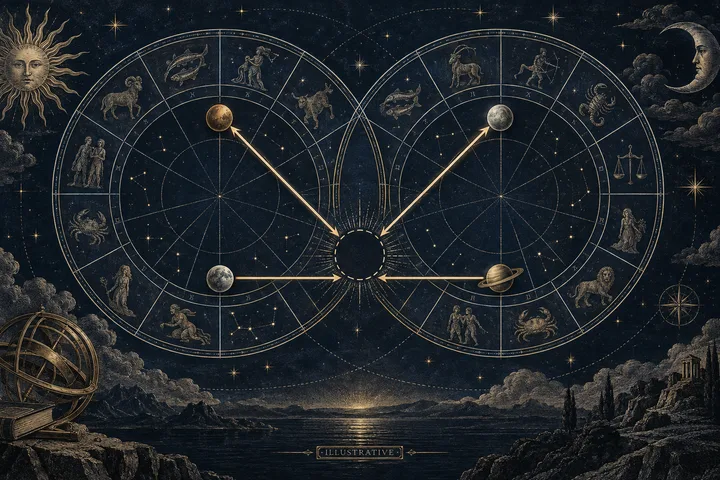
You and your partner keep reaching the same fork: one of you wants an answer now, while the other slows down, protects a feeling, or asks for more time. Before you call that pattern a sign of trouble, you may want to know whether your supplied placements form a cross-chart T-square. You can see a T-square across two charts. The name describes a shape made by aspects, not a pattern that belongs only to one person's birth chart. In a cross-chart version, one person's planet may oppose another person's planet, while a third planet from either chart squares both. The pattern still has three active points and one unoccupied leg. What changes is the reading context. Instead of describing one person's inner pressure, it describes a pressure point in the meeting between two people.
Start with the angles. An opposition is 180 degrees. A square is 90 degrees. If A's Moon at 12 degrees of Aries opposes B's Saturn at 12 degrees of Libra, and B's Mars sits at 12 degrees of Cancer, Mars squares both ends. That is a mathematically exact cross-chart T-square. The example is illustrative, not a supplied couple's chart. Its point is simple: the three bodies can be split between the charts and still make the figure.
The missing point sits opposite the apex. In this example, Mars is the apex, so 12 degrees of Capricorn is the empty leg. Nothing is physically there. You don't read it as an invisible fourth planet. You read it as a direction the pattern lacks and may seek through action, compromise, or shared practice. The empty leg gives the pattern a question: what quality would balance the opposition if the relationship made room for it?
That distinction matters because a synastry wheel can look busy. Colored lines cross. Symbols overlap. A report may call attention to every square it finds. Don't let the picture choose the pattern for you. List the three points, write down their degrees, and check each angular distance. The T-square exists because the contacts line up, not because the chart looks dramatic.
Use the figure to answer a narrower question: where does this interaction concentrate pressure, and what response would give it room? The apex names the active channel. The empty leg names a quality that can balance it. That is enough to guide a reading and a conversation. It isn't a dating verdict, and it doesn't tell you what either person secretly feels.
Sources: Aspect Patterns in an Astrology Chart; Aspects Between Charts; Square Aspect: Meaning, T-Square, Signs
What information do you need before naming the pattern?
You need the known placement of each point and its sign. For a basic relationship comparison, that may be the Moon, Venus, or Mars in each chart. You also need degrees if you want to confirm a T-square rather than describe a sign-based possibility. The report scope here uses supplied placements and optional degrees. It does not calculate a natal chart from birth details, assign houses, or create a full wheel from an unverified birth time.
Make a small table before you interpret. Put one person's points in one column and the other person's points in another. Record the sign, degree, and point name. Then search for an opposition pair. Once you find one, look 90 degrees from each end. A third point must be close to both square positions. If you only know signs, you can notice that Aries and Libra oppose while Cancer and Capricorn square them, but you cannot know whether the actual planets are close enough in longitude.
The exact degree tells you how close each contact is. If the opposition is at 12 degrees and the two squares are at 11 and 13 degrees, the figure is tight. If the opposition is at 2 degrees and the supposed apex is at 18 degrees, the signs may belong to the same cross, but the aspect is too wide for the same emphasis.
You also need to know what kind of point you're comparing. A planet carries a different story from an angle, node, asteroid, or house cusp. For a focused reading, begin with the personal planets and the relationship significators you actually have. Add other points only when the calculation method is clear and the contact is close. More symbols don't automatically produce a deeper answer. Often they bury the answer you already had.
Finally, keep the two layers separate. A natal T-square belongs to one chart. A cross-chart T-square belongs to the comparison. One person's natal opposition may be activated by the other person's planet, so name whose point is whose before assigning a role.
If the degrees are missing, narrow the claim. You can describe a possible cross by sign, but you can't present it as a confirmed T-square. State what is known and what remains open.
Sources: Aspect Patterns in an Astrology Chart; Square Aspect: Meaning, T-Square, Signs; Synastry: Love and Relationship Astrology
Read the opposition first, because it carries the central argument
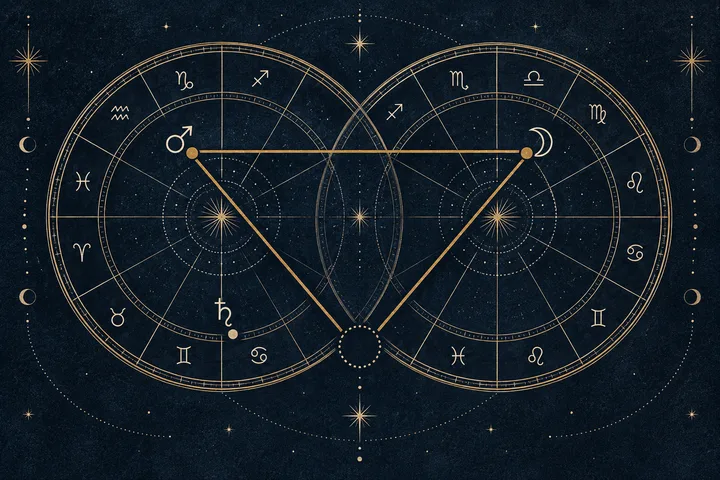
The opposition is the spine of the T-square. It places two points across from each other, so the relationship has a polarity to hold. One side may seek closeness while the other protects independence. One may press for action while the other needs time. The planets tell you what is being expressed. The signs tell you how. In synastry, the people carrying those planets also matter, because each person may live one side of the exchange more readily than the other.
Imagine Maria's Moon opposing Daniel's Saturn. Maria may bring the immediate emotional response, while Daniel may bring caution, duty, or a need for control. That sentence is a starting lens, not a personality verdict. Maria still has her whole chart. Daniel still has his. The contact describes a role that can appear in their interaction, especially when Maria asks for reassurance and Daniel answers by organizing the problem.
The opposition isn't automatically a failure. It can create awareness because each person sees a quality the other carries. But awareness isn't the same as ease. Ask, ‘What does each end of this opposition protect?’ That question gives the pattern human scale.
Then name the subject in ordinary language. Moon-Saturn might become feeling and responsibility. Venus-Mars might become affection and desire. Mercury-Mercury might become two ways of thinking and speaking. Don't rush to a grand interpretation. The reader needs to know what the two ends are trying to do before the apex enters the story.
Read the exact opposition before the squares, then read the planets before the signs. A close Moon-Saturn opposition carries more weight than a loose sign-based claim about ‘cardinal energy.’ In daily life, it may appear as the same choice returning: talk now or later, protect the plan or make room for feeling. The chart shows why that choice carries charge.
Sources: Aspect Patterns in an Astrology Chart; Aspects Between Charts; Synastry: Love and Relationship Astrology
The apex shows where the shared tension turns into behavior
The third point is the apex, or focal point. It squares both ends of the opposition. In a natal reading, astrologers often describe it as the place where pressure concentrates and seeks expression. In synastry, ask which person's point occupies that role and what happens when the couple reaches the opposition's impasse. The apex doesn't cause every problem. It shows the channel through which the pattern tends to act.
Consider an example. Maria's Moon at 12 degrees Aries opposes Daniel's Saturn at 12 degrees Libra. Daniel's Mars at 12 degrees Cancer squares both. In the relationship, Mars may turn the Moon-Saturn tension into urgency, irritation, pursuit, or a demand for a concrete response. Maria asks for emotional presence. Daniel tries to solve or defend. The exchange moves quickly because Mars gives the stalemate a motor.
The same Mars can motivate the couple to act, protect one another, or address a problem before it grows. It can also make disagreement feel like a contest if nobody pauses. The chart gives the style of pressure. The people decide how to handle it.
Read the apex in both directions. The Mars person may feel pushed to act, blamed for acting, or responsible for breaking the deadlock. The Moon and Saturn people may experience Mars as the spark that finally makes the issue visible. These roles can shift with the topic. A couple may enact the pattern around plans, sex, money, or family without using the same planet in the same way every time.
The apex deserves attention, but it isn't the whole chart. Check whether other contacts support the same theme. Venus may help repair, Mercury may help name the problem, and another hard aspect may add strain. Then return to the actual behavior before reaching for a dramatic label.
Yes. A cross-chart T-square can exist when three chart points create one opposition and a third point squares both ends. The points may come from either person. The squared third point is the apex, or focal point. The position opposite it is the empty leg, the place that would complete a grand cross. It isn't a hidden planet, and it doesn't decide whether a relationship will last. It gives you a balancing direction. Read the opposition first, identify whose point is the apex, then test the empty leg by sign and degree. A tight pattern carries more weight than a wide sign resemblance. Use supplied placements and, when available, exact degrees. A sign-only comparison can suggest the shape, but it can't confirm the aspect.
Sources: Aspect Patterns in an Astrology Chart; Square Aspect: Meaning, T-Square, Signs; Synastry: Love and Relationship Astrology
What the empty leg changes
The empty leg is opposite the apex. In the illustrative example, Mars at 12 Cancer is the apex, so 12 Capricorn is the empty leg. If a planet occupied that degree, the figure would become a grand cross, with a second opposition and two additional squares. As it stands, the pattern concentrates activity through Mars and leaves Capricorn as the unoccupied balancing direction.
The empty leg has no planet's agenda, so don't assign it a personality or a person. Read it as a quality the pattern can develop. Capricorn in the example points toward structure, timing, accountability, or a plan that can contain Mars in Cancer's urgency. The sign gives the language. The couple still chooses the form.
The empty leg can describe what the relationship needs outside its immediate loop. A couple caught between emotional need and practical restraint may need a shared schedule, a boundary, or a clear decision rule. The sign gives the symbolic language. The actual practice must fit the people and the situation.
In a natal chart, the empty leg belongs to one person's long-term pattern. In a cross-chart reading, it belongs to the geometry between the placements, so the balancing response is shared. Read the missing sign as a quality to develop, not as a person or a promise.
A transit through the empty leg can later bring that balancing theme into focus, especially when the couple is already working on the pattern. Read the transit as an activation of a sensitive area, not as a promise of an event. The comparison remains the foundation.
Sources: Aspect Patterns in an Astrology Chart; Aspects Between Charts; Square Aspect: Meaning, T-Square, Signs
Degrees and orbs decide whether the T-square is tight or stretched
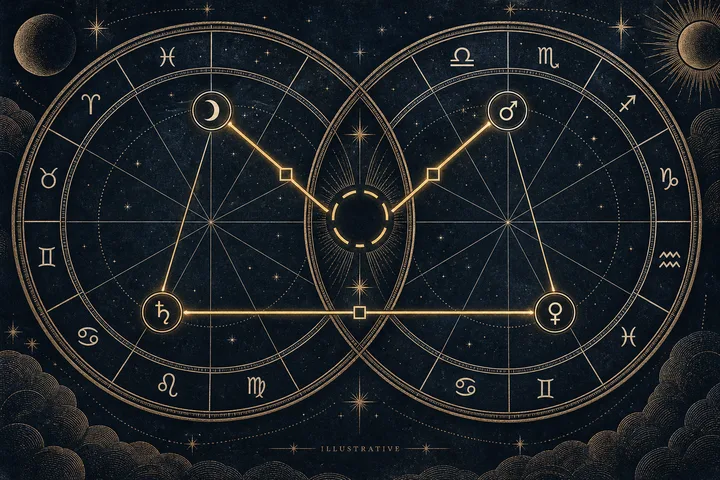
A T-square needs aspect geometry, and aspect geometry lives in degrees. Signs can show the cross. Degrees tell you whether the points are actually close to the cross's exact angles. Use a six-degree orb for this report's selected major-aspect checks. That gives you a clear editorial rule: an opposition should sit within six degrees of 180, and each square should sit within six degrees of 90. Record the actual difference instead of hiding it behind a label.
Here is a clean example. Maria's Moon is 12 Aries 00. Daniel's Saturn is 12 Libra 00. Daniel's Mars is 12 Cancer 00. The opposition is exact. Each square is exact. This is a tight T-square. Now move Mars to 17 Cancer. The squares are five degrees from exact, so they remain within the stated orb. The pattern is still present, but the apex has less precision than in the first example.
Move Mars to 25 Cancer and the sign picture still resembles a T-square, but the degree picture no longer supports the same claim. You can say the placements occupy a cross by sign. You shouldn't call the aspect pattern tight. This distinction protects the reader from a common mistake: treating four broad sign labels as if they were four measured contacts.
Check the opposition separately. Maria's Moon at 2 Aries and Daniel's Saturn at 8 Libra are six degrees from exact, so they qualify under this rule. At 20 Libra, Saturn is 18 degrees from the exact opposition, so the sign axis remains visible but the close aspect does not. When contacts have different orbs, describe the tightest line first and call the pattern lopsided when one square is exact and the other barely qualifies.
Also check for out-of-sign aspects. A planet near the end of one sign can aspect a planet near the beginning of another even when the signs don't form the neat textbook cross. Degree-based astrology can include that contact if the angular distance qualifies. If your comparison only supplies signs, don't invent the missing precision. Mark the possibility and stop there. A careful boundary increases trust in the interpretation.
Sources: Aspects Between Charts; Square Aspect: Meaning, T-Square, Signs; Synastry: Love and Relationship Astrology
Separate a true cross-chart pattern from a natal pattern being activated
A cross-chart T-square can contain a natal aspect, but the two readings are not interchangeable. Suppose Maria already has Moon opposite Saturn in her natal chart. Daniel's Mars then squares both natal points. Daniel's planet activates Maria's existing pattern. The relationship may feel like a live switch has been turned on. That tells you something important about the contact, but it is not the same as three purely cross-chart points forming the figure.
Now reverse the arrangement. Maria's Moon opposes Daniel's Saturn, and Daniel's Mars squares Maria's Moon and Saturn. The three points are still split across the charts, and the figure is cross-chart. But the personal experience may differ because Daniel owns two of the three bodies. He may feel the apex as his urge to act and the Saturn role as his restraint, while Maria feels the Moon side most directly.
Ownership changes the emphasis. The three points may be distributed between the charts, or two may belong to one person while the third activates the pattern from the other chart. A natal opposition can also pre-exist, with the partner's planet supplying the squares. These are different routes into the same geometry, not compatibility grades.
Write the ownership into the reading: ‘Your Moon opposes his Saturn, and his Mars squares both.’ That sentence lets you test the interpretation against real exchanges without assigning blame. If the partner activates a pattern you already carry, notice your familiar response before asking them to change theirs. If the pattern exists only between the charts, study the interaction itself.
Sources: Aspects Between Charts; Synastry: Love and Relationship Astrology
How sign modality changes the way the pressure moves
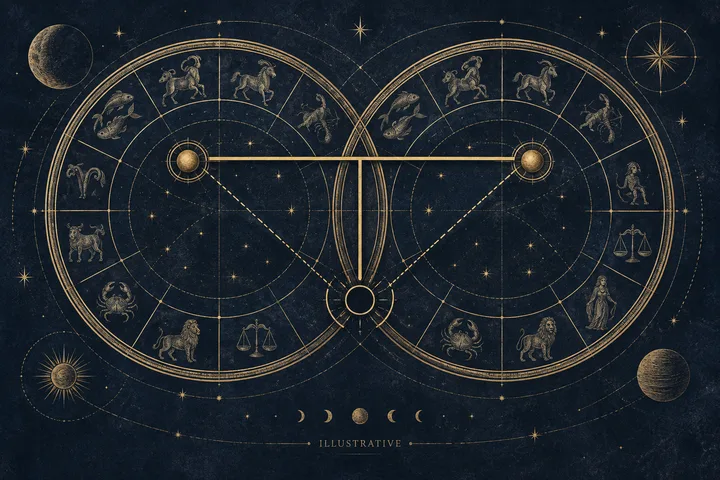
Once the geometry is confirmed, read the signs and their modality. A cardinal T-square tends to push toward action. A fixed T-square can hold pressure for a long time and resist changing course. A mutable T-square may scatter attention, revise the plan, or struggle to settle on one response. These are interpretive tendencies, not personality labels. The planets still tell you what the pressure concerns.
In the illustrative Aries-Libra-Cancer pattern, cardinal signs make the issue immediate. The Moon wants a direct emotional response. Saturn weighs fairness, timing, or responsibility. Mars wants to move. The empty Capricorn leg suggests a form of action that is planned and accountable rather than purely reactive. The couple may not need less feeling. They may need a container strong enough to hold feeling while they decide.
A fixed example changes the pace. Imagine a Taurus-Scorpio opposition with an Aquarius apex. The relationship may circle questions of security, trust, and control while the apex seeks distance, principle, or a different way to solve the problem. The missing Leo leg can point toward warmth, visible appreciation, and a willingness to say what matters out loud. The same pattern shape now asks for steadiness without silence.
A mutable example moves differently. Consider a Gemini-Sagittarius opposition with a Virgo apex. One side gathers possibilities. The other searches for a larger truth. Virgo turns the tension into analysis, correction, or practical sorting. The missing Pisces leg may suggest compassion, surrender, or a capacity to let an imperfect answer remain human. Without it, the couple can keep editing the relationship instead of living it.
Modality helps choose the first response. Cardinal patterns need a plan and a pause. Fixed patterns need a safe way to move. Mutable patterns need a decision that doesn't require perfect certainty. Read the modality after the planets, and let the element refine rather than create the interpretation.
Sources: Aspect Patterns in an Astrology Chart; Aspects Between Charts; Square Aspect: Meaning, T-Square, Signs
The strongest exception: a complete pattern can still describe a workable bond
The strongest exception is a bond with enough support and skill to use the pressure well. A hard pattern can create friction, but it can also force clearer speech and better decisions. A T-square concentrates a problem. It doesn't settle the relationship.
Read the contacts around it by function. Venus may make affection easier to express. Mercury may give the couple words for the conflict. Saturn may add steadiness, or make the stakes feel heavier. These contacts change how the pattern is lived. They don't erase its tension.
A tight T-square becomes more workable when the rest of the comparison offers a way to repair. It becomes more tiring when the same conflict repeats everywhere and neither person changes the exchange. Weigh exactness, personal planets, repeated themes, and the behavior you can actually see. Several loose trines shouldn't outweigh one close contact that shapes every difficult conversation.
That's the useful exception. A difficult figure can describe attraction, effort, and devotion in the same bond. But supportive aspects aren't excuses for broken trust, and a tense pattern isn't proof that trust must break. The lived exchange ranks first.
Sources: Aspect Patterns in an Astrology Chart; Square Aspect: Meaning, T-Square, Signs; Synastry: Love and Relationship Astrology
Turn the empty leg into one useful conversation
A chart reading earns its place when it changes the next question you ask. Name the two sides plainly: ‘We keep moving between reassurance and restraint.’ Then name the visible action: who presses for an answer, who pauses, who starts fixing the problem, and who needs to be heard first. Keep the chart language behind the behavior.
Now turn the missing sign into a small practice. Capricorn might become a clear agreement or timetable. Leo might become appreciation before analysis. Pisces might become a pause that lets feeling exist without correction. The sign offers the language. You choose the action.
Make it easy to keep. Try one sentence: ‘When this happens, I push for an answer and you slow down. What would a fair middle pace look like?’ Then agree on one next move, such as a scheduled check-in, a pause before replying, or a written decision. Don't ask one conversation to solve the whole chart.
If you use the Synastry Comparison Report, enter the Moon, Venus, and Mars placements you already know, then add degrees where you have them. It compares supplied placements and selected major aspects within a six-degree orb. It doesn't calculate a natal chart, houses, or a relationship outcome. If you only know signs, use the cross as a question and get the degrees before naming a confirmed T-square.
Sources: Aspects Between Charts; Square Aspect: Meaning, T-Square, Signs
Sources & further reading
- Aspect Patterns in an Astrology Chart
Defines the T-square as an opposition joined by two squares, names the focal planet, and describes the unoccupied opposite leg as a sensitive point.
- Aspects Between Charts
Supports reading interchart contacts through both planets' roles, plus each planet's sign and house context, with attention to personal planets.
- Square Aspect: Meaning, T-Square, Signs
Defines the 90-degree square, explains its tension and adjustment themes, and describes a T-square as an opposition with a third point square to both.
- Synastry: Love and Relationship Astrology
Supports weighing personal-planet interaspects, reading hard contacts as friction that can be worked with, and using surrounding contacts to refine the comparison.
Synastry Comparison Report
Enter known placements for two people. Get an input-by-input comparison, selected aspect calculations and a clear record of what remains uncertain.
Compare our placements