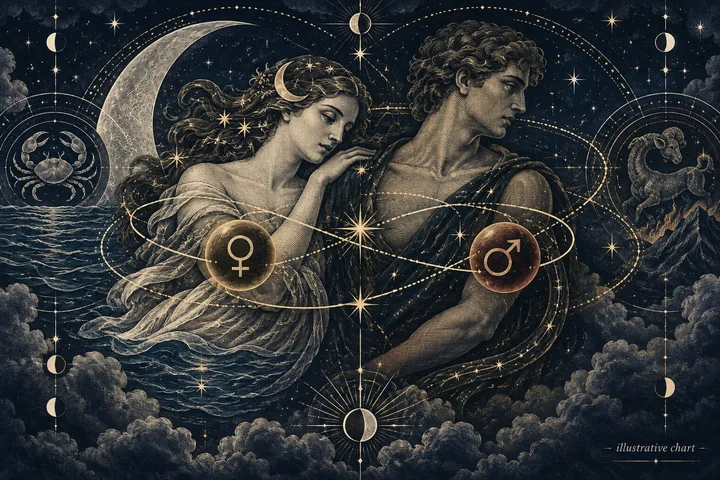
Ask, "Do you want this connection to become romantic, or do you mainly value the emotional closeness we already have?" That question fits a chart where Moon or Moon-Venus contacts create warmth, familiarity, and an easy sense of being understood, while Venus-Mars or Moon-Mars evidence of desire is weak, uneven, wide by degree, or missing from the supplied placements. In synastry, comfort and attraction belong to related but different layers. The Moon shows how safety and feeling move between you. Venus shows affection, pleasure, and romantic preference. Mars shows pursuit, heat, and the way desire takes action. Read those layers in that order. Then compare the symbolism with behavior: who initiates, who names the connection, and what happens after a moment of closeness? The best next step is a calm conversation about intention, pace, and boundaries. The chart can help you choose the question. The answer still needs to be spoken.
Why emotional ease is not the same as romantic desire
Emotional ease is powerful. You may finish each other’s sentences, share private memories without strain, or sit in silence and feel accompanied rather than awkward. That kind of contact matters in synastry. It often points toward a relationship that can hold tenderness, trust, and ordinary closeness. But it does not settle the romantic question by itself. A person can feel deeply at home with you and still want friendship, kinship, creative partnership, or a bond that has no romantic name.
That distinction gives you the right starting point. Do not ask the chart, "Are we meant to be together?" Ask a narrower question: "What kind of closeness comes easily here, and what kind needs to be chosen?" This wording keeps the reading honest and useful. It also prevents a familiar synastry mistake, which is to treat every soft contact as proof of desire. The pattern may be loving without being erotic. It may be erotic without feeling emotionally safe. Often the real work begins when those two experiences do not arrive at the same speed.
Astrologers usually separate the Moon, Venus, and Mars for this reason. The Moon describes feeling, instinct, memory, and the conditions under which a person settles. Venus describes attraction, affection, pleasure, taste, and the way someone gives or receives romantic warmth. Mars describes appetite, initiative, assertion, and the movement that turns wanting into action. These planets overlap in lived experience, but they do not answer the same question. A soft Moon contact may tell you why a person feels safe. It cannot, alone, tell you whether they want to kiss you, date you, or build a romance.
So the strongest answer is simple. When emotional ease is strong and desire is uncertain, ask for the relationship’s intended direction before you interpret the warmth as an invitation. Use the chart to name the difference between comfort and pursuit. Use the conversation to find out whether both people want to cross that difference. The reading becomes more precise, not less romantic, when it gives each layer its own language.
Sources: Synastry; Synastry: Venus-Mars Aspects Between Two Charts; Synastry (Relationship Astrology) Moon Mars Aspects
Start with the Moon: what feels safe between you
The Moon is the first layer to read when the central experience is emotional ease. In relationship astrology, it describes the quick inner response that says, "I know this feeling," or, "I can let my guard down here." Moon contacts can show how two people soothe one another, share domestic rhythms, respond to vulnerability, and create a private emotional climate. They can also show why a connection feels familiar before either person has explained why.
Moon-Moon contacts often make two people recognize one another’s moods. One person may notice when the other needs quiet, food, touch, or reassurance. Moon-Venus contacts add sweetness. The Moon person may feel cherished, while the Venus person enjoys offering affection and beauty. A supportive Moon-Jupiter contact can widen generosity and goodwill. These are meaningful signs of relational ease. They tell you that care has somewhere to land.
But the Moon can also make a bond feel complete before the relationship has been defined. Familiarity lowers the cost of closeness. You may talk for hours, disclose family stories, or become the person each other calls first. That can create a strong attachment even when neither person has expressed romantic intent. The comfort is real. The conclusion may still be premature. A warm room is not the same thing as a chosen destination.
When you read the Moon, ask practical questions. Do you calm each other after conflict? Do you make room for one another’s changing moods? Can you name what helps you feel secure without expecting the other person to guess? The answers show how emotional care operates. They do not replace the next layer, which is Venus. Once you know what feels safe, you can ask what each person actually values and enjoys in the connection.
The Moon’s strongest gift here is permission to speak gently. If you fear that a direct question will damage the bond, the lunar pattern may explain why the bond matters so much. Say what you have noticed: "We feel unusually close, and I want to understand what this means to you." Then test the lunar promise in ordinary life. Do you both return after small disappointments? Do you make room for needs when nobody is in crisis? Repeated care is stronger evidence of emotional steadiness than one intense confession.
Sources: Synastry; Synastry (Relationship Astrology) Moon Mars Aspects
Use Venus to separate affection from romantic preference
Venus brings the question of preference. What do you enjoy together? What kind of attention feels loving? What do you value in a partner, and how do you show that value? In synastry, Venus contacts can make time together pleasant, graceful, and affirming. They may describe shared tastes, an easy exchange of compliments, mutual appreciation, or a feeling that the other person understands your way of giving and receiving affection.
A Venus-Moon contact is especially easy to mistake for a full romantic answer because it combines tenderness with attraction to one another’s emotional style. One person may feel emotionally held. The other may feel welcomed and admired. This is beautiful. Still, Venus can work through friendship, art, hospitality, shared values, and simple enjoyment. Romantic love may be present, but the contact does not force it to be the only form of love available.
Compare the Venus signs before you rank the aspect. Two people may both value loyalty, yet one person shows love by staying close while the other shows it by giving space. One may need verbal reassurance. The other may trust practical help more than declarations. The sign relationship adds style to the contact. The degree aspect adds the angle and intensity. Read both. If you have only signs and no degrees, describe the sign-based pattern as a broad preference rather than a calculated major aspect.
Venus also tells you what can be idealized. A person may enjoy how you make them feel and still avoid a relationship that asks for commitment, exposure, or physical desire. This is why the question should not be, "Do you like me?" Most close relationships contain liking. Ask, "What kind of relationship are you choosing with me?" That question moves from Venus’s pleasure to the shared agreement that pleasure needs.
Use Venus to describe the bond’s style, then look for an exchange rather than a one-way performance. Who offers affection? Who accepts it? Who makes room for the other person’s preferences? If Venus is warm but Mars is quiet, name a bond that may be admiring and affectionate without much pursuit. If Venus meets Mars closely, the romantic layer has more motion, but the next question is still whether both people are willing to move together.
Sources: Synastry; Synastry: Venus-Mars Aspects Between Two Charts
Let Mars answer the question of pursuit
Mars is where the reading becomes more direct. It describes desire as movement: the wish to approach, initiate, claim time, make contact, and act on instinct. Mars does not make a person love forever. It does not certify devotion. It shows how heat, appetite, and assertion enter the relationship. When emotional ease is strong but desire is uncertain, Mars is the first planet to inspect for a missing or uneven answer.
Venus-Mars contacts are classic attraction signatures in synastry. A conjunction can blend affection and appetite so closely that the chemistry is hard to ignore. A trine or sextile can make romantic and physical expression feel natural. A square or opposition can create strong attraction with friction, mismatched timing, or different thresholds for directness. The aspect does not tell you which person is right. It shows how the two styles meet, press against each other, and ask to be handled.
Moon-Mars contacts add another kind of heat. The Moon person may feel awakened, protected, irritated, or emotionally exposed by the Mars person. A flowing contact can combine courage with tenderness. A tense contact may make desire arrive as argument, teasing, defensiveness, or quick reactivity. That pattern can feel alive. It can also exhaust you if conflict becomes the only way either person knows how to create intensity.
Look at expression, not only symbolism. Does someone make a clear plan? Do they move toward physical or romantic closeness with care? Do they respond when you name interest, or do they keep the relationship in a warm but undefined zone? Mars becomes useful when you compare the chart layer with the pace of real contact. A wide or absent Mars contact may fit a connection that has affection but little pursuit. A close contact may show potential for heat, yet potential still needs consent and mutual action.
Mars also has a style. Some people initiate with direct invitations. Others use playful challenge, practical help, physical proximity, or a sudden increase in contact. A quiet expression is not automatically absent desire, but desire that never becomes a choice remains only a possibility. Track initiative over time: who creates private time, who responds to a clear opening, and who follows through after closeness? Those details show whether heat has a path into the relationship.
Sources: Synastry; Synastry: Venus-Mars Aspects Between Two Charts; Synastry (Relationship Astrology) Moon Mars Aspects; The Classical Origin and Traditional Use of Aspects
Read the aspect before you read the story
A synastry story becomes clearer when you separate three inputs: the planets, the aspect, and the orb. The planets tell you what functions meet. The aspect tells you how they meet. The orb tells you how close the contact is to exactness. A conjunction blends. An opposition pulls two poles into a live exchange. A trine supports an easy flow. A sextile offers an opening that grows through use. A square creates friction that asks for skill. None of these words means simply good or bad.
The orb matters because an aspect is not equally loud at every distance. In this report’s stated scope, selected major aspects use a six-degree orb. That is an editorial calculation rule for the supplied placements. A contact at one degree receives more weight than a contact at five degrees, especially when the rest of the comparison does not repeat the theme. If you have no degrees, do not pretend to know whether the contact is exact, wide, applying, or separating. Keep the interpretation at the sign and planet level.
This is where many readings get noisy. Someone sees Venus in a water sign and Mars in another water sign, then calls the pair a trine without checking degrees. Someone else sees a close degree relationship across signs and ignores it because the signs do not form the expected relationship. Astrological traditions handle these cases differently. The practical answer is to name what you are using. Say, "By sign, there is an elemental affinity. By degree, there is no selected major aspect within six degrees," or the reverse.
A close contact deserves attention, not worship. If the Moon is at 12 degrees and Venus is at 13 degrees, the conjunction is tight and should lead the emotional reading. If Venus and Mars form a square with a five-degree orb from exactness, the attraction and friction are present within the chosen scope, but they should not outrank a tighter Moon-Saturn or Venus-Saturn pattern without a reason. Rank the chart. Do not collect contacts like proof.
The conversation follows the same rule. A soft, close Moon-Venus contact supports the sentence, "We have an easy emotional and affectionate bond." It does not support, by itself, "You want a relationship with me." A close Venus-Mars contact supports a question about attraction and pace. The aspect gives you a precise door. You still have to knock.
Use the narrowest claim that answers the reader’s real concern. "There is a five-degree Venus-Mars square within this method" is useful. "This person cannot resist you" is not. The first statement identifies a relationship between symbols and leaves room for choice. The second pretends that a chart can speak over a person. Good synastry gives the reader more agency as the interpretation becomes more exact.
Sources: Synastry; The Classical Origin and Traditional Use of Aspects
Rank the chart layers instead of counting contacts
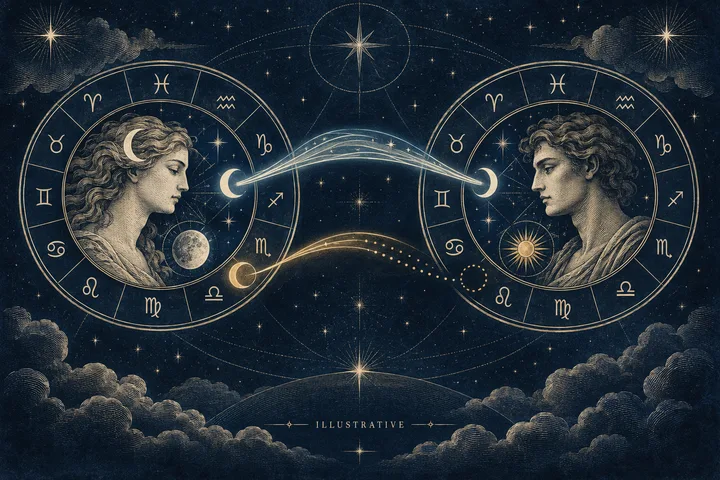
Synastry is not a tally sheet. Five soft contacts do not automatically outweigh one tense contact, and one dramatic Venus-Mars aspect does not erase a lack of emotional safety. The most useful reading ranks themes by relevance to the question. Here, the question is not whether the charts are generally pleasant. It is why the connection feels emotionally easy while desire remains uncertain.
First, rank the emotional foundation. Look for Moon contacts, Moon sign relationships, and repeated links to the person’s Venus or Jupiter. Ask whether the chart describes warmth, care, familiarity, or a wish to spend ordinary time together. Second, rank romantic preference. Compare Venus signs and Venus contacts to the other person’s personal planets. Ask whether affection, taste, and appreciation move in both directions or mainly through one person’s experience.
Third, rank desire and initiation. Compare Venus-Mars, Moon-Mars, and relevant Mars contacts. Note whether they are close by degree and whether the aspect is flowing or tense. Fourth, check the brakes and distortions. Saturn can make someone cautious, responsible, or slow to act. Uranus can make attraction exciting but irregular. Neptune can soften boundaries and encourage projection. Pluto can intensify attachment and control themes. These planets add context. They should not be used to invent a private motive for someone who has not spoken.
Then look for repetition. Suppose you find Moon-Venus, Venus-Venus, and a close Venus-Mars contact. The chart repeats affection, ease, and attraction. Your conversation can be open and specific about becoming romantic. Suppose instead you find Moon-Venus and Jupiter contacts, but no selected Venus-Mars or Moon-Mars contact within six degrees. The chart repeats warmth and goodwill more strongly than pursuit. Your question should protect the existing closeness while asking whether romance is actually desired.
The strongest exception is a chart with one tense, exact desire contact hidden beneath many gentle ones. A close Venus-Mars square may make the relationship feel charged even when the people behave cautiously. That does not cancel the caution. It explains why the uncertainty may feel frustrating. Rank the theme, name the exception, and return to behavior. A good reading leaves you with a better question, not a larger pile of symbols.
A repeated pattern is stronger than a dramatic isolated phrase. If Venus-Mars suggests heat but Moon-Saturn, Venus-Saturn, and the observed pace all point toward restraint, describe attraction under conditions and ask what would make movement feel safe. If warmth, desire, and mutual initiative repeat together, the conversation can move from interpretation to a small romantic experiment, such as an intentional date.
Sources: Synastry; Synastry: Venus-Mars Aspects Between Two Charts; Synastry (Relationship Astrology) Moon Mars Aspects
A worked example: ease first, desire still unspoken
Imagine Maria and Daniel. They have supplied Moon, Venus, and Mars signs for a comparison, but they have not supplied degrees. Their Moon signs are compatible by element, and Maria’s Venus shares an easy sign relationship with Daniel’s Moon. They talk every evening. Daniel remembers small details. Maria feels calm around him and tells him things she does not usually share. When they meet, the conversation flows. They leave each encounter with more tenderness than certainty.
Without degrees, do not announce a Moon-Venus conjunction, trine, or sextile. The available information supports a sign-based reading of emotional and affectionate ease. That is enough to explain the atmosphere. It is not enough to claim a selected major aspect. Their chart inputs describe a promising emotional language, but the comparison does not calculate houses, exact aspects beyond the supplied data, or a score that could settle what happens next.
Now add the lived pattern. Maria sometimes touches Daniel’s arm and waits. Daniel smiles, stays close, and changes the subject. He sends caring messages but rarely proposes a date that carries romantic intention. This is the point where a reader may reach for a Neptune explanation or call the bond fated. Resist that shortcut. The observable pattern is clearer: affection is present, emotional access is strong, and initiation remains unclear. The chart describes why the connection feels meaningful. It does not give Daniel’s private answer.
Imagine Maria later receives the degrees and finds a close Moon-Venus contact, but no selected Venus-Mars or Moon-Mars contact within six degrees. The new information sharpens the explanation for tenderness. It does not turn Daniel’s hesitation into hidden desire. Maria can say, "The comparison reflects the warmth I feel with you, but it doesn’t tell me whether you want romance." The technical finding makes her question cleaner because it removes the temptation to use emotional ease as a substitute for an answer.
Consider a different version of the same example. The degrees show a close Venus-Mars square, while Daniel still avoids a romantic invitation. Now the chart gives uncertainty more charge, not more certainty. The square can describe attraction meeting friction, delayed expression, or different ways of approaching intimacy. Maria should ask about pace and willingness: "I sense chemistry, but we keep circling the subject. Would you like to explore this romantically, and what would feel comfortable?" His response remains the deciding information.
A third version points in another direction. The supplied signs suggest Moon-Venus ease, the degrees show no close selected desire contact, and both people consistently choose friendship-shaped behavior. They talk warmly but don’t create romantic space. In that case, the most faithful reading is not a romance waiting to be uncovered. It is a meaningful bond whose language is affection and trust. Maria may still ask for clarity, but she needn’t keep searching for a stronger symbol to overrule the pattern they are living.
These branches show why the order matters. First identify what the available data can describe. Then ask whether the degrees strengthen, soften, or complicate it. Finally compare the symbolism with initiative, timing, and the agreements already visible between the people. The result is a cleaner conversation, not a more dramatic prediction.
The same method works when the roles reverse. The person asking for clarity needn’t be the person associated with Venus or Mars in a textbook interpretation. Cross-chart planet labels describe functions in the contact, not fixed gender roles or guaranteed behavior. Each person should name their own experience.
The right question is, "I feel a strong emotional closeness with you, and I’m open to exploring whether this could be romantic. Do you want that too, or do you want us to remain close friends?" It does three jobs. It names Maria’s experience. It gives Daniel two real options. It protects the bond from vague hope. She can add, "If you’re unsure, I’d rather move slowly than keep guessing." That sentence gives the connection a pace instead of a verdict.
If Daniel answers clearly, the chart can help them discuss the style of what comes next. If he wants romance but moves slowly, Saturn or a cautious Venus style may describe the pace. If he wants closeness without romance, the Moon-Venus pattern still has a truthful place. If he avoids answering while continuing to receive romantic intimacy, Maria has a practical choice: pause the behavior that keeps her hoping, or ask for a firmer boundary.
The strongest exception: intense chemistry can hide behind hesitation
The clear rule has an important exception. Uncertain desire does not always mean weak desire. Sometimes the chart shows strong attraction, but one or both people manage it through restraint, delay, joking, intellectualizing, or emotional retreat. A close Venus-Mars square can bring romantic heat and poor timing together. A Moon-Mars contact can make the body react before the mind has decided what feels safe. Saturn can add caution to a pattern that is otherwise highly charged.
In this version of the story, emotional ease may be the safe surface over a more difficult current. The two people may talk about everything except what happens when they are physically close. One person may flirt and then withdraw. The other may offer care instead of a direct invitation. They may argue over small matters because conflict creates a form of contact that desire has not yet been allowed to name.
Read the exact contact before making this interpretation. A vague sign resemblance is not enough. Within the report’s six-degree scope, a tight Venus-Mars or Moon-Mars aspect deserves more weight than a loose, unconfirmed suggestion. Then check whether the pattern repeats through the other person’s Venus, Mars, or Moon. Repetition can show that the tension is central rather than a single colorful detail.
Even here, do not turn chemistry into permission. Intensity can explain hesitation. It cannot excuse pressure, mixed signals, or a refusal to respect a boundary. The right question becomes more precise: "There seems to be attraction between us, but we keep avoiding a clear step. What pace and kind of closeness do you actually want?" That question allows desire to exist without demanding that it become a relationship.
If the answer is yes, agree on one small action. Choose a date. Name whether physical affection is welcome. Decide whether you are exploring or committing. If the answer is no, believe it without using the chart to argue. The strongest exception strengthens the main judgment: chart symbolism can reveal why the uncertainty feels charged, but only a direct exchange can turn charge into a shared choice.
Sources: Synastry: Venus-Mars Aspects Between Two Charts; Synastry (Relationship Astrology) Moon Mars Aspects; The Classical Origin and Traditional Use of Aspects
What to do when the chart data is incomplete
A placement comparison can still be useful when you know only the Moon, Venus, and Mars signs. It can explain broad style: how each person seeks safety, how affection is offered, and how desire tends to move. But missing degrees change the level of confidence. You cannot responsibly call a relationship between two planets a conjunction, opposition, square, trine, or sextile unless the supplied positions support that calculation.
The same limit applies to houses. Without reliable birth times and a chart calculation, do not claim that one person’s Venus falls in the other person’s seventh house or that Mars activates a private eighth-house story. Those interpretations may belong in a full natal and synastry study, but they do not belong in a report built from supplied sign placements alone. Be exact about what you have. Precision makes the reading stronger.
Record the inputs before you interpret them. Write down each person’s Moon sign, Venus sign, and Mars sign. Add degrees when available. Mark whether a claimed aspect is within six degrees. Note the direction of the contact if your method uses planet-person language, but do not treat that direction as a fixed role. The Venus person is not always the softer person, and the Mars person is not always the pursuer in everyday behavior.
Then separate three statements. A chart statement says, "Your supplied Moon signs are in an easy elemental relationship." An interpretive statement says, "That can support a familiar emotional rhythm." A lived statement says, "You both make time for private conversation and repair misunderstandings." Keep them distinct. When they agree, the reading gains depth. When they disagree, the lived pattern tells you what needs a conversation now.
A placement-only Synastry Comparison Report can organize this work. It uses the supplied Moon, Venus, and Mars signs, optional degrees, selected major-aspect calculations with a stated six-degree orb, and explicit missing-data limits. It does not calculate a natal chart from birth details, calculate houses, or issue a relationship verdict. That scope is enough for a careful first question. It is not a substitute for the conversation the chart has helped you find.
If the Moon sign itself is uncertain because the birth date falls near a sign change, mark that uncertainty before building the story. The same care applies when an aspect depends on an unavailable degree. A clean report can say what it knows, what it cannot rank, and which question remains useful. Missing information should narrow the claim, not invite a more imaginative one.
Sources: Synastry; The Classical Origin and Traditional Use of Aspects
Turn the interpretation into a conversation you can actually have
A useful reading ends in words you could actually say. Start with your experience, not a diagnosis. "I feel unusually comfortable and close with you, and I’ve realized we haven’t said what kind of relationship we’re building. I’m interested in exploring romance. Is that something you want, or does this feel like friendship to you?"
That question is clear without being theatrical. It gives the other person room to want romance, want friendship, or need time. It also keeps the chart in its proper place. Astrology can help you name the pattern that made you curious. It can’t speak for the person sitting across from you.
Choose a quiet moment, then let the answer have consequences. If you both want to explore romance, make one small plan, such as an intentional date, and agree on a pace that feels good to both of you. If one person wants friendship, adjust the habits that keep romantic hope alive. If both of you are unsure, set a time to revisit the question instead of allowing ambiguity to become the relationship’s only structure.
Watch the next choice, not just the first answer. Mutual interest usually creates room for mutual movement. That doesn’t require instant commitment. It does require some follow-through: a plan, a check-in, or a clear statement about what each person is ready to try. Warm messages without any willingness to define or explore the bond leave the central question open.
The Synastry Comparison Report can help you prepare for this talk. Enter the Moon, Venus, and Mars placements you already know, add degrees when you have them, and use the comparison to put the strongest symbolic theme into plain language. Bring one observation, not a verdict: "This helped me understand why the connection feels so easy." Then ask what the relationship means to the other person.
You may learn that the bond is a tender friendship. You may learn that attraction is present but moving slowly. You may learn that your feelings are not shared. None of those answers erases the closeness that brought you to synastry. Each one gives that closeness a form you can choose together.
Ask the question aloud: "Do you want this connection to become romantic, or do you mainly value the emotional closeness we already have?" Then listen carefully. The next honest action will tell you more than another round of guessing.
Sources: Synastry: Venus-Mars Aspects Between Two Charts; Synastry (Relationship Astrology) Moon Mars Aspects
A little more clarity
Can strong Moon synastry mean we are romantically attracted?
It can support emotional familiarity, care, and a feeling of safety, but it does not answer the romantic question alone. Compare Venus for affection and preference, then Mars for desire and pursuit. If degrees are available, check whether the relevant contacts fall within the stated six-degree orb. If not, ask directly what kind of closeness each person wants.
What should I ask when Venus-Mars attraction feels uneven?
Ask, "I feel attraction between us, but I’m not sure we want the same pace. What kind of closeness do you want, and what feels comfortable to you now?" A Venus-Mars square or opposition can describe strong chemistry with friction or mismatched timing. It cannot decide consent, readiness, or whether both people want a relationship.
Do I need birth times to compare Moon, Venus, and Mars synastry?
You can compare supplied signs without birth times, but you need degrees for selected major-aspect calculations and a stated orb. Birth times are also needed for houses and angles. A placement-only report can discuss sign relationships and supplied degrees, but it should not invent houses, calculate missing natal positions, or turn incomplete data into a compatibility verdict.
What if the chart suggests attraction but the person avoids the conversation?
Treat the avoidance as important relationship information. The chart may describe chemistry, caution, or emotional conflict, but it does not grant access to another person’s private intention. Ask once in clear language, give room for a real answer, and judge the connection by the agreement and actions that follow.
Sources & further reading
- Synastry
Supports Venus as romance and pleasure, Venus-Moon familiarity, Mars as desire and assertion, and the interpretive differences among major aspects.
- Synastry: Venus-Mars Aspects Between Two Charts
Supports the comparison of Venus-Mars conjunction, opposition, square, trine, and sextile as attraction and timing patterns.
- Synastry (Relationship Astrology) Moon Mars Aspects
Supports reading Moon-Mars contacts as emotionally and physically animated, with possible volatility and domestic friction.
- The Classical Origin and Traditional Use of Aspects
Supports the distinction between sign relationships, degree-based aspects, applying and separating contacts, and varied historical orb practice.
Synastry Comparison Report
Enter known placements for two people. Get an input-by-input comparison, selected aspect calculations and a clear record of what remains uncertain.
Compare our placements