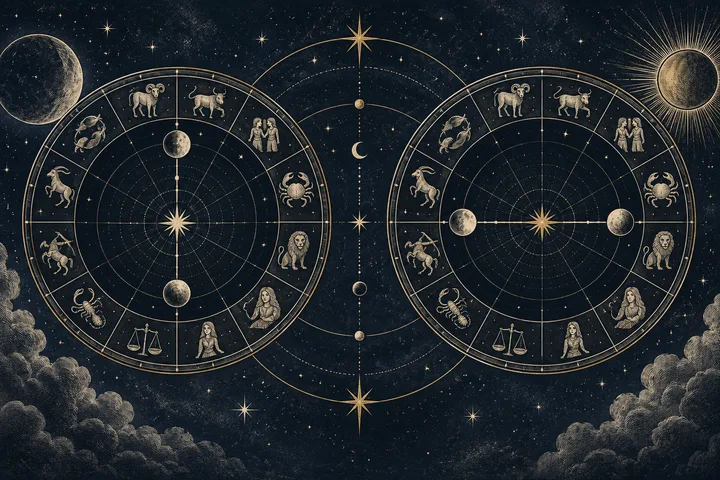
Read the opposition first when it is a close, relevant longitude aspect. Then check whether a contraparallel reinforces the same planets through declination. An opposition spans 180 degrees of zodiacal longitude. A contraparallel links bodies at similar declinations on opposite sides of the celestial equator. It can echo an opposition, but it isn't a second one. Rank the contacts by closeness, planets, and repeated themes in the comparison. A very tight personal-planet contraparallel can lead when the opposition is wide and the relationship shows the same polarity. If degrees or declinations are missing, describe the contact as reported and keep the conclusion modest.
Start with the measurement, not the mood
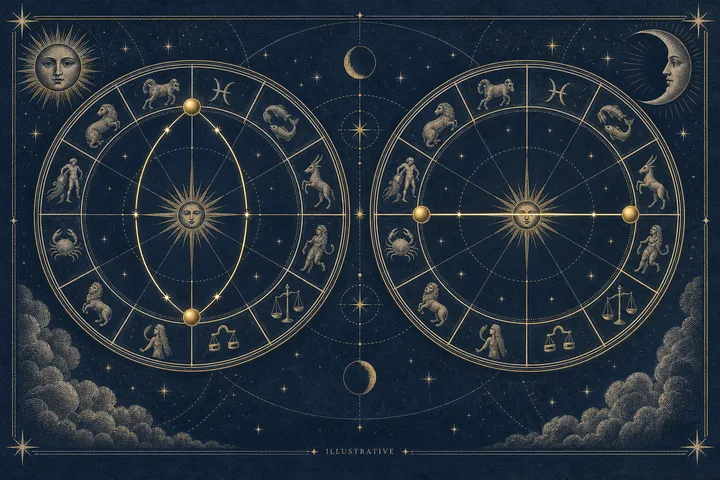
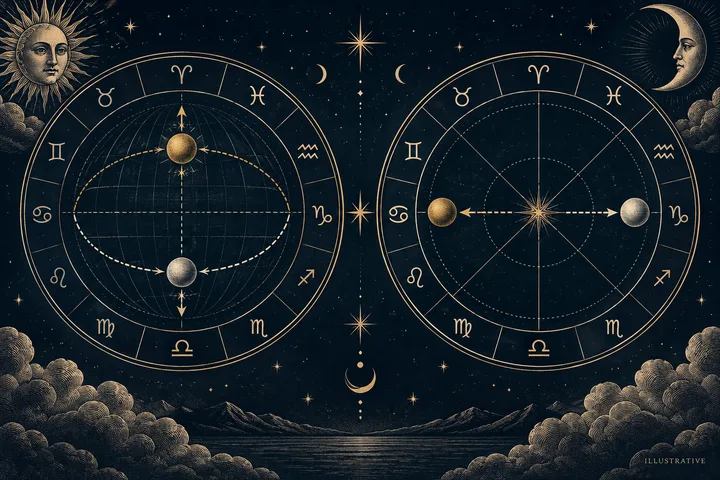
An opposition and a contraparallel can describe a similar polarity, but they don't measure the same thing. An opposition is a 180-degree relationship in zodiacal longitude. A contraparallel compares declinations, placing two bodies at nearly equal distances from the celestial equator, one north and one south.
That distinction sets the order of the reading. Treat the opposition as the main longitude contact. Treat the contraparallel as a second declination layer that can reinforce, qualify, or introduce a related theme. It isn't a hidden opposition, and it shouldn't be counted as one.
To check the report, record the planet pair, the longitude separation, the two declinations with their N or S labels, and the orb used for each. If the report gives only a symbol and no underlying values, call the contact reported rather than exact.
Name the coordinate system before you interpret the feeling. Then ask whether the same planets are involved. Same planets may reinforce one theme. Different planets may describe two stories that need separate reading.
Sources: Determining Parallels and Contra-Parallels in Synastry; Declinations in Synastry: The Astrology of Relationships; Aspect - Astrodienst Astrowiki
What an opposition brings into synastry
An opposition puts one person's planet across the zodiac from the other person's planet. In synastry, that creates direct awareness. You meet the other person's expression across the room, across the conversation, or across a decision. The contact is hard to ignore because the planets face one another by longitude.
The aspect doesn't choose a winner. It shows two functions that need a relationship between them. The Sun and Moon may set identity beside instinct. Venus and Mars may place affection beside desire and pursuit. Mercury and Saturn may bring speech into contact with caution, timing, or judgment. The planets tell you what is meeting. The signs tell you how each side acts. The houses, when reliably known, tell you where the tension becomes visible.
The signs can change the texture without changing the basic geometry. A Venus-Mars opposition in fixed signs may hold a disagreement in place until both people name what they will and won't change. In mutable signs, the same planet pair may keep adjusting the terms. In cardinal signs, the issue may arrive quickly through initiative and competing plans. These are interpretive possibilities, not replacements for the actual placements supplied in a report.
This is why an opposition can feel compelling as well as difficult. The other person carries a quality that your chart can recognize, challenge, or project. You may see a missing pole in them. You may also expect them to manage a part of you that belongs to your own chart. A good reading keeps both possibilities in view.
Degree matters. A 1-degree opposition usually deserves more attention than a 6-degree opposition, all else being equal. The aspect's meaning still comes from the planets, but closeness tells you how sharply the contact enters the comparison. A wide opposition may describe a background theme. A tight one tends to show up in repeated exchanges and choices.
In a couple's chart comparison, the opposition can also show where projection starts. One partner may experience the other as the source of a quality they have not claimed for themselves. A person with a strong need for order might meet a partner who seems to carry freedom, softness, or risk. The other person may feel equally seen, but in a different way. The aspect creates a mirror, not a diagnosis.
Read each side in its own terms. If one person's Venus opposes the other's Mars, don't collapse Venus into the Venus person and Mars into the Mars person as if one must always be receptive and the other must always pursue. The chart factors describe functions, not fixed gender roles. Ask how each person expresses affection, wants contact, takes initiative, and reacts when the other person moves at a different speed.
This matters in synastry because the planets belong to separate people. A natal opposition asks how one person integrates two functions. A synastry opposition asks how two people meet through those functions. The same geometry can therefore feel more interpersonal in comparison work. It may show up as attraction to difference, irritation with difference, or both in the same week.
Keep the reading reciprocal. The faster planet isn't the only one acting, and the person whose planet receives the contact isn't the only one feeling it.
Sources: Planetary Aspects; Synastry in More Detail; Determining Parallels and Contra-Parallels in Synastry
What a contraparallel adds
A contraparallel is found by comparing declinations rather than zodiacal degrees. In a report, look for two bodies at nearly the same distance from the celestial equator, with one marked north and the other south. The key is the mirrored distance and the opposite side of the equator, not a sign or degree copied from the zodiac wheel.
In practice, astrologers often use a 1-degree orb for declination aspects. That gives the contraparallel a tighter doorway than many readers use for a major longitude aspect. A close contraparallel can matter even when the planets don't form a major zodiacal aspect. It can also sit beside a conjunction, square, trine, or opposition and add another layer to the same pair.
Its opposition-like quality describes polarity, not automatic conflict. The planets remain the heart of the interpretation. A Moon-Mars contraparallel may make feeling and action meet across a sensitive line. Venus-Saturn may ask love and restraint to negotiate. Mercury-Uranus may bring a sharp exchange between thought and disruption. You don't get a fixed verdict from the word contraparallel alone.
The declination aspect can explain why a relationship feels more immediate than the longitude chart suggests. A pair may have no close major aspect, yet a tight contraparallel keeps their planets in an active dialogue. That dialogue should be treated as meaningful testimony, then checked against the personal planets, repeated sign themes, and the couple's observable pattern.
Read the contraparallel as a beam of emphasis. It may light up a contact already present, or reveal a second route by which the two planets meet. It doesn't erase the longitude chart.
Sources: Determining Parallels and Contra-Parallels in Synastry; Declinations in Synastry: The Astrology of Relationships; Aspect - Astrodienst Astrowiki
When both contacts connect the same planets
If the same two planets form an opposition and a contraparallel, read one planetary conversation through two coordinate systems. Start with the opposition's longitude meaning. Let the contraparallel add emphasis to that same exchange.
Imagine Maria's Venus and Daniel's Mars appear as both contacts in a report. No chart values are supplied here, so this is a method example. Begin with Venus-Mars themes: attraction, initiative, preference, timing, and reciprocity. Then ask whether the close declination contact makes that polarity harder to ignore or more likely to return after a conversation seems finished.
Don't count the pair twice. A doubled label isn't a compatibility score. It means the same Venus-Mars topic has support from both the zodiac wheel and declination. Watch who initiates, how the other responds, and whether a different pace feels inviting or pressuring.
The natal charts can explain why each person carries the exchange differently. The Venus person may notice welcome and receptivity. The Mars person may notice pursuit and timing. Those are functions, not fixed roles or gender rules. If one person says, We keep returning to closeness, while the other says, I feel wanted until the pace changes, the symbols have a clear lived question to work on.
Keep other contacts distinct. A Moon-Saturn contraparallel beside Venus-Mars opposition may add a story about reassurance and limits, but it doesn't automatically describe the same issue. Name each contact first. Connect them only when the planets and the couple's experience give you a reason.
When only the contraparallel is present
A contraparallel with no close longitude aspect deserves attention, but it starts in a supporting role. Don't discard it because a familiar aspect grid is empty. Don't let the unusual label outrank a tight conjunction, square, or trine without a clear reason.
Consider an example in which one person's Moon and the other's Saturn are in contraparallel, while the longitude table shows no close major aspect. The contact invites questions about emotional timing, reassurance, reserve, and limits. It doesn't tell you that one person will always withdraw or that the other must provide care.
Test the symbolism against the wider comparison. Does the relationship actually turn toward rules when one person asks for warmth? Does a close Moon-Venus contact provide an easier language for repair? Does the contact belong to the part of the relationship you're studying? Venus-Mars speaks more directly to desire and initiative than to family expectations, unless other chart factors connect those subjects.
Use the planets before the analogy. A Moon-Venus contraparallel enters tenderness differently from a Jupiter-Saturn contraparallel. Declination supplies the way the bodies meet. The planets supply the subject.
A lone contraparallel is a useful observation prompt, not permission to make every possible theme central.
Sources: Determining Parallels and Contra-Parallels in Synastry; Aspect - Astrodienst Astrowiki; Planetary Aspects
A four-pass ranking method
Use four passes when an aspect table gives you both contacts. First, identify the planets. Second, measure the geometry. Third, look for repetition. Fourth, turn the leading pattern into a question about ordinary life.
The planets set the first priority. Personal planets usually speak most quickly through identity, feeling, speech, affection, and action. A close Moon or Venus contraparallel may matter more in a couple's daily experience than a loose opposition between two slower bodies. That is a judgment about relevance, not a universal rule.
Then check repetition. Venus opposite Mars plus Venus contraparallel Mars concentrates one theme. Venus opposite Mars plus an unrelated Jupiter-Saturn contraparallel gives you two themes. The second contact may matter, but it shouldn't be folded into the first just because both sound intense.
Finally, ask what the pattern changes. If the leading contact describes different speeds around closeness, ask whether both people can name a pace they can live with. If it describes emotional pressure, ask what each person does when the pattern returns. The best interpretation leaves you with a question you can answer through observation.
Write the result in three lines: measured contact, symbolic meaning, observable test. For example: reported Venus-Mars opposition, longitude, close; reported Venus-Mars contraparallel, declination, reinforcing polarity; test, how do we handle initiation and refusal? This keeps the chart readable and prevents a technical resemblance from becoming a total equivalence.
Sources: Determining Parallels and Contra-Parallels in Synastry; Planetary Aspects; Synastry in More Detail
The strongest exception: a close contraparallel can lead
The opposition leads by default because it is a major longitude aspect. A very tight contraparallel can take the lead when three conditions meet: it involves a personal planet, the opposition is wide, and the same polarity appears in the couple's experience.
Imagine Maria's Moon and Daniel's Sun are listed as a wide opposition and a near-exact contraparallel. This remains an illustrative pattern, not a calculated chart. If their conversations repeatedly center on Maria's emotional response to Daniel's self-expression, the declination contact may describe the living exchange more sharply. The wide opposition still belongs in the reading, but it works as background geometry.
The reverse is just as important. A one-degree Sun-Moon opposition can command attention even when no contraparallel repeats it. A second layer isn't required for a major contact to matter.
If the declinations are rounded or the orb is missing, keep the contact at the level of a reported symbol. The reason for the ranking matters as much as the ranking itself.
Sources: Determining Parallels and Contra-Parallels in Synastry; Declinations in Synastry: The Astrology of Relationships; Aspect - Astrodienst Astrowiki
The decision point
For a supplied-placement comparison, record the signs, optional degrees, declinations if available, aspect type, orb, and one observable question. The Synastry Comparison Report is built for that work: it compares supplied Moon, Venus, and Mars placements, with optional degrees and selected major aspects using a six-degree orb. It doesn't calculate a natal chart from birth details or add houses, so the report keeps the comparison inside the data you actually provide.
Then decide what you'll do with the insight. Have the pacing conversation. Ask for warmth with the limit. Slow down the argument long enough to hear the meaning beneath it. When you want the placements organized in one comparison, compare your placements and use the report to keep the measurements, rankings, and missing layers clear.
Compare the measurements. Name the planets. Have the conversation.
Sources: Determining Parallels and Contra-Parallels in Synastry; Planetary Aspects; Synastry in More Detail
A little more clarity
Is a contraparallel the same as an opposition in synastry?
No. An opposition is a 180-degree relationship in zodiacal longitude. A contraparallel links planets at similar declinations on opposite sides of the celestial equator. Astrologers often read the contraparallel as opposition-like, but it remains a separate declination contact.
Which matters more, a close contraparallel or a wide opposition?
Usually the opposition leads because it is a major zodiacal aspect. A very close contraparallel can take priority when it involves personal planets and repeats a clear relationship pattern, while the opposition is wide. Compare exactness, the planets involved, and the rest of the synastry before ranking it.
Can I read a contraparallel without birth times?
You can compare planetary declinations if you have reliable placement data for both charts. Birth times become especially important for angles and houses, which should be left out when the times are unknown or rounded. A placement comparison should state which data it uses and which layers it cannot assess.
Sources & further reading
- Determining Parallels and Contra-Parallels in Synastry
Defines parallel and contraparallel by same or opposite declination and notes a typical one-degree orb in synastry.
- Declinations in Synastry: The Astrology of Relationships
Explains same-side parallels and opposite-side contraparallels in synastry, gives a typical one-degree orb, and relates contacts to planet pairs.
- Aspect - Astrodienst Astrowiki
Defines the major aspects, including the 180-degree opposition, and explains that planet meanings shape aspect interpretation.
- Planetary Aspects
Defines the opposition as a 180-degree zodiacal aspect and explains that planetary aspects combine the natures of the planets involved.
- Synastry in More Detail
Explains that synastry declination contacts are likened to conjunctions or oppositions and can reinforce a chart relationship.
Synastry Comparison Report
Enter known placements for two people. Get an input-by-input comparison, selected aspect calculations and a clear record of what remains uncertain.
Compare our placements