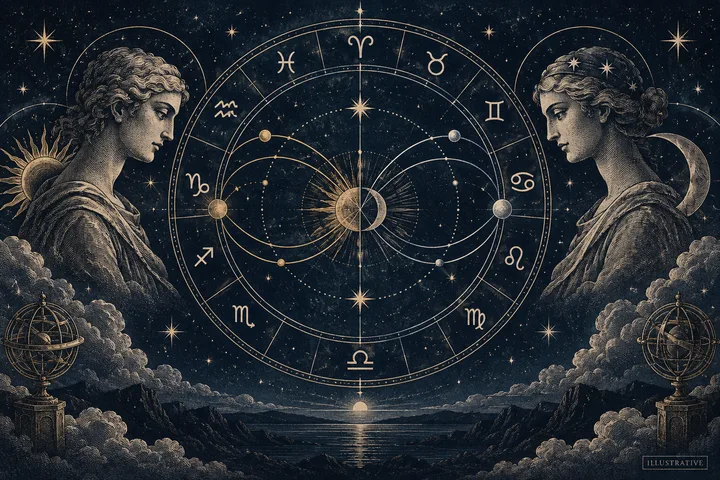
A contra-antiscia contact forms when one person's planet sits on, or very close to, the contra-antiscion of the other person's planet. Find it by reflecting a zodiac degree across the Aries-Libra equinox axis, or by taking the opposition of its antiscion. In traditional astrology, it acts like a hidden counterpoint with the nature of a square or opposition. Keep it when the degrees are exact or very close, the planets answer the reader's question, and the contact echoes a theme already visible in the synastry. Leave it out when you have sign placements only, the orb is loose, the report has confused longitude with declination, or the mirror adds no useful information. Let the visible chart lead.
Why the contact belongs in second place
Contra-antiscia can show why two placements seem to press on one another when the usual aspect grid stays quiet. The connection is made by degree, not by sign resemblance alone. One point reflects across the equinox axis, from 0 degrees Aries to 0 degrees Libra, and meets the other point through that mirror.
That makes the technique valuable, but easy to overuse. A close contact can name a hidden tension between two planetary functions. It can't prove attraction, equal investment, or a fixed outcome. Read the ordinary synastry first. Then keep the mirror only if it sharpens a question the chart already raises.
Sources: The Classical Basis of Antiscia and Contra-antiscia; Contra-Antiscia: Mirror Points Across the Equinox Axis
What contra-antiscia mean
Antiscia reflect a degree across the solstice axis at 0 degrees Cancer and 0 degrees Capricorn. Contra-antiscia take the opposite point of that mirror. In other words, they reflect across the equinox axis. Traditional astrologers often describe antiscia as more sympathetic and contra-antiscia as more difficult, with the latter carrying something of the nature of a square or opposition.
Difficult doesn't mean hopeless. An opposition brings awareness. It asks two functions to recognize each other and find a workable balance. In synastry, a contra-antiscia contact can describe the place where one person's way of loving, speaking, acting, or protecting meets the other person's pattern at an angle. Translate that symbolism into a question about behavior. Don't turn it into a claim about hidden motives.
Sources: The Classical Basis of Antiscia and Contra-antiscia; Contra-Antiscia: Mirror Points Across the Equinox Axis
How to calculate a contra-antiscion
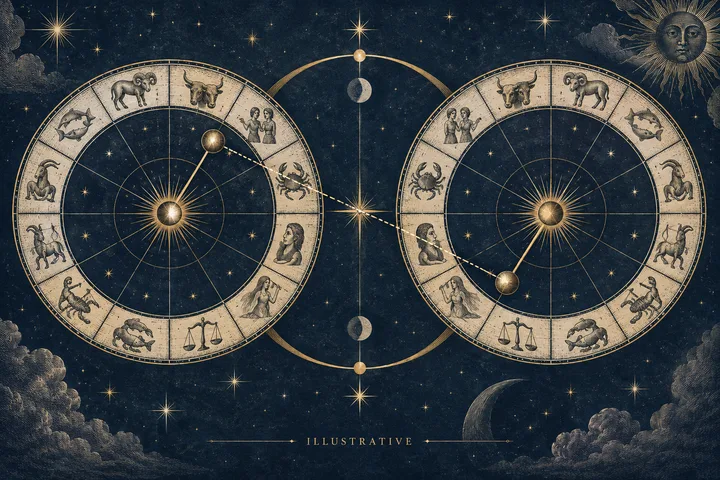
Convert the first placement to ecliptic longitude. Aries starts at 0 degrees, Taurus at 30, Gemini at 60, and so on. The direct formula is (360 - L) modulo 360, where L is the original longitude. The result is the contra-antiscion.
Take Venus at 7 degrees Virgo. Virgo begins at 150 degrees, so the longitude is 157 degrees. Subtract 157 from 360 and you get 203 degrees, or 23 degrees Libra. A second person's planet at 23 degrees Libra makes an exact contra-antiscia contact to that Venus. The sign pair is only a shortcut. The degree completes the calculation.
The same arithmetic handles minutes and the zodiac's wraparound. Venus at 7 degrees 30 minutes Virgo becomes 157.5 degrees and reflects to 22 degrees 30 minutes Libra. A planet at 22 degrees 45 minutes Libra is 15 minutes from exact. Write down the original degree, the mirror degree, the second placement, and the separation so another reader can follow the result.
Sources: The Classical Basis of Antiscia and Contra-antiscia; Contra-Antiscia: Mirror Points Across the Equinox Axis
How it differs from an opposition or contraparallel
Keep the geometry clear. An ordinary opposition places two points 180 degrees apart in zodiacal longitude. An antiscia contact uses the solstice-axis mirror. A contra-antiscia contact uses the point opposite that mirror. A contraparallel belongs to declination work and compares how far planets sit north or south of the celestial equator.
You can't derive a contraparallel from sign and degree alone. If a report uses that label, look for declination data. If it calls a longitude mirror a contra-antiscion, don't silently translate it into a declination aspect. The names may sound related, but the inputs differ.
The distinction matters in interpretation. A visible opposition is already part of the ordinary chart story. A contra-antiscia contact is an additional mirror layer. Name both when both exist, then decide whether the hidden layer adds anything.
Sources: The Classical Basis of Antiscia and Contra-antiscia; Contra-Antiscion: Opposing point
What orb gives the contact weight
Use a tight orb. One degree is a sensible default for a contra-antiscia contact. Some modern practitioners review contacts within one to two degrees, but the meaning should soften as the distance grows. Exact can lead. Within one degree can support a theme. Around two degrees deserves a check, not a headline. Beyond that, leave it out unless your chosen tradition gives a clear reason to keep it.
Minutes matter. A contact that is 12 minutes from exact is not equal to one that is 1 degree 52 minutes away, even though both fit inside a two-degree window. Record the actual separation. If the placement belongs to an angle or a sensitive point and the birth time is uncertain, tighten the standard further because the degree may not hold.
The six-degree orb in the Synastry Comparison Report applies to selected major aspects. It does not automatically extend to contra-antiscia. This is a different calculation, so keep its orb separate.
Sources: The Classical Basis of Antiscia and Contra-antiscia; Contra-Antiscia: Mirror Points Across the Equinox Axis
Which planets should you read first
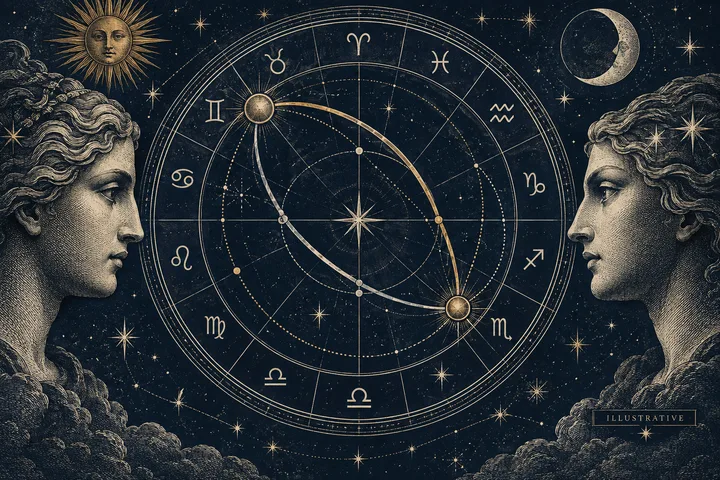
Let the question choose the planets. For affection and desire, start with the Moon, Venus, and Mars. For conversation, look at Mercury. For duty, fear, delay, or commitment, Saturn may matter. A mirror contact doesn't replace planet meanings. It changes the way two functions meet.
A close Moon-Venus contact may describe care that feels tender but is offered in different languages. Venus-Mars can put attraction beside different speeds or boundaries. Mercury-Moon may show words landing on feeling. Mercury-Saturn can make a conversation carry weight. These are starting hypotheses, not statements about what either person secretly intends.
Read each planet in its own natal context before reading the contact between charts. If the supplied material includes only Moon, Venus, and Mars signs with optional degrees, stay within that scope. Don't invent houses, angles, or a complete natal pattern.
Sources: The Classical Basis of Antiscia and Contra-antiscia; Contra-Antiscia: Mirror Points Across the Equinox Axis
The ranking test: exactness, relevance, corroboration
Rank the contact in three moves. First, check exactness. A sign pair without matching degrees is only a candidate. Second, check relevance. A close mirror involving Mercury matters more to a communication question than to a question about physical attraction. Third, check corroboration. Does the ordinary synastry or the couple's described pattern give the contact a clear job?
Consider a close Venus-Saturn mirror alongside a visible Venus-Saturn square and a repeated pattern of caution around affection. The mirror can explain why the pressure feels indirect or catches the couple by surprise. It supports the existing story. It shouldn't start a second story with new claims.
The strongest exception is a close personal-planet contact that matches a repeated situation the visible chart leaves unexplained. Even then, call it a useful symbolic frame, not a secret cause. If you can't name the question it clarifies, keep it in technical notes.
Sources: The Classical Basis of Antiscia and Contra-antiscia; Contra-Antiscia: Mirror Points Across the Equinox Axis; Contra-Antiscion: Opposing point
Worked example: Venus at 7 Virgo and Mars at 23 Libra
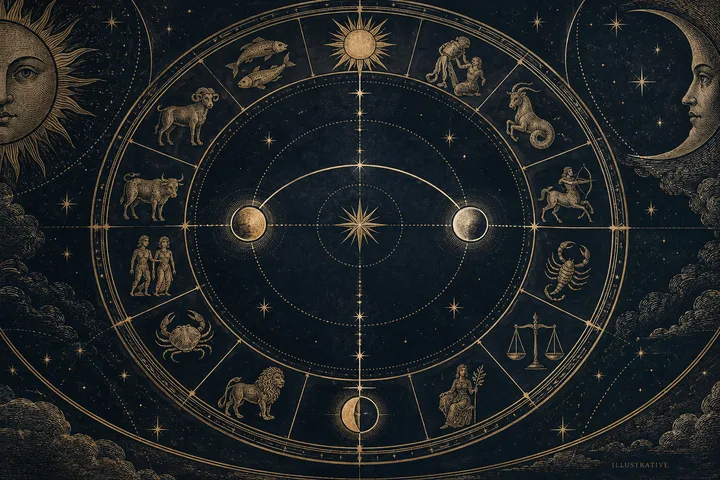
Consider an example. Venus is at 7 degrees Virgo, and Mars is at 23 degrees Libra. Virgo begins at 150 degrees, so Venus sits at 157 degrees of longitude. The contra-antiscion is 360 minus 157, which equals 203 degrees, or 23 degrees Libra. Mars lands exactly on the mirror.
The geometry gives you a Venus-Mars counterpoint. Venus speaks to affection, taste, and value. Mars speaks to desire, pursuit, and initiative. The pair may describe attraction with a difference in pace or style. That interpretation becomes useful when the rest of the comparison, or the couple's own account, shows that pattern.
Now change Mars to 20 degrees Libra. The same sign pair remains, but the separation becomes three degrees. Under a tight standard, qualify or omit it. Change the planets instead, and the geometry stays exact while the subject changes. A Moon at 7 Virgo mirrored to Mars at 23 Libra asks about feeling and action, not Venusian affection and pursuit. Geometry finds the link. Planet symbolism tells you what to ask.
Sources: The Classical Basis of Antiscia and Contra-antiscia; Contra-Antiscia: Mirror Points Across the Equinox Axis
When leaving it out is the better reading
Leave the contact out of the main interpretation when the degrees are missing, rounded beyond confidence, or too far apart. Sign-only data can support a sign-level observation, but it can't support an exact mirror claim. The same restraint applies when an uncertain birth time affects the point you are using.
Leave it out when the report has confused ecliptic longitude with declination. Correct the method before interpreting it. Also leave it out when a minor mirror merely repeats a clearer conjunction, square, opposition, or personal-planet theme. A report earns clarity by ranking evidence, not by displaying every possible contact.
Finally, omit it when the interpretation would claim another person's attraction, withholding, loyalty, betrayal, or future action. The contact describes a relationship between functions. It doesn't read a mind.
Sources: The Classical Basis of Antiscia and Contra-antiscia; Contra-Antiscion: Opposing point
Include, qualify, or omit: the final decision
Include a contra-antiscia contact when the degrees are exact or very close, the planets answer the question, and the mirror clarifies a theme already visible in the comparison. Qualify it when the degrees are reliable but the orb is wider, the planets are less central, or the rest of the chart offers no echo. Omit it when the signs are all you have, the method is unstable, or the contact adds drama without information.
For this report, gather the planet names and exact degrees, calculate the mirror, record the orb, and keep longitude separate from declination. Then ask one grounded question: what pattern could this contact help the couple discuss? If the answer is clear, include the mirror as a secondary sentence. If the answer is uncertain, qualify it. If the data cannot carry the claim, leave it out.
The firm answer is simple. A contra-antiscia contact earns space by making the synastry clearer. It doesn't earn space merely because it is rare.
Sources: The Classical Basis of Antiscia and Contra-antiscia; Contra-Antiscia: Mirror Points Across the Equinox Axis; Contra-Antiscion: Opposing point
A little more clarity
Is a contra-antiscia contact the same as a contraparallel in synastry?
No. A contra-antiscia contact uses zodiacal longitude and mirrors a degree across the Aries-Libra equinox axis, or finds the opposition of its antiscion. A contraparallel uses declination, measuring one planet north and the other south of the celestial equator. They require different data and should be read as different layers.
Sources & further reading
- The Classical Basis of Antiscia and Contra-antiscia
Supports the traditional mirror axes, the longitude and declination distinction, contra-antiscia as the point opposite the antiscion, and close-orb restraint.
- Contra-Antiscia: Mirror Points Across the Equinox Axis
Supports the equinox-axis calculation, sign-pair list, hidden-opposition interpretation, and typical one-to-two-degree review range.
- Contra-Antiscion: Opposing point
Supports the concise definition as the opposing point to an antiscion and the rule that it should not outrank visible chart testimony without context.
Synastry Comparison Report
Enter known placements for two people. Get an input-by-input comparison, selected aspect calculations and a clear record of what remains uncertain.
Compare our placements