
Start with the calculation contract, not the conclusion
When two synastry reports disagree, compare them in this order: first, confirm that both use the same two chart records and the same chart type; second, identify the zodiac frame and compare the displayed planetary positions; third, mark any birth-time uncertainty that affects the factors under dispute; fourth, check which bodies or points are included and whether either report adds house overlays; fifth, compare the aspect families and orb rules; finally, choose one disputed contact and see whether its calculation can be reproduced from the printed positions and declared rule. This order moves from inputs to settings to a checkable result, so a disagreement can be located before either interpretation is trusted. A label such as “synastry” does not by itself tell you that two reports calculated the same thing. Nor does a different result alone prove an error: the reports may use different, internally consistent conventions. If the disclosed inputs and calculation rules match but the contact still differs, the remaining issue is calculation reproducibility. If the contact matches but its meaning differs, that is an interpretive disagreement to examine separately. Matching calculations also do not require identical readings; interpretation depends on the stated approach and the question being considered. Keep a simple distinction in view throughout: calculation answers what positions and contacts the report produced under its rules; interpretation asks how an astrologer reads those contacts. A report can be reproducible without its reading being the only available one. Begin with the first difference you can verify, rather than treating either report’s overall conclusion as the test.
What exactly did each calculator calculate?
Before comparing conclusions, establish identity and scope: are the reports using the same two people’s chart records, comparing natal charts with natal charts, and including the same kinds of factors? In synastry, one person’s chart is considered in relation to another’s. That broad label leaves room for different calculation contracts. One report may present interchart planetary aspects; another may also show house overlays or include additional points. A result can therefore be absent from one report because that report did not calculate or display that factor. The useful first question is not which narrative sounds more persuasive, but whether both narratives were built from comparable chart material. Separate the factors each report actually lists from factors that might exist in a fuller reading. A missing item is evidence of a difference in scope only when the report’s stated coverage lets you identify the omission. Pay attention to whether a report is showing a complete list, a selected set, or only highlighted contacts; those formats answer different questions about what was calculated versus what was chosen for display. When the format is unclear, do not read silence as exclusion. Instead, note that the output does not let you tell whether the factor was omitted at calculation or presentation. That distinction matters before you compare the prose, since two summaries can differ even when their underlying calculations overlap. If its method page is silent, record the setting as unknown instead of filling the gap with an assumption.
Provider disclosures illustrate why this distinction matters. In “Free Synastry Calculator: Compare Two Birth Charts | Umbriel Astrology,” Umbriel describes its own included factors, aspect and orb cutoffs, and scoring inputs. “Synastry Chart Calculator: Birth Chart Compatibility | Charting Stars” describes its own birth-time handling, aspect choices, and whole-sign overlay approach. These are examples of choices those providers state about their calculators; they do not establish that either approach is universal, that the providers use identical settings, or that an undisclosed setting matches the other tool. Compare only the details each page actually discloses. For example, a stated difference in overlay approach can explain why house material is presented differently, while the available disclosures do not justify inferring every other calculation choice. The pages offer provider descriptions, not independent audits of implementation. Disclosure makes a method easier to compare, but it cannot by itself prove that a calculator executed the described method correctly.
Next identify the position conventions behind the displayed signs and degrees. A sign label without its zodiac frame is not enough to establish that two reports are comparing like with like. If both reports name the same frame and provide positions, compare the values for the factors at issue; if they do not reveal the convention or degrees, you may not be able to reproduce a disputed result. This is still an input-and-scope question. A report that withholds a needed setting has left the cause unresolved; it has not thereby demonstrated a calculation mistake. Likewise, two declared conventions can yield different presentations without either report contradicting its own method. Keep that diagnosis distinct from judging what a listed contact means.
Birth-time treatment belongs in the same contract because some chart factors depend on time. A calculator may state how it handles an unknown time, while another may require a time or leave time-sensitive material conditional. Do not silently treat a default convention as the person’s verified birth time. Ask whether the disagreement concerns a factor whose calculation uses the uncertain input; if so, its status remains conditional until the input or convention is clarified. A difference confined to that factor does not automatically settle the status of placements that do not depend on the same time-sensitive calculation. The point here is to identify which records and declared assumptions went into each output, not to infer missing data from a polished report.
Also distinguish a report’s list of contacts from its summary score. If a provider publishes a scoring formula, that formula can explain how its own displayed total is assembled from selected factors. The score still represents that provider’s aggregation rule; the existence of a formula does not turn the number into a measurement of relationship quality or a neutral referee between two readings. When components or weights are not disclosed, the reader cannot reconstruct the total from the visible information. Treat the number as a feature of that report’s presentation, then return to the underlying contacts and settings that can actually be compared. This distinction prevents a precise-looking output from obscuring what the calculator included.
The Synastry Comparison Report offered here works from placements the reader supplies: Moon, Venus, and Mars signs, with degrees optional, and selected major aspects under its stated six-degree orb. It does not calculate natal charts from birth details or calculate houses. It can therefore help compare supplied placements within that scope, but it cannot resolve a disagreement that depends on unprovided birth records, hidden calculator settings, or house calculations. Those limits identify what the report can compare; they do not decide which of two external calculators is correct.
A practical record for each report can stay brief: note the chart records and type, the factors shown, and the settings explicitly stated. Mark anything material but undisclosed as unknown. Then select one contact that appears in one report but not the other and carry its required inputs and rule into the next check. This is enough to locate whether the disagreement begins with chart identity, coverage, or a declared convention; it avoids turning a provider’s marketing summary into proof of methodological equivalence. Different declared settings may each be coherent within their approach. If settings match, compare the reproducible contact itself before drawing a conclusion from either narrative.
Before trusting either synastry report, compare what each calculator used: the two chart records and chart type, zodiac frame, displayed positions, time-sensitive inputs, included points, house method, and aspect and orb rules. Then trace one disputed contact from the displayed positions using each report’s stated rules. This can show whether a difference comes from calculation settings or from interpretation. When the calculations match, compare the meanings through the stated interpretive approach and the question each factor is being used to explore. A score summarizes its provider’s chosen inputs and weighting; it cannot establish a universal ranking or settle what a contact means. If a needed input or setting is hidden, leave that claim unresolved. Use shared, reproducible contacts to frame a useful question for conversation, not a verdict about the relationship.
Sources: Free Synastry Calculator: Compare Two Birth Charts | Umbriel Astrology; Synastry Chart Calculator: Birth Chart Compatibility | Charting Stars
Do the reports use the same zodiac frame and positions?
Yes, this can explain a sign-label disagreement before either report's arithmetic or interpretation is judged. A zodiac frame is the convention used to locate zodiac signs against the sky. Tropical and sidereal zodiacs use different reference points, so a planet can receive different sign labels under the two frames while referring to a position derived from the same observation. A longitude is the angular position of a planet along the zodiac, expressed in degrees around the circle; its sign name is a 30-degree segment of that coordinate. For a useful comparison, identify the frame each report uses, then compare the planet positions in a common frame. Matching sign words alone does not establish matching coordinates, and different sign words alone do not establish a calculation mistake.
Swiss Ephemeris documentation describes selectable calculation modes and named sidereal or ayanamsha options. An ayanamsha is the offset used to set a sidereal zodiac's reference relative to the tropical zodiac; selecting a different named value can therefore change the resulting sidereal longitude and possibly its sign label. This establishes that such computational choices exist. It does not show which choice a particular website made, whether either report uses Swiss Ephemeris, or whether a calculator executed its disclosed settings correctly. Treat each report's own method statement as the evidence for its settings. If a page is silent, write “unknown” rather than assigning it a convention from the software documentation.
Start with the most specific disclosure available. Look for “tropical” or “sidereal”; if sidereal, look for the named ayanamsha. Then check whether the report prints degrees as well as sign names. The comparison only becomes a like-for-like position check when both reports' frame conventions are known or their longitudes can be expressed in the same frame. A sign label compresses a continuous position into one of twelve bins: two planets in the same sign can still occupy different degrees, and positions near a boundary can be assigned to adjacent signs under a changed frame. A comparison limited to sign names cannot reveal how far apart the underlying positions are. The zodiac frame names the coordinate system, while the longitude supplies the position within it; both are needed to decide whether two displayed placements refer to comparable points.
If the two reports disclose different frames, first record that method difference. The sign labels may diverge for that reason; any later aspect table can also diverge because the aspects are computed from the positions being compared. Do not use one report's sign label as proof that the other is wrong. To compare the displayed placements themselves, obtain the longitudes under one declared convention, or use a source that states the convention and the inputs used. If either report omits the degrees or frame, the disagreement may remain unresolved at this level. That is a limit of the available output, not evidence for a particular hidden setting.
If the declared frames match but the printed positions do not, look next at the records and computation path behind those values. Confirm that the same birth date, recorded time, location and time-zone treatment were supplied. A time-zone conversion or a different recorded time can alter the instant used for calculation; a different source or calculation setting may also matter. This is a diagnostic branch, not a claim that any one cause is present. Ask the providers what inputs and settings produced the displayed position if the report does not expose them. Without that information, you can identify a position-level discrepancy but may not be able to assign its cause.
Keep three questions separate: are the zodiac conventions alike, do the displayed longitudes match, and do the reports interpret the resulting contact alike? Each answer narrows the disagreement. Frame differences explain why sign labels might differ without establishing an error; matching frames with different printed longitudes call for an input or calculation-source check; matching positions leave the interpretive comparison for later. This order matters because aspect comparison depends on the positions that enter it. A reader should not try to settle a disputed aspect by comparing sign names alone when the reports have not established that they use the same zodiac frame and underlying longitudes.
Some reports give only signs, while others print degrees and minutes. When degrees are available, preserve the notation as shown and note its frame; a degree value without that convention is not a complete coordinate for cross-report comparison. When only signs are shown, you can still ask whether the reports name the same frame, but you cannot reconstruct the exact position or determine how close two planets are from those labels alone. Avoid filling that gap with a guessed degree or an assumed default. The practical result is specific: classify the sign disagreement as convention-dependent when the disclosed frames differ, and classify the position comparison as unresolved when a required frame or longitude is missing.
The strongest counterpoint is that a visible sign mismatch may be entirely consistent with two disclosed conventions. It is not a verdict against either calculator. Conversely, a shared zodiac label does not guarantee identical longitude: the reports could use different inputs or calculation sources, or round their output differently. The useful test is therefore not whether their prose uses the same sign word, but whether their coordinate conventions and displayed positions can be brought into a common comparison. Only after that can a reader tell whether the next disagreement comes from aspect inclusion or from an astrologer's interpretation.
Sources: Swiss Ephemeris documentation
Which results depend on an accurate birth time?
An uncertain birth time matters when the disputed result depends on a time-sensitive chart factor. Ask what the claim is about before treating the whole report as reliable or unreliable. A chart's Ascendant and other angles depend on the time and place used to set the chart; houses divide the chart by those angles and likewise require an adequate time basis. If the time is unknown or only approximate, angle and house claims may be unavailable or conditional. A report that supplies them anyway may be using a stated default or assumed time, which should be recorded as a convention rather than treated as the verified birth time.
The Moon requires a more specific check. Its sign can be uncertain when the plausible birth-time interval spans a sign boundary, but it does not follow that every uncertain time changes the Moon sign. If the possible times all leave the Moon in the same sign, that sign-level placement may still be comparable even though its exact degree could vary. If the interval crosses a boundary, record both possible signs or mark the sign unresolved; do not choose one without a basis. The relevant question is whether the report's disputed statement depends on the sign, the degree, or a contact involving the Moon. Those claims can have different levels of certainty from the same birth-time uncertainty.
Separate the chart layers rather than letting one uncertain input erase every comparison. A missing time can make the Ascendant, angles and house placements conditional while leaving some supplied planetary sign placements usable for a narrower comparison. The degree-level precision of a placement may still need separate scrutiny, so do not silently carry a sign-level certainty into an exact-position claim. For each disputed item, name the factor it depends on and ask whether that factor uses the uncertain time. If not, compare that displayed placement on its own terms; if it does, preserve the uncertainty beside the claim. It also helps to distinguish a claim about a planet's sign from a claim about its exact degree. A sign can remain the same throughout an uncertain interval even though the longitude moves within that sign; a contact that depends on precise positions may therefore remain less certain than the sign label. Conversely, a difference in house placement should not be used to infer that the planet's sign must also be wrong. Write down the disputed factor, the time range that is genuinely possible, and the level of detail the report claims. This turns a vague concern about a missing time into a bounded question about which displayed result that uncertainty can affect.
A disclosed noon chart or other default-time convention can produce a complete-looking display, but it is a calculation convention for missing data, not evidence that the person was born at noon. The same applies to a rounded or estimated time: it narrows the uncertainty only as far as that estimate is trustworthy. Record the value as reported, estimated or assumed, and do not collapse those categories. When two reports use different defaults, their time-sensitive factors are not directly comparable until the underlying time convention is known. This explains why two outputs can present different angles or houses without establishing what the correct values would be for an unknown birth time.
Use a simple dependency check for the item in dispute. If one report cites an Ascendant, an angle or a house overlay, ask whether the birth time and location are sufficiently known for that factor and whether both reports used compatible chart conventions. If the claim rests on the Moon's sign, check whether the plausible time interval crosses a sign boundary. If the reports differ only on a placement whose relevant supplied inputs are stable across that interval, isolate that placement and assess it separately. This prevents a conditional house reading from being used to invalidate a separate sign comparison, while also preventing a polished report from making an uncertain angle look settled.
When the time-sensitive factor cannot be established, set that particular claim aside as conditional or unresolved. Do not convert missing information into a definite chart feature, and do not force the reports to agree by selecting whichever default produces the preferred reading. If one report marks the factor unknown and the other fills it from a default, the difference is partly a difference in handling missing data. Once that is recorded, the reader can still compare the portions that do not rely on that assumption, provided their other relevant inputs and conventions align.
This is a scope judgment, not a claim about how often birth times are wrong or how frequently a Moon sign changes. The test is whether the possible time range crosses a boundary or supplies an angle or house calculation that the disputed interpretation actually uses. Unknown time limits selected layers; it does not automatically invalidate every placement. A useful comparison keeps the uncertain factor visible, narrows the conclusion to what the available time supports, and leaves the affected claim open until better birth-time information or a clearly stated calculation basis is available.
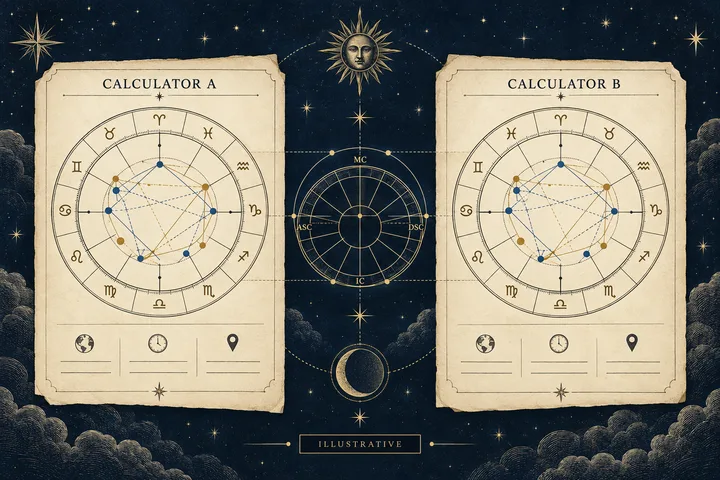
Are houses and overlays part of the same comparison?
No. An interchart aspect describes an angular relationship between a point in one person’s chart and a point in the other person’s chart. A house overlay describes where one person’s planet falls in the other person’s house structure. Both are ways of comparing charts, but they are different chart layers, rely on different chart information, and answer different interpretive questions. If one calculator lists cross-chart aspects and another also discusses overlays, their reports are not presenting identical material. The second report has added a house-based layer; it has not necessarily found an aspect the first report missed.
The distinction is visible in what each statement relates. “One chart’s Venus is in aspect to the other chart’s Mars” describes a cross-chart planetary relationship. “One person’s Venus falls in the other person’s seventh house” describes a planet-to-house placement. The first comparison can be expressed through the positions of two chart points and an angular relationship. The second depends on the house divisions in the receiving chart as well as the planet’s position. A report can therefore include cross-aspects without calculating or displaying overlays. A report that includes both has expanded the comparison, not merely offered a longer list of the same kind of result.
This matters when two written readings seem to disagree. If one says nothing about houses, that silence does not cancel a cross-aspect reported by the other. First ask whether the reports are describing the same layer. An omitted overlay is absent from the report’s coverage or presentation; it is not a contrary calculation of an interchart aspect. Conversely, a difference between two stated overlay readings cannot be diagnosed by checking only the aspect list. The evidence needed to compare one layer does not automatically verify the other.
The Astrology Podcast transcript “Ep. 165 Transcript: Synastry: The Astrology of Relationships” records astrologers Chris Brennan and John Green discussing cross-aspects and house overlays as parts of synastry. Their conversation presents considering cross-aspects and then overlays as one practitioner’s way to organize a reading, with emphasis guided by the question being explored. That is a useful example of a reading sequence, not a universal rule that every astrologer must follow or a ranking proven by the transcript. A calculator may prioritize, omit, or arrange these layers differently and still be answering a narrower question about chart comparison.
House method adds another source of non-equivalence. Houses divide a chart into twelve areas using a chosen convention; an overlay assigns one person’s planet to an area in the other person’s chart. Two reports can therefore use the same planetary positions yet display different house placements if their house conventions differ. A provider might disclose its house approach, while another may give no method or no overlay at all. Compare the declared convention and the layer being shown before treating differing house labels as a planetary-position disagreement. The house label is not itself a new longitude for the planet.
An overlay also depends on having a usable house structure for the chart receiving the planet. House conclusions require suitable birth-time data and a known calculation basis. If that basis is missing, a report’s overlay may be conditional or impossible to reproduce, even when planetary positions elsewhere in the report can still be compared. This is a dependency of the house layer, not a reason to reopen every input question for every factor. Keep the uncertainty attached to the overlay whose house divisions rely on it.
For a focused comparison, separate the report statements into two simple groups: relationships between chart points across the charts, and placements of one chart’s planets in the other chart’s houses. Within the second group, compare the stated house convention and whether the house inputs are available. This separation shows whether a disagreement concerns coverage, house construction, or a cross-aspect itself. It also keeps an interpretive difference in emphasis from looking like a calculation error. One astrologer may begin with cross-aspects; another may find a house overlay more relevant to the reader’s question. The transcript supports that flexibility as a practitioner approach, while leaving the choice of emphasis open.
The same distinction helps when reports use different labels for their outputs. “Synastry” can name the broad practice of comparing two charts, while an individual calculator may use the word for a selected package of factors. One package may be limited to point-to-point contacts; another may add house placement statements. Readers should compare the actual claims printed, not infer that a shared heading means the same chart layers were examined. If the method page identifies overlays, that disclosure clarifies what the report intends to cover. If it does not, the reader cannot conclude from a short summary whether houses were calculated, omitted, or simply left out of the displayed interpretation. This keeps the question narrow: does the report offer the same kind of result, based on a comparable house basis? It avoids mistaking a difference in report design for a conflict about a planetary contact.
A declared house convention can make a house comparison reproducible, but it does not make every interpretive use of that house identical. The convention answers how the house placement was assigned; the reading still depends on the astrologer’s approach and the question at hand. Keep those two steps distinct when comparing prose. A mismatch in the assigned house points to a layer or convention difference. Similar house placements paired with different explanations point instead to interpretive emphasis. Neither observation changes the cross-aspect geometry unless the reports also use different planetary positions.
Sources: Ep. 165 Transcript: Synastry: The Astrology of Relationships | The Astrology Podcast
Can you reproduce the disputed aspect from the printed degrees?
Yes, if both reports show comparable longitudes for the two chart points and disclose the aspect and orb rules they apply. An aspect is an angular relationship between two points. Its exact angle is the target separation assigned to that aspect; the orb is how far the actual separation lies from that target. The calculation can establish whether a stated contact falls within a particular report’s policy. It cannot, by itself, establish how much interpretive weight the contact should receive.
The technical guide “Aspects: Geometry, Orbs, and Exact Timing” from Kerykeion describes this geometry as a comparison between angular separation and an exact aspect angle, with the difference called the orb. To audit a listed contact, take the two displayed longitudes and find their shortest separation around the zodiac circle. Compare that separation with the target angle named for the aspect. The absolute difference between the two values is the orb. Then compare the result with the report’s stated allowance for that aspect and those planets.
The shortest separation matters because the zodiac is circular. Longitudes near opposite ends of a 360-degree notation can be close across the boundary rather than far apart by the subtraction that first appears on the page. If the absolute difference between two written values exceeds half the circle, subtract it from 360 degrees to obtain the shorter arc. This is a geometric normalization, not an interpretive adjustment. After that, the target angle and orb comparison can be made using the same angular units.
For example, consider an explicitly invented teaching calculation, not a real chart: suppose two made-up longitudes are 42 degrees and 126 degrees, and the aspect under review is a square with a target angle of 90 degrees. Their separation is 84 degrees, so the orb is 6 degrees. Under a policy that allows this pair and aspect an orb of 6 degrees, the contact meets that numerical cutoff; under a narrower allowance, it does not. The example demonstrates only the operation. It says nothing about an actual pair of people or whether a square is meaningful in a particular reading.
The target angle must be named before the arithmetic settles anything. Reports may include different aspect families, and the same two positions can be evaluated against more than one target. Check whether both calculators include the aspect in question and whether their tables mean the same thing by its label. A contact absent from one report may simply fall outside its selected aspect set. It may also be calculated but not displayed in a summary. The list’s omission alone cannot distinguish those possibilities unless the report explains whether it is complete.
Next inspect the orb rule at the level the calculator actually states. Kerykeion’s technical guide describes different orb conventions, including fixed allowances and approaches that vary allowances by planetary factors. That variation is why one report’s cutoff cannot be assumed to govern another. A provider may use a different allowance for different aspects or planet pairs, or make a special allowance for particular factors. If the rule is not visible, do not infer it from a contact that happens to appear. Record the inclusion policy as unknown and the disputed result as unverified.
Positions must also be comparable for the arithmetic to be reproducible. If one report prints only sign labels, or the reports do not establish a shared zodiac frame, the reader may not have the longitudes needed to check the separation. A remembered sign position or guessed degree cannot fill that gap. Likewise, if the two reports print different positions, first resolve that position-level difference using the earlier coordinate comparison; an aspect calculation based on mismatched inputs will only reproduce each report’s separate inputs. The audit begins once the relevant positions are aligned or their difference is explained.
There are thus two distinct reasons for different aspect lists. If positions differ, the geometry may differ because the values being compared differ. If positions match but inclusion does not, the reports may be applying different aspect families, orb policies, or display choices. The first is a position or calculation comparison; the second can be a policy difference even when both tools apply their own rules consistently. If either longitude, the target aspect, or the relevant orb allowance is unavailable, classify that contact as unverified rather than declaring one calculator wrong.
A reproduced contact still has a limited result: it meets or fails a named rule under specified inputs. The arithmetic does not rank the contact’s importance, resolve a disagreement over its symbolism, or establish a relationship outcome. A wider orb might be accepted under one practitioner’s method and excluded under another’s. Once the calculation is clear, the reports can be compared on what their respective interpretive traditions say, with the policy boundary visible. Geometry supplies a checkable basis for inclusion; meaning remains a separate judgment.
A concise audit record can state the two point names, both printed longitudes and the zodiac frame, their shortest separation, the named target angle, the resulting orb, and the report rule used to include or exclude it. This is not a fresh general inventory of every calculator setting; it records only the values needed for this one contact. If the outputs use different rules, write each result under its own policy rather than forcing a single verdict. For instance, a contact can satisfy the wider disclosed allowance and miss the narrower one. That description is more precise than saying that one report “has” the aspect and the other “does not,” because it explains how each list was produced. When the listed values are rounded, state that the calculation uses the printed precision and may not reproduce hidden extra decimals. The resulting check remains limited to the visible data.
Rounding is worth keeping visible because reports do not always print the same number of decimal places. A result calculated from rounded display values may differ slightly from a tool’s internal calculation using greater precision. If a contact lies close to a stated boundary, the printed values may be insufficient to reproduce the final inclusion decision exactly. Mark that precision limit rather than supplying extra digits or assuming the tool’s hidden value. The point is to report what the visible record can support: a reproducible separation at displayed precision, or an unresolved cutoff decision if the missing precision could change it.
Sources: Aspects: Geometry, Orbs, and Exact Timing | Kerykeion Learn Astrology
What does a compatibility score actually add?
A score cannot settle a disagreement between two narrative readings. At most, it summarizes how a particular provider has combined the factors it chose to count. If the report does not disclose those factors and their weights, you cannot reconstruct the total or tell what a changed contact would do to it. If the method is disclosed, you can audit the aggregation, but the result still describes that provider’s scoring system rather than choosing which symbolic reading is more persuasive.
The distinction is between a rule and a conclusion. A rule might assign values to selected contacts, combine them, and display a total. That gives the number an internal meaning: under the provider’s selected inputs and policy, this is the output. It does not, by itself, answer why one astrologer reads a contact as supportive while another emphasizes its tension, or why one factor matters more to a question the reader cares about. Those are interpretive judgments. A consistent arithmetic operation can summarize them only if the provider has already translated them into inputs and weights; the arithmetic does not independently justify that translation.
Umbriel Astrology’s “Free Synastry Calculator: Compare Two Birth Charts | Umbriel Astrology” is a provider-specific example of a disclosed scoring method, discussed briefly in section 1. Its method page describes selected factors and scoring inputs. That makes the score more inspectable than a number with no explanation, because a reader can see what that provider says contributes. It does not establish that Umbriel’s choices are standard, that its weights are neutral, or that the total is a substantiated conclusion about a relationship. The relevant question is not whether the page has a formula, but what the formula is designed to summarize and whether that summary helps with the current interpretive disagreement.
A score may still be useful as navigation. If a provider makes its components and weights clear, the total can point you toward how that system has grouped its selected contacts. You might then open the component list and ask which contacts produce the result. But the convenience of a compact summary comes with information loss: different sets of factors can be collapsed into the same total, and the total alone does not preserve the separate meanings or tensions of each contact. If a narrative says one thing and a score appears to say another, the number cannot explain the mismatch without the underlying contributions being available.
The score also has a boundary of scope: it compresses only what its method has chosen to represent. If a calculator scores selected aspects but its prose discusses sign context, a house overlay, or a factor outside that scoring set, the total cannot stand in for those omitted layers. A disagreement about a point the number does not encode remains unanswered by it. Even when every listed component is visible, the reader still needs the underlying contact names and interpretive descriptions to understand what the aggregation has combined. A total can direct attention to a summary; it cannot recover detail that the summary leaves out.
Nor does a number become a shared comparison language simply because two reports both display one. One provider may include a different set of factors, group contacts differently, or assign different contributions. Identical-looking totals can therefore summarize unlike constructions; different totals can arise even when the reports agree on some underlying contacts. Unless both systems disclose compatible inputs and aggregation rules, comparing their totals does not show that one reading is stronger. It shows only that the displayed outputs differ under methods that may themselves differ.
The practical decision is straightforward. When components or weights are hidden, set the score aside as unresolved shorthand and compare the stated contacts and interpretations you can inspect. When the construction is disclosed, read the component list before using the total, and keep the score attached to that provider’s method. If the narratives disagree despite matching calculations, return to the symbolic question each contact addresses rather than asking the aggregate to arbitrate. That preserves what the number can offer as a summary without turning it into a verdict about the relationship.
When the formula is unavailable, do not reverse-engineer it from a handful of displayed examples or assume that a label such as “compatibility” names a shared scale. The provider’s explanation is the evidence for what its number means. Without that explanation, the safest comparison is at the level the reports actually expose: contacts, stated rules, and the meanings attached to them.
Sources: Free Synastry Calculator: Compare Two Birth Charts | Umbriel Astrology
What does a distinct Moon, Venus, or Mars factor add?
When two reports use matching calculations, compare their meanings by asking what question each contact contributes to the reading, which interpretive tradition is being used, and what other reading remains possible. There is no single source-backed ranking that turns a close contact, a Moon contact, or a Venus contact into the most important factor in every comparison. Cafe Astrology offers one organized approach: consider the planets’ signs and houses, give closer attention to inner-planet and relationship-significator interaspects, and interpret the contacts through planet-pair meanings. In “Aspects Between Charts | Cafe Astrology,” those suggestions describe that site’s method. “Ep. 165 Transcript: Synastry: The Astrology of Relationships | The Astrology Podcast” records a different emphasis from astrologers Chris Brennan and John Green: cross-aspects and house overlays are considered in relation to the question being explored. These are identifiable approaches, not evidence of universal consensus.
That distinction matters because the same list of contacts can be organized around different reader questions. If the question concerns emotional response or care, the Moon can serve as a lens in this publication’s reading vocabulary. If it concerns affection, values, or what each person appreciates, Venus can frame the inquiry. Mars can prompt questions about desire, initiative, or how energy is expressed. Cafe Astrology’s “Aspects Between Charts: Synastry | Cafe Astrology” gives Moon, Venus, and Mars distinct interpretive themes and planet-pair discussions that support using them as separate prompts. These labels guide symbolic reading; they do not establish fixed traits or guarantee how either person behaves.
A contact’s planet pair therefore matters because it names the subjects being brought into relation, not because the label supplies a complete answer. A Moon-to-Venus contact can invite a reading about how emotional needs and expressions of affection meet. A Mars-to-Venus contact raises a different symbolic question about desire and attraction. Two Moon contacts are not interchangeable merely because both involve the Moon: the other planet, the signs and houses being considered, and the chosen tradition shape the specific interpretation. Cafe Astrology’s planet-pair organization makes this differentiation visible, while Brennan and Green’s question-led discussion leaves room to select emphasis according to the inquiry. Together, they support a reading that names its lens and question instead of assigning each planet a universal score.
Closeness and meaning should also remain separate. A tighter orb may be a clear first sorting convention when a report states that policy and both contacts are calculated under it. It tells the reader how close the displayed points are to the exact aspect according to that rule. It does not prove that the contact matters more for every question, or that one practitioner must prioritize it over a wider contact with a different symbolic role. Cafe Astrology’s closer-attention advice is one source’s interpretive hierarchy; the transcript’s question-led organization shows another way of choosing emphasis. A reader can note tightness as a reproducible feature while still asking what the contact contributes and whether the selected tradition gives it a particular role.
Consider this invented reading exercise, which describes no real people or chart positions. Suppose two reports agree on separate Moon and Venus contacts, while one report also includes a wider Mars contact under its stated orb policy. Start by treating the Moon and Venus contacts as distinct factors, rather than repeating either one in longer prose and counting the repetition as new information. Ask what the Moon contact contributes to a question about emotional response or care; then ask what the Venus contact contributes to a question about affection or values. These are prompts from the stated reading vocabulary, not conclusions about how either person actually feels.
In the exercise, keep three columns in view: the named contact, the interpretive question it raises, and the contextual choices needed to read it. For a Moon contact, the question might concern a style of emotional response or care; the comparison still needs the signs and any house context the chosen method uses. For Venus, ask what the contact contributes to a reading of affection or values, again without treating that vocabulary as a direct report of either person’s conduct. For Mars, ask whether desire or initiative is relevant to the inquiry and whether the contact is actually within the stated inclusion rule. These prompts prevent the planet label from becoming a diagnosis. They also make clear why two reports can agree on the geometry but choose different contextual details in their prose.
Now compare the reports line by line. If both list the same Moon contact but explain it differently, the difference belongs to interpretation unless a contextual input or convention also differs. If one lists a Venus contact and the other does not, check whether both include that factor and whether the displayed results have the same scope before reading omission as disagreement. If only one includes the wider Mars contact, distinguish the policy question from the meaning question: first establish whether the contact qualifies under that report’s own rule, then ask what symbolic contribution the reading assigns it. This order keeps inclusion, context, and interpretation from collapsing into one judgment.
Next inspect the Mars contact on its own terms. Is it included under the report’s disclosed policy, and what question about desire or initiative would it add? The wider orb can be recorded as a difference in closeness under that method, but the inclusion alone does not force it to outrank the other two contacts. If the other report omits it, first distinguish an actual calculation disagreement from different coverage or display choices. When the relevant inputs and policy match but one reading simply gives the contact less attention, the difference may be interpretive emphasis. Brennan and Green’s discussion supports relating emphasis to the question; Cafe Astrology offers closer attention to selected inner-planet and relationship-significator interaspects. Neither source resolves every choice for the reader.
The useful synthesis is convergence across distinct factors, not repeated wording about the same factor. If the Moon, Venus, and Mars contacts each speak to different parts of the question, a reader can describe how those symbolic themes sit alongside one another. That synthesis may show why a reading foregrounds several layers or why two practitioners select different starting points. It is still an interpretation built from the chosen tradition and inputs, not independent confirmation of a relationship fact. Likewise, a report that elaborates one aspect at length has not thereby supplied several separate contacts. Keep the list of calculated factors distinct from the amount of prose devoted to each one.
A useful comparison need not force all factors into one ranking. Instead, write a short reading that preserves their separate jobs: “The Moon contact is being used to explore emotional response; the Venus contact brings in affection or values; the Mars contact is included under this report’s stated rule and adds a question about desire or initiative.” Then name the live alternative: another reading may follow the question-led approach in the transcript and foreground whichever factor most directly addresses the reader’s concern, while Cafe Astrology recommends closer attention to specified inner-planet and relationship-significator interaspects. The sentence makes the basis for emphasis visible, and the competing route remains available for examination.
This way of composing the reading also helps distinguish a real convergence from a rhetorical one. Distinct contacts can bring different symbolic questions into the same discussion, and a practitioner may find that combination useful. But adding more sentences about a single contact does not create more contacts, and a cluster of distinct factors does not independently verify an outcome. It is appropriate to say that several symbolic lenses converge within a particular reading framework. It would overstate the sources to turn that into a measured indication of relationship quality or a prediction. The first describes how an interpretation is assembled; the second claims a kind of validation the cited practitioner references do not provide.
For a reader weighing two narratives, the difference can be documented without scoring the astrologers. Note whether the disagreement concerns the factor list, the context selected for a factor, or the relative emphasis given to otherwise matching contacts. Then identify the source approach behind each reading, if it is stated. Cafe Astrology’s page supplies one explicit set of interpretive recommendations and planet-pair meanings; the Brennan and Green transcript shows practitioners tying emphasis to the question and discussing both cross-aspects and overlays. If neither report names an approach, describe the observed difference plainly and leave its methodological basis open rather than assigning either report a tradition it has not claimed.
A competing reading remains possible even after the arithmetic matches. One practitioner may follow Cafe Astrology’s recommendation to attend more closely to particular interaspects; another may follow the question-led emphasis described by Brennan and Green and begin with whichever contact bears most directly on the inquiry. They may also use different sign, house, or planet-pair context while accepting the same contact list. State the approach being used, name the question it serves, and show the other plausible emphasis. This lets a reader see where the readings diverge without disguising one practitioner’s organizing choice as a calculation result.
Several conditions could change the reading. If a supplied placement is uncertain, then a contact that depends on it may need to remain conditional even when the prose sounds definite. If the reports use different conventions or one omits a factor, their matching statements may cover less ground than they appear to. A practitioner working from another stated tradition may organize the same planets differently, and a different reader question may make another contact more relevant. These are reasons to qualify the interpretive synthesis or narrow its scope, not reasons to invent a missing placement or decide which person is more invested.
So when the calculations match but the narrative readings differ, compare the interpretive work rather than searching for a hidden winner. Identify the Moon, Venus, or Mars factor being discussed, state the question it is being used to explore, check whether the report’s policy includes it, and preserve the strongest alternative emphasis. The contacts can then be read as separate symbolic contributions, with their contexts visible. A tighter orb, a favored planet, or a longer explanation may guide attention within a stated method; none alone settles the meaning.
Sources: Ep. 165 Transcript: Synastry: The Astrology of Relationships | The Astrology Podcast; Aspects Between Charts | Cafe Astrology; Aspects Between Charts: Synastry | Cafe Astrology
Choose what to verify and what to discuss
Choose one visible disagreement as the next check. If both reports show the relevant positions and state the rules used, compare that contact under those rules; if either hides a necessary input or setting, mark that claim unresolved. You do not need to settle every difference before deciding what the reports can tell you. A calculation question can remain open while the two of you discuss a useful interpretive question, such as what each person means by feeling cared for or expressing affection. Let the conversation answer that question. The chart can offer a symbolic lens, but it cannot answer on either person’s behalf.
If you want a structured comparison of known placements, the Synastry Comparison Report uses supplied Moon, Venus, and Mars signs, optional degrees, and selected major aspects under its stated six-degree orb. It does not calculate natal charts from birth details or houses. Compare the placements you already have, or ask the calculator for the missing setting needed to check one disputed result. Then leave the remaining interpretation open where the reports do not give enough information. The useful outcome is a clearer question to bring into conversation, not a score or verdict about the relationship.
Sources & further reading
- Free Synastry Calculator: Compare Two Birth Charts | Umbriel Astrology
This provider discloses its own synastry settings, including included factors, aspect/orb cutoffs and score construction; use it as an example of disclosures to compare, not as a universal standard.
- Synastry Chart Calculator: Birth Chart Compatibility | Charting Stars
This provider states its birth-time handling, aspect choices and whole-sign overlay approach; these are provider-specific settings readers can compare with another report.
- Swiss Ephemeris documentation
Swiss Ephemeris documents astronomical position computation and named sidereal/ayanamsha options, supporting the narrow point that coordinate and zodiac conventions affect displayed positions.
- Ep. 165 Transcript: Synastry: The Astrology of Relationships | The Astrology Podcast
Astrologers Chris Brennan and John Green describe synastry as comparing charts to explore relational dynamics, discuss cross-aspects and house overlays, and explicitly connect interpretive emphasis to the question being explored; this supports an attributed practitioner method, not a measured ranking rule.
- Aspects Between Charts | Cafe Astrology
The page organizes interchart interpretations by planet pairs and advises considering each planet's sign and house placements; it also recommends closer attention to inner-planet and relationship-significator interaspects. This is one site's stated interpretive approach, not an objective hierarchy.
- Aspects: Geometry, Orbs, and Exact Timing | Kerykeion Learn Astrology
The technical guide explains angular separation, distance from an exact aspect (orb), and alternative fixed or planet-based orb conventions; it supports recalculating a listed aspect only when its convention is known.
- Aspects Between Charts: Synastry | Cafe Astrology
Cafe Astrology assigns distinct interpretive themes to Moon, Venus and Mars interaspects, providing one explicit tradition-based example of why a contact can be discussed through different chart functions; these meanings are interpretive prompts, not observed outcomes.
Synastry Comparison Report
Enter known placements for two people. Get an input-by-input comparison, selected aspect calculations and a clear record of what remains uncertain.
Compare our placements