Imagine the date is known, but the clock is not
Imagine Maria has her birth certificate. It gives her date, place, and a time precise to the minute. Daniel knows the day he was born and the city, but nobody in his family remembers whether it happened before breakfast or after dinner. They want to compare charts. Maria worries that the missing clock makes the whole exercise useless. Daniel worries that a chart set for noon will quietly turn a guess into a fact.
That is the real problem. A careful comparison keeps the usable material, marks the moving pieces, and refuses to let a neat wheel pretend to know more than the birth record supplies.
Synastry compares two horoscopes. In the relationship chart, one person's planets are read against the other person's planets, angles, and houses. The comparison can show where their ways of feeling, loving, speaking, acting, expanding, and carrying responsibility meet. It can also show friction. A square may demand adjustment, while a trine may make ease feel natural. Neither one, by itself, gives a verdict about the future.
For Maria and Daniel, the first question is not, 'Are we compatible?' It is, 'Which parts of this comparison remain meaningful when Daniel's birth time is unknown?' That question produces a better reading. It also protects the couple from two opposite mistakes: throwing away useful planetary contacts, or treating a noon placeholder as Daniel's actual Ascendant and house map.
A birth date fixes much of the zodiac picture. The Sun and slower planets usually stay in the same signs all day, while Mercury, Venus, Mars, and especially the Moon need a boundary check. Use the birthplace too. It helps establish the local date and the Moon's range, and it matters if an approximate time later becomes available.
There is a useful distinction here. A sign tells you the style in which a planet works. An aspect tells you how two planets meet by degree. A house tells you where that energy lands in a person's life. When the time is missing, the first two layers may remain available while the third becomes unsettled. Start with the layers that the record can hold.
For Maria and Daniel, that means comparing Daniel's Venus, Mars, and Saturn by sign, then checking supplied degrees. They shouldn't begin with a guessed house map.
Sources: What if I don't know my birth time? - CHANI; Can You Read a Natal Chart Without a Birth Time? - StellaLogic; Birth time unknown: what your chart still reveals - Astraleria
The Moon is the first live uncertainty
The Moon needs its own checkpoint. It moves quickly, roughly thirteen degrees in a day, and changes signs every two or three days. On most birthdays, the Moon stays within one sign from the first hour to the last. On a sign-change day, the birth time decides whether the person has one Moon or the next. A chart that lists one answer without checking that day has skipped the most important question.
Suppose Daniel's Moon travels from 29 degrees Gemini to 12 degrees Cancer across his birthday. A noon chart may display Cancer, but Daniel could have been born with a late Gemini Moon. Those are not tiny variations in interpretation. Gemini Moon and Cancer Moon describe different emotional habits, even though both can be curious, responsive, and deeply attached in their own ways.
The answer is not to choose the Moon that sounds more like Daniel. Personality matching can help you explore the two possibilities, but it does not recover a clock. Treat both signs as candidates until a record or a narrow time window settles the question. You can still read Maria's Moon against both versions of Daniel's Moon, then note which emotional pattern remains present in either case and which one changes.
Degrees matter too. The Moon's position can shift enough during the day to change a close Moon-to-planet aspect or move it outside the chosen orb. If Daniel's Moon could be anywhere from 2 to 14 degrees Cancer, Maria's Venus at 8 degrees Virgo might form a possible sextile across the range, while Maria's Moon at 3 degrees Aries might make a relationship that is exact in one part of the window and wider in another. Do not call a moving aspect exact.
Test the Moon at the earliest and latest plausible times. If its sign and closest contacts survive the interval, the lunar theme is durable. If they do not, write two paths and keep both visible.
Maria may recognize one path more strongly than the other, but her recognition is a conversation starter, not proof. She can ask Daniel how he responds when he needs comfort, how quickly he names feelings, and whether he processes emotion by talking, retreating, protecting, or changing the subject. The chart gives language to those patterns. His actual behavior tells them how the pattern is living now.
You can compare synastry when one person has a birth date but no birth time. Start with the planetary signs and close planet-to-planet aspects that hold across the date. Test the Moon across the full day, because it may change signs or move a close contact outside your working orb. Treat noon as a display reference only. Leave the unknown person's Ascendant, angles, houses, house overlays, and Vertex out of the main reading. If your own time is known, you can still read where the other person's stable planets fall in your houses, but you can't reverse that overlay with confidence. For this report, use supplied placements and optional degrees with a six-degree working orb. Label each conclusion stable, conditional, or withheld. That gives you a useful comparison now and a clean way to update it if a record turns up.
Sources: What if I don't know my birth time? - CHANI; Can You Read a Natal Chart Without a Birth Time? - StellaLogic; CHANI unknown-birth-time guidance
Read aspects before you read houses
Once the stable signs and the Moon range are clear, move to aspects. An aspect is an angular relationship between two chart factors. The major aspects are the conjunction at zero degrees, sextile at sixty, square at ninety, trine at one hundred twenty, and opposition at one hundred eighty. The closer the angle is to exact, the more confidently many astrologers give it weight.
Synastry doubles the field. You are not reading one set of planets against itself, but two sets of planets against each other. That is why a smaller orb is useful. This article uses a six-degree working orb for selected major aspects when the degrees are supplied. The orb is a boundary for the report, not a magical switch. A contact at 0 degrees 40 minutes deserves more attention than one at 5 degrees 55 minutes, even though both enter the same six-degree screen.
Use the planets as the verbs of the relationship. The Sun brings identity and vitality. The Moon describes feeling and instinct. Mercury carries speech and thought. Venus shows attraction, taste, affection, and the way pleasure is shared. Mars brings desire, initiative, conflict, and pursuit. Jupiter expands. Saturn defines, tests, and steadies. The outer planets can add generational material or a more compelling, difficult-to-name layer when they touch personal planets closely.
Then read the aspect as the meeting. Maria's Venus conjunct Daniel's Mars can make attraction direct and visible. Maria's Mercury square Daniel's Moon can create a lively but tender mismatch between what one person says and what the other person feels. Maria's Saturn trine Daniel's Sun can support patience and respect, while a Saturn square may feel heavy before the couple learns how to turn responsibility into a shared structure. These are interpretive possibilities, not fixed outcomes.
Rank the contacts instead of counting them. Begin with close contacts to the Sun, Moon, Venus, Mars, Mercury, and Saturn. Then ask whether several contacts repeat one theme. Three separate signatures of warmth and steadiness deserve more attention than one loose, dramatic contact. A single Pluto aspect should not overrule every ordinary act of care. An exact square should not be treated as a curse.
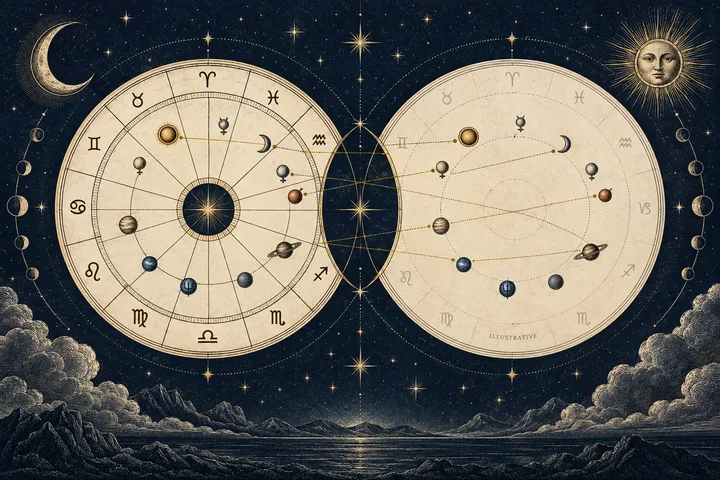
For Maria and Daniel, the dependable core might be Maria's Venus in Taurus trine Daniel's Mars in Virgo at 2 degrees, Daniel's Saturn in Pisces sextile Maria's Moon in Capricorn at 4 degrees, and a possible Moon contact that depends on Daniel's birth hour. The first two can anchor the reading. The third can add emotional detail, but it should not carry the entire conclusion.
Sources: What if I don't know my birth time? - CHANI; Can You Read a Natal Chart Without a Birth Time? - StellaLogic; Birth time unknown: what your chart still reveals - Astraleria; StellaLogic unknown-time chart guidance
Why a noon chart is a reference, not a confession
Many chart tools ask for a time even when you do not know one. Noon is a practical reference point because it places the day in the middle and makes it possible to display planetary positions. It is not a recovery of the missing birth moment. It should help you inspect the parts of the chart that stay stable, not invite you to adopt a guessed Ascendant.
This distinction changes the way you read the wheel. A noon snapshot may show Daniel with a Sagittarius Ascendant and a Taurus seventh-house cusp. Unless the time is known, those are display artifacts. They can change as the clock moves. If you use them to tell Maria that Daniel's planets fall in her houses, or that she activates his partnership axis, you have moved from a useful reference into invented precision.
The same warning applies to fast-moving angles and house cusps. The Ascendant, Midheaven, Imum Coeli, Descendant, and Vertex are time-sensitive, so leave them out when Daniel's time is genuinely unknown.
You can use a solar or sign-based approach as an exploratory frame if you label it clearly. Setting the Sun as the first-house reference organizes sign themes, but it doesn't turn Daniel's Sun into his actual Ascendant.
That frame has a narrower job than a natal house chart. It can help the couple ask better questions about sign relationships. It cannot support an exact statement such as, 'Your Venus is in his fifth house, so he will fall in love with you.' The sign-based frame is a map for reflection. The actual birth time is still needed for the chart's lived angles and house structure.
Keep the planet-to-planet reading separate from any hypothetical house exercise. The main judgment belongs to the first.
Sources: What if I don't know my birth time? - CHANI; Can You Read a Natal Chart Without a Birth Time? - StellaLogic; CHANI unknown-birth-time guidance
The house overlay has a one-sided version and a two-sided limit
House overlays are one of synastry's richest layers. When a partner's planet falls in your first house, you may experience that person as immediate and visible. A fifth-house emphasis can bring play, desire, creativity, and romance into focus. A seventh-house contact can make partnership feel central. An eighth-house contact may draw attention to trust, intimacy, shared resources, and vulnerability. These meanings become more useful when the house position is calculated from a known Ascendant.
If Maria's birth time is known, Daniel's planets can be placed in Maria's houses with reasonable confidence, provided his planetary positions are stable for the date. This gives Maria one direction of the overlay: where Daniel's energy enters her chart. It does not solve the reverse direction. Without Daniel's birth time, Maria's planets cannot be placed confidently in Daniel's houses because his house cusps remain unknown.
That one-sided result still has value. Maria may notice that Daniel's Venus falls in her seventh house and that she experiences him through partnership themes. She can read that as her response to his presence in her chart. She should not automatically say that she activates his seventh house in return. Synastry is relational, but the data can be asymmetrical.
A planet near a possible cusp deserves extra caution. A modest time correction can move the emphasis, so don't let a guessed cusp carry the reading.
Consider an example. Maria's Sun is known to fall in Daniel's possible tenth-house zone under a noon reference, so a reader might announce that she advances his public life. But if Daniel's Ascendant moves during the day, that same Sun could sit in the ninth, tenth, or eleventh house. The better statement is that Maria's Sun may connect with Daniel's themes of direction, visibility, learning, or community, while the exact house awaits his birth time.
If one time is missing, read the known person's house response and label it one-sided. If both times are missing, set overlays aside. An hour- or two-hour window can support a possible house only if the cusp stays put across that range.
Sources: What if I don't know my birth time? - CHANI; Can You Read a Natal Chart Without a Birth Time? - StellaLogic; CHANI unknown-birth-time guidance
A worked comparison for Maria and Daniel
Now return to the case. Maria has a verified time. Daniel has a date and birthplace, but no time. They do not invent Daniel's rising sign. They make a data sheet with four columns: placement, stable or moving, aspect range, and interpretive weight. The sheet feels plain. That is its strength. It makes the reasoning visible before either person starts telling a story about destiny.
For a worked method, take a hypothetical worksheet with three confirmed contacts: a Venus-Mars trine within four degrees, a same-sign Mercury-Venus contact within five degrees, and a Moon that changes from late Gemini to early Cancer during the unknown person's birthday. These are teaching inputs, not the birth charts of real people. The point is to show how the ranking works when a date gives you stable contacts but the clock leaves one emotional placement open.
The first pass compares signs. Maria's Leo Sun and Daniel's Libra Sun bring fire and air into the exchange. She may lead with warmth and personal conviction; he may lead with proportion, dialogue, and a wish to keep the social field balanced. That is not a promise of ease. It is a style difference worth watching. Maria's Taurus Venus and Daniel's Virgo Venus share an earth emphasis. Affection may become tangible through reliability, touch, practical help, and attention to small preferences.
The second pass checks close aspects. Maria's Venus at 12 Taurus and Daniel's Mars at 16 Virgo form a trine within four degrees. That is a strong attraction and action signature in this working method. Daniel's Mars can energize Maria's pleasure nature, while Maria's Venus can soften and steady his way of pursuing. The same contact may become irritating if one person experiences the other as too passive or too insistent. The aspect shows the channel. The couple decides how to use it.
Maria's Mercury at 9 Virgo and Daniel's Venus at 14 Virgo sit in the same sign within five degrees. Their tastes and language may meet around detail, usefulness, craft, or shared routines. Maria may notice what Daniel likes and say it precisely. Daniel may respond to the care in her wording. But Virgo can also turn affection into correction. Their question is not only whether they understand each other. It is whether they can keep improvement from replacing appreciation.
The third pass tests the Moon. If Daniel has a Gemini Moon, Maria's Capricorn Moon may need more proof and structure than Daniel's quick, verbal processing naturally offers. If he has a Cancer Moon, the pair may share a stronger instinct to protect and remember, though Maria's controlled Capricorn manner could still feel restrained to him. The Moon path changes the emotional texture, but neither path cancels the Venus-Mars and Mercury-Venus contacts.
The fourth pass handles houses. Maria can read Daniel's stable planets through her known houses. If his Virgo Mars falls in her fifth house, she may feel playful desire and creative activation; if it falls in her sixth, attraction may express through work and routines. Without Daniel's time, she can't reverse the overlay with confidence.
The exception matters. A stable aspect may deserve less weight if it is wide, out of sign, or unsupported by the rest of the chart. A conditional Moon contact may deserve more if it stays exact across the only plausible time window and touches a personal planet. Rank the symbols, but still test them against the whole comparison.
Keep the worksheet beside the interpretation. Mark each claim confirmed, possible, or unavailable, then ask which contact both people recognize in daily life. That question separates useful chart language from a story built around the missing clock.
Sources: Can You Read a Natal Chart Without a Birth Time? - StellaLogic; Birth time unknown: what your chart still reveals - Astraleria; CHANI unknown-birth-time guidance
What changes when the time is found, and what does not
A birth time can sharpen the chart without rewriting every part of it. When Daniel finds a long-form birth record, the Ascendant, Midheaven, Descendant, Imum Coeli, houses, and Vertex can be calculated for the recorded moment. His Moon degree can be fixed, and a Moon sign that was uncertain can become clear. House overlays can then run in both directions.
The time may also alter the exactness of a contact involving the Moon or an angle. Maria's Venus may move from a possible sextile to a definite one, or the Moon may fall outside a six-degree orb. That is why the earlier reading should preserve ranges instead of presenting a single guessed degree. A good first report can survive refinement because it tells you which conclusions were stable and which were waiting.
What usually does not change is the broad sign placement of the slower bodies. Daniel's Saturn does not leap across several signs because a record turns up. His Jupiter, Uranus, Neptune, and Pluto remain anchored to the date, and his Venus or Mars may remain in the same sign if they were not near an ingress. The relationship reading can gain precision without losing its original core.
An approximate time helps too. If Daniel's family remembers that he was born between 2 and 4 p.m., test both endpoints. If the Ascendant stays in the same sign, you have a rising-sign possibility worth discussing, though the exact degree still moves. If it crosses a sign boundary, keep both signs live. Do the same with the Moon and the house cusps. A narrower window reduces uncertainty. It does not make uncertainty disappear.
Rectification is another route. An astrologer can work backward from verified life events to explore a likely birth time. Treat that result as a specialized interpretive process, not as a replacement for a civil record. The quality of the result depends on the events, their dates, the method, and the astrologer's judgment. It can offer a useful hypothesis, but the report should name it as rectified rather than recorded.
Maria and Daniel should update the comparison in layers when new information arrives. First confirm the Moon. Then calculate Daniel's angles and houses. Then revisit the aspect list for fast planets and house-cusp contacts. Do not discard the first reading just because the wheel now looks fuller. Ask which observations were confirmed, which were narrowed, and which belonged only to the earlier range. That is how a chart becomes more precise without becoming theatrical.
Sources: What if I don't know my birth time? - CHANI; Can You Read a Natal Chart Without a Birth Time? - StellaLogic; Birth time unknown: what your chart still reveals - Astraleria; CHANI unknown-birth-time guidance
The useful decision is to compare what is known, then ask for better data
Maria began with a fear that Daniel's unknown birth time made synastry impossible. It doesn't. Their first reading can stand on planetary signs, stable aspects, and a tested Moon range. The missing-time layers stay clearly marked for later.
Choose the chart layer that matches the question. Venus and Mars suit attraction. The Moon suits emotional fit. Saturn belongs in a conversation about commitment, alongside the lived pattern of reliability.
A chart can show the kind of conversation that matters. Maria may ask whether Daniel experiences her directness as warmth or pressure. Daniel may ask whether her practical care feels supportive or critical. Their contacts give those questions shape; the answers belong to the people living the relationship.
Before ordering records, write down the claims suggested by the noon chart. Cross out anything that depends on Daniel's Ascendant, a cusp, an angle, or an exact Moon degree. Mark conditional claims with 'if.'
A simple comparison sheet keeps this work honest. Put the contact in the first column, the available degree range in the second, and its status in the third. Write 'stable' when the full birth date keeps the placement and aspect inside the working orb. Write 'conditional' when only part of the day supports it. Write 'unavailable' when the claim depends on a house cusp or angle. In the last column, add the lived question the contact raises. Venus-Mars might become, 'How do we handle initiative and affection?' A Moon possibility might become, 'What helps each of us feel safe when we are upset?' This turns uncertainty into a usable conversation instead of a vague warning. It also gives both people a record of what changed and what stayed true.
The practical next step is to gather the best time evidence available. Check the long-form birth certificate, hospital record, and family papers. Record the time zone and daylight-saving status. If no time appears, keep the comparison and mark each conclusion firm, conditional, or withheld.
If you know the relevant Moon, Venus, and Mars placements, take this method into the Synastry Comparison Report. It compares supplied placements and optional degrees with a six-degree working orb for selected major aspects. It doesn't calculate a natal chart from birth details or fill in missing houses.
Firm means a placement or aspect holds across the available date. Conditional means it changes with the Moon or a narrow time range. Withheld means it depends on an angle, cusp, or exact lunar position. Keep that vocabulary when better information arrives.
Sources: What if I don't know my birth time? - CHANI; Can You Read a Natal Chart Without a Birth Time? - StellaLogic; CHANI unknown-birth-time guidance
A little more clarity
Can you compare synastry if only one birth time is known?
Yes. Read the stable planet-to-planet signs and aspects first. If the timed chart belongs to you, you can also see where the other person's stable planets fall in your houses. Leave the reverse house overlay, their Ascendant, angles, and Vertex out until their time is known.
Should you use noon when a birth time is missing?
You can use noon as a reference point for displaying the day's planetary positions, especially for signs and aspects that stay stable. Do not treat the noon Ascendant, houses, or angles as the person's actual chart. Label the entry as an unknown-time or reference chart.
What if the Moon changed signs on the unknown birth date?
Read both possible Moon signs and check the Moon's degree range across the day. Keep only the emotional themes and aspects that survive both possibilities in the main interpretation. A record or a narrow time window can settle which Moon belongs to the person.
Can missing birth time change a synastry aspect?
It can change contacts involving the Moon or an angle, and it can move a fast planet's degree enough to affect a close orb. Many aspects between slower planets remain nearly the same across the day. Check the degree range instead of assuming every aspect shown by a noon chart is exact.
Sources & further reading
- What if I don't know my birth time? - CHANI
Supports using planetary signs and aspects without a birth time, while setting aside the Ascendant, houses, and angles.
- Can You Read a Natal Chart Without a Birth Time? - StellaLogic
Supports the date-stable planetary signs, Moon range, time-sensitive houses and angles, and noon as a reference moment.
- Birth time unknown: what your chart still reveals - Astraleria
Supports the stability of most signs and aspects without a time, alongside uncertainty around the Moon, Ascendant, and houses.
- CHANI unknown-birth-time guidance
Supports checking the Moon across a date, finding long-form records, and testing earliest and latest times in an approximate window.
- StellaLogic unknown-time chart guidance
Supports separating reliable planetary signs and slower aspects from uncertain houses, angles, Vertex, and exact Moon placement.
- Astraleria birth-time guidance
Supports treating unknown-time chart work as a bounded reading of signs and aspects, with houses and the Ascendant withheld.
Synastry Comparison Report
Enter known placements for two people. Get an input-by-input comparison, selected aspect calculations and a clear record of what remains uncertain.
Compare our placements