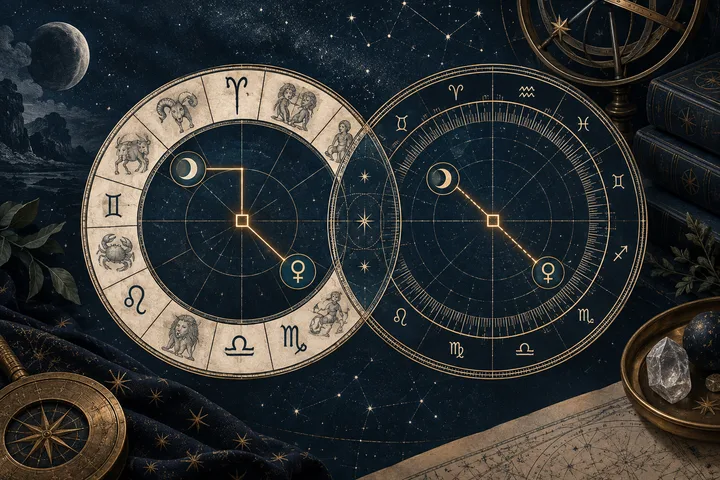
You don't have to choose between the two reports. Read the sign relationship as the broad bond between the planets, then read the degrees as its intensity and focus. A Taurus Moon and Aquarius Venus form a square by sign. If the Moon is 4° Taurus and Venus is 6° Aquarius, their shorter degree distance is 88°, which makes a 2° square. If the Moon is 28° Taurus and Venus is 2° Aquarius, the signs still describe a square, but the 116° distance is a 4° trine by degree. Keep both layers visible, name the method behind each one, and rank the contact that answers the reader's question. When one report uses signs and another uses degrees, compare the method before comparing the verdict. Start by putting each planet, sign, degree, aspect, and orb in one table.
Start with the same chart facts
A synastry comparison can look contradictory when the two reports are actually answering different layers of the same question. One report may say that your Moon and your partner's Venus are in a square because Taurus and Aquarius form a square by sign. Another may leave the contact out because the planets sit too far apart in degrees for its selected orb. Before you interpret either result, put the chart facts on common ground.
Record the planet from person one, the planet from person two, each sign, each degree and minute, and the aspect named by the report. Add the angular distance if the report gives it. Then write down the method: whole-sign, degree-based, or a blend. Last, record the orb. An orb is the gap between the exact angle and the angle in the charts. A square is exact at 90°. A contact at 94° has a 4° orb. A trine is exact at 120°, a sextile at 60°, an opposition at 180°, and a conjunction at 0°.
This small inventory prevents a common mistake. People compare labels as if they came from one rulebook. They don't always. A site that reads whole-sign aspects can keep a contact that a tight degree-based calculator drops. A site that uses a six-degree orb can show fewer contacts than one that allows eight or ten degrees. Neither label tells you enough until you know what produced it.
For this guide, the working scope is supplied synastry placements in the tropical zodiac, with optional degrees and a six-degree orb for selected major aspects. That scope can compare known Moon, Venus, and Mars placements. It doesn't calculate natal positions from birth details, houses, or a complete birth chart. If your source reports different placements, resolve that difference first. A method dispute can't repair mismatched inputs.
Sources: Orb - Astrodienst Astrowiki; Aspect - Astrodienst Astrowiki; Aspects in Astrology: The Five Major Configurations
What a sign-based aspect tells you
Sign-based interpretation begins with the relationship between the signs, not the exact point inside each sign. Each zodiac sign occupies 30° of the circle. Signs two apart form a sextile, signs three apart form a square, signs four apart form a trine, and signs six apart form an opposition. Planets in the same sign form a conjunction in this way of reading. The sign relationship stays present across the whole sign.
That gives sign-based synastry a wide field of meaning. It tells you that the two planetary functions can see one another through a familiar astrological pattern. A Moon in Cancer and Venus in Libra make a square by sign. The Moon brings emotional safety, memory, and instinct. Venus brings attraction, taste, pleasure, and the way affection is offered. Their square says that these functions meet with friction, even before you ask whether the degrees make the angle exact.
The word friction doesn't mean failure. A square can make a couple notice one another. It can turn a quiet preference into a live conversation. The Moon person may want reassurance through closeness, while the Venus person may reach for harmony through tact, beauty, or social ease. The signs show the style of the tension. Cancer protects and remembers. Libra weighs and negotiates. That is already useful information.
Sources: Aspect - Astrodienst Astrowiki; Aspects in Astrology: The Five Major Configurations; Aspects Used in the CHANI app
What the degrees add
Degrees turn a broad relationship into a measured contact. They tell you how close the planets are to the exact angle. This matters because a 1° square and a 5° square belong to the same aspect, but they don't occupy the same interpretive weight. The tighter contact usually deserves more attention. It is easier to feel as a recurring exchange between the two planets, and it is less likely to disappear when you tighten the orb.
Suppose your Moon is at 4° Taurus and your partner's Venus is at 6° Aquarius. Taurus and Aquarius form a square by sign. Convert them to longitudes: 34° and 306°. Their shorter distance is 88°, so the square has a 2° orb. You can write: Moon square Venus, 2° orb, sign-based and degree-based. That is a high-priority contact. The sign layer describes the fixed-earth and fixed-air mismatch. The degree layer says the contact is close enough to keep returning to the relationship's surface.
Now change only the placements. Your Moon is at 28° Taurus and your partner's Venus is at 2° Aquarius. Their longitudes are 58° and 302°, a shorter distance of 116°. That is 4° from an exact trine, not a six-degree square. The signs still supply a Taurus-Aquarius square, while the degree method supplies a close trine. Keep both facts, label the disagreement, and let the chosen method decide which aspect leads.
Sources: Orb - Astrodienst Astrowiki; Aspect - Astrodienst Astrowiki; Aspects in Astrology: The Five Major Configurations
Use one orb rule across the comparison
An orb is a chosen range of tolerance. No single orb table governs every astrological tradition or every astrologer. Some modern approaches allow wider contacts for the Sun and Moon and tighter contacts for the other planets. Other readers use a simple fixed limit. The mistake isn't choosing six degrees instead of eight. The mistake is changing the limit halfway through the report because one contact feels exciting.
A clean synastry comparison states its rule before it ranks the contacts. Here, use six degrees for the selected major aspects. A 0° to 2° contact is exact enough to lead the reading. A 3° to 4° contact is strong. A 5° to 6° contact is present but should share the stage with closer contacts. Beyond 6°, keep a whole-sign contact as background if your method includes it, but don't call it a close degree aspect.
The nature of the planets can still guide priority. A close Moon-Venus contact may speak quickly in daily affection. A close Venus-Mars contact may draw attention through desire, pursuit, and chemistry. A close Moon-Mars contact may describe how feeling and action set each other off. These are interpretive priorities, not permission to widen the orb. Let the rule decide whether the aspect enters. Let the planets and signs decide what it means.
Sources: Orb - Astrodienst Astrowiki; Aspect - Astrodienst Astrowiki; Aspects Used in the CHANI app
How to handle an out-of-sign contact
An out-of-sign aspect is a degree-based contact that crosses a sign boundary. Imagine Maria's Moon at 29° Aries and her partner's Sun at 2° Scorpio. Their longitudes are 29° and 212°, so the shorter separation is 177°, or 3° from an exact opposition. Aries and Scorpio are not opposite signs, though, so one report may call this an out-of-sign opposition while another keeps only the sign relationship. This is the point where method matters most.
The strongest reading is layered and modest. First, name the degree contact and its orb. Then name the sign mismatch. In Maria's example, the Moon and Sun are close in degree to an opposition, but the signs don't supply the usual Aries-Libra or Taurus-Scorpio axis. The contact may still describe a sharp pull between emotional instinct and identity, yet it doesn't carry the full symbolism of a clean sign-based opposition. Its expression may feel less straightforward. The planets reach one another, but they don't speak from the expected pair of signs.
Some astrologers accept close out-of-sign contacts, especially when the degree orb is very tight. Others give priority to the sign relationship and leave the contact out unless it is exceptionally close. The difference isn't a reason to erase one report. It is a reason to label the contact honestly. Write ‘possible out-of-sign opposition, 3° orb’ rather than presenting it as identical to a 3° opposition between Aries and Libra.
A practical rule helps. If the out-of-sign contact is within six degrees, include it as a secondary degree layer and explain the sign exception. If it is wider, keep it as a possible background connection only when your chosen tradition supports that approach. Never let one borderline contact outrank several clean, close aspects.
Sources: Orb - Astrodienst Astrowiki; Aspects in Astrology: The Five Major Configurations; Aspects Used in the CHANI app
Rank Moon, Venus, and Mars contacts
Moon, Venus, and Mars make the comparison concrete. Moon contacts speak to emotional response. Venus contacts speak to affection, pleasure, and values. Mars contacts speak to desire, initiative, and conflict pace.
Moon contacts show how one person receives the other emotionally. A Moon-Venus trine by sign can make care feel welcome, even when the degree distance is broad and the contact remains gentle rather than urgent. A close Moon-Mars square can bring heat to ordinary moments. One person acts before the other feels ready, or one person's mood changes the other's pace. Don't call that doomed. Ask what practice lets action wait long enough for feeling to arrive.
Venus contacts describe attraction, pleasure, taste, and the values that shape affection. A Venus-Mars conjunction within two degrees can be vivid. The two people may move toward one another quickly, and the relationship can gain energy from mutual pursuit. The same conjunction's signs decide whether that energy feels playful, private, steady, or restless. Degrees tell you how concentrated the contact is. Signs tell you the language it uses.
A close square may bring arguments, yet it can also keep a couple engaged with real problems. Translate the contact into a behavior to watch. Astrology becomes useful when the symbol points to a conversation or practice.
Sources: Aspects in Astrology: The Five Major Configurations; Aspects Used in the CHANI app
Read the aspect type after the method
Don't begin with ‘square means bad’ or ‘trine means easy.’ Begin with the contact's method, then read the aspect type. A conjunction combines. A sextile opens a cooperative possibility. A square creates pressure, difference, and movement. A trine supports flow. An opposition makes two ends of a polarity visible. The planets decide what is being combined, opened, pressed, flowed, or opposed.
This order matters when reports disagree. Consider an example: one report gives Venus in Gemini and Mars in Virgo a sign-based square. Another gives the planets a 3° square. The second report isn't contradicting the first. It is making the same relationship more precise. Gemini speaks through questions, variety, and words. Virgo acts through adjustment, skill, and useful detail. Venus may want playful exchange while Mars wants a plan that works. The 3° orb raises the volume. It doesn't turn the pair into a verdict about the relationship.
Now consider Venus in Gemini at 27° and Mars in Virgo at 1°. The signs still form a square, but their longitudes are 87° and 151°, a shorter distance of 64°. That is a 4° sextile by degree. With both layers visible, the sign story describes tension between words and useful detail, while the degree story adds a nearby opening for cooperation. You might notice the difference when a practical decision forces the couple to turn words into a schedule.
The aspect type is a verb, not a verdict. It describes how the planets meet. Give the reader the strongest supported interpretation, then its exception. A square can become a shared practice when both people name the pressure and choose a response. A trine can go unused when ease removes the need to speak. The chart shows the style of exchange. The people still give it form.
Sources: Aspect - Astrodienst Astrowiki; Aspects in Astrology: The Five Major Configurations; Aspects Used in the CHANI app
A worked comparison from two reports
Consider an example with three supplied contacts. Report A uses whole-sign relationships. Report B uses a six-degree orb and lists only close major aspects. The placements are: Person one Moon at 4° Taurus, Venus at 18° Gemini, and Mars at 12° Cancer. Person two Venus at 6° Aquarius, Mars at 15° Libra, and Moon at 20° Pisces. These are example inputs for learning the method, not a personal chart calculation.
First contact: Moon at 4° Taurus to Venus at 6° Aquarius. Taurus and Aquarius form a square by sign, and their 34° and 306° longitudes are 88° apart, a 2° square orb. Both reports should keep it, although Report A may describe the broad fixed-sign tension while Report B may lead with the close square. Rank it first. Moon and Venus bring needs for safety and affection into the same room, but Taurus wants steadiness while Aquarius protects freedom and difference.
Second contact: Venus at 18° Gemini to Mars at 15° Libra. Gemini and Libra form a trine by sign. The degree distance is 117°, a 3° orb. Both methods keep this too. Rank it second, or first if the reader asks about attraction rather than emotional ease. Venus in Gemini enjoys talk, wit, and movement. Mars in Libra pursues through charm, negotiation, and social awareness. The trine can help desire move through conversation, but it may also delay a direct choice if harmony becomes more important than clarity.
Third contact: Mars at 12° Cancer to Moon at 20° Pisces. Cancer and Pisces form a trine by sign. Their 102° and 350° longitudes are 112° apart, an 8° gap from exact trine. Report A keeps a broad water-sign trine. Report B drops it under six degrees. Keep both statements. The sign layer suggests an instinctive water connection between action and feeling. The degree method says the contact isn't close enough to outrank the first two. It may describe a background ease, not the main engine of the comparison.
You can write the same comparison in a short report table. Put ‘Moon 4° Taurus - Venus 6° Aquarius’ in the first row, then ‘square by sign, 2° degree orb, lead contact.’ Put ‘Venus 18° Gemini - Mars 15° Libra’ in the second, then ‘trine by sign, 3° degree orb, support contact.’ Put ‘Mars 12° Cancer - Moon 20° Pisces’ in the third, then ‘trine by sign, 8° degree gap, background only.’ The table makes the reasoning visible before the prose adds meaning.
Before you interpret the table, check what each report actually did. Did it use tropical or sidereal signs? Did it round minutes? Did it list only major aspects, or did it include minor contacts? A missing line may reflect a filter rather than a different chart.
Finish with a clean decision record
Once the methods are clear, stop trying to make the reports agree word for word. Preserve the difference in a short record: the supplied placements, zodiac framework, aspect method, orb, and the contact each report keeps. A report can show that two methods select different layers. It can't make one aspect decide the whole bond.
Use three ranks. Lead means the closest relevant major contact for the question. Support means a contact that helps explain how the lead pattern can move. Background means a sign relationship or wider degree contact that belongs in the picture but shouldn't carry the reading. If the question is emotional safety, begin with the strongest Moon contact. If it's attraction, begin with Venus and Mars. Relevance chooses the doorway; degree closeness sets the order inside it.
Keep the audit narrow. Record minutes when the source gives them, because a rounded 6° contact may sit just inside or outside a six-degree rule. Note filters too. A report that shows only Moon, Venus, and Mars hasn't proved that Saturn makes no contact. And don't claim applying or separating motion from a static placement list. That needs movement data.
Then turn the lead contact into one question for the couple. For Moon-Venus, ask: ‘When I ask for steadiness, do you hear closeness or control?’ For Venus-Mars, ask: ‘What would turn attraction into a clear plan?’ The chart supplies the pattern. The conversation tests how that pattern is lived.
That is the finished comparison. Name why the reports differ, state what each layer contributes, and choose the next conversation that fits the leading contact. Ask together: ‘Which contact leads by our stated orb, what does its sign relationship add, and what can we do with that pattern this week?’
Sources: Orb - Astrodienst Astrowiki; Aspects in Astrology: The Five Major Configurations; Aspects Used in the CHANI app
Sources & further reading
- Orb - Astrodienst Astrowiki
Defines orb as the allowed deviation from an exact aspect and notes that astrologers use different ranges, including out-of-sign exceptions.
- Aspect - Astrodienst Astrowiki
Defines aspects as angular relationships and distinguishes major aspects from the range of degrees allowed by an orb.
- Aspects in Astrology: The Five Major Configurations
Explains sign-based and degree-based aspects, close orbs, out-of-sign contacts, and applying or separating contact.
- Aspects Used in the CHANI app
Gives a current example of whole-sign natal aspects, degree distance as orb, and stronger potency as planets draw nearer.
Synastry Comparison Report
Enter known placements for two people. Get an input-by-input comparison, selected aspect calculations and a clear record of what remains uncertain.
Compare our placements