The appealing shortcut gets the order wrong
A Chiron sign is easy to find. It sits in a chart table beside a familiar zodiac name, and the sign description gives you an immediate story. Chiron in Aries sounds like a wound around assertion. Chiron in Libra suggests a tender place around partnership, fairness, or being chosen. Chiron in Capricorn can point toward achievement, authority, and the fear of failing a serious standard. Those themes can be useful. They can also become a trap.
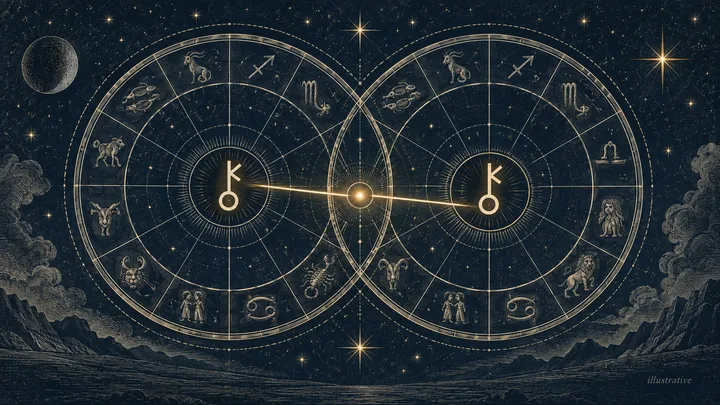
The shortcut says that two people have a meaningful Chiron connection because their Chiron signs sound compatible, or because one person's Chiron is in the same sign as the other's planet. That approach mistakes shared scenery for an event. Two people may carry Chiron in the same sign because they belong to a similar age group, especially when Chiron moves slowly. The shared sign can describe a generational tone. It doesn't, by itself, show that one person's chart factor is pressing on the other's Chiron.
Synastry asks a more precise question. Which factor in one chart forms an angle to which factor in the other chart? The angle is the aspect. The factors are the planets, Chiron, angles, or other points. The distance from the exact angle is the orb. Together, those details tell you whether the connection is close enough to put its theme in the foreground.
This doesn't make the sign irrelevant. It changes its job. The sign tells you the language of the sensitivity. The contact tells you who or what speaks that language in the relationship. If Chiron is in Virgo, the sign can describe the tender subject. If someone's Venus is exactly conjunct it, love and approval may carry the charge. If someone's Mars squares it, desire and self-assertion may carry it instead. Same Chiron sign. Different relationship experience.
That distinction matters when you're comparing known placements. A sign-only reading can encourage you to collect broad labels: healing, wounding, soulmate, karmic. A contact-based reading gives you something you can observe. Who feels exposed when affection is withheld? Who becomes defensive after a request? Does a partner's encouragement help, or does it land as criticism? Chiron names the vulnerable material. Synastry shows the channel through which it moves.
The shortcut is especially tempting when a chart table gives you sign meanings before aspect details. The eye settles on the sentence that feels most personal. Slow down. A placement can describe a lifelong theme without describing the other person at all. Synastry begins when the charts meet by degree, house, or a reliable angle.
That order also keeps the two people visible. Chiron belongs to the person who carries it, and the contacting planet belongs to the person who expresses that function. Neither person is reduced to a role such as healer or wounded one. The roles can switch by contact, context, and moment.
Chiron's sign matters, but it usually works as the background story. The exact contact tells you what part of the relationship brings that story to life. Chiron in Virgo, for example, may describe sensitivity around usefulness, imperfection, or being judged. A close contact from one person's Venus to the other's Chiron makes those themes relational: affection, rejection, giving, and receiving become the doorway. A contact to Mars shifts the focus toward desire, anger, initiative, and boundaries. Read the sign first, then rank the contact by exactness, aspect, planet, and the rest of the synastry. This is why a loose sign comparison can sound meaningful yet say little about the bond itself. For a useful comparison, gather both Chiron signs and degrees, check major aspects within a stated six-degree orb, and separate close contacts from wide possibilities. The next step is not to ask whether Chiron makes you destined. Ask what gets touched, how closely, and what you both do with it.
Sources: Chiron in Aspect in the Natal Chart; Synastry; The Meaning of the Aspects in Astrology
What Chiron's sign contributes to the reading
Start with the sign because it gives the contact a vocabulary. Chiron is commonly read through the paradox of the wounded teacher: a place where pain, exclusion, or inadequacy can become knowledge, guidance, and compassion. Cafe Astrology's Chiron reference describes insecurity, overcompensation, and the teacher side of Chiron, then shows how the meaning changes by the planet involved. The sign is one layer of that story, not the whole story.
Think of the sign as the question Chiron keeps asking. In Aries, the question may be, Can I act without proving that I deserve space? In Taurus, Can I trust my body, worth, and right to have enough? In Gemini, Can I speak without expecting my words to be dismissed? In Cancer, Can I need care without feeling weak or unwanted? In Leo, Can I be visible without turning performance into a test of love? These are interpretive themes, not fixed biographies.
The sign becomes most useful when you attach it to the contacted factor. Ask what the sign says, then ask where the relationship places pressure on that theme. Chiron in Pisces contacted by Mercury may make words, silence, and tone unusually sensitive. The same Chiron contacted by Saturn may make duty, criticism, and reliability carry the weight. Without the contact, you have a symbolic subject. With it, you have a relational mechanism to investigate.
Don't use the sign to diagnose a childhood or assign a permanent wound. Use it to choose the right question. That is its proper strength in a synastry reading.
Sources: Chiron in Aspect in the Natal Chart; Synastry
The exact contact turns a theme into a live exchange
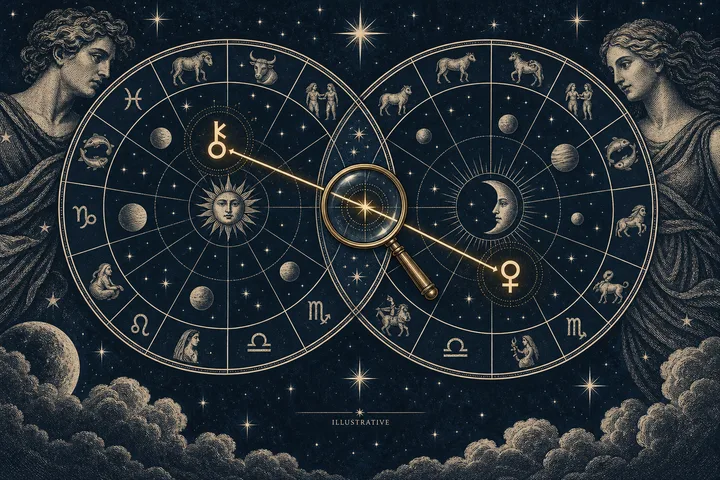
An aspect is an angular relationship between two chart factors. The major aspects used most often in synastry are the conjunction at zero degrees, opposition at 180 degrees, square at 90 degrees, trine at 120 degrees, and sextile at 60 degrees. Cafe Astrology's aspect guide treats the conjunction as a blend, the opposition as a relationship between two sides, flowing aspects as ease, and the square as tension that calls for action.
The closer the aspect is to its exact angle, the more confidently you can place it near the top of the reading. A Chiron at 18 degrees 12 minutes of Virgo and another person's Venus at 18 degrees 35 minutes of Virgo form a conjunction with an orb of 23 minutes. That is a concentrated contact. The sign tells you the Virgo subject. Venus tells you that affection, taste, worth, pleasure, and the experience of being desired are involved. The close orb tells you to pay attention.
Now change only the degree. Put Venus at 23 degrees Virgo. The sign relationship still looks familiar, but the conjunction is 4 degrees 48 minutes wide. It may remain relevant under a six-degree working orb, yet it should rank below the close contact. You might notice the theme, but it may not organize the relationship in the same way. Put Venus at 29 degrees Virgo and the distance reaches nearly 11 degrees. A sign-based sentence may still sound poetic. The aspect is no longer strong evidence for a direct Chiron-Venus exchange under the stated method.
This is why degrees matter. They prevent the reading from treating every possible connection as equally loud. Astrologers use different orbs depending on the factors and method, and synastry often calls for a tighter working range because two charts create more possible contacts. A report needs to name its rule. In this publication's comparison scope, use a six-degree orb for selected major aspects, then rank the contacts inside that range by closeness and relevance.
If the degrees came from rounded sign placements rather than a full chart table, label the result as a sign-level possibility. A placement listed simply as Virgo cannot tell you whether it is at 1 degree or 29 degrees. That missing detail may change the aspect completely. Precision starts with admitting which precision you actually have.
Exactness creates emphasis, not a script. Read the planets, aspect type, sign, and any reliable house context before deciding what the contact means in practice.
Sources: The Meaning of the Aspects in Astrology; Aspects Between Charts
Read the contacted planet before you reach for a big story
Name the contacted planet before you reach for a large story. Chiron enters the relationship through a function, and the planet shows whether that function is loving, speaking, pursuing, protecting, or setting limits.
Chiron-Venus contacts bring affection and worth to the center. A close conjunction can feel tender and magnetic because one person embodies a style of love that reaches a sensitive place in the other. A trine or sextile may make acceptance easier to offer and receive. A square or opposition can stir rejection fears, unequal giving, or the feeling that one person's way of showing love misses the other's sore spot. Cafe Astrology's synastry material describes both the healing potential and the risk of old wounds shaping reactions in challenging Venus-Chiron contacts.
Chiron-Mars contacts move the reading toward desire, anger, courage, pursuit, and boundaries. Mars may press on the Chiron person's fear that their wants are too much, too clumsy, too aggressive, or not welcome. Chiron may make the Mars person feel that direct action always causes damage. The mature expression isn't endless restraint. It is cleaner desire, clearer consent, and the ability to repair after a sharp moment. A difficult aspect can describe friction without excusing cruelty.
Chiron-Moon contacts bring emotional need, habit, family memory, and the body into focus. The Moon person may offer comfort that feels deeply familiar, or may unintentionally touch the Chiron person's oldest sense of not being held. Chiron-Mercury contacts make language consequential. A small correction, a delayed reply, or a badly timed joke can carry more charge than the speaker expects. Chiron-Sun contacts can touch identity, visibility, and the right to shine.
Jupiter can widen the wound and the wisdom at once, while Saturn can bring responsibility, fear, and a steadier container. A house can add the setting when reliable birth times are available, but it belongs to a separate layer. Keep uncertain houses from overruling a measured interaspect.
Sources: Chiron in Aspect in the Natal Chart; Synastry: Jupiter-Chiron Aspects; Synastry
Aspect type changes the way the contact speaks
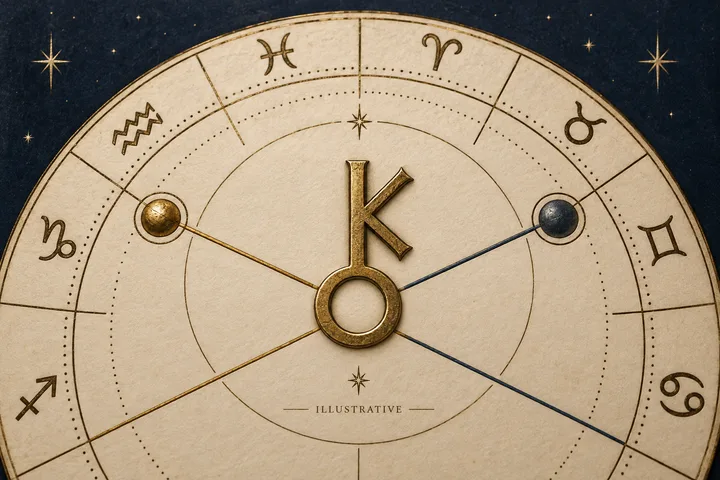
Once you've identified the planet and degree, read the aspect. The aspect doesn't replace the planet's meaning. It describes how the two functions meet. A conjunction blends them. An opposition pulls them into a visible polarity. A square creates friction that demands a response. A trine allows a more natural flow. A sextile offers an opening that becomes useful when both people choose to use it.
Imagine Maria has Chiron at 12 degrees Libra and her partner's Venus is at 12 degrees Libra. His affection lands directly on the place where she worries about being chosen, valued, or met fairly. When he praises her, she may feel cherished. When he withdraws warmth, the silence may feel larger than the immediate event. The conjunction doesn't prove that he will hurt her or heal her. It shows why Venusian behavior carries unusual weight.
Change the contact to a square. Maria's Chiron remains at 12 degrees Libra, but Venus is at 12 degrees Capricorn. His way of showing love may emphasize practical responsibility, control, or long-term plans, while her Chiron in Libra longs for visible reciprocity and a sense of relational balance. The attraction can be real. So can the bruise. They need to translate affection instead of assuming that love is obvious in one shared language.
An opposition can make the difference impossible to ignore. Chiron in Libra opposite Venus in Aries may set partnership needs against direct self-interest. One person seeks evidence that the bond is fair; the other may show love through initiative and personal freedom. They can complement each other, but each can also feel that the other is making a basic need difficult. The tension becomes useful only when both sides can name what they protect.
A trine or sextile usually lowers the effort needed to recognize the sensitive place, but ease has its own blind spot. The Venus person may assume kindness is enough. The Chiron person may smile, accept care, and never state what still hurts. A flowing aspect supports repair. It doesn't perform repair for you. Read the aspect as a style of contact, then observe whether the couple develops the skill that style requires.
Use the aspect as a verb. A conjunction joins, an opposition confronts, a square provokes work, a trine carries, and a sextile invites. These are styles of contact, not moral grades. Ask what each style requires from the two people.
Sources: Synastry; Synastry: Jupiter-Chiron Aspects
The strongest exception: a wide aspect can still matter
The case for exactness has a real exception. A wider contact can matter when an angle or luminary is involved, when other contacts repeat the same theme, or when the relationship keeps activating it in ordinary life. Exact does not mean important in isolation. Wide does not mean meaningless. The question is where each clue belongs in the reading.
Consider an example. One person's Chiron is at 4 degrees Taurus. The other's Venus is at 9 degrees Taurus, a five-degree conjunction under the six-degree method. Read it as present, but secondary to a one-degree contact. If a close Moon-Chiron aspect and a Saturn contact to that Venus return the reading to safety, value, and dependable care, the wider Venus-Chiron contact gains context. It still isn't exact.
Angles can add weight, too. Chiron to the Ascendant or Midheaven may bring vulnerability into self-presentation, the body, work, or public direction. But an uncertain birth time weakens any angle-based conclusion. Mark that layer as tentative and let measured planet contacts carry the reading.
A dissociate aspect is another useful exception. The degrees can form a major angle while the signs do not show the usual sign relationship. Chiron at 29 degrees Virgo and a Moon at 3 degrees Aries are 176 degrees apart, a four-degree opposition. Record the opposition and the sign mismatch. Don't turn it into a tidy Virgo-Pisces story.
Sources: The Meaning of the Aspects in Astrology; Aspects Between Charts; Synastry
Sign, degree, planet, and pattern: a working ranking
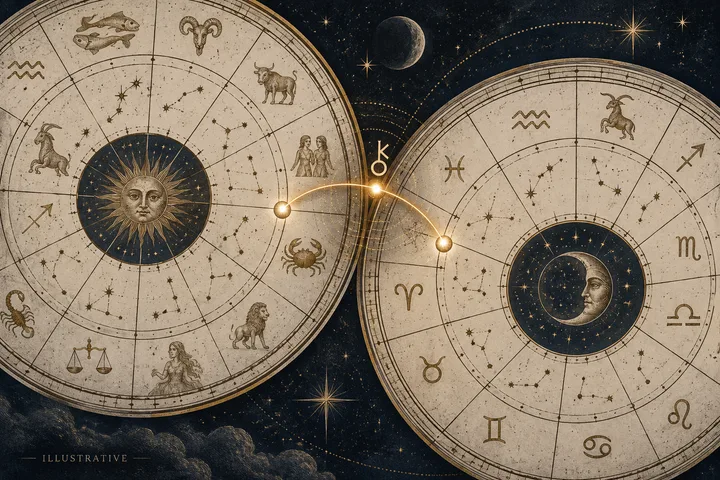
When clues compete, use a reading order rather than a score: closest measured contact first, then the contacted planet, aspect, sign, and any repeated pattern. Within this six-degree working orb, one degree is concentrated, two to three degrees is strong, and four to six degrees is present but usually secondary.
Record each candidate as contact, orb, aspect, planet function, sign theme, and one observable question. If two contacts are close in orb, let the more personal factor or repeated theme lead.
Sources: The Meaning of the Aspects in Astrology; Synastry: Jupiter-Chiron Aspects; Chiron in Aspect in the Natal Chart
A worked comparison without inventing a personal chart
A good example needs degrees, but it should not pretend to be a reader's birth chart. Use the following as a method illustration. Person A has Chiron at 18 degrees Virgo. Person B has Venus at 19 degrees Virgo, Mars at 24 degrees Sagittarius, and Moon at 2 degrees Pisces. We are comparing supplied placements only. We are not calculating houses, angles, or any missing natal positions.
The first contact is Chiron conjunct Venus with a one-degree orb. It ranks first. Virgo gives the sensitivity a language of usefulness, standards, repair, and the fear of falling short. Venus makes affection and value the live exchange. Person B may make Person A feel appreciated through practical care, attention to detail, or sincere praise. The same habits may sting if they become correction, comparison, or a suggestion that Person A must improve to remain lovable.
The second contact is Chiron square Mars. Virgo to Sagittarius forms a mutable square, and the six-degree distance places it within the stated six-degree range. It matters, but it ranks below the close Venus conjunction. Mars activates desire, bluntness, pursuit, and anger. Person B's directness may motivate Person A, then touch the fear of being judged. Person A's caution may help Mars become more precise, then feel to Person B like criticism or delay. The practical question is whether they can state a desire without turning feedback into a verdict.
The Moon at 2 degrees Pisces does not form a close major aspect to Chiron at 18 degrees Virgo under this method. The signs oppose by axis, but the degree distance is too wide for a direct opposition. This is the exact lesson the article is built to show. A compelling sign story cannot substitute for an actual aspect. Pisces and Virgo may give you a useful symbolic contrast, yet the data supplied here does not support calling it a Chiron-Moon opposition.
The resulting reading is layered. Lead with the close Chiron-Venus contact. Add the wider Chiron-Mars square as a secondary tension. Use the Virgo themes to explain the kind of vulnerability involved. Leave the Moon out of the direct Chiron contact unless more chart factors create a separate, measured link. That sequence is more modest than a list of every sign connection. It is also more useful because it tells the couple what to watch: praise, correction, desire, timing, and repair.
The example gives each contact a subject and a question. If praise makes Person A uncomfortable, what reassurance would help? If directness turns into criticism, can both people pause before the exchange becomes a verdict? That is how symbolism returns to choice.
What the contact can say, and what it can't
A Chiron contact can show where one person's ordinary expression reaches another person's tender material. Use it beside behavior. With Chiron-Venus, ask whether affection is mutual. With Chiron-Mars, ask whether desire and anger can be expressed without punishment. The contact can name why a moment feels loaded, but it doesn't decide what either person will do.
Record the closest contact, name one recent event that fits its planet, and ask what changed after the feeling was spoken. If the pattern doesn't appear, narrow the interpretation. If it does, choose the next conversation from the chart's question and have it.
Sources: Chiron in Aspect in the Natal Chart; Synastry; The Meaning of the Aspects in Astrology; Aspects Between Charts; Synastry: Jupiter-Chiron Aspects
Sources & further reading
- Chiron in Aspect in the Natal Chart
Supports Chiron themes and the distinct relational meanings of Venus, Mars, Moon, Mercury, and Sun contacts.
- Synastry
Supports reading planets, signs, aspect types, and Chiron interaspects together in relationship astrology.
- The Meaning of the Aspects in Astrology
Defines major aspect geometry and gives interpretive distinctions between conjunctions, oppositions, squares, trines, and sextiles.
- Aspects Between Charts
Supports reading interchart planets, signs, aspect types, and the roles each person can take in a synastry contact.
- Synastry: Jupiter-Chiron Aspects
Supports the Jupiter-Chiron reading of growth, belief, vulnerability, sensitivity, and communication style.
Synastry Comparison Report
Enter known placements for two people. Get an input-by-input comparison, selected aspect calculations and a clear record of what remains uncertain.
Compare our placements