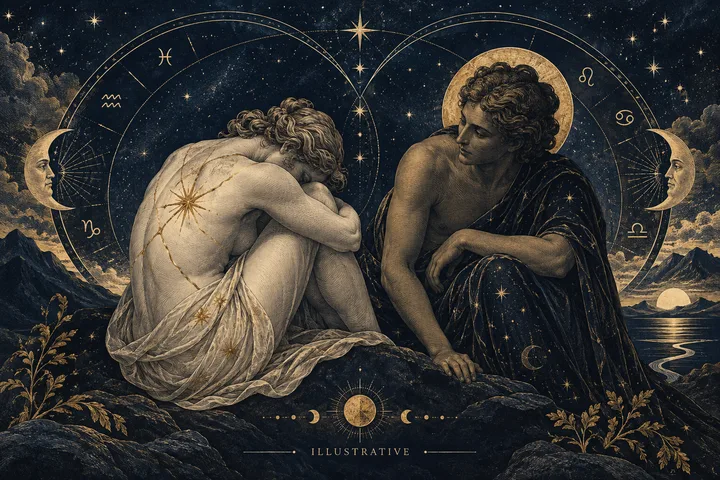
Chiron in synastry describes the place where one person's presence touches another person's old tenderness. That can feel exposing, but it doesn't automatically mean the relationship is harmful or meant to heal you. Read the contact as a pattern of sensitivity first. Then ask what planet is involved, how close the aspect is, which person carries Chiron, and whether the bond responds with care or keeps reopening the same hurt. A close Chiron conjunction to the Moon may expose emotional needs; a contact to Venus may make affection feel both soothing and risky; a contact to Mars may bring shame, anger, or courage into desire. The strongest reading comes from the whole chart comparison, not Chiron alone. If you know both placements and optional degrees, compare them with a six-degree orb, then check the lived pattern: do you become more honest and supported, or smaller and more afraid?
What Chiron brings into a synastry chart
Chiron is the tender point that refuses to stay theoretical. In relationship astrology, it often describes an old hurt, a place of difference, or a need that a person has learned to protect. When another person's planet makes a close contact to Chiron, that person can seem to find the exact place you usually keep covered. Sometimes they do it with a sentence. Sometimes with a look. Sometimes simply by wanting what you have not felt safe enough to offer.
That is why Chiron in synastry can feel so personal so quickly. The contact doesn't have to create a brand-new wound. More often, it brings an existing sensitivity into the room. The Chiron person may feel seen, found, or unusually understood. The planet person may feel drawn to help, teach, encourage, or defend. But the same contact can also make both people clumsy. The planet person presses without meaning to. The Chiron person hears threat in an ordinary request.
Astrologers commonly call Chiron the Wounded Healer, a phrase that captures both halves of the symbol. Chiron carries pain, yet also knowledge gained through living with that pain. In synastry, the relationship can become a place where an old pattern gets named and handled differently. It can also become a place where one person is cast as the injured one and the other as the expert. That second arrangement rarely feels healing for long.
The most useful question is not, Is this our soulmate aspect? It is, What becomes difficult to hide when we are together? The answer points toward the contact's subject. A Chiron-Moon link may expose the need for comfort. Chiron-Venus may expose fears about being lovable, chosen, or desired. Chiron-Mars may expose anger, sexual confidence, or the right to act. Chiron-Sun may touch identity and the fear of being fundamentally wrong.
Synastry also assigns roles, though the roles can move. The person whose Chiron receives the contact often feels the tender spot most directly. The person whose planet makes the contact may act as the activator. They may embody the quality that awakens the wound, or they may offer a new way to meet it. Neither role makes one person guilty and the other wise. A chart shows the door that opens. Behavior decides what happens after it opens.
This is where Chiron differs from a simple attraction marker. Venus and Mars contacts can describe pleasure, desire, and chemistry. Chiron adds vulnerability. It asks what intimacy costs, what it reveals, and whether both people can stay present when the easy charm fades. A beautiful contact can still be hard. A square can still carry a gift. The symbol describes the subject; the aspect describes the style and pressure.
Astro.com’s relationship treatment of Chiron places the symbol inside close bonds where people may hurt one another deeply while struggling to understand the reason. That emphasis matters. Chiron is not a decorative label for a dramatic connection. It is a cue to look for the hidden meaning beneath the visible exchange. What sounded like criticism may have touched shame. What looked like withdrawal may have protected an old fear.
So when you feel exposed around someone, don't rush to make the feeling proof of destiny. Let it be information. Notice the exact moment the room changes. What did they say? What did you expect them to do? What did you suddenly need to defend? Those details give the chart a living subject. Without them, Chiron becomes a vague story about wounds. With them, it becomes a precise guide to the kind of care the connection requires.
Sources: Chiron in Love - The Astrology of Envy, Rage, Compassion and Wisdom; Aspects Between Charts
Why the planet touching Chiron changes the story
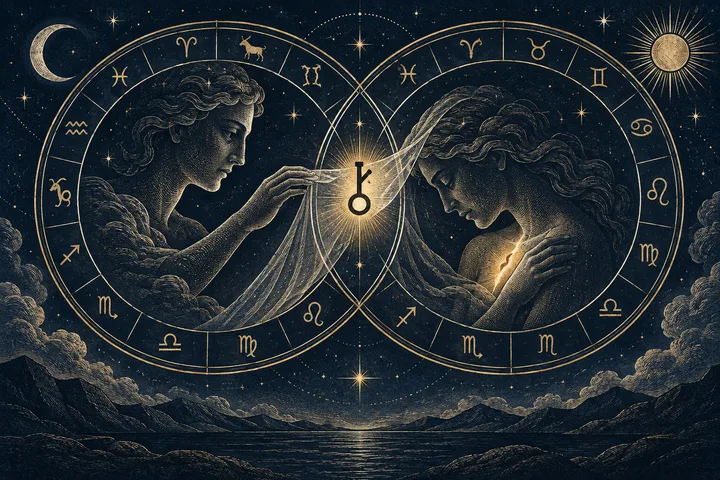
Chiron does not speak in one voice. The planet or point contacting it tells you what kind of experience gets exposed. Start there. Then read the sign as the style of the sensitivity and the house, when reliable birth times are available, as the life area where it tends to appear. If you only know signs and degrees, stay with the planet, sign, and aspect. A precise narrow reading is stronger than an invented house story.
The Sun-Chiron contact often makes identity feel visible. The Sun person may embody confidence, self-expression, leadership, or a kind of permission the Chiron person has struggled to claim. The Chiron person can help the Sun person notice an old insecurity beneath pride. In a supportive bond, they encourage each other's real self-expression. Under strain, one person's presence can feel like a constant judgment, even when no judgment was intended.
The Moon-Chiron contact reaches the private body of the relationship. It can expose how each person asks for comfort, reacts to distance, and protects emotional memory. The Moon person may feel that the Chiron person understands an old sadness without explanation. The Chiron person may feel both held and helpless, especially if care brings up memories of not being cared for. Small domestic moments can carry more weight than grand declarations.
Mercury-Chiron makes words the instrument. One person may help the other name a difficult experience, learn a subject, or tell a story that had stayed locked away. But a correction can cut deeper than expected. A joke can sound like ridicule. Silence can feel like rejection. This contact needs clean speech. Say what you meant, ask what was heard, and don't use insight as a weapon. Understanding is not the same as permission to diagnose your partner.
Venus-Chiron touches affection, attraction, values, pleasure, and the fear of not being wanted. The Venus person may make the Chiron person feel beautiful, chosen, or safe enough to receive love. The Chiron person may teach Venus to love with more patience and depth. Yet praise can feel unbelievable when it reaches a wound around desirability. A person may test the love they want, then distrust the answer. Tenderness must become consistent, not merely intense.
Mars-Chiron brings heat to action and desire. It can awaken sexual courage, anger, competition, and the right to pursue what one wants. The Mars person may energize the Chiron person, helping them stop apologizing for their force. Or Mars may seem invasive, impatient, or contemptuous of caution. This contact needs consent and pacing in real life. Astrological chemistry never outranks a clear no. The chart can show where desire is sensitive; it cannot turn pressure into passion.
Jupiter-Chiron can enlarge the wound and the faith around it. The Jupiter person may offer perspective, education, humor, or a wider horizon. The Chiron person may show Jupiter where confidence has become moral certainty. This can be generous. It can also become preaching. Saturn-Chiron adds duty, fear, endurance, and the question of whether care feels reliable or heavy. Uranus can awaken freedom and shock. Neptune can soften the edges while blurring what is actually happening. Pluto can expose power, compulsion, and deep change.
The angles make the contact more immediate when they are known accurately. Chiron near the Ascendant can make identity and visibility tender. Near the Descendant, partnership itself becomes the mirror. Near the IC, private belonging and family memory may rise. Near the Midheaven, public confidence and life direction can be touched. But angle readings depend on birth time. If the birth time is uncertain, don't treat a house or angle contact as settled. Keep the interpretation at the level the data can hold.
This planet-first method keeps the reading human. Instead of saying, Chiron means healing, you can ask, Healing of what? Instead of saying, This person wounds me, ask, Which quality do they carry that makes my old defense visible? That shift does not excuse hurtful conduct. It helps you tell the difference between a tender truth and a pattern that asks you to abandon yourself.
Sources: Chiron in Love - The Astrology of Envy, Rage, Compassion and Wisdom; Aspects Between Charts; Getting Started with Synastry
How the aspect and orb show the contact’s pressure
Once you know the planet, look at the aspect. An aspect is the angular relationship between two chart positions. In synastry, it describes how the two symbols meet. A conjunction brings them into the same place. A square creates friction and insistence. An opposition creates a pull across a polarity. A trine and sextile offer easier flow, though ease is not the same as awareness. Chiron can matter in every major aspect, but it won't feel the same in each one.
The conjunction is immediate. The planet person and Chiron person may recognize each other in the contact before they have language for it. The planet quality sits on the sensitive point. That can feel like relief: finally, someone understands. It can also feel like exposure: there is nowhere to hide. The conjunction goes both ways, and its outcome depends heavily on the natal condition of Chiron, the planet, and the rest of the synastry.
A square tends to make the tender subject active. You may keep returning to the same argument, even when the surface topic changes. One person asks for reassurance; the other hears accusation. One person asks for space; the other hears abandonment. Squares can create the courage to work on a pattern because they won't let you float past it. They can also exhaust a relationship when neither person takes responsibility for the response they bring.
An opposition often makes the other person seem to hold what you lack. You may admire their boldness and resent it in the same breath. The Chiron person may experience the planet person as a powerful mirror. The planet person may feel unusually exposed by the Chiron person's response. This aspect needs translation. Ask which quality belongs to each person, which quality gets projected, and how the pair can share the polarity instead of assigning it to one partner.
A trine can make support feel natural. The planet person may know how to reach the Chiron person without forcing the issue. A sextile can create a helpful opening, especially when both people choose to use it. But harmonious aspects may stay quiet. You might enjoy the understanding without realizing how much it matters. When a soft Chiron contact is activated by a real-life crisis, its strength can become clear. Ease is a resource, not a guarantee.
The orb measures how close the two positions are. For this publication's comparison scope, use a six-degree orb for selected major aspects. A contact at one degree usually speaks more loudly than a contact at six degrees. That doesn't mean the wider contact is useless. It means you should rank it below a close contact and test it against what the relationship actually repeats. A loose aspect should not overturn several close, clear patterns.
The sign matters after the aspect. Chiron in Aries may bring exposure around independence, anger, or the right to begin. In Taurus, the sensitive ground may involve worth, stability, the body, or having enough. In Gemini, words and being understood can be tender. In Cancer, belonging and protection may carry the charge. In Leo, visibility and creative pride may be at stake. In Virgo, usefulness, imperfection, and criticism may hurt. Libra can expose fairness and desirability; Scorpio trust and control; Sagittarius belief and freedom; Capricorn competence and status; Aquarius difference and belonging to a group; Pisces boundaries, surrender, and compassion.
Those sign themes are starting points, not verdicts. The same Chiron in Libra can look different when Venus, Saturn, or Mars contacts it. The same square can become a steady practice in one couple and a cycle of accusation in another. A chart reading earns its confidence by ranking the evidence. Begin with the closest major contact. Add the planet. Add the sign. Then check whether the lived exchange confirms the symbolism.
You can also ask who is moving first in the exchange. When the planet person speaks, pursues, comforts, or challenges, the Chiron person may feel the contact as an event. When the Chiron person reacts, the planet person may discover that their ordinary style has unusual force. This does not make the planet person active in every moment. It helps you notice the sequence. What happens before the feeling? What response follows it? The sequence often reveals more than the label. A Venus person may offer affection, the Chiron person may doubt it, and Venus may then withdraw. The chart has shown a tender loop. The couple still has to choose whether to interrupt it.
Keep the orb honest when you compare contacts from different charts. A sign-based resemblance is not the same as a measured aspect. If both placements are in Libra, you have a shared sign field, but you don't yet know whether they form a conjunction, square, trine, or no major aspect. If one position is at 2 degrees and the other at 8 degrees, the six-degree conjunction is clear. If they sit at 2 and 26 degrees, the signs may look related in a casual list, but the angular relationship is not a conjunction. Degrees turn a mood into a technical claim. Use them when you have them.
Cafe Astrology's synastry guidance makes the same broader point in its treatment of interchart aspects: read the role each person takes, consider both sign and house placement, and give special weight to close personal-planet links. That sequence keeps you from treating an aspect as a floating slogan. It also explains why you shouldn't compare two Chiron contacts by aspect alone. A close Moon-Chiron square and a wide Jupiter-Chiron trine belong to different levels of the reading.
Sources: Aspects Between Charts; Getting Started with Synastry
A worked example: exposure is not the same as injury
Imagine Maria has Chiron at 14 degrees of Libra, and Daniel has Venus at 12 degrees of Libra. This is an illustrative example, not a calculated personal chart. Their Venus-Chiron conjunction falls within the six-degree comparison orb. Maria feels unexpectedly visible around Daniel. When he compliments her, she wants to believe him, then searches for the hidden condition. When he asks what she wants for dinner, the ordinary question can turn into a test she feels she must answer perfectly.
The first reading is not that Daniel has found Maria's wound and now owns it. The contact suggests that Venus themes become tender in their exchange. Love, approval, beauty, harmony, and the fear of being difficult may all become more charged. Daniel's Venus may offer the very quality Maria has needed. His warmth can make it possible for her to receive affection. It can also bring her fear of losing affection to the surface.
Now change the behavior while keeping the aspect. In the first version, Daniel listens when Maria says praise makes her nervous. He doesn't demand a performance of gratitude. He keeps showing affection without turning it into a debt. Maria names the old fear instead of testing him. She also learns to accept that a compliment can be a gift, not a contract. The conjunction remains intense, but intensity becomes a doorway to trust.
In the second version, Daniel notices that Maria is sensitive and starts using that knowledge during arguments. He calls himself the only person who can truly understand her. Maria begins to doubt her reactions and relies on his interpretation of them. The same Venus-Chiron symbolism now feeds a hierarchy. What looked like healing becomes dependence. The astrology did not force that outcome. The pair chose a way of handling vulnerability that made one person smaller.
Add an aspect change. Suppose Daniel's Venus were instead at 20 degrees of Libra. At six degrees from Maria's 14-degree Chiron, that would still be a conjunction, not an opposition. To study an opposition, Daniel's Venus would need to sit near 14 degrees of Aries, allowing for the chosen orb. The geometry must be checked before interpretation. If the contact is not actually a major aspect, don't promote it because the story sounds good. This is why degrees matter. Sign sameness alone can suggest resonance, but a close angular relationship carries the sharper synastry claim.
Now imagine Maria's Moon also receives a close Saturn square from Daniel's chart. We still don't calculate or invent the rest of their charts here; we are changing the example to show the method. The Chiron-Venus contact may describe why affection feels exposing. The Saturn-Moon contact may describe why emotional timing feels guarded or heavy. The answer is no longer simply, Daniel heals Maria's self-worth. The relationship needs warmth and dependable emotional pacing.
A worked example should end in a question you can use. When I feel exposed, am I becoming more able to tell the truth, or am I becoming easier to control? When my partner touches a tender place, do I want to punish the touch, explain it, or ask for a different form of care? When I activate my partner, can I stay curious about the impact without accepting blame for every feeling? These questions turn symbolism into practice.
Notice how quickly a private interpretation can become a public accusation. Maria might read the conjunction and tell Daniel, You are my Chiron wound. Daniel might answer, Then I must be your healer. Both statements sound intimate. Neither gives them a workable task. A better exchange names the behavior and the choice: When you praise me and then ask me to prove I trust you, I shut down. I need affection that doesn't become a test. Daniel can answer that request directly. Maria can observe whether he follows it. The symbol stays meaningful, but it stops running the conversation.
The example also works when the roles reverse. Daniel may carry Venus themes that feel tender, while Maria's Chiron response exposes his fear of being unable to please her. He might appear to be the confident one because he gives the compliment, yet the contact can unsettle him too. Synastry is not a one-way diagnosis. It describes an exchange of symbols. Ask what each person receives, what each person activates, and what each person does next. That three-part view catches mutual vulnerability without pretending that both people behave in exactly the same way.
The example also shows why a Chiron aspect cannot answer whether two people should date. It can describe why the bond feels intimate before trust has been earned. It can name the subject of a recurring sensitivity. It can suggest a skill worth building. It cannot replace observation. Look at follow-through, consent, repair, and room for two separate people. Exposure may be the beginning of closeness. It is not evidence that closeness is safe.
What changes the interpretation in the whole synastry
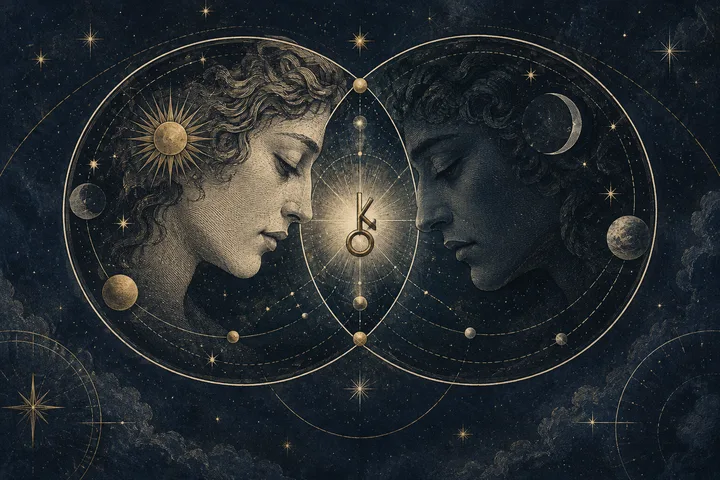
Chiron should be read after you understand the main relationship pattern, not as the opening argument for a dramatic conclusion. Start with the personal planets and angles you can establish. Then rank the Chiron contacts by closeness and relevance to the question. If the question is why affection feels risky, Venus and Moon contacts deserve more attention than a loose Chiron-Jupiter link. If the question is why desire brings anger, Mars and Pluto may frame the Chiron story.
Look for support around the tender contact. A close Moon-Venus trine may give the couple a shared language of care. Mercury-Saturn can help them make difficult conversations concrete. Jupiter can bring forgiveness and perspective. Saturn can provide staying power when it operates as reliability rather than punishment. These contacts don't erase Chiron. They show the resources available when Chiron becomes active.
Then look for pressure that Chiron cannot solve by itself. Hard contacts from Saturn, Pluto, or Neptune may intensify control, fear, confusion, or projection. Uranus can make the opening sudden and difficult to stabilize. A twelfth-house overlay, when the birth time is reliable, can add privacy or uncertainty to the experience. None of these symbols should be read alone. The point is to see whether the chart offers a container for vulnerability or only a powerful trigger.
The natal chart of the Chiron person matters too. A Chiron contact may feel familiar if their own Sun, Moon, Venus, or Mars already activates natal Chiron. It may feel more manageable if the natal chart has learned a working response to that sensitivity. A person with a quiet natal Chiron contact may experience a partner's planet as the first clear awakening of the issue. Without both natal charts, you can describe the synastry contact, but you can't rank its personal depth with confidence.
House overlays add context when both birth times are dependable. If one person's planet falls in the other person's fourth house, the Chiron contact may emerge through home, family memory, and private belonging. In the fifth, it may appear through romance, play, creativity, or the risk of being seen enjoying yourself. In the seventh, the partnership mirror becomes central. In the eighth, trust, merging, shared resources, and fear of loss may carry the charge. In the twelfth, the feeling may stay hard to name.
But don't let a house overlay outrank a close aspect simply because the house story sounds vivid. Cafe Astrology's interchart guidance advises readers to consider sign and house, while giving closer attention to personal planets and relationship significators. That is a useful hierarchy. The closest relevant contact describes the strongest conversation. The house tells you where it tends to happen. The sign tells you how it speaks.
Mutuality matters. If your Venus contacts their Chiron but their Mars contacts your Moon, you may not experience the bond in the same language. One person may feel desired and exposed. The other may feel emotionally pursued or easily hurt by action. Ask both people what the connection brings up. A synastry chart is a dialogue between two experiences, not a label placed on one person.
The strongest exception is this: a gentle Chiron contact can still hurt when the relationship has poor boundaries, and a hard Chiron contact can become meaningful when both people have the skill and willingness to repair. Aspect quality ranks the style of the opening. It does not rank character. A trine doesn't make contempt kind. A square doesn't make honesty impossible. Real care decides whether the symbol becomes medicine or a repeated cut.
Timing can change the volume without changing the natal contact. A transit or progression may bring a dormant synastry pattern to the surface, while a new stage of intimacy may activate it without any notable sky event. This article isn't calculating transits or progressed positions. The useful point is simpler: don't assume that a contact must feel equally strong every day of the relationship. Ask what was happening when it became loud. A move, a commitment conversation, a sexual threshold, or a period of distance can give the same symbolism a new setting.
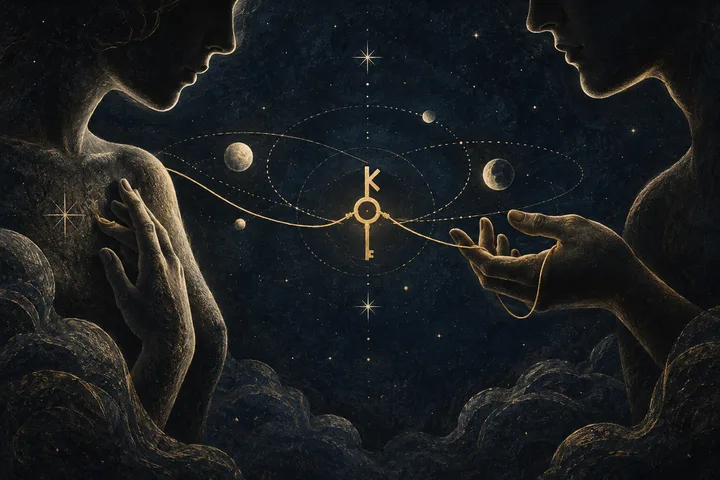
You can make a final ranking by separating three layers. Layer one is the technical contact: Chiron to which planet, by which aspect, at what orb? Layer two is the felt theme: identity, comfort, speech, affection, desire, belief, duty, freedom, or trust. Layer three is the response: curiosity, care, avoidance, blame, control, repair, or withdrawal. The first layer tells you what to inspect. The second gives it meaning. The third tells you what the relationship is doing with that meaning. Don't let layer one overrule layer three.
Sources: Chiron in Love - The Astrology of Envy, Rage, Compassion and Wisdom; Aspects Between Charts; Getting Started with Synastry
How to respond when the connection makes you feel exposed
Begin with the event, not the label. Write down what happened in plain words. Your partner asked about your spending. You went quiet. They touched you and you pulled away. They praised your work and you felt embarrassed. The chart can help you understand the pattern, but the event tells you what needs care today. If you begin with Chiron, you may miss a simple request or excuse a clear breach of trust.
Next, name the tender subject without assigning intent. Try, When you asked me to decide quickly, I felt I would disappoint you. Or, When you joked about my body, I felt exposed and unsafe. This is different from, You always trigger my Chiron. The first sentence gives your partner something they can respond to. The second turns the chart into a charge sheet.
Ask for a concrete change. You may need more time before answering. You may need praise without a demand for reassurance in return. You may need sexual pacing, a private conversation, or a promise not to use disclosed pain during conflict. A Chiron reading becomes useful when it produces a behavior both people can understand. Healing language without a request can leave everyone moved and nothing changed.
Watch the response. A caring partner may be surprised, defensive for a moment, or unsure what to do. What matters next is whether they listen, ask, adjust, and remember. You also have work. Don't make the other person responsible for curing an old wound. Receive care, but keep your own judgment. Say when a pattern belongs to your past. Say when their present behavior is the problem. Both can be true.
Use the six-degree orb as a ranking tool, not as a verdict machine. If a close Chiron contact matches a repeated exchange, study it. If a wide contact does not fit anything you live, set it aside. Check the planet, aspect, sign, and any stronger contacts before you build a story. When birth information is incomplete, compare supplied placements and optional degrees only. Don't invent houses, angles, or a full natal chart.
It helps to separate a feeling from the meaning you attach to it. Feeling exposed might mean you are ready to be known. It might mean someone crossed a line. It might mean an old memory has entered a new room. Chiron can describe all three kinds of threshold, but it cannot choose among them without the facts of the exchange. Ask what you need in order to stay present. Ask what you will do if the request is ignored. A good interpretation leaves you with more discernment, not less.
You can also review the pattern after the conversation. Did your body settle, or did you spend the next day trying to prove that your response was reasonable? Did the other person become more careful, or did they learn a new phrase to dismiss you? Repair has a shape. It includes recognition, a change in conduct, and enough time to see whether the change holds. Chiron symbolism becomes constructive when the relationship can carry that process. A moving apology is only the first step.
A Synastry Comparison Report can help when you already know the Moon, Venus, and Mars signs and want selected major aspects checked with a stated six-degree orb. It works from the placements you supply. It doesn't calculate a natal chart from birth details, determine houses, or hand you a relationship verdict. That limit is useful. It keeps the question visible: what are these known placements saying, and what still needs to be observed between us?
For a practical comparison, make three columns. In the first, write the closest Chiron contact and its planet. In the second, write the feeling or exchange it seems to expose. In the third, write the care or boundary that would help. Then add one supporting contact and one exception. This small table prevents the Chiron aspect from becoming the entire relationship. It gives the symbol a place in the chart and a place in your life.
Return to the question that started the reading. What does Chiron in synastry describe when one person feels exposed around the other? It describes a live tender place, activated through a particular planet and aspect. The contact asks for honesty, pacing, and mutual care. Your next action is simple: identify the exact exchange, check the closest relevant contact, and ask for one concrete change. Then watch what your partner does with the truth you offered. That response is part of the reading. It tells you whether the chart's opening has become a shared path or a warning you need to honor.
Sources: Chiron in Love - The Astrology of Envy, Rage, Compassion and Wisdom; Aspects Between Charts
A little more clarity
Does Chiron in synastry always mean one person will hurt the other?
No. Chiron shows sensitivity and exposure, not an unavoidable injury. A close hard aspect can make a tender subject active, while a trine or sextile may offer easier support. Any aspect can still become painful if someone uses private knowledge to control or shame the other person. Read the planet, aspect, orb, wider chart, and behavior together.
Which Chiron synastry contact feels the most exposing?
There is no single contact that feels most exposing for every couple. A close conjunction is often immediate because the planet sits directly on Chiron. Moon-Chiron can expose emotional needs, Venus-Chiron affection and desirability, Mars-Chiron desire and anger, and Sun-Chiron identity. The closest relevant contact usually deserves the highest rank.
What orb should I use for Chiron in synastry?
For this comparison guide, use a six-degree orb for selected major aspects, then rank closer contacts above wider ones. A one-degree contact usually speaks more loudly than a six-degree contact. Don't treat the orb as proof by itself. Confirm the reading against the planet involved, the aspect, the sign, and the pattern you actually experience.
Can Chiron in synastry show healing?
It can describe a relationship that brings an old sensitivity into conscious care. Healing is possible when both people name the pattern, respect boundaries, and change how they respond. Chiron doesn't make one partner a permanent healer or the other a permanent patient. The relationship becomes more helpful when vulnerability leads to mutual responsibility, not dependence.
Sources & further reading
- Chiron in Love - The Astrology of Envy, Rage, Compassion and Wisdom
Supports Chiron's relationship symbolism as a deeply sensitive point that can bring hidden hurt, compassion, and wisdom into close bonds.
- Aspects Between Charts
Supports reading interchart roles, aspect relationships, sign and house context, and the priority of close personal-planet contacts.
- Getting Started with Synastry
Supports the Wounded Healer interpretation of Chiron and the different tendencies of harmonious, challenging, and conjunction aspects.
- Synastry
Supports the distinction between synastry interaspects, house overlays, and broader relationship-chart techniques.
Synastry Comparison Report
Enter known placements for two people. Get an input-by-input comparison, selected aspect calculations and a clear record of what remains uncertain.
Compare our placements