Begin with the data and the question
A minor aspect earns space only when you know what it is meant to explain. Start with the supplied Moon, Venus, and Mars signs for both people. Add exact degrees only where they were provided. Mark the person and planet on every line. This report compares those inputs. It does not calculate missing natal positions, houses, or angles from birth details.
The question gives the contact a subject. Are you trying to understand a difference in emotional timing? A mismatch between affection and desire? A caring gesture that lands as pressure? Moon speaks first to feeling, safety, habit, and instinct. Venus describes affection, pleasure, taste, and appreciation. Mars describes pursuit, assertion, heat, and action. The same angle means different things across those pairs.
Now separate sign language from degree geometry. A sign pairing can describe style without proving an exact aspect. A close aspect can cross signs that don't look naturally alike. Keep both facts. If the degrees are absent, discuss the sign relationship and leave the minor angle unconfirmed. That small act of restraint keeps the reading precise.
Sources: An Introduction to Aspects and Chart Shaping in Natal Astrology; Aspect - Skyscript Glossary
Measure the angle before you interpret it
An aspect is a distance. Measure the shortest zodiacal separation between the two supplied positions, then compare it with the angle you are testing. A semi-sextile is 30 degrees. A semi-square is 45 degrees. A quintile is 72 degrees. A sesquiquadrate is 135 degrees. A quincunx, or inconjunct, is 150 degrees. The name matters less than recording the angle and the orb you used.
Imagine Maria's Moon at 12 degrees Taurus and Alex's Venus at 12 degrees 42 minutes Gemini. Their separation is 30 degrees 42 minutes, so the semi-sextile orb is 0 degrees 42 minutes. That is a tight contact under a two-degree working limit. If Alex's Venus were at 17 degrees Gemini, the separation would be 35 degrees. The sign sequence might still interest you, but the semi-sextile would not qualify under that rule.
Skyscript lists common minor aspects with two-degree orbs and notes that closer contacts carry more strength than loose ones. Its glossary also warns that minor detail can pull attention away from clearer major contacts. For this publication's report, selected major aspects use a six-degree orb. Minor contacts need a tighter, stated limit. Don't widen it because the interpretation sounds attractive. Decide the measurement first, then read what survives.
Sources: An Introduction to Aspects and Chart Shaping in Natal Astrology; Aspect - Skyscript Glossary; The Semi-Sextile
Let the major pattern set the scale
Read the major Moon, Venus, and Mars contacts before the minor list. Conjunction, opposition, square, trine, and sextile give the comparison its main structure. A minor contact can refine that structure, but it shouldn't compete with it without a clear reason. The order matters because a chart full of symbols still needs a scale of importance.
Make a quick map. Look at Moon to Moon, Moon to Venus, Moon to Mars, Venus to Venus, Venus to Mars, and Mars to Mars. Note the sign relationships too. Then ask what is missing. Is affection easy but emotional comfort less obvious? Is attraction strong while initiation happens at different speeds? Does one person soothe while the other immediately acts? A minor aspect becomes useful when it names that gap.
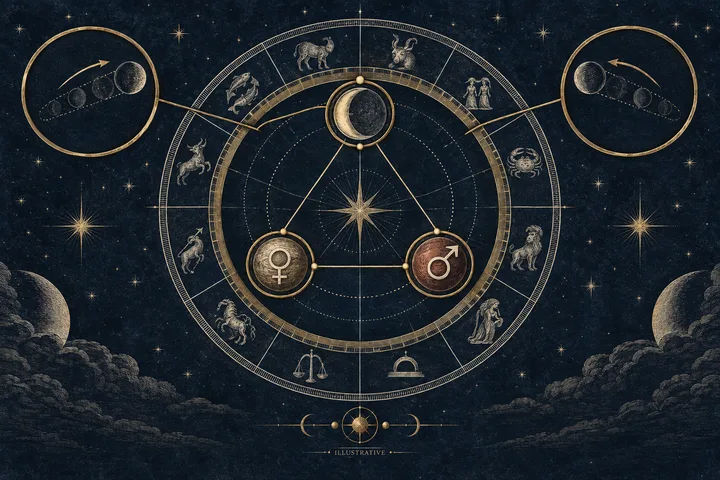
Consider two separate cross-chart contacts. Maria's Moon in Taurus may trine Alex's Venus in Virgo, giving the comparison an easy care channel. Maria's Moon may also form a 1-degree 15-minute semi-square to Alex's Mars, adding pressure to the timing of help. These are not two aspects between the same Moon and Venus pair. The first describes emotional ease with affection. The second describes feeling meeting action. Keep the pairings distinct, and the example becomes readable.
An exact minor contact can deserve a full note when it explains the one missing function in an otherwise sparse comparison. Even then, it remains a refinement. It doesn't erase the major pattern or turn a small contact into a verdict about the bond.
Sources: An Introduction to Aspects and Chart Shaping in Natal Astrology; Aspect - Skyscript Glossary
Check whether the contact repeats a real theme
After the main pattern is clear, test repetition. Look for the same planet pair appearing more than once, one planet receiving several relevant contacts, or the same sign tension returning in different forms. Repetition doesn't mean the aspect counts twice. It means the chart gives you more than one route into one question.
Make the question observable. Moon-Venus contacts can lead to a question about how each person recognizes care. Venus-Mars contacts can point to timing around affection, desire, and initiative. Moon-Mars contacts can focus on what happens when one person needs comfort and the other moves straight toward action. A theme earns weight when a couple could recognize it in an ordinary scene.
Suppose the Moon-Venus trine in the example shows that Maria and Alex can offer practical reassurance with ease. The Moon-Mars semi-square may explain why Alex's solution arrives before Maria is ready for it. The minor contact adds a timing question. It does not announce a hidden problem. A useful conversation might be simple: do you want comfort, action, or both?
Don't force repetition where it isn't there. An isolated, wide contact that doesn't touch the assigned Moon, Venus, or Mars question belongs in the notes, not the lead reading. A rare aspect isn't automatically important. Rank it by what it clarifies.
Before adding a minor aspect, check the degrees, the planet pair, and the larger Moon-Venus-Mars pattern. Then ask what the contact adds. A semi-sextile at 0 degrees 40 minutes may sharpen a reading; the same label at 5 degrees usually shouldn't lead it. This report compares supplied placements and optional degrees. It uses a stated six-degree orb for selected major aspects, while minor contacts need a tighter working orb. Read the major contacts first. Keep the minor aspect only if it explains a specific timing problem, repeats a clear theme, or fills a real gap. Otherwise, record it briefly or leave it out. The right final question is practical: what could the two people notice, name, or try because this contact is in the reading?
Sources: Aspect - Skyscript Glossary; The Quincunx or Inconjunct: Interpretations
Keep aspect, signs, and direction separate
A clean interpretation has three layers. The aspect describes how the planets meet. The signs describe the style each planet brings. The direction shows whose planet is meeting whose. Blend those layers too early and the reading turns vague.
A Moon-Venus contact joins feeling with affection. A Moon-Mars contact joins feeling with action. A Venus-Mars contact joins appreciation and attraction with desire and initiative. Add the aspect after naming the pair. A semi-sextile may call for translation between neighboring styles. A semi-square may show a small friction that keeps asking for adjustment. A quincunx may require a change of approach. These are useful frames, not fixed outcomes.
In the worked example, Taurus Moon may seek steadiness while Gemini Venus offers interest through words and variety. The tight semi-sextile can describe a small translation between those forms of care. It doesn't say the signs cannot connect. It shows why one person may need to explain what reassurance looks like instead of assuming the other person will recognize it.
Direction matters too. If Alex's Mars contacts Maria's Moon, Alex's way of acting meets Maria's instinctive response. That doesn't make Alex permanently forceful or Maria permanently fragile. It describes one exchange between functions. State the exchange, then leave room for the rest of each chart.
A close aspect can cross sign boundaries. When it does, state the exact angle and the sign relationship together. Skyscript describes dissociate contacts as more varied and potentially complicated. That difference can be the point. Don't discard the geometry, and don't let it flatten the signs.
Sources: An Introduction to Aspects and Chart Shaping in Natal Astrology; Aspect - Skyscript Glossary; The Semi-Sextile; The Quincunx or Inconjunct: Interpretations
Decide what the contact changes
Now remove the minor aspect from the draft and read the result. What disappears? If nothing changes except a decorative adjective, cut the contact. If removing it leaves a specific question unanswered, put it back and state that job plainly. This is the best final check because it measures usefulness, not novelty.
A Moon-Venus semi-sextile might add a question about translating care. A Moon-Mars semi-square might add a question about whether support should soothe or solve. A Venus-Mars quincunx might point to different entrances into closeness. The wording stays modest, but the action can be concrete. Ask what makes affection inviting. Ask what feels like pressure. Ask before acting.
Write the conclusion in three lines. Name the strongest major contact and the function it joins. Give the minor contact's exact distance and the one detail it adds. End with one observable question or practice. If the second line merely repeats the first, the minor aspect has not earned a full paragraph. If the final question is only whether the connection is intense, return to the planet pair and name the behavior.
The verdict is simple. Keep the minor aspect when it is tight, relevant, and interpretively useful. Keep it brief when it adds color without changing the reading. Leave it out when the degrees are missing, the orb is wide, or the contact repeats a stronger point. Start with the placements you have, then [compare our placements](/compatibility-test) when you want the Moon, Venus, and Mars layers organized in one report.
Sources: An Introduction to Aspects and Chart Shaping in Natal Astrology; Aspect - Skyscript Glossary; The Quincunx or Inconjunct: Interpretations
A little more clarity
How close should a minor aspect be in synastry?
Use a tighter orb than you use for a major aspect. A two-degree ceiling is a clear working limit for the common minor aspects discussed here, and contacts within one degree deserve the closest attention. Without exact degrees, describe the sign relationship but don't confirm the aspect.
Should a minor aspect come before a Moon, Venus, or Mars square or trine?
No. Read the major contact first, then ask whether the minor aspect adds a distinct layer. It may explain timing, translation, or a small pressure point, but it shouldn't outrank a close major contact without a specific reason.
What if an exact minor aspect crosses signs?
Keep both layers. The degree distance describes the direct contact, while the signs describe how each planet operates. State the exact angle and the cross-sign relationship together, then use the difference between them to sharpen the interpretation.
Sources & further reading
- An Introduction to Aspects and Chart Shaping in Natal Astrology
Defines aspects by precise distance, distinguishes major and minor contacts, lists common minor angles with two-degree orbs, and explains applying and separating aspects.
- Aspect - Skyscript Glossary
Explains longitude-based aspect geometry, the 30-degree semi-sextile, the 150-degree quincunx, dissociate signs, and the risk of excessive minor detail.
- The Semi-Sextile
Identifies the semi-sextile as a 30-degree minor aspect and provides planet-pair interpretation examples for the aspect.
- The Quincunx or Inconjunct: Interpretations
Provides a reference framework for reading the quincunx as an adjustment and redirection contact in planet-pair interpretation.
Synastry Comparison Report
Enter known placements for two people. Get an input-by-input comparison, selected aspect calculations and a clear record of what remains uncertain.
Compare our placements