The first question is whether the chart can support the claim
A synastry reading can feel difficult for two very different reasons. The first is technical. The chart may be built from the wrong date, a rounded time, the wrong birthplace, a daylight-saving mistake, or settings that don't match the comparison you intended. The second is interpretive. The data may be sound, yet the symbolism may describe a relationship with real friction, uneven needs, or a lesson that takes work to live well. Those two problems often get mixed together. Then every uncomfortable sentence sounds like a calculation error, and every calculation error gets treated as a deep message.
Separate them at the beginning. Before you ask what a square means, ask whether the two planets are actually where the report says they are. Before you reject a contact because its meaning feels harsh, ask whether the contact is close, repeated, and relevant to the question. This order matters. Astrology gives you a language of relationships between chart factors, but the language still needs a stable set of factors to work with.
Skyscript defines synastry as the comparison of one natal chart with another, judged through aspects between planetary positions and angles. That definition gives you the first diagnostic rule: synastry depends on two charts, not on a sign slogan or an isolated feeling. Cafe Astrology makes a related point in plainer terms. Sun-sign comparisons can have value, but they are general; a fuller relationship reading considers signs, houses, aspects, and the way the charts interact. The technical layer comes before the poetic one.
So make a small inventory. Write down each person's birth date exactly as supplied. Add the birth time and place, if known. Note whether the chart uses tropical or sidereal zodiac, which house system it uses, and whether the software is showing all aspects or only selected ones. If you are working from an existing report, copy the planet names, signs, degrees, aspect names, and orbs into a plain table. Don't begin by copying the interpretation paragraph. That paragraph is already a conclusion.
This doesn't mean you need perfect information before you can learn anything. It means you need to match the strength of the statement to the strength of the input. A known Venus sign can support a sign-based comparison. A known Venus degree can support a degree-based aspect check. An unknown birth time cannot support a confident Ascendant, house overlay, or angle contact. The reader's question is not 'Can I say something?' It is 'What kind of something can I say honestly within this chart?'
That distinction protects the reading from two bad habits. One habit makes every uncertainty fatal. The other treats every gap as permission to fill in a story. Good synastry keeps the usable part, labels the unstable part, and lets the interpretation grow only as far as the chart allows.
Start with the data, not the drama. A chart-input problem means a placement, degree, angle, or house may be wrong because the birth date, time, place, zodiac, or settings are missing or inconsistent. A difficult synastry interpretation is different: the same verified placements remain, but their relationship requires a careful reading of tension, repetition, context, and rank. Check the raw inputs first. Then check whether the contact survives a reasonable uncertainty window, whether the orb is tight enough for your method, and whether several chart layers repeat the same theme. If the contact disappears when the Moon moves one degree, treat it as conditional. If a close Venus-Mars square remains while the sign meanings, planet roles, and surrounding contacts all point toward friction and attraction, the difficulty belongs to the interpretation. For this report, you can compare supplied Moon, Venus, and Mars signs, add degrees when known, and review selected major aspects with a stated six-degree orb. The next step is simple: record what is certain, what is conditional, and what the contact asks you to discuss.
Sources: Free Reports FAQ, Cafe Astrology; Synastry, Skyscript Glossary
What counts as an input problem?
An input problem is a mismatch between the information you have and the chart factor you are trying to read. It can be obvious, such as a birth year typed incorrectly. It can be quiet, such as a time entered in local clock time when the program expects a different time-zone setting. It can also be a scope problem. You may have reliable Moon, Venus, and Mars signs but no reliable houses, while the report speaks as if every house overlay were established.
The date is the first checkpoint. A one-day error can change the Moon's degree and can move a fast planet enough to alter a close contact. A larger error can change several sign placements. Compare the written date with the source it came from, especially when the date was converted from another calendar or copied from a message. If two reports use different dates, don't average them. Find the original entry.
The time is the next checkpoint. It matters most for the Ascendant, Midheaven, house cusps, and any planet close to a house boundary. It can matter for the Moon when the Moon is near a sign change. Cafe Astrology's discussion of Ascendant degrees and minutes stresses that small changes can matter near a cusp or sign boundary, while the Skyscript glossary treats angles as part of the chart factors compared in synastry. If the time is 'around noon' or 'sometime in the evening,' you don't have one Ascendant. You have a range of possible Ascendants.
The place and time zone deserve equal care. Birthplace is not decoration. It supplies geographic coordinates, and those coordinates help establish the local horizon and houses. A city name can also be ambiguous. Two towns may share a name, or a birth may have occurred outside the city entered in a form. Check the country and region. Check historical time-zone rules when the birth is old or the location changed its clocks. A chart can look precise on screen while resting on a wrong location setting.
Then check the astrology settings. Tropical and sidereal zodiacs won't place planets in the same signs. Whole Sign and quadrant house systems won't always put a planet in the same house. A program may include minor aspects, asteroids, nodes, or points that another report omits. None of those choices is automatically an error. The error comes from comparing outputs as if they used the same method when they didn't.
When you find an input problem, fix or narrow the claim before interpreting. Record the alternatives, then ask which contacts remain true across them. Those surviving contacts belong to the stable reading. The rest belong in a conditional note.
Sources: Free Reports FAQ, Cafe Astrology; Synastry, Cafe Astrology; Accuracy of Degrees and Minutes of the Ascendant, Cafe Astrology
How degrees and orbs reveal a real, difficult contact
Once the basic inputs are checked, move from signs to degrees. A sign tells you the style in which a planet acts. An aspect tells you the angle of contact between two planets. The orb tells you how far that contact sits from exact. You need all three. Signs alone can describe affinity or friction, but they don't prove a major aspect. A degree list without sign context shows geometry, but not the language of the planets involved.
The major aspects give the first shape. A conjunction joins two functions and intensifies their meeting. An opposition creates a polarity that asks the two people to negotiate a line between them. A trine and sextile tend to make the exchange easier to enter, though ease can remain unused. A square presses the planets into friction. That friction can become a recurring irritation, a source of growth, or both. Cafe Astrology describes squares as energies that need work to integrate, while also allowing that tension can create interest and movement.
The orb is not a verdict by itself. A tight contact deserves priority because the two chart factors meet with greater precision. A wider contact may still matter, especially between luminaries or when the same theme repeats elsewhere, but you should write it with less force. Astrologers use different limits for synastry, so the practical lesson is not to pretend that one orb system rules every chart. State the rule you use, then apply it consistently. Cafe Astrology's report guidance makes the same practical point from another angle: compare the time zone, location, and chart settings when two outputs differ.
For this publication's comparison report, selected major aspects use a six-degree orb when optional degrees are supplied. That creates a clear working boundary. A contact within six degrees can enter the selected aspect review. A contact outside it doesn't become meaningless in every astrological school, but it shouldn't be presented as one of the report's calculated major contacts. If the degree is missing, you can compare signs, but you cannot claim a precise orb.
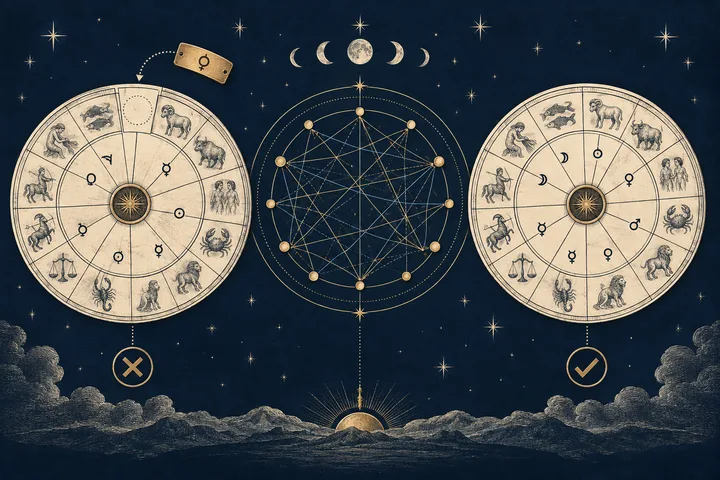
Consider an example. Maria's Moon is at 11 degrees of Libra. Her partner's Mars is at 15 degrees of Cancer. The shortest cross-chart separation is 86 degrees, which places the pair four degrees from an exact square. The Moon speaks to feeling, habit, and the need for emotional safety. Mars brings action, heat, assertion, and conflict pace. A Moon-Mars square can describe strong activation. It can also describe a mismatch between one person's need to process and the other's urge to act. That is a difficult interpretation, but it isn't a calculation error if the degrees are verified.
Now change the input. If Maria's Moon is actually at 5 degrees of Libra, the shortest separation is 80 degrees, ten degrees from an exact square. Under the report's six-degree rule, the contact drops out of the selected aspect list. The emotional pattern might still be explored through the signs or other contacts, but the specific Moon-Mars square should not be treated as established. This is what a degree check can do. It turns a vague feeling of contradiction into a clear decision.
Sources: Free Reports FAQ, Cafe Astrology; Synastry, Cafe Astrology; Accuracy of Degrees and Minutes of the Ascendant, Cafe Astrology
When a hard interpretation is still the right interpretation
A difficult interpretation should survive a clean audit. That doesn't mean every reader will like it, or that the contact describes an inevitable outcome. It means the data is stable, the method is named, the aspect is within range, and the symbolism fits the planets and signs involved. At that point, calling the reading 'wrong' because it feels uncomfortable confuses interpretation with reassurance.
Start with the planet roles. In relationship astrology, Venus describes attraction, pleasure, affection, taste, and the way a person values closeness. Mars describes desire, assertion, physical initiative, and the way conflict gathers speed. The Moon describes emotional rhythms, comfort, habits, and the need for safety. Mercury helps you study words, thought, and exchange. Saturn can describe limits, duty, endurance, and pressure. These meanings don't operate alone. The aspect shows how the functions meet.
Cafe Astrology's synastry guide offers a useful ranking habit. Venus-Mars contacts can show attraction, but difficult contacts can also bring friction. Moon-Mars contacts can be sexy and volatile, while Mercury-Mars contacts can turn stimulating talk into arguments. The important move is to hold both halves at once. If you keep only 'chemistry,' you romanticize the tension. If you keep only 'conflict,' you miss the attraction that makes the conflict matter.
Next, read the signs as the manner of the exchange. A fixed-sign square may hold its position and resist quick change. A mutable-sign square may scatter the disagreement into fussing, revisions, or small complaints. A cardinal-sign square may bring the conflict into the open quickly. These are interpretive tendencies, not scripts. The same Mars contact will look different when Mars acts through a patient earth sign, a quick fire sign, or an inward water sign.
Then ask whether the theme repeats. One hard contact deserves attention. Several related contacts deserve priority. A Venus-Mars square joined by a Moon-Mars square tells a different story from a lone wide Mars aspect surrounded by easy Moon-Venus and Mercury-Jupiter contacts. The first pattern may ask how desire and emotional safety collide. The second may show one energetic snag inside a relationship with more available ways to repair and understand.
Rank the contact by closeness, personal importance, repetition, and lived relevance. Closeness comes first. A one-degree contact usually outranks a six-degree contact between the same kinds of planets. Personal planets and luminaries often speak more directly to the relationship experience than a distant generational contact. Repetition matters because astrology gains force when several factors describe the same room. Lived relevance matters because the reading should return to an actual question, not force a symbol onto a couple's life.
The strongest exception is a difficult contact with strong support around it. A close Saturn square can feel heavy, yet supportive Venus-Jupiter or Moon-Venus contacts may provide goodwill and tenderness. A Venus-Neptune opposition can invite idealization and disappointment, but a clear Mercury-Saturn connection may help the pair name reality and keep promises. The hard contact remains hard. It simply doesn't own the whole chart.
The reverse exception matters too. A chart with many trines can feel easy and still leave important needs unspoken. Ease may mean the two people understand one another without effort, or it may mean they never press the relationship toward a clearer agreement. A soft aspect is support, not proof of use. Ask what the people actually do with the opening it gives them.
Don't let a single frightening word carry the reading. 'Saturn' is not a synonym for rejection. 'Pluto' is not a synonym for destruction. 'Neptune' is not a synonym for deception. Read the planet, aspect, sign, house if known, orb, and repetition together. Then describe the constructive expression and the difficult expression. The reader needs a path through the symbol, not a label placed over the relationship.
A hard interpretation becomes especially useful when it names the point of choice. With Moon-Mars, the choice may be between immediate reaction and a pause with a return time. With Venus-Saturn, it may be between treating restraint as rejection and asking for a clearer form of reassurance. With Mercury-Neptune, it may be between guessing and checking. Astrology gives the pattern a shape. The couple still has to choose the form it takes.
This is where a mature reading differs from a verdict. A chart can describe attraction with friction, ease with blind spots, or commitment with pressure. It cannot decide whether two people should date, stay, leave, or call a connection destined. Your task is narrower and more useful: identify the pattern, name the need it activates, and turn that need into a conversation or practice.
Sources: Synastry, Skyscript Glossary; Synastry, Cafe Astrology
A worked comparison: unstable Moon versus difficult Moon-Mars synastry
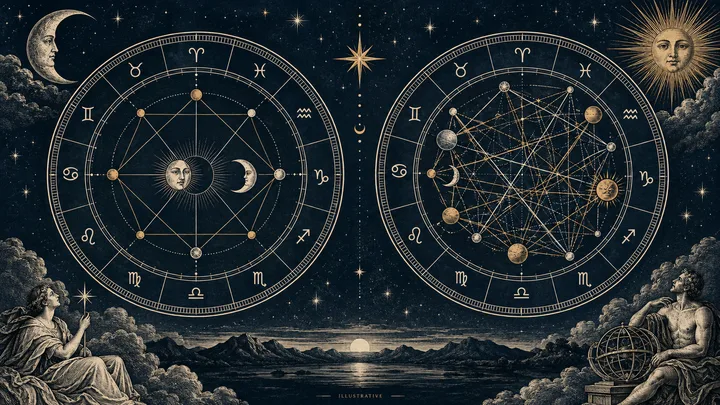
A worked comparison makes the distinction easier to use. Consider an example with two versions of the same report. In Version A, Maria's birth time is recorded as 7:20 a.m. on a birth certificate. Her partner's time is unknown, but his date and place are reliable. The report includes supplied Moon, Venus, and Mars signs, plus degrees copied from a trusted chart table. It shows Maria's Moon at 11 degrees Libra and his Mars at 15 degrees Cancer, a four-degree square. It also shows her Venus in Taurus making a close trine to his Moon in Capricorn.
Version A contains a difficult pattern, but the input problem is limited. His houses and angles are unavailable because his time is unknown. His Moon may need checking if his date places it near a sign boundary. The Moon-Mars square can be read as a selected major contact if the degrees are reliable and the report's six-degree orb is being used. The Venus-Moon trine can be read as a supportive emotional and affection layer. The reading should say exactly that. It should not invent his Ascendant or house overlays.
The interpretation now has a clear shape. Maria's Libra Moon may seek dialogue, fairness, and a calm exchange before emotion settles. His Cancer Mars may act protectively, defensively, or from a strong instinct to secure what feels vulnerable. In a square, the Moon may experience his action as pressure, while Mars may experience her weighing and balancing as delay. The trine between her Venus and his Moon offers a different channel. Affection, touch, shared comfort, or a familiar domestic rhythm may help them return to one another after the sharp moment.
The useful question is not 'Are they compatible?' It is 'What happens in the first ten minutes of conflict?' If Maria needs a measured conversation and he moves immediately into defense or action, the square is visible. If he can slow down and she can state one need without opening five related cases, the same square becomes a practice they can work with. The chart describes the pressure point. Their behavior shows how they carry it.
Now consider Version B. Someone enters his birth time as 12:00 p.m. because the form requires a value. That setting places his Moon at a degree that appears to make a close square, and it assigns house overlays. But the actual birth time could fall anywhere in the day. His Moon shifts enough that the contact is close in one part of the window and outside the six-degree orb in another. His Ascendant and houses change as well. The report's exact-looking output is not a stable foundation.
Version B is primarily an input problem. You can still read the confirmed sign placements if they remain confirmed. You can still list a conditional Moon-Mars contact if the uncertainty window contains it. But you must not turn the noon placeholder into a fact. Say, in plain terms, 'This contact depends on the unknown birth time.' Then move the interpretation down the rank order. Read the stable Venus sign comparison first. Read any contacts between planets whose degrees remain fixed across the date. Leave the uncertain Moon and house material for a later check.
Notice what changed. The relationship didn't change because the report changed. The level of knowledge changed. That's why the two cases need different language. Version A calls for a careful interpretation of a verified hard aspect with a missing house layer. Version B calls for input repair before the hard aspect can lead the reading.
That is enough to make the distinction. In Version A, interpret a verified hard aspect while keeping houses unavailable. In Version B, repair or narrow the input before the uncertain contact can lead. The report's appearance is not the evidence. The surviving placement and the stated method are.
Sources: Free Reports FAQ, Cafe Astrology; Synastry, Skyscript Glossary; Synastry, Cafe Astrology
Turn the audit into a better synastry conversation
The Synastry Comparison Report fits this middle ground. It works from placements you supply, especially Moon, Venus, and Mars signs, with optional degrees for selected major-aspect review. It doesn't calculate a natal chart from birth details. It doesn't calculate houses, assign a soulmate score, or decide whether a relationship will succeed. Its value is the comparison itself: a stated scope, a six-degree working orb for selected major aspects, and a clear separation between what you entered and what the interpretation adds.
After the comparison, choose one small practice. If the chart highlights emotional timing, agree on a return time after a pause. If it highlights different affection styles, name one behavior each person recognizes as love. If it highlights attraction mixed with irritation, separate desire from the argument instead of using chemistry to excuse the argument. A useful interpretation should alter what you notice and what you try.
After one meaningful conversation or one repeated conflict, return to the question. Did the practice change the exchange? If the data was conditional, does the unresolved factor still matter to what you observe? That review keeps the report connected to life without turning it into a fixed sentence about two people.
Start with the inputs. Keep the boundaries visible. Rank the contacts. Make one choice. That's how you tell a chart problem from a difficult synastry interpretation, and that's how a comparison becomes useful.
Sources: Synastry, Skyscript Glossary; Synastry, Cafe Astrology; Accuracy of Degrees and Minutes of the Ascendant, Cafe Astrology
A little more clarity
Can I read synastry without both birth times?
Yes, but narrow the scope. You can compare supplied planetary signs and, when reliable degrees are available, selected planet-to-planet aspects. Without a birth time, treat the Ascendant, angles, houses, and any time-sensitive Moon placement as unavailable or conditional. Don't replace an unknown time with noon and present the result as exact.
What does a six-degree orb mean in a synastry report?
It means the selected major aspect may be included when the degree distance is within six degrees of the exact angle used by the report. A tighter orb usually earns more attention. A contact outside that boundary isn't a universal statement about every astrological method, but it falls outside this report's selected aspect scope.
Why do two synastry reports disagree?
Compare their inputs and settings before comparing their interpretations. Check the birth date, time zone, place, tropical or sidereal zodiac, house system, aspect list, orb rule, and planet degrees. A disagreement may come from a wrong or placeholder input, a borderline contact, or two legitimate methods. Keep the contacts that survive the same stated method, and label the rest conditional.
Sources & further reading
- Free Reports FAQ, Cafe Astrology
The FAQ explains how local time, historical time zones, location choices, and house settings can change chart outputs.
- Synastry, Skyscript Glossary
The glossary defines synastry as comparing natal charts through planetary positions, aspects, and angles.
- Synastry, Cafe Astrology
The guide explains why signs, planets, major aspects, and repeated relationship themes must be read together.
- Accuracy of Degrees and Minutes of the Ascendant, Cafe Astrology
The article explains why small time changes matter most near Ascendant and house boundaries.
Synastry Comparison Report
Enter known placements for two people. Get an input-by-input comparison, selected aspect calculations and a clear record of what remains uncertain.
Compare our placements