The aspect is a pattern of contact, not a sentence
You see the red line in a synastry wheel. Maybe it is a square between your Moon and his Mars. Maybe it is Venus opposite Saturn, or Mercury square Mercury. The eye catches the hard aspect first, and the mind rushes to finish the story. Difficult. Toxic. Doomed. Stop there.
In astrology, an aspect shows how two chart factors meet. It is an angle, measured in degrees, between planets or points. A conjunction brings them together. A square creates a ninety-degree tension. An opposition places the planets across the zodiac from one another. A trine offers a one-hundred-and-twenty-degree flow, while a sextile opens a sixty-degree opportunity. The geometry gives the contact its kind of movement. It does not write the couple's script.
Astrodienst describes an aspect as an angle that creates a flow of energy between horoscope factors, and it defines an orb as the allowed distance from an exact angle. That language matters. The aspect is an interaction. The orb tells you how closely the two planets are speaking. You still need to ask what they are saying, in which signs, and through whose life experience.
That is the first shift from label to practice. Instead of asking, What does this bad aspect mean for us?, ask, What situation does this contact keep putting on the table? A Moon-Mars square may bring feeling and action into the same room at the wrong speed. The Moon person may want reassurance before a decision. The Mars person may try to solve the matter immediately, push for movement, or speak with blunt force. The square keeps asking for coordination.
Imagine Maria has her Moon at 14 degrees of Cancer and Daniel has Mars at 15 degrees of Libra. This is an illustrative chart example, not a calculated personal chart. The planets sit in a close square, with a one-degree orb. Maria may experience Daniel's directness as pressure when she is vulnerable. Daniel may experience Maria's emotional caution as delay or resistance. Neither response is the whole person. It is the role each person can slip into when this contact is activated.
The shared practice is not, Be less emotional, or, Be less forceful. Those instructions make one person carry the whole aspect. A better practice gives both planets a job. The Moon gets time to register what it feels. Mars gets a clear route toward action. The couple might agree that the person who first feels flooded names the feeling and asks for a twenty-minute pause, while the other agrees to return at a named time with one proposal. That is astrology translated into conduct.
The aspect still has heat. Good. A square can keep a relationship awake to a difference that an easy trine might let pass without discussion. But the contact must become visible before it can become skill. Read the red line as a recurring meeting point. Then watch what you both do there.
Sources: Aspect - Astrodienst Astrowiki; Aspects Between Charts - Cafe Astrology
Before you interpret, gather the inputs that can change the reading
A useful synastry reading starts with clean inputs. You need the two placements involved, the exact sign and degree when available, and the aspect you are testing. If you only know that one person has Moon in Cancer and the other has Mars in Libra, you can discuss sign-based tension. You cannot honestly call it a close square without degrees.
The degree decides whether the contact is exact, wide, or absent under your chosen method. An orb is the distance between the measured angle and the exact aspect. A six-degree orb means a square may be considered when the planets are no more than six degrees from ninety degrees. A two-degree contact usually demands more attention than a six-degree contact. It speaks with a tighter voice. The six-degree boundary is the scope used by the Synastry Comparison Report described here.
Astrology.com's introductory synastry guide places aspects beside planets, signs, elements, and houses rather than treating one line as a complete reading. That layered order matters. First establish what is actually present. Then weigh the contact against the rest of the comparison and the question you are asking.
You should also record whose planet is whose. In a synastry contact, the Moon person and the Mars person may feel the exchange differently. The planet person is not a villain, and the receiving person is not merely passive. The labels describe the function each chart factor brings to the meeting. Cafe Astrology's interchart guide makes this role distinction explicit, then adds that the sign and house placement can change how the same planet pair behaves.
For the illustrative Moon-Mars square, write the record in plain language: Maria's Moon, 14 Cancer. Daniel's Mars, 15 Libra. Square, one-degree orb. The Moon brings emotional safety and instinctive response. Mars brings action, assertion, and heat. Cancer protects through feeling; Libra seeks a workable arrangement through dialogue.
Now mark what you do not know. If the degrees are missing, say that the example is sign-level only. If birth times are missing, do not invent houses or angles. If you have only Moon, Venus, and Mars signs, stay with those placements and any selected major aspects supported by supplied degrees. The reading becomes narrower, not useless. A narrow reading you can reproduce will serve you better than a grand reading built on missing pieces.
Name the question before you interpret. Are you asking about attraction, conflict, emotional safety, commitment, or daily decisions? A Venus-Mars square may matter greatly for desire and less for shared finances. Also separate a natal tendency from a synastry event: the contact shows what can happen when two existing styles meet.
Sources: Aspects Between Charts - Cafe Astrology; What Is a Synastry Chart? Birth Chart Compatibility - Astrology.com
Read the first layer: what does each planet need to do?
Start with the planets before you judge the aspect. This keeps the reading human. The Moon is not simply mood. It shows instinctive feeling, comfort, familiar habits, and the conditions under which a person can soften. Mars is not simply anger. It describes drive, assertion, heat, desire, and the way a person moves toward what they want. When they meet across two charts, the relationship puts feeling and action into direct contact.
A Moon-Mars conjunction often makes the contact immediate. The two functions sit together, so desire and feeling can spark quickly. A trine or sextile may let action support emotional expression with less resistance. A square or opposition makes the timing harder. The Moon may feel pursued before it feels ready. Mars may feel blocked when it believes it is offering momentum. The same energy can produce attraction, protectiveness, arguments, or all three in one evening.
Cafe Astrology's synastry reference describes difficult Mars-Moon contacts as potentially sexy and volatile, with emotionalism and domestic arguments more likely to become prominent. Read that as an interpretive direction, not a promise. A Mars contact does not tell you that two people must stay together. It tells you where desire, action, and emotional response may stimulate one another. The couple's choices decide whether stimulation becomes play, conflict, or repair.
Next, ask what role the aspect assigns in the moment. Who feels first? Who moves first? Who explains? Who wants the issue settled? In the Maria and Daniel example, Maria's Moon may tighten when Daniel begins pressing for an answer. Daniel's Mars may speed up when Maria becomes quiet. The sequence matters more than either adjective. Maria withdraws, Daniel pursues, Maria feels more pressured, Daniel pushes harder. Now the square has become a loop.
A good reading names both sides of the loop. If you describe only Maria as sensitive, you turn a Moon need into a flaw. If you describe only Daniel as aggressive, you turn Mars into a moral judgment. Try this instead: the Moon protects through pause; Mars protects through movement. Under stress, pause can look like refusal and movement can look like threat. The couple needs a third move that honors both functions.
That third move could be a two-part sentence. First, the Moon says, I need ten minutes to understand what I feel. Then Mars hears a limit and a return point, not an open-ended disappearance: I will come back at 8:30 and tell you what I need. Mars then states the action without forcing a verdict: I want us to decide whether we are changing Saturday's plan. The Moon receives a subject it can answer. Mars receives a path forward.
This is where a challenging aspect becomes a shared practice. You are not trying to erase the planets. You are giving them a ritual that lets each one work at its best. The chart describes the raw material. The couple develops the technique.
Sources: Aspects Between Charts - Cafe Astrology; Synastry (Relationship Astrology) Moon Mars Aspects - Cafe Astrology
Read the second layer: signs change the way the friction moves
The aspect tells you the relationship between the planets. The signs tell you how those planets express themselves. A square between a Cancer Moon and Libra Mars will not sound like a square between an Aries Moon and Capricorn Mars. Do not paste one generic square interpretation onto every pair. Keep the geometry, then change the language.
Cancer is cardinal water. It begins through feeling, protection, memory, and the need to establish emotional safety. Libra is cardinal air. It begins through comparison, dialogue, social balance, and the search for a fair arrangement. Both signs are cardinal, so both can initiate. The tension is not simply emotion versus action. It is one kind of initiation meeting another. Cancer says, Let us secure the bond before we move. Libra says, Let us discuss the terms so we can move together.
That distinction produces a better practice. Maria does not need to prove that her feeling is rational before it counts. Daniel does not need to wait silently until Maria guesses what he wants. The shared rule can be: name the emotional impact, name the practical request, then decide whether the request can happen now. The Moon receives care. Mars receives a decision path. Libra gets a fair conversation. Cancer gets a protected one.
Element and modality help you refine the picture. Water may process through feeling and atmosphere. Air may process through words and perspective. Cardinal signs start things. Fixed signs may hold a position until it becomes safe to move. Mutable signs may adapt, reframe, or scatter the issue across several possibilities. These are interpretive tools, not boxes. A person's whole chart will alter how a sign behaves, and the contact may be supported or challenged elsewhere.
Consider an example with Venus in Taurus square Mars in Aquarius. The Venus person may seek steady touch, familiar pleasures, and proof through consistency. The Mars person may need freedom, novelty, and room to act differently from the expected script. Calling the aspect incompatible misses its useful question: how can devotion remain steady without becoming possession, and how can independence remain alive without becoming absence? A weekly plan with one dependable ritual and one unscripted window may answer it better than another abstract conversation about chemistry.
Now compare the orbs. A Venus-Mars square at one degree deserves a front seat. A six-degree contact may still matter under this report's method, but you should rank it below a tighter contact and test it against lived repetition. A sign-based square without degrees belongs in the background until the data improves. The strength of an interpretation comes from both symbolic fit and technical closeness.
Hard does not mean hopeless, and easy does not mean handled. A trine can leave a habit unexamined while a square forces a couple to learn a new language. Rank by function: what does the contact bring forward, what does it make difficult, and what other contact could help? For conflict, Moon, Mars, and Mercury lead. For affection, read Venus and the Moon. For durable agreements, bring in Saturn.
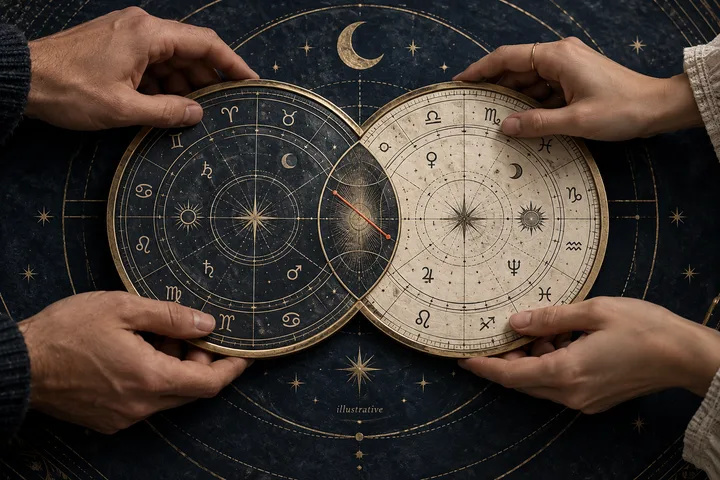
A challenging synastry aspect becomes useful when you stop treating it as a verdict and name the behavior it repeats. Start with the exact planets and aspect, then read the signs, the orb, and the wider pattern. A Moon-Mars square, for example, can describe one person needing emotional safety while the other moves toward action. That does not settle the relationship. It gives you a practice: slow the first reaction, name the feeling, ask for one concrete change, and return to the subject after both people can listen. Rank the contact beside supportive links, especially Mercury, Venus, Jupiter, or Saturn contacts. Then test the reading against what actually happens. This report uses placements you supply and optional degrees. It can examine selected major aspects with a six-degree orb, but it does not calculate natal charts, houses, or a relationship outcome from birth details.
Sources: Aspect - Astrodienst Astrowiki; What Is a Synastry Chart? Birth Chart Compatibility - Astrology.com
Rank the whole synastry pattern before you give the hard aspect power
No single aspect should outrank the rest of the chart comparison by default. Read the strongest contact, then check what surrounds it. A tense Moon-Mars square may describe conflict pace, but Mercury contacts may show whether the couple can explain the conflict. Venus contacts may show how affection is offered and received. Jupiter can bring generosity and perspective. Saturn can add structure, responsibility, and staying power, though difficult Saturn can also feel restrictive.
Astrology.com identifies Moon-Venus, Sun-Venus, Sun-Moon, Mercury-Mercury, and Saturn contacts as useful areas to examine in relationship synastry. Cafe Astrology likewise advises attention to inner-planet interaspects and relationship significators, while its broader synastry material places flowing and difficult contacts in relation to one another. The practical lesson is simple: do not let the most dramatic line become the only line.
Use a three-rank system. Rank one is the repeating core. Choose the tightest major aspect involving personal planets, or the contact that clearly matches the couple's recurring situation. Rank two is the support system. Look for contacts that can help the core work, such as Mercury for naming the pattern, Venus for restoring warmth, Jupiter for forgiveness and goodwill, or Saturn for a reliable container. Rank three is the modifier. Read signs, additional contacts, and missing data that may change tone or timing.
In the illustrative example, the one-degree Cancer Moon square Libra Mars is rank one because it describes the observed pursue-and-pause loop. Suppose the supplied placements also show Mercury trine Mercury at three degrees. That is rank two. The couple may have the words to repair, even when the first reaction is sharp. Suppose Venus square Saturn appears at five degrees. That is rank three, a modifier that may make affection feel measured during stress or bring a fear of criticism into the room. It deserves attention, but it does not cancel the Mercury support or prove that love is cold.
Do not calculate a score from these ranks. A total can hide the very pattern the couple needs to understand. Ask three better questions. Which contact gets activated first? Which contact makes repair easier? Which contact changes the meaning of the hard one? If Mercury can translate Moon into a clear feeling and Mars into a clear request, the Moon-Mars square becomes workable. If Saturn also asks for patience, the repair may need more time and more structure. The reading grows in resolution.
The strongest exception belongs here. Sometimes a chart has many soft contacts, yet one difficult personal-planet contact dominates daily life because it is exact and repeatedly triggered. A close Mars-Saturn square, for instance, may make initiative meet restraint so often that a broad field of Venus-Jupiter warmth cannot solve the practical frustration by itself. Supportive aspects help. They do not magically dissolve a contact that the couple keeps activating without a new response.
The reverse exception matters too. A difficult aspect may look frightening on paper and remain quiet in the relationship because it is wide, unsupported by other contacts, or already integrated through the individuals' natal patterns. Rank the evidence you have. Keep the hard aspect important, but keep it in proportion.
Sources: Aspects Between Charts - Cafe Astrology; What Is a Synastry Chart? Birth Chart Compatibility - Astrology.com; Synastry (Relationship Astrology) Moon Mars Aspects - Cafe Astrology
Turn the interpretation into a practice, then test its limits
A chart reading earns its place when it changes the next conversation. Build the practice from the aspect's actual sequence. For Moon-Mars tension, the sequence may be feeling, pressure, pursuit, withdrawal, and a second argument about the first argument. You do not need ten rules. You need one small interruption that both people can remember when the body is already reacting.
Use a simple reset. Name the reaction, translate it into a need, make one request, and set a return point. Maria might say, I felt shut out when the plan changed. I need ten minutes, then I want to choose a new plan together. Daniel might answer, I hear that it felt abrupt. I want us to leave by seven, and I can offer two options. The aspect stays active, but both planets now have a workable part to play.
Test that response in one kind of moment for a week. Notice whether the request arrives before the sharper words and whether both people keep the return point. Then keep what helped and cut what became ceremony. A short practice is easier to remember than a relationship manual.
The same logic changes with the planet pair. Venus-Saturn may need affection that is not earned through perfect performance. Mercury-Mars may need turns without interruption. Venus-Uranus may need dependable contact plus chosen freedom. The planets name the work; the signs show its style.
The practice must be mutual. A pause cannot become punishment, and a request cannot become a demand for instant agreement. If one person keeps carrying the regulation, translation, or repair, the issue has moved beyond chart technique. It calls for a boundary and a decision about participation.
Sources: Aspect - Astrodienst Astrowiki; Aspects Between Charts - Cafe Astrology; Synastry (Relationship Astrology) Moon Mars Aspects - Cafe Astrology
End with one conversation, then read the chart again
End with one concrete question, not a verdict. For the illustrative Moon-Mars square, ask: When I slow down, what helps you trust that we'll return to the issue, and when you want action, what can you do that lets me feel included rather than pushed? It names both needs and tests whether both people will take part.
If the answer is vague, ask for one detail: When will we return? What request can each of us make without demanding an immediate yes? Then write down the closest contact, the behavior it seems to describe, and the response you agreed to try. Keep houses and angles out when those inputs are unavailable.
The report can help rank supplied Moon, Venus, and Mars placements and selected major aspects under its six-degree scope. It cannot decide the relationship's future. Your decision is smaller and more useful: will both people recognize the pattern, accept a mutual response, and respect the limit if that response fails?
Ask the question tonight. What happens between us when one person needs care and the other wants movement, and what will we each practice the next time it happens? Listen for a real agreement. If only one person will participate, stop refining the chart language and address participation and boundaries instead.
Sources: Aspects Between Charts - Cafe Astrology; What Is a Synastry Chart? Birth Chart Compatibility - Astrology.com
A little more clarity
Can a difficult synastry aspect become positive?
Yes, when both people can recognize the pattern and practice a response that serves both planets. A square or opposition still describes tension, but tension can become skill through clear requests, agreed pauses, honest repair, and shared responsibility. It does not guarantee a lasting relationship, and it does not excuse harmful behavior. Read the aspect beside its orb, signs, other contacts, and what actually happens between you.
What if I know the signs but not the degrees?
You can make a sign-level interpretation, but you should not claim a precise major aspect or strength. Degrees establish the angular relationship and orb. If they are missing, record that limit, keep the reading general, and avoid houses or angles unless you have reliable birth times and a calculated chart. Add degrees later if you want to rank the contact more confidently.
Sources & further reading
- Aspect - Astrodienst Astrowiki
Defines major aspect angles and explains orb as the allowed distance from exactitude.
- Aspects Between Charts - Cafe Astrology
Explains how planet roles, signs, houses, and inner-planet contacts shape interchart interpretation.
- What Is a Synastry Chart? Birth Chart Compatibility - Astrology.com
Introduces layered synastry reading through planets, signs, elements, houses, and aspects.
- Synastry (Relationship Astrology) Moon Mars Aspects - Cafe Astrology
Interprets Moon-Mars synastry contacts as emotionally and physically active, with different expressions for hard and flowing aspects.
Synastry Comparison Report
Enter known placements for two people. Get an input-by-input comparison, selected aspect calculations and a clear record of what remains uncertain.
Compare our placements